



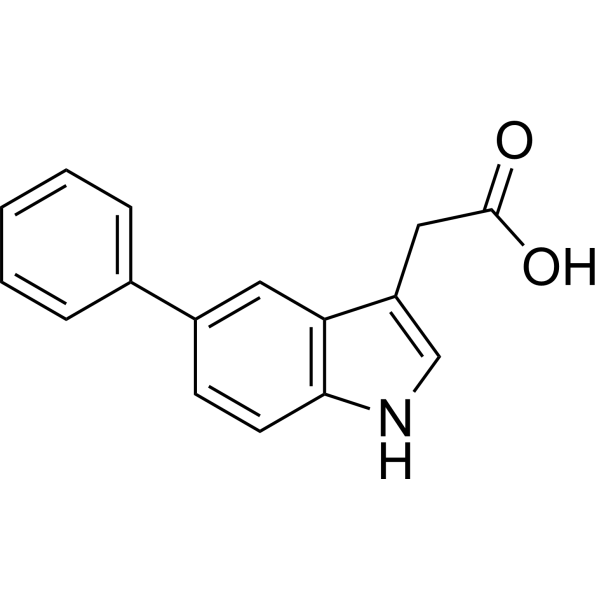
5-Ph-IAA
Based on 57 publication(s) in Google Scholar
5-Ph-IAA is a derivative of IAA. 5-Ph-IAA, a ligand, establishes the auxin-inducible degron 2 (AID2) system together with an OsTIR1 (F74G) mutant. AID2 induces rapid and efficient depletion of mAID-fused proteins to study protein function in living cells, causing tumor suppression.
For research use only. We do not sell to patients.
- Purity: 99.80%
- CAS No.: 168649-23-8
- Formula: C16H13NO2
- Molecular Weight:251.28
-
Storage:Powder -20°C, 3 years , 4°C, 2 years ; In solvent -80°C, 2 years , -20°C, 1 year

To place orders, for customer services and technical support, please contact: MedChemExpress USA
Tel: 609-228-6898 E-mail: [email protected] [email protected]


-
 Biological Activity
-
Chemical Information
-
Solvent & Solubility
- Purity & Documentation
- References
-
 Help & FAQs


Publications Citing Use of MedChemExpress (MCE) 5-Ph-IAA
More- Nature. 2023 Jun;618(7963):180-187. [Abstract]
- Science. 2023 Sep 22;381(6664):eadi3448. [Abstract]
- Nat Immunol. 2024 Sep;25(9):1663-1677. [Abstract]
- Nat Commun. 2025 Jul 27;16(1):6919. [Abstract]
- Nat Commun. 2025 Jul 18;16(1):6631. [Abstract]
- Nat Commun. 2025 May 6;16(1):4214. [Abstract]
- Mol Cell. 2026 May 21:S1097-2765(26)00277-7. [Abstract]
- Mol Cell. 2026 May 21;86(10):1911-1930.e11. [Abstract]
- Mol Cell. 2023 Jan 19;83(2):252-265.e13. [Abstract]
- Sci Adv. 2025 Jan 10;11(2):eadq6652. [Abstract]
- Sci Adv. 2025 Jan 24;11(4):eadp0855. [Abstract]
- Nat Struct Mol Biol. 2025 Jan;32(1):48-61. [Abstract]
- Genome Biol. 2025 May 12;26(1):126. [Abstract]
- Genome Biol. 2023 Jan 26;24(1):14. [Abstract]
- Cell Genom. 2025 Mar 12;5(3):100778. [Abstract]
- J Genet Genomics. 2025 Dec 23:S1673-8527(25)00349-2. [Abstract]
- Curr Biol. 2026 Apr 20;36(8):1977-1993.e8. [Abstract]
- Cell Rep. 2026 Apr 28;45(4).
- Cell Rep. 2026 Apr 8;45(4):117236. [Abstract]
- Genes Dev. 2025 Mar 3;39(5-6):348-363. [Abstract]
- PLoS Biol. 2025 Feb 3;23(2):e3003024. [Abstract]
- Genetics. 2025 Jul 28:iyaf143. [Abstract]
- Commun Biol. 2025 Nov 17;8(1):1589. [Abstract]
- PLoS One. 2025 Mar 7;20(3):e0315659. [Abstract]
- bioRxiv. 2026 Apr 14:2026.04.13.716336. [Abstract]
- bioRxiv. 2026 Mar 26.
- bioRxiv. 2026 Mar 17:2026.03.15.711889. [Abstract]
- Northwestern University. 2026.
- bioRxiv. 2026 Jan 29:2026.01.29.702555. [Abstract]
- bioRxiv. 2026 Jan 29.
- bioRxiv. 2025 Dec 23.
- University of Wurzburg. 2025.
- Heidelberg University. 2026 Jan 2.
- bioRxiv. 2025 Nov 19.
- bioRxiv. 2025 Nov 5.
- bioRxiv. 2025 Oct 23.
- bioRxiv. 2025 Sep 9.
- University of Rochester. 2025.
- University of Pennsylvania. 2025.
- bioRxiv. 2025 Sep 23:2025.09.21.677607. [Abstract]
- Dartmouth College. 2025.
- bioRxiv. 2025 Jun 15:2025.06.13.659552. [Abstract]
- bioRxiv. 2025 May 23.
- bioRxiv. 2025 April 02.
- bioRxiv. 2025 March 24.
- bioRxiv. 2025 Feb 16:2025.02.12.637959. [Abstract]
- bioRxiv. 2024 Oct 03.
- bioRxiv. 2024 October 22.
- bioRxiv. 2024 October 26.
- bioRxiv. 2024 Nov 18:2024.11.18.624150. [Abstract]
- Res Sq. 2024 Nov 15:rs.3.rs-5348956. [Abstract]
- bioRxiv. 2024 September 10.
- bioRxiv. 2024 May 2:2024.04.15.589678. [Abstract]
- bioRxiv. 2024 Mar 28.
- bioRxiv. 2024 Jan 25.
- Dartmouth College. 2023 Jul 17
- bioRxiv. 2023 Aug 19.
 Customer Validation & Images

-
WB
-
WB
-
Cell Imaging/Staining
-
WB
-
WB



Biological Activity
5-Ph-IAA (1 μM; 6 hours) leads to DHC1-mAC degradation in HCT116 cells constitutively expressing OsTIR1(F74G), which means the AID2 system better than the original AID system in generating conditional mutant cell lines[1].
MedChemExpress (MCE) has not independently confirmed the accuracy of these methods. They are for reference only.
-
Cell Line:HCT116 cells
-
Concentration:1 µM
-
Incubation Time:6 hours
-
Result:Depleted DHC1-mAC efficiently in HCT116 cells constitutively expressing OsTIR1(F74G).
MedChemExpress (MCE) has not independently confirmed the accuracy of these methods. They are for reference only.
-
Animal Model:Balb/c-nu female mice (7 weeks old; 16–20 g ) bearing mAID-BRD4 and TOP2A-mAC xenograft tumours cells[1]
-
Dosage:0 mg/kg, 1 mg/kg, 3 mg/kg and 10 mg/kg
-
Administration:Intraperitoneally injection; every day; 7 days
-
Result:Displayed significant tumour suppression of mAID-BRD4 xenografts and TOP2A-mAC xenografts.


Chemical Information
-
CAS No. 168649-23-8
-
Appearance Solid
-
Molecular Weight 251.28
-
Formula C16H13NO2
-
Color White to light yellow
-
SMILES
O=C(O)CC1=CNC2=C1C=C(C3=CC=CC=C3)C=C2
-
Shipping
Room temperature in continental US; may vary elsewhere.
-
Storage
Powder -20°C 3 years 4°C 2 years In solvent -80°C 2 years -20°C 1 year


Publications (57)
-
Journal Impact Factor
-
Most Recent
-
Nature
2023 Jun;618(7963):180-187. PMID: 37225980
5-Ph-IAA purchased from MedChemExpress. Usage Cited in: Nature. 2023 Jun;618(7963):180-187. [Abstract]
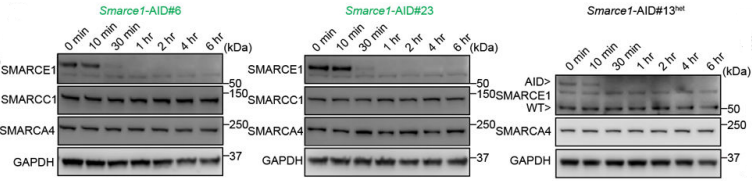
Representative immunoblot in Smarce1-AID clones #6, #23, and #13het treated with 1 μM 5-Ph-IAA (0,10,30 min, 1,2,4, 6 h) for the indicated time following release from mitotic arrest. GAPDH was used as a loading control
5-Ph-IAA purchased from MedChemExpress. Usage Cited in: Nature. 2023 Jun;618(7963):180-187. [Abstract]
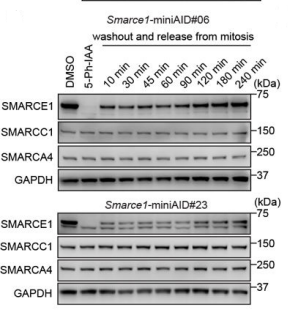
Representative immunoblot in mitotic Smarce1-AID cells (clones #6 and #23) treated with DMSO or 1 μM 5-Ph-IAA for 1 hour (lanes 1 and 2) and in cells that underwent washout and release from mitotic arrest for the indicated time periods.
5-Ph-IAA purchased from MedChemExpress. Usage Cited in: Nature. 2023 Jun;618(7963):180-187. [Abstract]
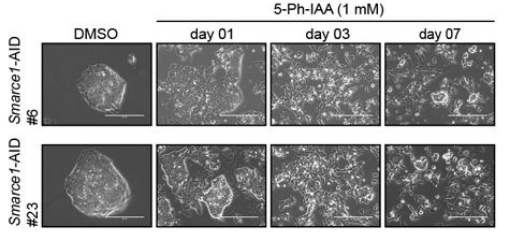
Cell morphologies of DMSO treated Smarce1-AID cells (clones #6 and #23) and the cells treated with 1 μM 5-Ph-IAA for the indicated days (0, 1, 3, 7 days).
5-Ph-IAA purchased from MedChemExpress. Usage Cited in: Nature. 2023 Jun;618(7963):180-187. [Abstract]
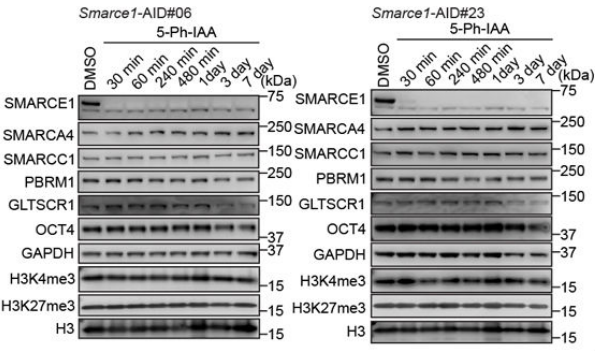
Representative immunoblot of Smarce1-AID cells (clones #6 and #23) treated with DMSO or 1 μM (30, 60, 240, 480 min, 1, 3, 7 days) 5-Ph-IAA.
-
Science
In silico protein interaction screening uncovers DONSON's role in replication initiation. [Abstract]2023 Sep 22;381(6664):eadi3448. PMID: 37590370 -
Nat Immunol
Transcriptional function of E2A, Ebf1, Pax5, Ikaros and Aiolos analyzed by in vivo acute protein degradation in early B cell development. [Abstract]2024 Sep;25(9):1663-1677. PMID: 39179932 -
Nat Commun
2025 Jul 27;16(1):6919. PMID: 40715076 -
Nat Commun
Systematic comparison and base-editing-mediated directed protein evolution and functional screening yield superior auxin-inducible degron technology. [Abstract]2025 Jul 18;16(1):6631. PMID: 40681502 -
Nat Commun
2025 May 6;16(1):4214. PMID: 40328743 -
Mol Cell
Ribo-Tweezer: Rapid removal of ribosomal proteins reveals additional layers of post-transcriptional gene regulation. [Abstract]2026 May 21:S1097-2765(26)00277-7. PMID: 42167236 -
Mol Cell
Transcription and cohesin direct domain boundary spatial positioning and are linked to Friedreich's ataxia. [Abstract]2026 May 21;86(10):1911-1930.e11. PMID: 42127908 -
Mol Cell
2023 Jan 19;83(2):252-265.e13. PMID: 36630955
5-Ph-IAA purchased from MedChemExpress. Usage Cited in: Mol Cell. 2023 Jan 19;83(2):252-265.e13. [Abstract]
5-Ph-IAA (5 μM; 1 h) rapidly induces Zpr1 depletion (Fig A), leading to cell growth arrest (Fig B), in ZPR1-AID cells.
-
Sci Adv
Chromatin conformation, gene transcription, and nucleosome remodeling as an emergent system. [Abstract]2025 Jan 10;11(2):eadq6652. PMID: 39792661 -
Sci Adv
2025 Jan 24;11(4):eadp0855. PMID: 39854464 -
Nat Struct Mol Biol
Topoisomerase-modulated genome-wide DNA supercoiling domains colocalize with nuclear compartments and regulate human gene expression. [Abstract]2025 Jan;32(1):48-61. PMID: 39152238 -
Genome Biol
2025 May 12;26(1):126. PMID: 40355969 -
Genome Biol
Auxin-inducible degron 2 system deciphers functions of CTCF domains in transcriptional regulation. [Abstract]2023 Jan 26;24(1):14. PMID: 36698211 -
Cell Genom
Long-range enhancer-controlled genes are hypersensitive to regulatory factor perturbations. [Abstract]2025 Mar 12;5(3):100778. PMID: 40010352 -
J Genet Genomics
2025 Dec 23:S1673-8527(25)00349-2. PMID: 41448493 -
Curr Biol
2026 Apr 20;36(8):1977-1993.e8. PMID: 41923633 -
-
Cell Rep
2026 Apr 8;45(4):117236. PMID: 41955098 -
Genes Dev
Two unrelated distal genes activated by a shared enhancer benefit from localizing inside the same small topological domain. [Abstract]2025 Mar 3;39(5-6):348-363. PMID: 39870429 -
PLoS Biol
Detailed characterisation of the trypanosome nuclear pore architecture reveals conserved asymmetrical functional hubs that drive mRNA export. [Abstract]2025 Feb 3;23(2):e3003024. PMID: 39899609 -
Genetics
Genetic Analysis of JNK MAPK Signaling in Stress-Induced Avoidance Behavior in C. elegans. [Abstract]2025 Jul 28:iyaf143. PMID: 40719140 -
Commun Biol
Revealing acute consequences of rapid degradation of synaptic fusion proteins at individual synapses using Auxin-Inducible Degron 2 technology. [Abstract]2025 Nov 17;8(1):1589. PMID: 41249467 -
PLoS One
2025 Mar 7;20(3):e0315659. PMID: 40053537 -
bioRxiv
TREX2 component PCID2 scaffolds alternative SAC3-based subcomplexes with distinct RNA processing and export function. [Abstract]2026 Apr 14:2026.04.13.716336. PMID: 42039562 -
-
bioRxiv
2026 Mar 17:2026.03.15.711889. PMID: 41889979 -
-
bioRxiv
Chromatin modifiers KMT2D, BAF, and p300 are required for de novo binding of transcription factors on enhancers. [Abstract]2026 Jan 29:2026.01.29.702555. PMID: 41659470 -
-
-
-
-
-
-
-
-
-
-
bioRxiv
Deciphering acquired resistance mechanisms to sustained auxin-inducible protein degradation in cells and mice. [Abstract]2025 Sep 23:2025.09.21.677607. PMID: 41040178 -
-
bioRxiv
The nucleus forms a dynamic contact with the plasma membrane to maintain the glandular epithelial architecture. [Abstract]2025 Jun 15:2025.06.13.659552. PMID: 40661617 -
-
-
-
bioRxiv
2025 Feb 16:2025.02.12.637959. PMID: 39990329 -
-
-
-
bioRxiv
An auxin-inducible degron system for conditional mutation in the fungal meningitis pathogen Cryptococcus neoformans. [Abstract]2024 Nov 18:2024.11.18.624150. PMID: 39605730 -
Res Sq
Comparative analysis and directed protein evolution yield an improved degron technology with minimal basal degradation, rapid inducible depletion, and faster recovery of target proteins. [Abstract]2024 Nov 15:rs.3.rs-5348956. PMID: 39606491 -
-
bioRxiv
Transcriptome-wide mRNA condensation precedes stress granule formation and excludes stress-induced transcripts. [Abstract]2024 May 2:2024.04.15.589678. PMID: 38659805 -
-
-
-


Solvent & Solubility
DMSO : 100 mg/mL (397.96 mM; Need ultrasonic; Hygroscopic DMSO has a significant impact on the solubility of product, please use newly opened DMSO)
Please refer to the solubility information to select the appropriate solvent. Once prepared, please aliquot and store the solution to prevent product inactivation from repeated freeze-thaw cycles.
Storage method and period of stock solution: -80°C, 2 years; -20°C, 1 year. When stored at -80°C, please use it within 2 years. When stored at -20°C, please use it within 1 year.
Please refer to the solubility information to select the appropriate solvent. Once prepared, please aliquot and store the solution to prevent product inactivation from repeated freeze-thaw cycles.
Storage method and period of stock solution: -80°C, 2 years; -20°C, 1 year. When stored at -80°C, please use it within 2 years. When stored at -20°C, please use it within 1 year.
Concentration (start) × Volume (start) = Concentration (final) × Volume (final)
Select the appropriate dissolution method based on your experimental animal and administration route.
- For the following dissolution methods, please ensure to first prepare a clear stock solution using an In Vitro approach and then sequentially add co-solvents:
- To ensure reliable experimental results, the clarified stock solution can be appropriately stored based on storage conditions. As for the working solution for In Vivo experiments, it is recommended to prepare freshly and use it on the same day.
- The percentages shown for the solvents indicate their volumetric ratio in the final prepared solution. If precipitation or phase separation occurs during preparation, heat and/or sonication can be used to aid dissolution.
Add each solvent one by one: 10% DMSO 40% PEG300 5% Tween-80 45% Saline
Solubility: ≥ 2.08 mg/mL (8.28 mM); Clear solution
This protocol yields a clear solution of ≥ 2.08 mg/mL (saturation unknown).
Taking 1 mL working solution as an example, add 100 μL DMSO stock solution (20.8 mg/mL) to 400 μL PEG300, and mix evenly; then add 50 μL Tween-80 and mix evenly; then add 450 μL Saline to adjust the volume to 1 mL.
Preparation of Saline: Dissolve 0.9 g sodium chloride in ddH₂O and dilute to 100 mL to obtain a clear Saline solution.
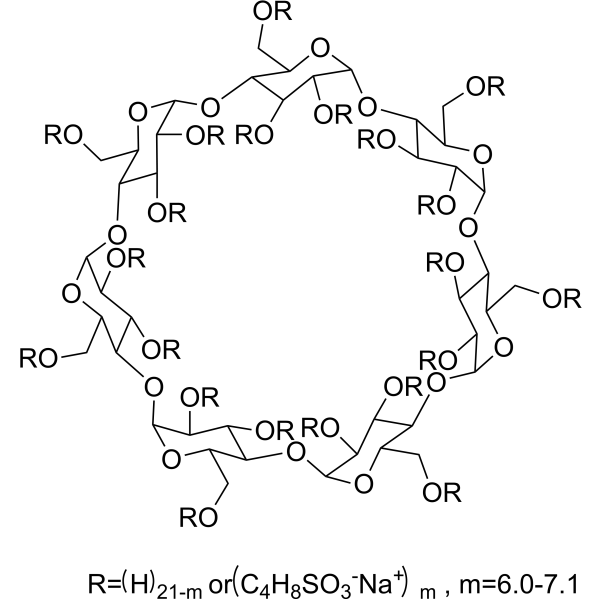
Add each solvent one by one: 10% DMSO 90% (20% SBE-β-CD in Saline)
Solubility: ≥ 2.08 mg/mL (8.28 mM); Clear solution
This protocol yields a clear solution of ≥ 2.08 mg/mL (saturation unknown).
Taking 1 mL working solution as an example, add 100 μL DMSO stock solution (20.8 mg/mL) to 900 μL 20% SBE-β-CD in Saline, and mix evenly.
Preparation of 20% SBE-β-CD in Saline (4°C, storage for one week): 2 g SBE-β-CD powder is dissolved in 10 mL Saline, completely dissolve until clear.
For the following dissolution methods, please prepare the working solution directly:
It is recommended to prepare fresh solutions and use them promptly within a short period of time.
The percentages shown for the solvents indicate their volumetric ratio in the final prepared solution. If precipitation or phase separation occurs during preparation, heat and/or sonication can be used to aid dissolution.
Add each solvent one by one: PBS
Solubility: 1 mg/mL (3.98 mM); Clear solution; Need ultrasonic and warming and heat to 60°C
Please enter the basic information of animal experiments:
-
-
-
-
Recommended: Prepare an additional quantity of animals to account for potential losses during experiments.
Please enter your animal formula composition:
-
%DMSO +
Recommended: Keep the proportion of DMSO in working solution below 2% if your animal is weak.
-
%+
-
+%Tween-80 + +
-
%Saline +
The co-solvents required include: DMSO, . All of co-solvents are available by MedChemExpress (MCE). , Tween 80. All of co-solvents are available by MedChemExpress (MCE).
Working solution concentration: 0.22 mg/mL
Method for preparing stock solution: mg drug dissolved in μL DMSO. Stock solution concentration: mg/mL.
1. Take μL DMSO stock solution;
2. Add μL .
μL , mix evenly;
3. Then add μL Tween 80, mix evenly;
4. Then add μL
Please ensure that the stock solution in the first step is dissolved to a clear state, and add co-solvents in sequence. You can use ultrasonic heating (ultrasonic cleaner, recommended frequency 20-40 kHz), vortexing, etc. to assist dissolution.


Purity & Documentation
-
Data Sheet (275 KB)
-
SDS (393 KB)
- English - EN (393 KB)
- Français - FR (393 KB)
- Deutsch - DE (393 KB)
- Norwegian - NO (393 KB)
- Español - ES (393 KB)
- Swedish - SV (393 KB)
- Italian - IT (393 KB)
- Korean - KR (393 KB)
- Portuguese - PT (393 KB)
-
Handling Instructions (2659 KB)
References


Complete Stock Solution Preparation Table
Please refer to the solubility information to select the appropriate solvent. Once prepared, please aliquot and store the solution to prevent product inactivation from repeated freeze-thaw cycles.
Storage method and period of stock solution: -80°C, 2 years; -20°C, 1 year. When stored at -80°C, please use it within 2 years. When stored at -20°C, please use it within 1 year.
| Optional Solvent | Concentration Solvent Mass | 1 mg | 5 mg | 10 mg | 25 mg |
|---|---|---|---|---|---|
| DMSO | 1 mM | 3.9796 mL | 19.8981 mL | 39.7962 mL | 99.4906 mL |
| 5 mM | 0.7959 mL | 3.9796 mL | 7.9592 mL | 19.8981 mL | |
| 10 mM | 0.3980 mL | 1.9898 mL | 3.9796 mL | 9.9491 mL | |
| 15 mM | 0.2653 mL | 1.3265 mL | 2.6531 mL | 6.6327 mL | |
| 20 mM | 0.1990 mL | 0.9949 mL | 1.9898 mL | 4.9745 mL | |
| 25 mM | 0.1592 mL | 0.7959 mL | 1.5918 mL | 3.9796 mL | |
| 30 mM | 0.1327 mL | 0.6633 mL | 1.3265 mL | 3.3164 mL | |
| 40 mM | 0.0995 mL | 0.4975 mL | 0.9949 mL | 2.4873 mL | |
| 50 mM | 0.0796 mL | 0.3980 mL | 0.7959 mL | 1.9898 mL | |
| 60 mM | 0.0663 mL | 0.3316 mL | 0.6633 mL | 1.6582 mL | |
| 80 mM | 0.0497 mL | 0.2487 mL | 0.4975 mL | 1.2436 mL | |
| 100 mM | 0.0398 mL | 0.1990 mL | 0.3980 mL | 0.9949 mL |


5-Ph-IAA Related Classifications
HY-134653 Related Classifications
 Powered by Bioz