



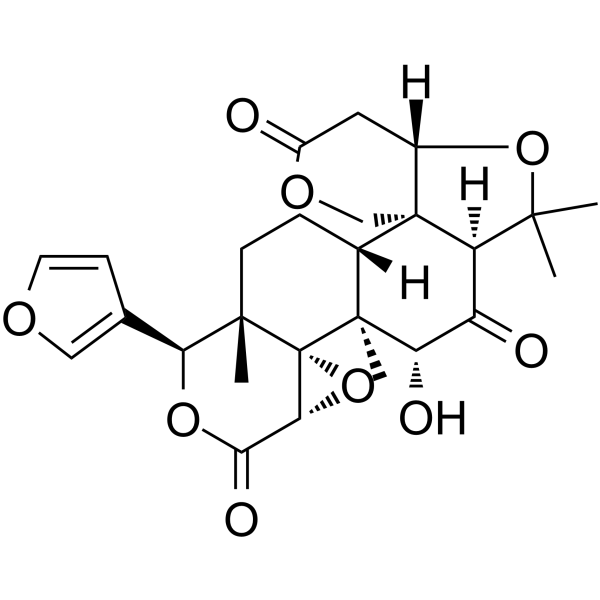
Rutaevin

Based on 1 Customer Validation
Rutaevin is an antifungal toxin and CYP3A4 inactivator. Rutaevin requires NADPH-dependent bioactivation to generate cis-but-2-ene-1,4-dial, which then covalently modifies and mechanism-based inactivates human CYP3A4 (IC50=4.48 μM, Ki=15.98 μM), and interacts with substances such as glutathione. Rutaevin disrupts the cellular structure of Sirococcus conigenus, accumulates linearly in resistant larch after pathogen exposure, and induces liver toxicity in mice via oral administration. Rutaevin can be applied to research in fields related to larch shoot blight and other associated areas.
商品は「研究用試薬」です。人や動物の医療用・臨床診断用・食品用の製品ではありません。
研究用途以外に使用した場合、当社は一切の責任を負いかねます。
- 純度 : 99.77%
- CAS 番号: 33237-37-5
- 分子式: C26H30O9
- 分子量:486.51
-
保管条件:
4°C, protect from light
* In solvent : -80°C, 6 months; -20°C, 1 month (protect from light)

To place orders, for customer services and technical support, please contact: MedChemExpress USA
Tel: 609-228-6898 E-mail: [email protected] [email protected]


-
 生物活性
生物活性
-
化学情報
- プロトコル
- 純度とドキュメンテーション
- 参考文献
-
 Help & FAQs




生物活性
製品説明
IC50 & Target
[1]|
CYP3A4 4.48 μM (IC50) |
体外実験
Rutaevin (20-100 μM; 1-2 h) undergoes NADPH-dependent bioactivation to form a reactive BDA intermediate in rat and human liver microsomes, which reacts with nucleophilic trapping agents GSH, NAL, and MOA to form 10 distinct conjugates, including the cyclic mono(GSH) conjugate M1[1].
Rutaevin (0.1-30 μM; 30 min) acts as a potential mechanism-based inactivator of CYP3A4 in human liver microsomes, as shown by the 5.03-fold decrease in IC50 (to 4.48 μM) following NADPH-dependent preincubation[1].
Rutaevin (0.0625-1.0000 mg/mL; up to 5 days) potently inhibits the growth of Neofusicoccum laricinum with an IC50 of 0.27 mg/mL and achieves complete inhibition at 0.5 mg/mL[2].
MedChemExpress (MCE) has not independently confirmed the accuracy of these methods. They are for reference only.
体内実験
Rutaevin (oral) induces hepatotoxicity in mice, as indicated by elevated serum ALT and AST activities[1].
Rutaevin (p.o.) induces hepatotoxicity in mice via bioactivation processes[2].
MedChemExpress (MCE) has not independently confirmed the accuracy of these methods. They are for reference only.
-
Animal Model:Sprague-Dawley (male, 220-250 g, bile duct cannulated)[1]
-
Dosage:5 mg/kg
-
Administration:i.v.; single dose
-
Result:Detected a cyclic mono(GSH) conjugate of rutaevin's bioactivated cis-butene-1,4-dial (BDA) intermediate (designated M1) as the most abundant metabolite in rat bile samples.


化学情報
-
CAS 番号 33237-37-5
-
性状 Solid
-
分子量 486.51
-
分子式 C26H30O9
-
Color White to off-white
-
SMILES
C[C@]1([C@H]2O)[C@@]3([C@@H]4O3)[C@]([C@H](C5=COC=C5)OC4=O)(CC[C@]1([H])[C@]67[C@](C(C)(C)O[C@@]6([H])CC(OC7)=O)([H])C2=O)C
-
Structure Classification
-
輸送条件
Room temperature in continental US; may vary elsewhere.
-
保管条件
4°C, protect from light
* In solvent : -80°C, 6 months; -20°C, 1 month (protect from light)


純度とドキュメンテーション
-
データシート (297 KB)
-
SDS (252 KB)
- English - EN (252 KB)
- Français - FR (252 KB)
- Deutsch - DE (252 KB)
- Norwegian - NO (252 KB)
- Español - ES (252 KB)
- Swedish - SV (252 KB)
- Italian - IT (252 KB)
- Korean - KR (252 KB)
- Portuguese - PT (252 KB)
-
取扱説明書 (2659 KB)
参考文献

Calculators
濃度 (開始) × 体積 (開始) = 濃度 (終了) × 体積 (終了)


Rutaevin 関連分類
HY-N2620 関連分類
 Powered by Bioz