



Umibecestat
Based on 1 publication(s) in Google Scholar
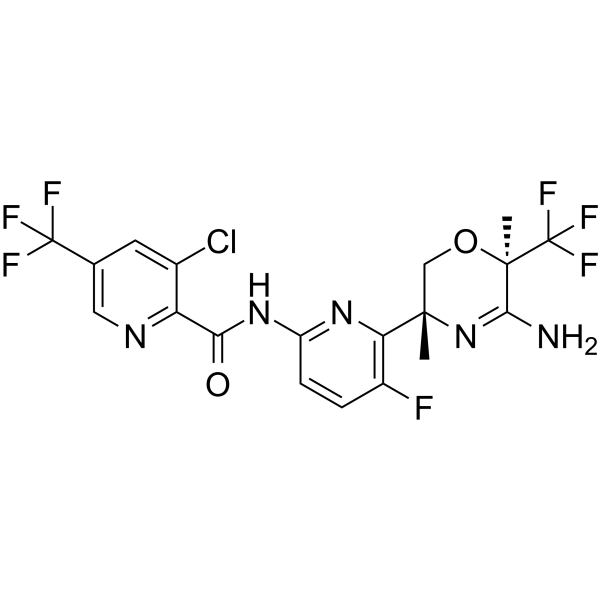
Umibecestat (CNP520) is a selective, orally active BACE inhibitor, with an IC50 of 11 nM for hBACE-1, 10 nM for mouse BACE-1, and 30 nM for hBACE-2. Umibecestat reduces β-Amyloid levels in the brain and cerebrospinal fluid, decreases β-amyloid plaque deposition, and inhibits plaque-associated neuroinflammation. Umibecestat is used in research related to Alzheimer's disease.
商品は「研究用試薬」です。人や動物の医療用・臨床診断用・食品用の製品ではありません。
研究用途以外に使用した場合、当社は一切の責任を負いかねます。
- 純度 : 99.81%
- CAS 番号: 1387560-01-1
- 分子式: C19H15ClF7N5O2
- 分子量:513.80
-
保管条件:
4°C, protect from light
* In solvent : -80°C, 6 months; -20°C, 1 month (protect from light)

To place orders, for customer services and technical support, please contact: MedChemExpress USA
Tel: 609-228-6898 E-mail: [email protected] [email protected]


-
 生物活性
-
化学情報
-
溶剤 & 溶解度
- プロトコル
- 純度とドキュメンテーション
- 参考文献
-
 Help & FAQs


-
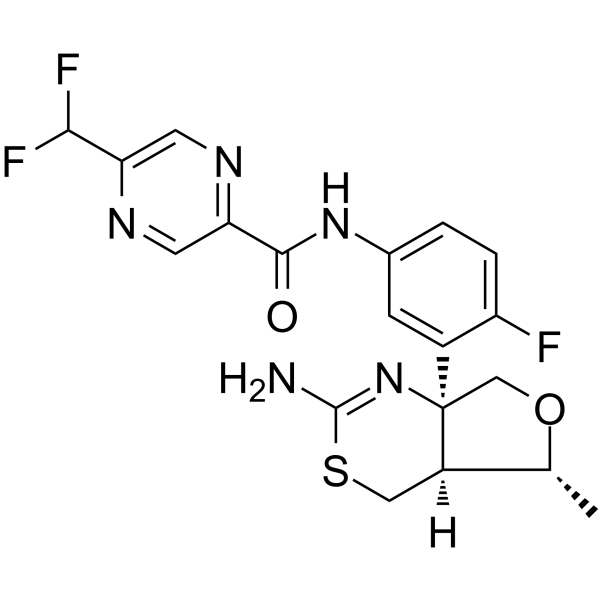
HY-109055
ElenbecestatBACE-1 Inhibitor -
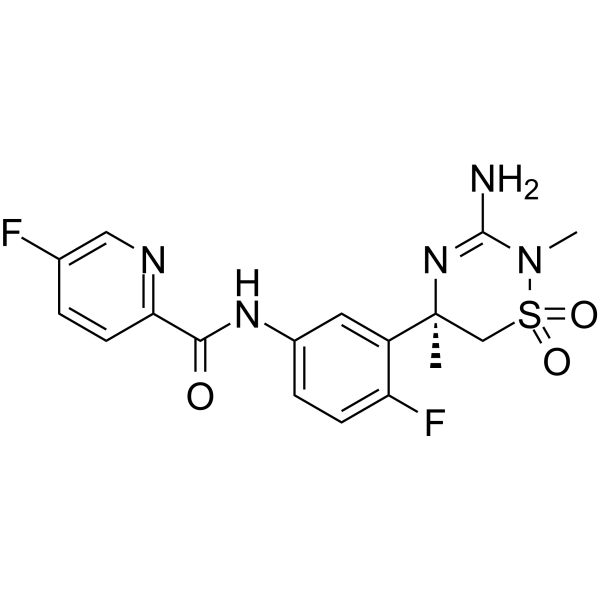
HY-16759
VerubecestatBACE1/2 Inhibitor -
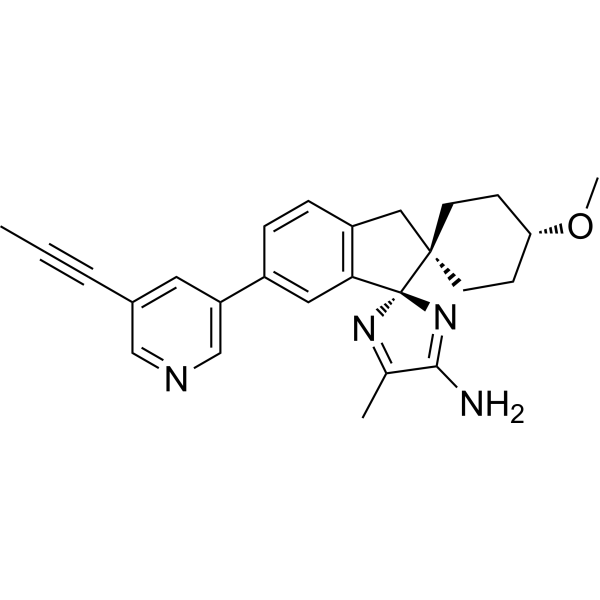
HY-100740
LanabecestatBACE1 Inhibitor -
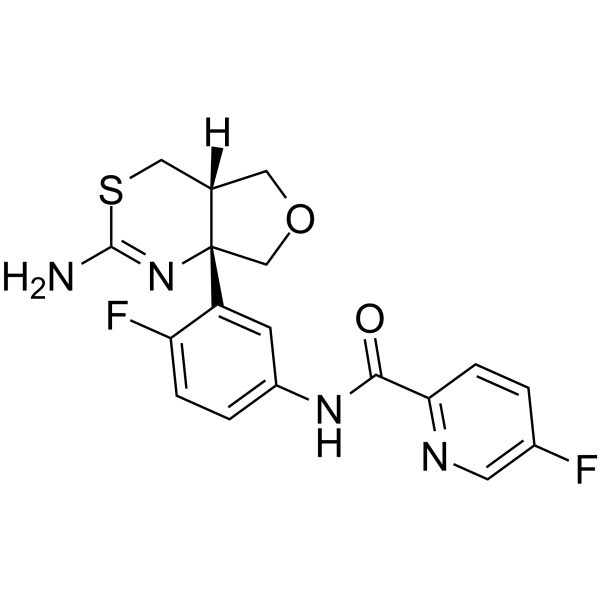
HY-13240
LY2886721BACE1 Inhibitor -
HY-Y0320
Dimethyl sulfoxide, meets analytical specification of Ch.P.Aprotic Solvent -
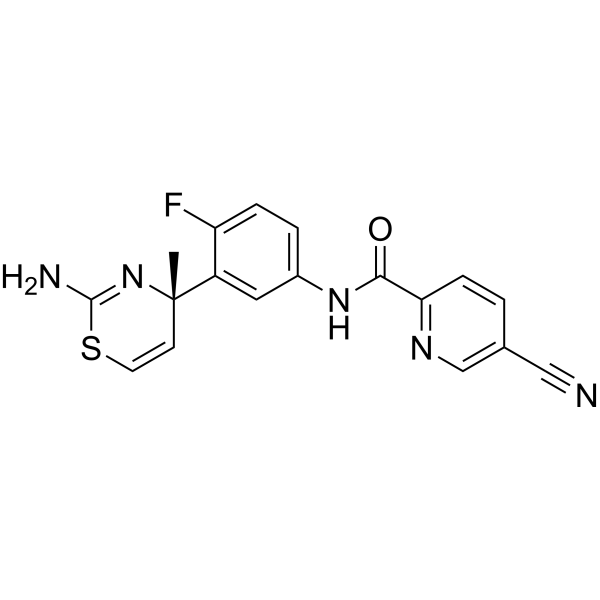
HY-109052
AtabecestatBACE1 Inhibitor -
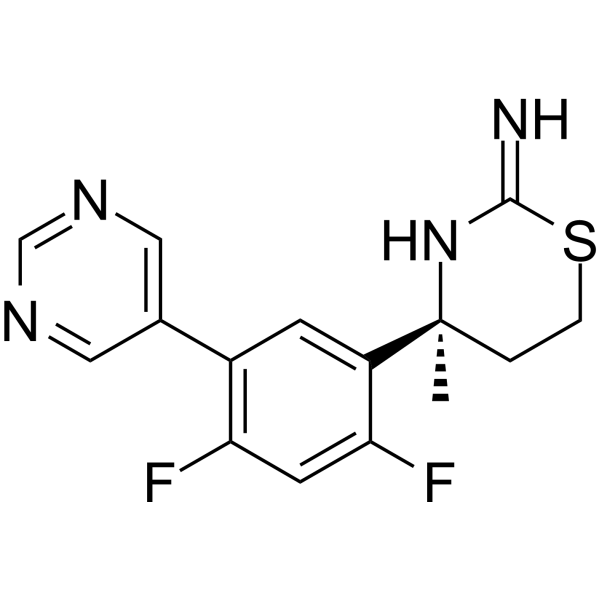
HY-10472
LY2811376BACE1 Inhibitor -
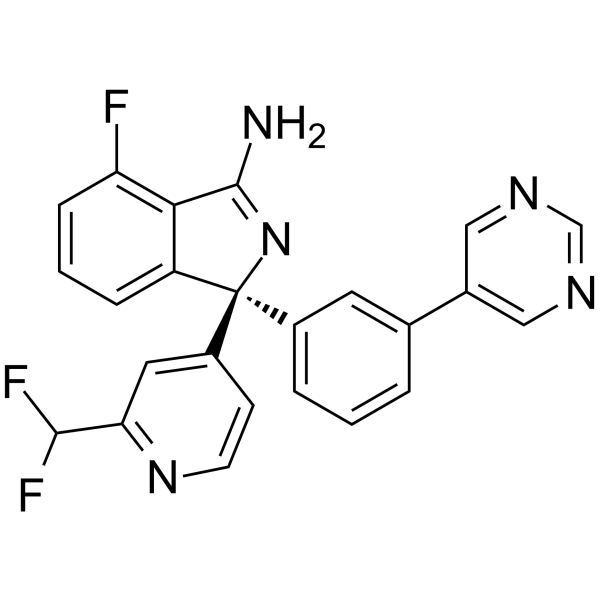
HY-13438
AZD3839 free baseBACE1 Iinhibitor -
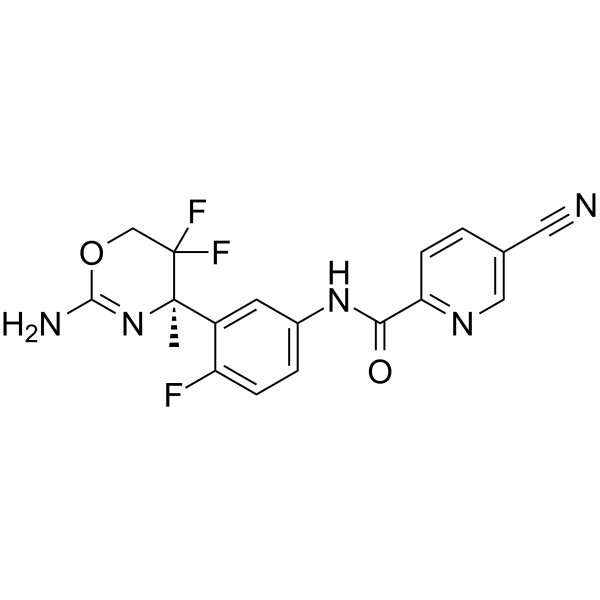
HY-100182
BACE1-IN-1BACE1/2 Inhibitor -
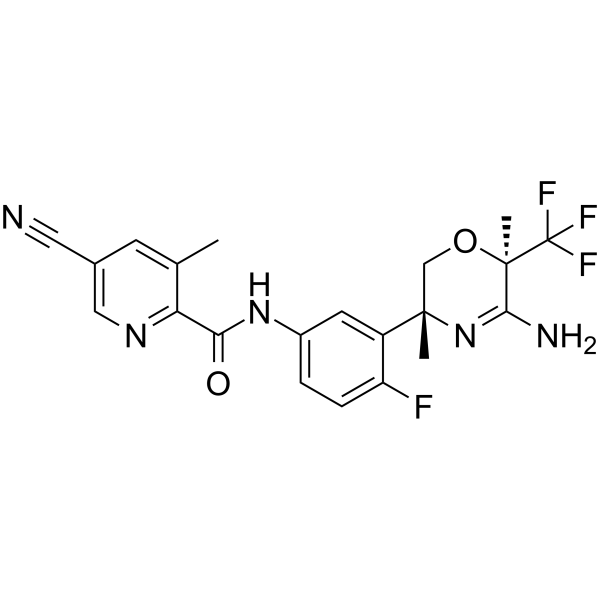
HY-124322
NB-360BACE1/BACE2 Inhibitor -
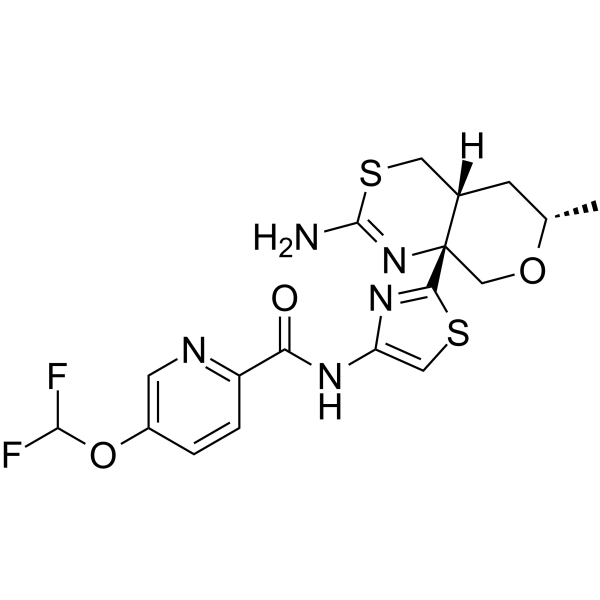
HY-112157
PF-06751979BACE1 Inhibitor -
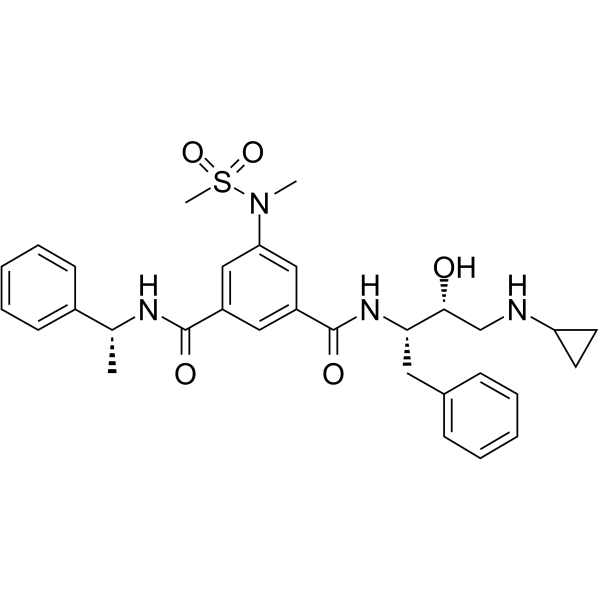
HY-10133
β-Secretase Inhibitor IVBACE-1 Inhibitor


生物活性
製品説明
IC50 & Target
[1]|
BACE1 11 nM (IC50) |
BACE2 30 nM (IC50) |
Cathepsin D 205000 nM (IC50) |
Cathepsin E 66400 nM (IC50) |
Cellular Effect
|
Cell Line

|
Type | Value | Description | References |
|---|---|---|---|---|
| CHO | IC50 |
3 nM
Compound: 5; CNP-520
|
Inhibition of BACE1 in CHO cells expressing human APP assessed as reduction in amyloidbeta (1 to 40 residues) level incubated for 24 hrs by immunoassay method
Inhibition of BACE1 in CHO cells expressing human APP assessed as reduction in amyloidbeta (1 to 40 residues) level incubated for 24 hrs by immunoassay method
|
[PMID: 30709653] |
体外実験
Umibecestat effectively inhibits Aβ40 secretion in CHO cells transfected with wild-type and Swedish mutant APP[1].
Umibecestat inhibits the hERG potassium channel in in vitro assays, with an IC50 of 3.2 μM[1].
Umibecestat (10 mM; 0.5-30 min) exhibits good in vitro metabolic stability in liver microsomes[2].
MedChemExpress (MCE) has not independently confirmed the accuracy of these methods. They are for reference only.
体内実験
Following a single oral administration of Umibecestat at a dose of 3.1 mg/kg in beagle dogs, Aβ40 and Aβ42 levels in the cerebrospinal fluid decrease continuously by more than 75% within 12-48 hours, and the compound exhibits high central nervous system distribution efficiency[1].
Umibecestat (3-100 μmol/kg; oral; single dose) hydrochloride produces a dose-dependent reduction in Aβ40 in Sprague-Dawley rats, and the reduction of cerebral Aβ40 reaches 89.1% 4 h after administration at an oral dose of 100 μmol/kg[2].
Umibecestat (200 mg/kg/day; administered daily for 6 months) hydrochloride significantly reduces Aβ levels in the rat brain without altering the histological structure of hippocampal mossy fibers[3].
MedChemExpress (MCE) has not independently confirmed the accuracy of these methods. They are for reference only.
-
Animal Model:Sprague Dawley (male, 3-4 months old, healthy normal model)[1]
-
Dosage:1.5 mg/kg; 15.4 mg/kg; 51.3 mg/kg
-
Administration:oral gavage; single dose
-
Result:Reduced brain Aβ40 by 89.3% relative to untreated controls at 51.3 mg/kg dose.
Achieved oral ED50 of 2.4 mg/kg for 50% lowering of rat brain Aβ40.
Produced ~50% Aβ40 reduction in both rat brain and CSF at 24 hours post-dose following a 15.4 mg/kg single dose, with overlapping effect-over-time curves for brain and CSF demonstrating that Aβ pharmacodynamics in CSF mirrors that in brain tissue.
-
Animal Model:Beagle (male, 4 months of age, healthy normal model)[1]
-
Dosage:3.1 mg/kg
-
Administration:oral gavage; single dose
-
Result:Maintained detectable levels in blood for 192 hours and in CSF for 72 hours after dosing.
Achieved a ratio of unbound CNP520 in CSF to unbound CNP520 in blood of 0.7, demonstrating efficient distribution to the central nervous system.
Induced >75% reduction in both CSF Aβ40 and Aβ42 concentrations at 12-48 hours after dosing, with levels returning slowly to baseline over the following 7 days.
Yielded an in vivo IC50 of 103.1 nM for total CNP520 and 3.3 nM for unbound CNP520 in dog blood via PK/PD modeling.
-
Animal Model:Sprague-Dawley rats (male, approximately 300 g body weight)[2]
-
Dosage:3 μmol/kg; 10 μmol/kg; 30 μmol/kg; 100 μmol/kg
-
Administration:p.o.; single dose
-
Result:Reach blood concentrations of 0.16 μM, 0.44 μM, 1.71 μM, and 3.43 μM at 3, 10, 30, and 100 μmol/kg doses respectively at 4 hours post-dose.
Reach corresponding brain concentrations of 0.18 μM, 0.85 μM, 3.28 μM, and 11.6 μM, with unbound brain concentrations of 0.002 μM, 0.008 μM, 0.03 μM, and 0.12 μM at 4 hours post-dose.
Achieve unbound brain concentration relative to the BACE1 IC50 of 0.18, 0.72, 3, and 11 at 3, 10, 30, and 100 μmol/kg doses respectively at 4 hours post-dose.
Produce brain Aβ40 reductions of 35.6%, 63.0%, 81.4%, and 89.1% at 3, 10, 30, and 100 μmol/kg doses respectively at 4 hours post-dose.
Produce corresponding CSF Aβ40 reductions of 59.3% (at 10 μmol/kg) and 78.2% (at 30 μmol/kg) at 4 hours post-dose.
Keep levels of the amide hydrolysis metabolite 21 in blood and brain all below 3.4% of parent compound levels at 4 hours post-dose.
-
Animal Model:Rat[3]
-
Dosage:200 mg/kg/day
-
Administration:daily; 6 months
-
Result:Significantly reduced brain Aβ levels.
Did not affect the length and organization of mossy fibers in the hippocampus.
臨床実験
| NCT Number | Sponsor | Condition | Start Date |
Phase
|
|---|---|---|---|---|
| NCT01329991 | 2011-05 | PHASE1 |


化学情報
-
CAS 番号 1387560-01-1
-
性状 Solid
-
分子量 513.80
-
分子式 C19H15ClF7N5O2
-
Color White to off-white
-
SMILES
O=C(NC1=NC([C@@]2(CO[C@](C)(C(N)=N2)C(F)(F)F)C)=C(C=C1)F)C3=NC=C(C=C3Cl)C(F)(F)F
-
別名
CNP520
-
輸送条件
Room temperature in continental US; may vary elsewhere.
-
保管条件
4°C, protect from light
* In solvent : -80°C, 6 months; -20°C, 1 month (protect from light)


Publications (1)
-
Journal Impact Factor
-
Most Recent


溶剤 & 溶解度
体外:
DMSO : 100 mg/mL (194.63 mM; Need ultrasonic; Hygroscopic DMSO has a significant impact on the solubility of product, please use newly opened DMSO)
Please refer to the solubility information to select the appropriate solvent. Once prepared, please aliquot and store the solution to prevent product inactivation from repeated freeze-thaw cycles.
Storage method and period of stock solution: -80°C, 6 months; -20°C, 1 month (protect from light). When stored at -80°C, please use it within 6 months. When stored at -20°C, please use it within 1 month.
濃度 (開始) × 体積 (開始) = 濃度 (終了) × 体積 (終了)
In Vivo Dissolution Calculator
Please enter the basic information of animal experiments:
-
-
-
-
Recommended: Prepare an additional quantity of animals to account for potential losses during experiments.
Working solution concentration: 0.22 mg/mL


純度とドキュメンテーション


参考文献
ホットトピック
-
All
-
Topics
-
Most Recent
-
Oldest
-
Topics Aβ Deposition: The "First Trigger" in the Pathogenesis of AD and Decoding its Molecular Mechanism
β-amyloid (Aβ) deposition is considered a key early event in the development of Alzheimer's disease (AD).
2026-01-26

Complete Stock Solution Preparation Table
Please refer to the solubility information to select the appropriate solvent. Once prepared, please aliquot and store the solution to prevent product inactivation from repeated freeze-thaw cycles.
Storage method and period of stock solution: -80°C, 6 months; -20°C, 1 month (protect from light). When stored at -80°C, please use it within 6 months. When stored at -20°C, please use it within 1 month.
| Optional Solvent | Concentration Solvent Mass | 1 mg | 5 mg | 10 mg | 25 mg |
|---|---|---|---|---|---|
| DMSO | 1 mM | 1.9463 mL | 9.7314 mL | 19.4628 mL | 48.6571 mL |
| 5 mM | 0.3893 mL | 1.9463 mL | 3.8926 mL | 9.7314 mL | |
| 10 mM | 0.1946 mL | 0.9731 mL | 1.9463 mL | 4.8657 mL | |
| 15 mM | 0.1298 mL | 0.6488 mL | 1.2975 mL | 3.2438 mL | |
| 20 mM | 0.0973 mL | 0.4866 mL | 0.9731 mL | 2.4329 mL | |
| 25 mM | 0.0779 mL | 0.3893 mL | 0.7785 mL | 1.9463 mL | |
| 30 mM | 0.0649 mL | 0.3244 mL | 0.6488 mL | 1.6219 mL | |
| 40 mM | 0.0487 mL | 0.2433 mL | 0.4866 mL | 1.2164 mL | |
| 50 mM | 0.0389 mL | 0.1946 mL | 0.3893 mL | 0.9731 mL | |
| 60 mM | 0.0324 mL | 0.1622 mL | 0.3244 mL | 0.8110 mL | |
| 80 mM | 0.0243 mL | 0.1216 mL | 0.2433 mL | 0.6082 mL | |
| 100 mM | 0.0195 mL | 0.0973 mL | 0.1946 mL | 0.4866 mL |


Umibecestat 関連分類
HY-119689 関連分類
 Powered by Bioz