



Oxolinic acid
Based on 3 publication(s) in Google Scholar
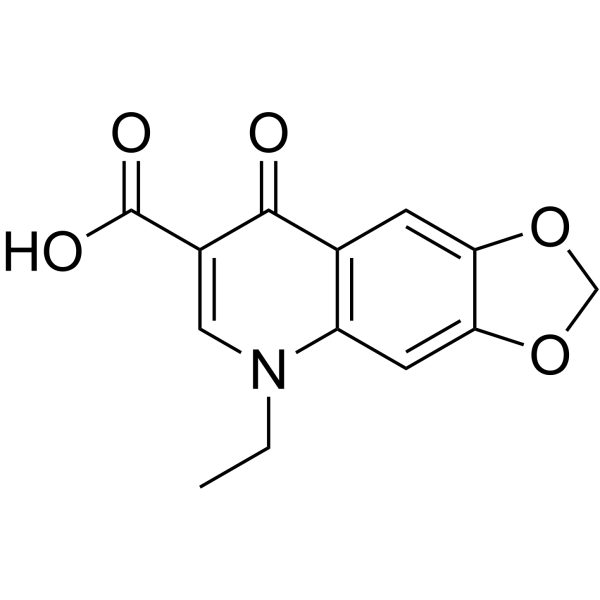
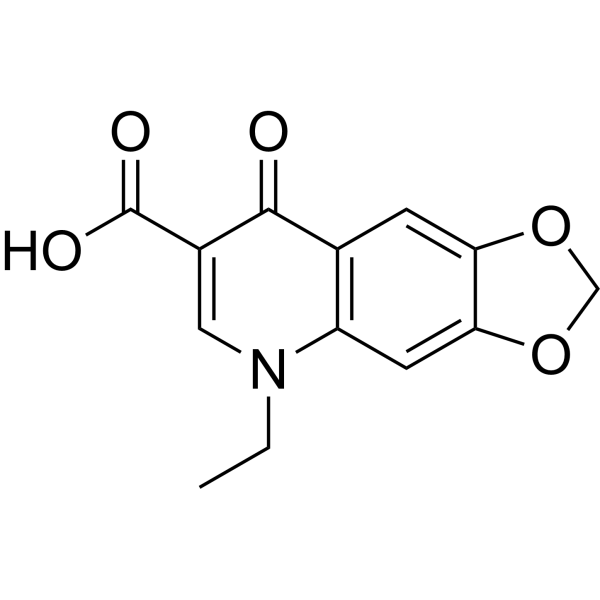
Oxolinic acid is an antibiotic against both Gram-negative and Gram-positive bacteria. Oxolinic acid can be used for the research of acute and chronic urinary tract infections. Oxolinic acid is a DNA/RNA synthesis inhibitor. Oxolinic acid acts a dopamine uptake inhibitor and stimulants locomotor effect in mice.
For research use only. We do not sell to patients.
- Purity: 98.97%
- CAS No.: 14698-29-4
- Formula: C13H11NO5
- Molecular Weight:261.23
-
Storage:Powder -20°C, 3 years , 4°C, 2 years ; In solvent -80°C, 2 years , -20°C, 1 year

To place orders, for customer services and technical support, please contact: MedChemExpress USA
Tel: 609-228-6898 E-mail: [email protected] [email protected]


-
 Biological Activity
-
Chemical Information
-
Solvent & Solubility
- Purity & Documentation
- References
-
 Help & FAQs



Publications Citing Use of MedChemExpress (MCE) Oxolinic acid
MoreAll Antibiotic Isoforms
MoreAll DNA/RNA Synthesis Isoforms
More

Biological Activity
Antimicrobial[1]
|
Cell Line

|
Type | Value | Description | References |
|---|---|---|---|---|
| HEK293 | EC50 |
0.81 μM
Compound: 1
|
Inhibition of RyR1 harboring R2163C mutant (unknown origin) stably expressed in HEK293 cells coexpressing R-CEPIA1er assessed as suppression in Ca2+ leakage from ER prestimulated with doxycycline for 24 to 28 hrs followed by compound addition at 100 secs
Inhibition of RyR1 harboring R2163C mutant (unknown origin) stably expressed in HEK293 cells coexpressing R-CEPIA1er assessed as suppression in Ca2+ leakage from ER prestimulated with doxycycline for 24 to 28 hrs followed by compound addition at 100 secs
|
[PMID: 31299492] |
Oxolinic acid (2-5 ug/mL) inhibits 115 strains of E. coli[1].
Oxolinic acid (0-31 ug/mL) inhibits 94 % of the 44 strains of Proteus mirabilis [1].
Oxolinic acid (>5 ug/mL) inhibits all strains of Strept. Faecalis[1].
Oxolinic acid (>2 ug/mL) causes chromosomal DNA supercoiling to decrease in the two wild-type E. coli K-12 strains tested, DM4100 and NI747[2].
Oxolinic acid reduces chromosomal DNA supercoiling and inhibits RNA synthesis in E. coli[2].
MedChemExpress (MCE) has not independently confirmed the accuracy of these methods. They are for reference only.
MedChemExpress (MCE) has not independently confirmed the accuracy of these methods. They are for reference only.
-
Animal Model:Male Swiss albino CD1 mice (22-25 g)[3]
-
Dosage:16 mg/kg, 32 mg/kg, 64 mg/kg, 128 mg/kg
-
Administration:Intraperitoneal injection
-
Result:Stimulated the horizontal activity of mice, culminated at the 32 mg/kg dose but disappeared at the highest tested dose, 128 mg/kg.


Chemical Information
-
CAS No. 14698-29-4
-
Appearance Solid
-
Molecular Weight 261.23
-
Formula C13H11NO5
-
Color White to off-white
-
SMILES
O=C(C1=CN(CC)C2=C(C=C3C(OCO3)=C2)C1=O)O
-
Shipping
Room temperature in continental US; may vary elsewhere.
-
Storage
Powder -20°C 3 years 4°C 2 years In solvent -80°C 2 years -20°C 1 year


Publications (3)
-
Journal Impact Factor
-
Most Recent
-
Theranostics
Antibiotic Azithromycin inhibits brown/beige fat functionality and promotes obesity in human and rodents. [Abstract]2022 Jan 1;12(3):1187-1203. PMID: 35154482 -
J Xenobiot
Uses of Antibiotics in Ornamental Fish in Hong Kong and the Antibiotic Resistance in the Associated Zoonotic Pathogens. [Abstract]2022 Dec 4;12(4):365-377. PMID: 36547470 -
Chemosphere
Mass-balance-model-based evaluation of sewage treatment plant contribution to residual pharmaceuticals in environmental waters. [Abstract]2019 Jun:225:378-387. PMID: 30884299


Solvent & Solubility
0.5 M NaOH : ≥ 50 mg/mL (191.40 mM)
DMSO : 1 mg/mL (3.83 mM; Need ultrasonic; Hygroscopic DMSO has a significant impact on the solubility of product, please use newly opened DMSO)
H2O : < 0.1 mg/mL (insoluble)
* "≥" means soluble, but saturation unknown.
Please refer to the solubility information to select the appropriate solvent. Once prepared, please aliquot and store the solution to prevent product inactivation from repeated freeze-thaw cycles.
Storage method and period of stock solution: -80°C, 2 years; -20°C, 1 year. When stored at -80°C, please use it within 2 years. When stored at -20°C, please use it within 1 year.
Please refer to the solubility information to select the appropriate solvent. Once prepared, please aliquot and store the solution to prevent product inactivation from repeated freeze-thaw cycles.
Storage method and period of stock solution: -80°C, 2 years; -20°C, 1 year. When stored at -80°C, please use it within 2 years. When stored at -20°C, please use it within 1 year.
Concentration (start) × Volume (start) = Concentration (final) × Volume (final)


Purity & Documentation
-
Data Sheet (276 KB)
-
SDS (392 KB)
- English - EN (392 KB)
- Français - FR (392 KB)
- Deutsch - DE (392 KB)
- Norwegian - NO (392 KB)
- Español - ES (392 KB)
- Swedish - SV (392 KB)
- Italian - IT (392 KB)
- Korean - KR (392 KB)
- Portuguese - PT (392 KB)
-
Handling Instructions (2659 KB)
References
[1]. M J Kershaw, et al. The antibacterial and pharmacological activity of oxolinic acid (Prodoxol). J Antimicrob Chemother. 1975 Sep;1(3):311-5. [Content Brief]
[2]. S H Manes, et al. Inhibition of RNA synthesis by oxolinic acid is unrelated to average DNA supercoiling. J Bacteriol. 1983 Jul; 155(1): 420-423. [Content Brief]
[3]. J Garcia de Mateos-Verchere, et al. Behavioural and neurochemical evidence that the antimicrobial agent oxolinic acid is a dopamine uptake inhibitor. Eur Neuropsychopharmacol. 1998 Dec;8(4):255-9. [Content Brief]


Complete Stock Solution Preparation Table
Please refer to the solubility information to select the appropriate solvent. Once prepared, please aliquot and store the solution to prevent product inactivation from repeated freeze-thaw cycles.
Storage method and period of stock solution: -80°C, 2 years; -20°C, 1 year. When stored at -80°C, please use it within 2 years. When stored at -20°C, please use it within 1 year.
| Optional Solvent | Concentration Solvent Mass | 1 mg | 5 mg | 10 mg | 25 mg |
|---|---|---|---|---|---|
| DMSO / 0.5 M NaOH | 1 mM | 3.8280 mL | 19.1402 mL | 38.2804 mL | 95.7011 mL |
| 0.5 M NaOH | 5 mM | 0.7656 mL | 3.8280 mL | 7.6561 mL | 19.1402 mL |
| 10 mM | 0.3828 mL | 1.9140 mL | 3.8280 mL | 9.5701 mL | |
| 15 mM | 0.2552 mL | 1.2760 mL | 2.5520 mL | 6.3801 mL | |
| 20 mM | 0.1914 mL | 0.9570 mL | 1.9140 mL | 4.7851 mL | |
| 25 mM | 0.1531 mL | 0.7656 mL | 1.5312 mL | 3.8280 mL | |
| 30 mM | 0.1276 mL | 0.6380 mL | 1.2760 mL | 3.1900 mL | |
| 40 mM | 0.0957 mL | 0.4785 mL | 0.9570 mL | 2.3925 mL | |
| 50 mM | 0.0766 mL | 0.3828 mL | 0.7656 mL | 1.9140 mL | |
| 60 mM | 0.0638 mL | 0.3190 mL | 0.6380 mL | 1.5950 mL | |
| 80 mM | 0.0479 mL | 0.2393 mL | 0.4785 mL | 1.1963 mL | |
| 100 mM | 0.0383 mL | 0.1914 mL | 0.3828 mL | 0.9570 mL |


Oxolinic acid Related Classifications
HY-B1002 Related Classifications
 Powered by Bioz