



NFF-3 TFA

Based on 1 Customer Validation
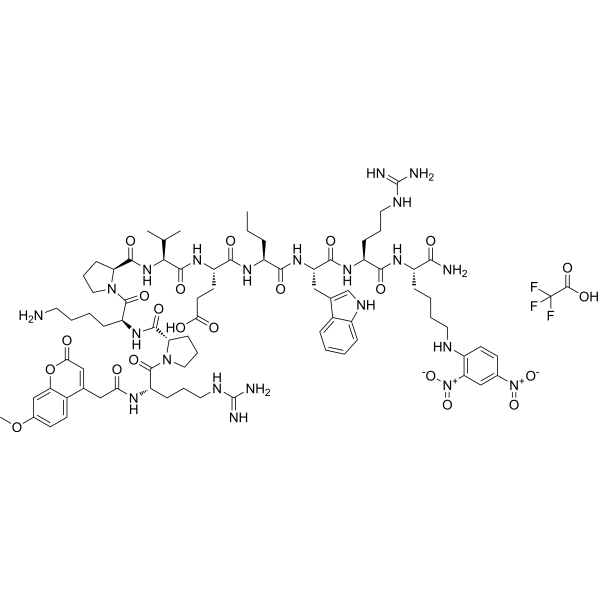
NFF-3 TFA, the peptide, is a selective MMP substrate. NFF-3 TFA selectively binds to MMP-3 and MMP-10 to be hydrolyzed. NFF-3 TFA is also cleaved by trypsin, hepatocyte growth factor activator, and factor Xa. Label NFF-3 TFA with a CyDye pair, Cy3/Cy5Q, can produce fluorescence in cell assays to detect cell activity.
For research use only. We do not sell to patients.
- Purity : 96.32%
- Formula: C80H111F3N22O22
- Molecular Weight:1789.87
-
Storage:
Sealed storage, away from moisture and light, under nitrogen.
Powder -80°C, 2 years , -20°C, 1 year* In solvent : -80°C, 6 months; -20°C, 1 month (sealed storage, away from moisture and light, under nitrogen)

To place orders, for customer services and technical support, please contact: MedChemExpress USA
Tel: 609-228-6898 E-mail: [email protected] [email protected]


-
 Biological Activity
-
Chemical Information
-
Solvent & Solubility
- Protocols
- Purity & Documentation
- References
-
 Help & FAQs




Biological Activity
Description
IC50 & Target
[1]|
MMP-3 |
MMP-10 |


Chemical Information
-
Appearance Solid
-
Molecular Weight 1789.87
-
Formula C80H111F3N22O22
-
Color Light yellow to yellow
-
Sequence
{Mca}-Arg-Pro-Lys-Pro-Val-Glu-{Nva}-Trp-Arg-Lys(DNP)-NH2
-
Sequence Shortening
{Mca}-RPKPVE-{Nva}-WR-{K(DNP)}-NH2
-
Shipping
Room temperature in continental US; may vary elsewhere.
-
Storage
Sealed storage, away from moisture and light, under nitrogen
Powder -80°C 2 years -20°C 1 year * In solvent : -80°C, 6 months; -20°C, 1 month (sealed storage, away from moisture and light, under nitrogen)


Solvent & Solubility
In Vitro:
DMSO : 100 mg/mL (55.87 mM; ultrasonic and warming and heat to 60°C; Hygroscopic DMSO has a significant impact on the solubility of product, please use newly opened DMSO)
H2O : < 0.1 mg/mL (insoluble)
Please refer to the solubility information to select the appropriate solvent. Once prepared, please aliquot and store the solution to prevent product inactivation from repeated freeze-thaw cycles.
Storage method and period of stock solution: -80°C, 6 months; -20°C, 1 month (sealed storage, away from moisture and light, under nitrogen). When stored at -80°C, please use it within 6 months. When stored at -20°C, please use it within 1 month.
Please refer to the solubility information to select the appropriate solvent. Once prepared, please aliquot and store the solution to prevent product inactivation from repeated freeze-thaw cycles.
Storage method and period of stock solution: -80°C, 6 months; -20°C, 1 month (sealed storage, away from moisture and light, under nitrogen). When stored at -80°C, please use it within 6 months. When stored at -20°C, please use it within 1 month.
Concentration (start) × Volume (start) = Concentration (final) × Volume (final)


Purity & Documentation
-
Data Sheet (275 KB)
-
SDS (252 KB)
- English - EN (252 KB)
- Français - FR (252 KB)
- Deutsch - DE (252 KB)
- Norwegian - NO (252 KB)
- Español - ES (252 KB)
- Swedish - SV (252 KB)
- Italian - IT (252 KB)
- Korean - KR (252 KB)
- Portuguese - PT (252 KB)
-
Handling Instructions (2659 KB)
References


Complete Stock Solution Preparation Table
Please refer to the solubility information to select the appropriate solvent. Once prepared, please aliquot and store the solution to prevent product inactivation from repeated freeze-thaw cycles.
Storage method and period of stock solution: -80°C, 6 months; -20°C, 1 month (sealed storage, away from moisture and light, under nitrogen). When stored at -80°C, please use it within 6 months. When stored at -20°C, please use it within 1 month.
| Optional Solvent | Concentration Solvent Mass | 1 mg | 5 mg | 10 mg | 25 mg |
|---|---|---|---|---|---|
| DMSO | 1 mM | 0.5587 mL | 2.7935 mL | 5.5870 mL | 13.9675 mL |
| 5 mM | 0.1117 mL | 0.5587 mL | 1.1174 mL | 2.7935 mL | |
| 10 mM | 0.0559 mL | 0.2793 mL | 0.5587 mL | 1.3967 mL | |
| 15 mM | 0.0372 mL | 0.1862 mL | 0.3725 mL | 0.9312 mL | |
| 20 mM | 0.0279 mL | 0.1397 mL | 0.2793 mL | 0.6984 mL | |
| 25 mM | 0.0223 mL | 0.1117 mL | 0.2235 mL | 0.5587 mL | |
| 30 mM | 0.0186 mL | 0.0931 mL | 0.1862 mL | 0.4656 mL | |
| 40 mM | 0.0140 mL | 0.0698 mL | 0.1397 mL | 0.3492 mL | |
| 50 mM | 0.0112 mL | 0.0559 mL | 0.1117 mL | 0.2793 mL |


NFF-3 TFA Related Classifications
HY-P2185A Related Classifications
 Powered by Bioz