



Moxalactam
Based on 1 publication(s) in Google Scholar
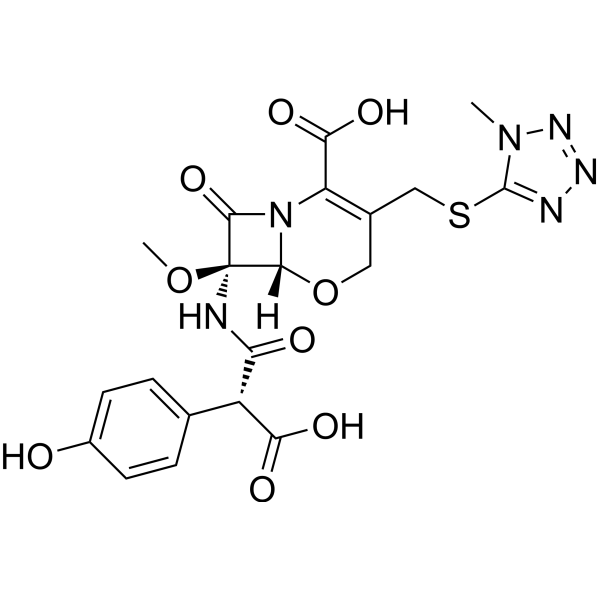
Moxalactam (Latamoxef) is a synthetic oxa-β-lactam antibiotic. Moxalactam has a broad spectrum of activity against Gram-positive and Gram-negative aerobic and anaerobic bacteria. Moxalactam inhibits production of β-lactamases.
For research use only. We do not sell to patients.
- CAS No.: 64952-97-2
- Formula: C20H20N6O9S
- Molecular Weight:520.47
-
Storage:
Please store the product under the recommended conditions in the Certificate of Analysis.

To place orders, for customer services and technical support, please contact: MedChemExpress USA
Tel: 609-228-6898 E-mail: [email protected] [email protected]


-
 Biological Activity
-
Chemical Information
- Protocols
- Purity & Documentation
- References
-
 Help & FAQs


Publications Citing Use of MedChemExpress (MCE) Moxalactam
MoreAll Beta-lactamase Isoforms
MoreAll Antibiotic Isoforms
More

Biological Activity
Description
IC50 & Target
|
β-lactam |
In Vitro
Moxalactam (Latamoxef) inhibits 90% of strains of Escherichia coli, Klebsiella species, Proteus species, Morganella morganii, Neisseria gonorrhoeae, Neisseria meningitidis, Haemophilus influenzae and Salmonella species, including strains which are resistant to Cephalothin (HY-B1275A) and Gentamicin (HY-A0276A) at concentrations of less than 1 μg/mL[1].
Moxalactam exhibits moderate activity against P. aeruginosa and is usually active against other species of Pseudomonas, Acinetobacter species are usually resistant to Moxalactam[1].
Moxalactam has marked stability in vitro against a variety of β-lactamases, including that produced by B. fragilis, inhibits production of β-lactamases and does not induce class I β-lactamase[1].
MedChemExpress (MCE) has not independently confirmed the accuracy of these methods. They are for reference only.
In Vivo
MedChemExpress (MCE) has not independently confirmed the accuracy of these methods. They are for reference only.
-
Animal Model:Four-week-old male strain ICR mice, weighing 18-20 g, bacterial infection model[2]
-
Dosage:0-7.4 mg/mouse
-
Administration:Subcutaneous injection, once
-
Result:Showed protective activity with ED50s less than 7.4 mg/mouse against gram-positive and gram-negative bacterial infected mice.
Clinical Trial
| NCT Number | Sponsor | Condition | Start Date |
Phase

|
|---|---|---|---|---|
| NCT01329991 | Plexxikon| | 2011-05 | PHASE1 |


Chemical Information
-
CAS No. 64952-97-2
-
Molecular Weight 520.47
-
Formula C20H20N6O9S
-
SMILES
O=C(C(N12)=C(CSC3=NN=NN3C)CO[C@]2([H])[C@](OC)(NC(C(C(O)=O)C4=CC=C(O)C=C4)=O)C1=O)O
-
Synonyms
Latamoxef; Lamoxactam; LY-127935
-
Shipping
Room temperature in continental US; may vary elsewhere.
-
Storage
Please store the product under the recommended conditions in the Certificate of Analysis.


Publications (1)
-
Journal Impact Factor
-
Most Recent
-
Biomed Res Int
In Vitro Activity of β-Lactams in Combination with β-Lactamase Inhibitors against Mycobacterium tuberculosis Clinical Isolates. [Abstract]2018 Jul 2:2018:3579832. PMID: 30065936


Purity & Documentation
References

Calculators
Concentration (start) × Volume (start) = Concentration (final) × Volume (final)


Moxalactam Related Classifications
HY-B1484A Related Classifications
 Powered by Bioz