



Norcyclizine

Based on 1 Customer Validation
Norcyclizine is a piperazine compound that can be used for the synthesis of antimicrobial agents. 1-Benzhydrylpiperazine derivatives have been found to enhance the antibacterial activity of β-lactam antibiotics (Oxacillin, HY-B0925A) against Methicillin (HY-121544)-resistant Staphylococcus aureus (MRSA). This enhancement is likely achieved by inhibiting the allosteric site of PBP2a. Additionally, 1-Benzhydrylpiperazine can also serve as a pharmacological scaffold for the synthesis of anticancer agents.
For research use only. We do not sell to patients.
- Purity : 98.0%
- CAS No.: 841-77-0
- Formula: C17H20N2
- Molecular Weight:252.35
-
Storage:
4°C, protect from light
* In solvent : -80°C, 6 months; -20°C, 1 month (protect from light)


To place orders, for customer services and technical support, please contact: MedChemExpress USA
Tel: 609-228-6898 E-mail: [email protected] [email protected]


-
 Biological Activity
-
Chemical Information
-
Solvent & Solubility
- Protocols
- Purity & Documentation
- References
-
 Help & FAQs


-
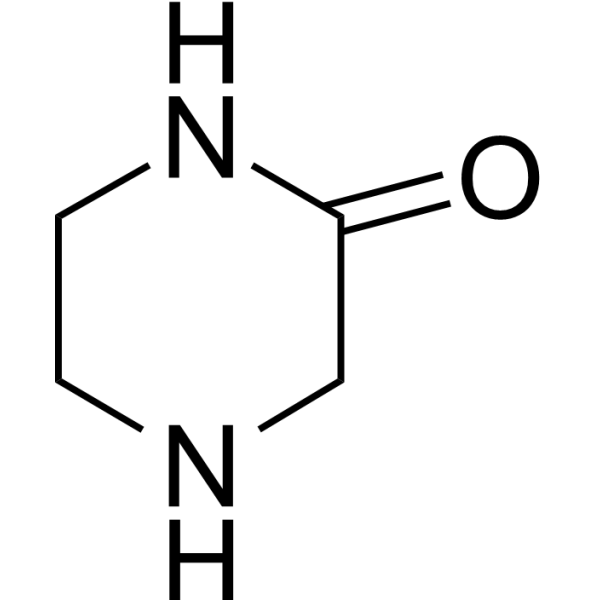
HY-20128
Piperazin-2-oneIntermediate -

HY-109659
1-(3-Aminopropyl)-4-methylpiperazineCapping Agent -
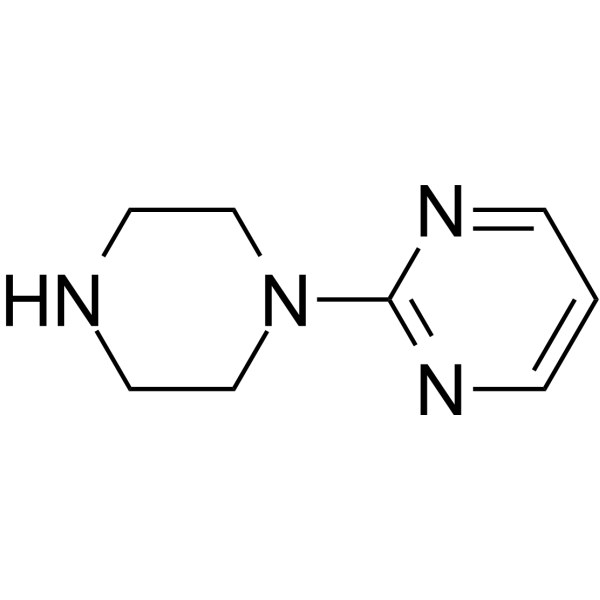
HY-W004464
2-(1-Piperazinyl)pyrimidineα2-adrenoceptor Antagonist/5-HT1A Receptor Agonist -
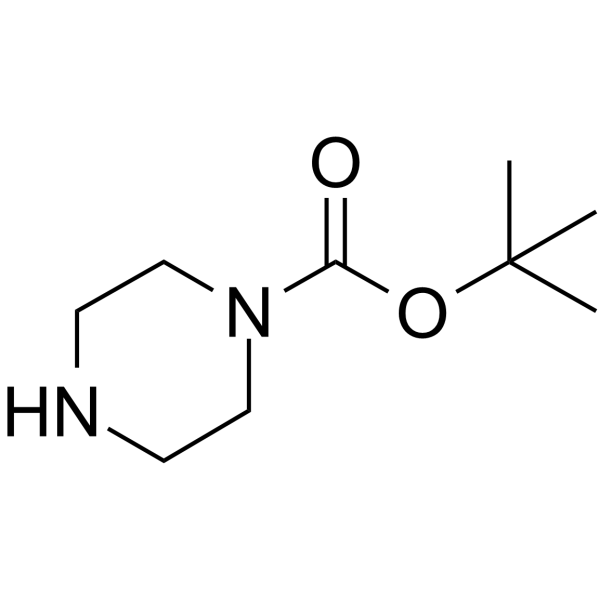
HY-30105
N-Boc-piperazinePROTAC Linkers -
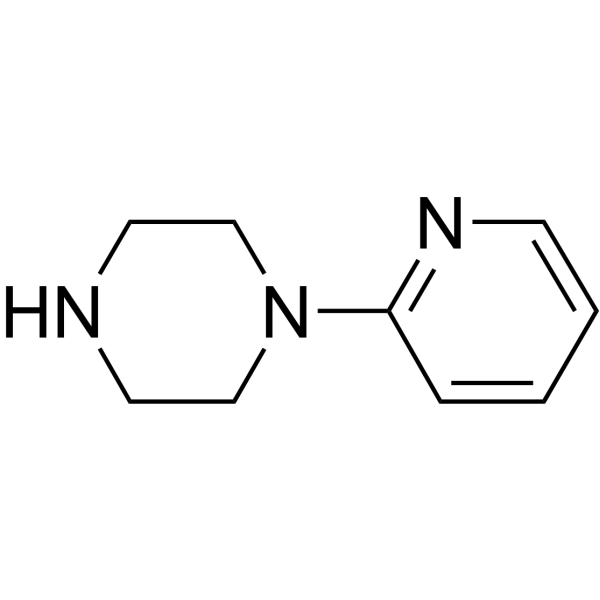
HY-W001990
2-PiperazinopyridineBiochemical Reagent -
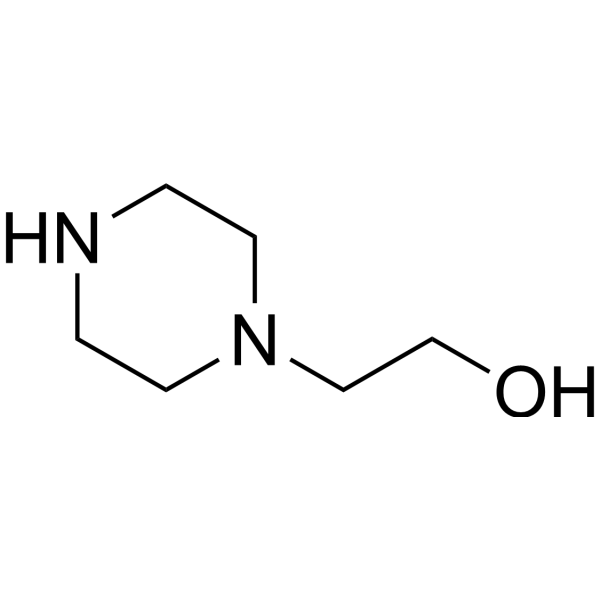
HY-41939
1-(2-Hydroxyethyl)piperazineBiochemical Reagent -

HY-W027208
1,4-Bis(3-aminopropyl)piperazineBiochemical Assay Reagent -
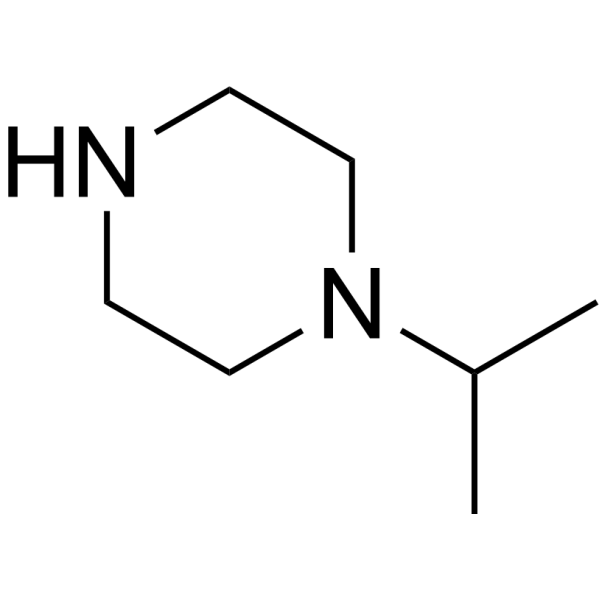
HY-W012744
IsopropylpiperazineBiochemical Reagent -
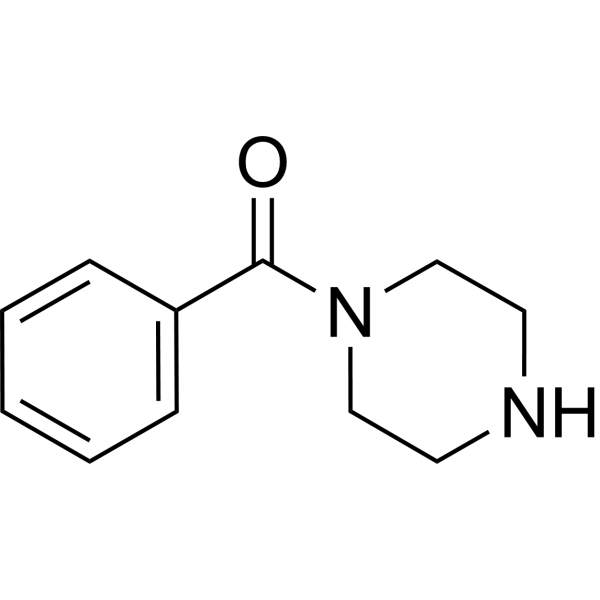
HY-W002698
1-BenzoylpiperazineBiochemical Reagent -

HY-W008813
1-(3-Methoxyphenyl)piperazinePiperazine -

HY-W004464R
2-(1-Piperazinyl)pyrimidine (Standard)Reference Standard -

HY-20797
Boc-Piperazine-OHPROTAC Linker
All Antibiotic Isoforms
More

Biological Activity
Description


Chemical Information
-
CAS No. 841-77-0
-
Appearance Solid
-
Molecular Weight 252.35
-
Formula C17H20N2
-
Color White to off-white
-
SMILES
C1(C(N2CCNCC2)C3=CC=CC=C3)=CC=CC=C1
-
Synonyms
1-(Diphenylmethyl)piperazine; 1-Benzhydrylpiperazine
-
Shipping
Room temperature in continental US; may vary elsewhere.
-
Storage
4°C, protect from light
* In solvent : -80°C, 6 months; -20°C, 1 month (protect from light)


Solvent & Solubility
In Vitro:
DMSO : 100 mg/mL (396.28 mM; Need ultrasonic; Hygroscopic DMSO has a significant impact on the solubility of product, please use newly opened DMSO)
Please refer to the solubility information to select the appropriate solvent. Once prepared, please aliquot and store the solution to prevent product inactivation from repeated freeze-thaw cycles.
Storage method and period of stock solution: -80°C, 6 months; -20°C, 1 month (protect from light). When stored at -80°C, please use it within 6 months. When stored at -20°C, please use it within 1 month.
Please refer to the solubility information to select the appropriate solvent. Once prepared, please aliquot and store the solution to prevent product inactivation from repeated freeze-thaw cycles.
Storage method and period of stock solution: -80°C, 6 months; -20°C, 1 month (protect from light). When stored at -80°C, please use it within 6 months. When stored at -20°C, please use it within 1 month.
Concentration (start) × Volume (start) = Concentration (final) × Volume (final)
In Vivo:
Select the appropriate dissolution method based on your experimental animal and administration route.
- For the following dissolution methods, please ensure to first prepare a clear stock solution using an In Vitro approach and then sequentially add co-solvents:
- To ensure reliable experimental results, the clarified stock solution can be appropriately stored based on storage conditions. As for the working solution for In Vivo experiments, it is recommended to prepare freshly and use it on the same day.
- The percentages shown for the solvents indicate their volumetric ratio in the final prepared solution. If precipitation or phase separation occurs during preparation, heat and/or sonication can be used to aid dissolution.
Add each solvent one by one: 10% DMSO 40% PEG300 5% Tween-80 45% Saline
Solubility: ≥ 5 mg/mL (19.81 mM); Clear solution
This protocol yields a clear solution of ≥ 5 mg/mL (saturation unknown).
Taking 1 mL working solution as an example, add 100 μL DMSO stock solution (50.0 mg/mL) to 400 μL PEG300, and mix evenly; then add 50 μL Tween-80 and mix evenly; then add 450 μL Saline to adjust the volume to 1 mL.
Preparation of Saline: Dissolve 0.9 g sodium chloride in ddH₂O and dilute to 100 mL to obtain a clear Saline solution.
Add each solvent one by one: 10% DMSO 90% (20% SBE-β-CD in Saline)
Solubility: ≥ 5 mg/mL (19.81 mM); Clear solution
This protocol yields a clear solution of ≥ 5 mg/mL (saturation unknown).
Taking 1 mL working solution as an example, add 100 μL DMSO stock solution (50.0 mg/mL) to 900 μL 20% SBE-β-CD in Saline, and mix evenly.
Preparation of 20% SBE-β-CD in Saline (4°C, storage for one week): 2 g SBE-β-CD powder is dissolved in 10 mL Saline, completely dissolve until clear.
In Vivo Dissolution Calculator
Please enter the basic information of animal experiments:
-
-
-
-
Recommended: Prepare an additional quantity of animals to account for potential losses during experiments.
Please enter your animal formula composition:
-
%DMSO +
Recommended: Keep the proportion of DMSO in working solution below 2% if your animal is weak.
-
%+
-
+%Tween-80 + +
-
%Saline +
The co-solvents required include: DMSO, . All of co-solvents are available by MedChemExpress (MCE). , Tween 80. All of co-solvents are available by MedChemExpress (MCE).
Working solution concentration: 0.22 mg/mL
Method for preparing stock solution: mg drug dissolved in μL DMSO. Stock solution concentration: mg/mL. * In solvent : -80°C, 6 months; -20°C, 1 month (protect from light)
1. Take μL DMSO stock solution;
2. Add μL .
μL , mix evenly;
3. Then add μL Tween 80, mix evenly;
4. Then add μL
Please ensure that the stock solution in the first step is dissolved to a clear state, and add co-solvents in sequence. You can use ultrasonic heating (ultrasonic cleaner, recommended frequency 20-40 kHz), vortexing, etc. to assist dissolution.

Protocols
-
Research Protocol for Infectious Diseases
Infectious-disease experiments test how pathogens interact with host barriers, innate immune receptors, inflammatory signaling, pathogen replication, and tissue injury; pattern-recognition receptors such as TLRs, RIG-I-like receptors, NOD-like receptors, and inflammasomes detect microbial molecules and activate NF-κB, interferon, and cytokine responses. The central hypothesis is that infection severity reflects the balance between pathogen burden and host response: protective inflammation restricts pathogen growth, whereas excessive or mislocalized inflammation contributes to tissue damage and disease phenotype. Unresolved questions include which host pathways are protective versus pathogenic, why some infection models fail to translate to human disease, and which combined readouts best predict clinically relevant infection outcomes.
-
Bacterial live/dead nucleic-acid viability staining
The LIVE/DEAD bacterial viability staining method is based on differential permeability of nucleic-acid-binding fluorescent dyes, most commonly SYTO 9 and propidium iodide (PI), which enables discrimination of bacterial populations with intact versus compromised cytoplasmic membranes. SYTO 9 penetrates both intact and damaged bacterial membranes and binds nucleic acids to produce green fluorescence, whereas propidium iodide penetrates only cells with compromised membranes and fluoresces red while also reducing SYTO 9 signal through competitive binding and fluorescence interactions. The resulting fluorescence pattern is interpreted as a proxy for membrane integrity, which is widely used as an indicator of bacterial viability in microscopy, flow cytometry, and spectroscopic platforms. However, mechanistic studies show that SYTO 9 and PI interactions involve displacement and fluorescence resonance energy transfer effects, which can influence signal interpretation depending on dye ratios a


Purity & Documentation
-
Data Sheet (275 KB)
-
SDS (950 KB)
- English - EN (950 KB)
- Français - FR (950 KB)
- Deutsch - DE (950 KB)
- Norwegian - NO (950 KB)
- Español - ES (950 KB)
- Swedish - SV (950 KB)
- Italian - IT (950 KB)
- Korean - KR (950 KB)
- Portuguese - PT (950 KB)
-
Handling Instructions (2659 KB)
References
[1]. Witek K, et al. Chalcogen-Varied Imidazolone Derivatives as Antibiotic Resistance Breakers in Staphylococcus aureus Strains. Antibiotics (Basel). 2023 Nov 11;12(11):1618. [Content Brief]
[2]. Ananda Kumar CS et al. Synthesis and in vitro antiproliferative activity of novel 1-benzhydrylpiperazine derivatives against human cancer cell lines. Eur J Med Chem. 2009 Mar;44(3):1223-9. [Content Brief]


Complete Stock Solution Preparation Table
Please refer to the solubility information to select the appropriate solvent. Once prepared, please aliquot and store the solution to prevent product inactivation from repeated freeze-thaw cycles.
Storage method and period of stock solution: -80°C, 6 months; -20°C, 1 month (protect from light). When stored at -80°C, please use it within 6 months. When stored at -20°C, please use it within 1 month.
| Optional Solvent | Concentration Solvent Mass | 1 mg | 5 mg | 10 mg | 25 mg |
|---|---|---|---|---|---|
| DMSO | 1 mM | 3.9628 mL | 19.8138 mL | 39.6275 mL | 99.0688 mL |
| 5 mM | 0.7926 mL | 3.9628 mL | 7.9255 mL | 19.8138 mL | |
| 10 mM | 0.3963 mL | 1.9814 mL | 3.9628 mL | 9.9069 mL | |
| 15 mM | 0.2642 mL | 1.3209 mL | 2.6418 mL | 6.6046 mL | |
| 20 mM | 0.1981 mL | 0.9907 mL | 1.9814 mL | 4.9534 mL | |
| 25 mM | 0.1585 mL | 0.7926 mL | 1.5851 mL | 3.9628 mL | |
| 30 mM | 0.1321 mL | 0.6605 mL | 1.3209 mL | 3.3023 mL | |
| 40 mM | 0.0991 mL | 0.4953 mL | 0.9907 mL | 2.4767 mL | |
| 50 mM | 0.0793 mL | 0.3963 mL | 0.7926 mL | 1.9814 mL | |
| 60 mM | 0.0660 mL | 0.3302 mL | 0.6605 mL | 1.6511 mL | |
| 80 mM | 0.0495 mL | 0.2477 mL | 0.4953 mL | 1.2384 mL | |
| 100 mM | 0.0396 mL | 0.1981 mL | 0.3963 mL | 0.9907 mL |


Norcyclizine Related Classifications
HY-W013376 Related Classifications
 Powered by Bioz