



PARP11 inhibitor ITK7

Based on 1 Customer Validation
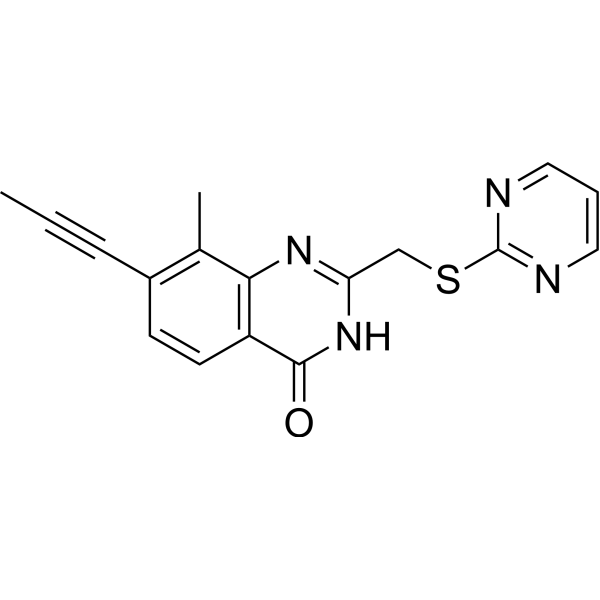
PARP11 inhibitor ITK7 (ITK7) is a potent and selective PARP11 inhibitor. PARP11 inhibitor ITK7 can potently inhibit PARP11 with an IC50 value of 14 nM. PARP11 inhibitor ITK7 can be used for the research of cellular localization.
For research use only. We do not sell to patients.
- Purity : 99.70%
- CAS No.: 2411890-36-1
- Formula: C17H14N4OS
- Molecular Weight:322.38
-
Storage:
4°C, sealed storage, away from moisture and light
* In solvent : -80°C, 6 months; -20°C, 1 month (sealed storage, away from moisture and light)

To place orders, for customer services and technical support, please contact: MedChemExpress USA
Tel: 609-228-6898 E-mail: [email protected] [email protected]


-
 Biological Activity
-
Chemical Information
-
Solvent & Solubility
- Protocols
- Purity & Documentation
- References
-
 Help & FAQs




Biological Activity
Description
IC50 & Target
IC50: 14 nM (PARP11); 13 nM (PARP11-dependent auto-MARylation)[1]
In Vitro
PARP11 inhibitor ITK7 (ITK7) can potently inhibit PARP11 with an IC50 value of 14 nM[1].
ITK7 exhibits a dose-dependent inhibition of PARP11-dependent auto-MARylation with an EC50 value of 13 nM[1].
ITK7 (0, 0.03, 0.1, 0.3, 1, 3 μM; 3 h) inhibits PARP11 auto-MARylation activity in cells and causes PARP11 to dissociate from the nuclear
envelope[1].
MedChemExpress (MCE) has not independently confirmed the accuracy of these methods. They are for reference only. Further protocols information, click here.
-
Cell Line:HeLa cells
-
Concentration:0, 0.03, 0.1, 0.3, 1, 3 μM
-
Incubation Time:3 h
-
Result:Inhibited GFP-PARP11 auto-MARylation activity in a dose-dependent manner in HeLa cells.


Chemical Information
-
CAS No. 2411890-36-1
-
Appearance Solid
-
Molecular Weight 322.38
-
Formula C17H14N4OS
-
Color White to off-white
-
SMILES
O=C1NC(CSC2=NC=CC=N2)=NC3=C1C=CC(C#CC)=C3C
-
Synonyms
ITK7
-
Shipping
Room temperature in continental US; may vary elsewhere.
-
Storage
4°C, sealed storage, away from moisture and light
* In solvent : -80°C, 6 months; -20°C, 1 month (sealed storage, away from moisture and light)


Solvent & Solubility
In Vitro:
DMSO : 4 mg/mL (12.41 mM; ultrasonic and warming and heat to 60°C; Hygroscopic DMSO has a significant impact on the solubility of product, please use newly opened DMSO)
Please refer to the solubility information to select the appropriate solvent. Once prepared, please aliquot and store the solution to prevent product inactivation from repeated freeze-thaw cycles.
Storage method and period of stock solution: -80°C, 6 months; -20°C, 1 month (sealed storage, away from moisture and light). When stored at -80°C, please use it within 6 months. When stored at -20°C, please use it within 1 month.
Please refer to the solubility information to select the appropriate solvent. Once prepared, please aliquot and store the solution to prevent product inactivation from repeated freeze-thaw cycles.
Storage method and period of stock solution: -80°C, 6 months; -20°C, 1 month (sealed storage, away from moisture and light). When stored at -80°C, please use it within 6 months. When stored at -20°C, please use it within 1 month.
Concentration (start) × Volume (start) = Concentration (final) × Volume (final)
In Vivo:
For the following dissolution methods, please prepare the working solution directly:
It is recommended to prepare fresh solutions and use them promptly within a short period of time.
The percentages shown for the solvents indicate their volumetric ratio in the final prepared solution. If precipitation or phase separation occurs during preparation, heat and/or sonication can be used to aid dissolution.
Add each solvent one by one: 0.5% CMC-Na/saline water
Solubility: 5 mg/mL (15.51 mM); Suspended solution; Need ultrasonic
Add each solvent one by one: 15% Cremophor EL 85% Saline
Solubility: 10 mg/mL (31.02 mM); Suspended solution; Need ultrasonic

Protocols
-
Cell Cytotoxicity Assay
Cytotoxicity assays are usually based on the assessment of cell membrane damage, which can also be indirectly detected by measuring cell viability. Detection methods include MTT assay, CKK-8 assay, LDH assay and ATP assay, etc.
-
Antibody-based immunofluorescence/immunocytochemistry staining
Antibody-based immunofluorescence/immunocytochemistry detects the cellular or subcellular localization of a target antigen by binding a primary antibody to the target and detecting that antibody directly with a fluorophore-conjugated primary antibody or indirectly with a fluorophore-conjugated secondary antibody. Indirect immunofluorescence can amplify signal because multiple secondary antibodies can bind one primary antibody. The assay readout is fluorescence intensity and localization measured by fluorescence or confocal microscopy, and the result reflects antigen distribution only when the antibody has been validated for the target, sample type, fixation condition, and imaging workflow. Antibody specificity must not be assumed from catalog information alone, and appropriate validation or control experiments are required for serious interpretation.
- Immunocytochemistry/Immunofluorescence


Purity & Documentation
-
Data Sheet (271 KB)
-
SDS (252 KB)
- English - EN (252 KB)
- Français - FR (252 KB)
- Deutsch - DE (252 KB)
- Norwegian - NO (252 KB)
- Español - ES (252 KB)
- Swedish - SV (252 KB)
- Italian - IT (252 KB)
- Korean - KR (252 KB)
- Portuguese - PT (252 KB)
-
Handling Instructions (2659 KB)
References


Complete Stock Solution Preparation Table
Please refer to the solubility information to select the appropriate solvent. Once prepared, please aliquot and store the solution to prevent product inactivation from repeated freeze-thaw cycles.
Storage method and period of stock solution: -80°C, 6 months; -20°C, 1 month (sealed storage, away from moisture and light). When stored at -80°C, please use it within 6 months. When stored at -20°C, please use it within 1 month.
| Optional Solvent | Concentration Solvent Mass | 1 mg | 5 mg | 10 mg | 25 mg |
|---|---|---|---|---|---|
| DMSO | 1 mM | 3.1019 mL | 15.5096 mL | 31.0193 mL | 77.5482 mL |
| 5 mM | 0.6204 mL | 3.1019 mL | 6.2039 mL | 15.5096 mL | |
| 10 mM | 0.3102 mL | 1.5510 mL | 3.1019 mL | 7.7548 mL |


PARP11 inhibitor ITK7 Related Classifications
HY-125218 Related Classifications
 Powered by Bioz