



PROTAC HSP90 degrader BP3
Based on 1 publication(s) in Google Scholar
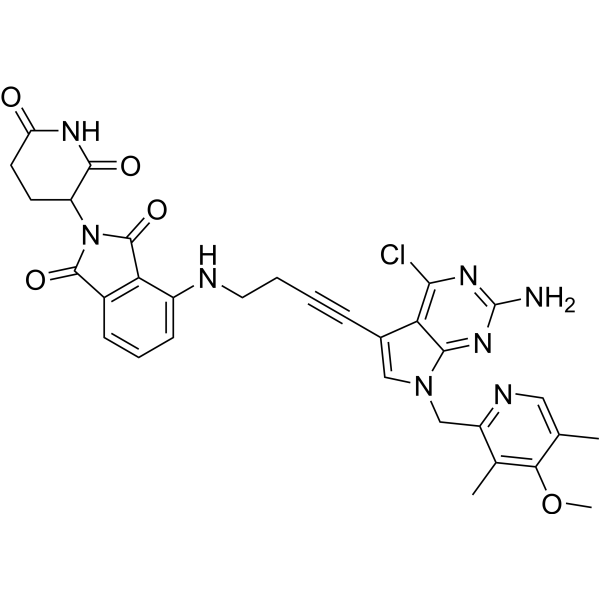
PROTAC HSP90 degrader BP3 is a potent and selective degradation of HSP90 in a CRBN-dependent fashion. PROTAC HSP90 degrader BP3 has a certain degradation effect on HSP90 protein in MCF-7 cells (DC50=0.99 μM). PROTAC HSP90 degrader BP3 inhibits the growth of breast cancer cell. PROTAC HSP90 degrader BP3 is a click chemistry reagent, it contains an Alkyne group and can undergo copper-catalyzed azide-alkyne cycloaddition (CuAAc) with molecules containing Azide groups.
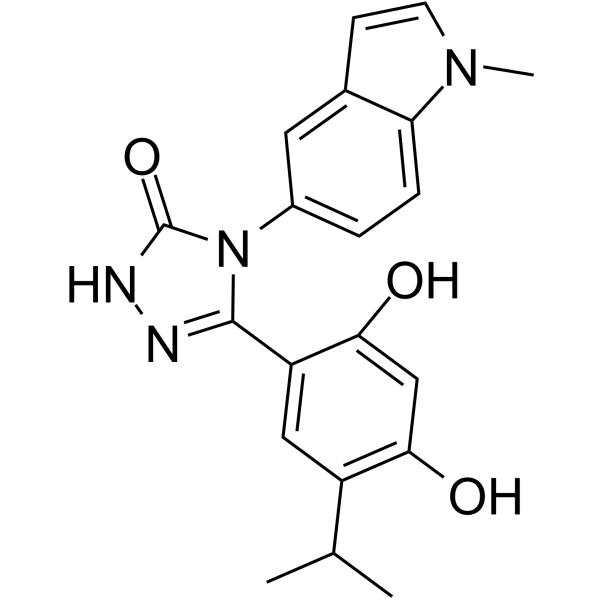
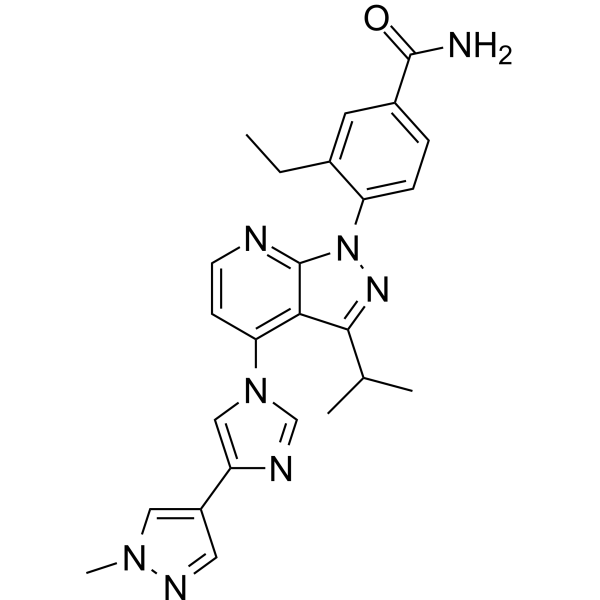
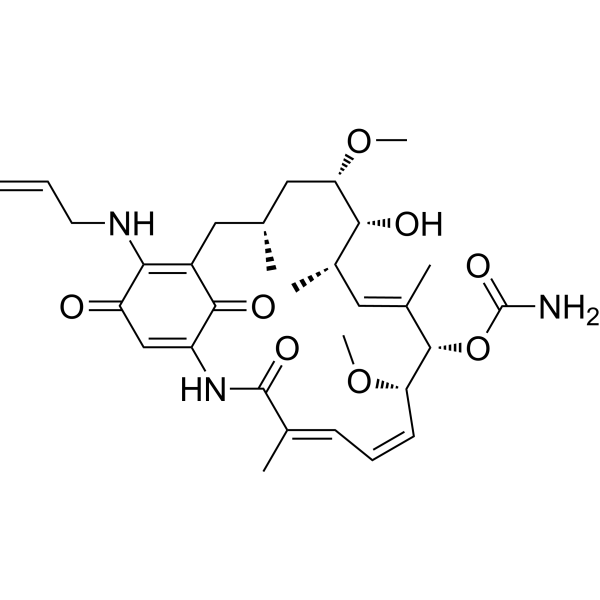
(Pink: HSP90 ligand (HY-W437598); Blue: Cereblon ligand (HY-10984); Black: linker).
For research use only. We do not sell to patients.
- Purity : 99.54%
- CAS No.: 2669072-88-0
- Formula: C32H29ClN8O5
- Molecular Weight:641.08
-
Storage:Powder -20°C, 3 years , 4°C, 2 years ; In solvent -80°C, 6 months , -20°C, 1 month

To place orders, for customer services and technical support, please contact: MedChemExpress USA
Tel: 609-228-6898 E-mail: [email protected] [email protected]


-
 Biological Activity
-
Chemical Information
-
Solvent & Solubility
- Protocols
- Purity & Documentation
- References
-
 Help & FAQs


Publications Citing Use of MedChemExpress (MCE) PROTAC HSP90 degrader BP3
MoreAll PROTACs Isoforms
More

Biological Activity
Description
IC50 & Target
|
HSP90 |
Cereblon |
Cellular Effect
|
Cell Line

|
Type | Value | Description | References |
|---|---|---|---|---|
| 4T1 | IC50 |
0.61 μM
Compound: 16b; BP3
|
Anticancer activity against mouse 4T1 cells assessed as inhibition of cell proliferation measured after 72 hrs by MTT assay
Anticancer activity against mouse 4T1 cells assessed as inhibition of cell proliferation measured after 72 hrs by MTT assay
|
[PMID: 34864330] |
| MCF7 | IC50 |
0.63 μM
Compound: 16b; BP3
|
Antiproliferative activity against human MCF-7 cells assessed as inhibition of cell proliferation incubated for 72 hrs by MTT assay
Antiproliferative activity against human MCF-7 cells assessed as inhibition of cell proliferation incubated for 72 hrs by MTT assay
|
[PMID: 34864330] |
| MDA-MB-231 | IC50 |
3.53 μM
Compound: 16b; BP3
|
Antiproliferative activity against human MDA-MB-231 cells assessed as inhibition of cell proliferation incubated for 72 hrs by MTT assay
Antiproliferative activity against human MDA-MB-231 cells assessed as inhibition of cell proliferation incubated for 72 hrs by MTT assay
|
[PMID: 34864330] |
| MDA-MB-468 | IC50 |
2.95 μM
Compound: 16b; BP3
|
Anticancer activity against human MDA-MB-468 cells assessed as inhibition of cell proliferation measured after 72 hrs by MTT assay
Anticancer activity against human MDA-MB-468 cells assessed as inhibition of cell proliferation measured after 72 hrs by MTT assay
|
[PMID: 34864330] |
In Vitro
PROTAC HSP90 degrader BP3 (compound 16b) (72 h) inhibits the growth of breast cancer cells (IC50=0.63 μM in MCF-7 cells, IC50=3.53 μM in MDA-MB-231 cells, IC50=0.61 μM in 4T1 cells, IC50=2.95 μM in MDA-MB-468 cells)[1].
PROTAC HSP90 degrader BP3 (2 μM; 6 h) shows degradation activity in the MCF-7 cells (DC50=0.99 μM)[1].
MedChemExpress (MCE) has not independently confirmed the accuracy of these methods. They are for reference only. Further protocols information, click here.
-
Cell Line:MCF-7 cells
-
Concentration:2 µM
-
Incubation Time:6 h
-
Result:Showed degradation activity in the MCF-7 cells (DC50=0.99 µM).
-
Cell Line:4T1, MDA-MB-468 cells
-
Concentration:0.01, 1, 100, 10000 µM
-
Incubation Time:72 h
-
Result:Inhibited the growth of cancer cells (IC50=0.61 µM in 4T1 cells, IC50=2.95 µM in MDA-MB-468 cells).
In Vivo
MedChemExpress (MCE) has not independently confirmed the accuracy of these methods. They are for reference only.
-
Animal Model:6- to 8-week-old female BALB/c mice[1]
-
Dosage:40 mg/kg
-
Administration:i.p., daily, 12 days
-
Result:Inhibited tumor growth and the tumor inhibition rate was 76.41%.
Clinical Trial
| NCT Number | Sponsor | Condition | Start Date |
Phase
|
|---|---|---|---|---|
| NCT01329991 | Plexxikon| | 2011-05 | PHASE1 |


Chemical Information
-
CAS No. 2669072-88-0
-
Appearance Solid
-
Molecular Weight 641.08
-
Formula C32H29ClN8O5
-
Color Light yellow to yellow
-
SMILES
O=C1N(C(CC2)C(NC2=O)=O)C(C3=C1C=CC=C3NCCC#CC4=CN(CC5=NC=C(C)C(OC)=C5C)C6=NC(N)=NC(Cl)=C64)=O
-
Shipping
Room temperature in continental US; may vary elsewhere.
-
Storage
Powder -20°C 3 years 4°C 2 years In solvent -80°C 6 months -20°C 1 month


Publications (1)
-
Journal Impact Factor
-
Most Recent
-
bioRxiv
2026 Jun 9:2026.06.01.729344. PMID: 42282570


Solvent & Solubility
In Vitro:
DMSO : 100 mg/mL (155.99 mM; Need ultrasonic; Hygroscopic DMSO has a significant impact on the solubility of product, please use newly opened DMSO)
Please refer to the solubility information to select the appropriate solvent. Once prepared, please aliquot and store the solution to prevent product inactivation from repeated freeze-thaw cycles.
Storage method and period of stock solution: -80°C, 6 months; -20°C, 1 month. When stored at -80°C, please use it within 6 months. When stored at -20°C, please use it within 1 month.
Please refer to the solubility information to select the appropriate solvent. Once prepared, please aliquot and store the solution to prevent product inactivation from repeated freeze-thaw cycles.
Storage method and period of stock solution: -80°C, 6 months; -20°C, 1 month. When stored at -80°C, please use it within 6 months. When stored at -20°C, please use it within 1 month.
Concentration (start) × Volume (start) = Concentration (final) × Volume (final)

Protocols
-
EdU Incorporation Assay (Click Chemistry-Based DNA Synthesis Measurement)
The EdU incorporation assay measures DNA synthesis by adding the thymidine analog 5-ethynyl-2′-deoxyuridine to cells or tissues, where it is incorporated into newly synthesized DNA during S phase. Incorporated EdU is detected by copper-catalyzed azide-alkyne cycloaddition, in which a fluorescent azide covalently reacts with the ethynyl group on EdU, allowing S-phase cells to be detected by fluorescence microscopy, flow cytometry, or high-content imaging. EdU detection does not require DNA denaturation or anti-BrdU antibody access, which preserves sample structure and improves compatibility with immunostaining and multiparameter cytometry compared with BrdU-based detection. EdU can be cytotoxic in a cell-type- and exposure-dependent manner, so pulse duration, concentration, and continuous-labeling designs should be validated for each cell type.
-
Breast Cancer Modeling
Breast cancer is a heterogeneous cancer, and it has been distinguished into four subtypes: luminal A, luminal B, HER2-positive and basal-like. Molecular mutations, epigenetic alterations, hormone exposure and immune microenvironment are related to the progression of breast cancer.


Purity & Documentation
-
Data Sheet (287 KB)
-
SDS (254 KB)
- English - EN (254 KB)
- Français - FR (254 KB)
- Deutsch - DE (254 KB)
- Norwegian - NO (254 KB)
- Español - ES (254 KB)
- Swedish - SV (254 KB)
- Italian - IT (254 KB)
- Korean - KR (254 KB)
- Portuguese - PT (254 KB)
-
Handling Instructions (2659 KB)
References


Complete Stock Solution Preparation Table
Please refer to the solubility information to select the appropriate solvent. Once prepared, please aliquot and store the solution to prevent product inactivation from repeated freeze-thaw cycles.
Storage method and period of stock solution: -80°C, 6 months; -20°C, 1 month. When stored at -80°C, please use it within 6 months. When stored at -20°C, please use it within 1 month.
| Optional Solvent | Concentration Solvent Mass | 1 mg | 5 mg | 10 mg | 25 mg |
|---|---|---|---|---|---|
| DMSO | 1 mM | 1.5599 mL | 7.7993 mL | 15.5987 mL | 38.9967 mL |
| 5 mM | 0.3120 mL | 1.5599 mL | 3.1197 mL | 7.7993 mL | |
| 10 mM | 0.1560 mL | 0.7799 mL | 1.5599 mL | 3.8997 mL | |
| 15 mM | 0.1040 mL | 0.5200 mL | 1.0399 mL | 2.5998 mL | |
| 20 mM | 0.0780 mL | 0.3900 mL | 0.7799 mL | 1.9498 mL | |
| 25 mM | 0.0624 mL | 0.3120 mL | 0.6239 mL | 1.5599 mL | |
| 30 mM | 0.0520 mL | 0.2600 mL | 0.5200 mL | 1.2999 mL | |
| 40 mM | 0.0390 mL | 0.1950 mL | 0.3900 mL | 0.9749 mL | |
| 50 mM | 0.0312 mL | 0.1560 mL | 0.3120 mL | 0.7799 mL | |
| 60 mM | 0.0260 mL | 0.1300 mL | 0.2600 mL | 0.6499 mL | |
| 80 mM | 0.0195 mL | 0.0975 mL | 0.1950 mL | 0.4875 mL | |
| 100 mM | 0.0156 mL | 0.0780 mL | 0.1560 mL | 0.3900 mL |


PROTAC HSP90 degrader BP3 Related Classifications
HY-115997 Related Classifications
 Powered by Bioz