



PROTAC TYK2 degrader-1

Based on 1 Customer Validation
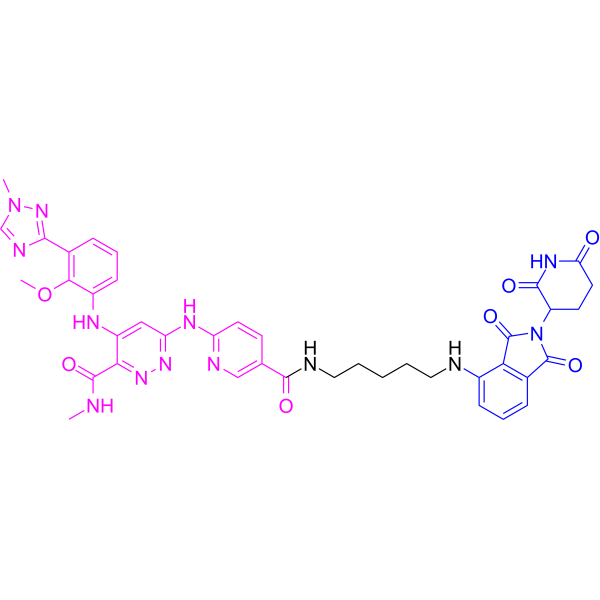
PROTAC TYK2 degrader-1 is a TYK2 PROTAC degrader with a Dmax ≥ 60%. PROTAC TYK2 degrader-1 reduces the phosphorylation levels of IFNα-induced STAT1 (Tyr701) and STAT3 (Tyr705) in immune cells. PROTAC TYK2 degrader-1 can be used in research on cancer, inflammatory diseases, etc.
(Pink: Tyk2 ligand (HY-158340); Blue: Cereblon ligand (HY-14658); Black: linker).
商品は「研究用試薬」です。人や動物の医療用・臨床診断用・食品用の製品ではありません。
研究用途以外に使用した場合、当社は一切の責任を負いかねます。
- 純度 : 99.46%
- CAS 番号: 2770470-20-5
- 分子式: C40H41N13O7
- 分子量:815.84
-
保管条件:
-20°C, protect from light, stored under nitrogen
* In solvent : -80°C, 6 months; -20°C, 1 month (protect from light, stored under nitrogen)

To place orders, for customer services and technical support, please contact: MedChemExpress USA
Tel: 609-228-6898 E-mail: [email protected] [email protected]


-
 生物活性
生物活性
-
化学情報
-
溶剤 & 溶解度
- プロトコル
- 純度とドキュメンテーション
- 参考文献
-
 Help & FAQs


PROTACs アイソフォーム固有の製品をすべて表示
More

生物活性
製品説明
IC50 & Target
[1]|
Tyk2 |
STAT3 |
STAT1 |
Cereblon |
体外実験
PROTAC TYK2 degrader-1 (0.1-1000 nM; 16 h) potently induces ≥60% TYK2 protein degradation in NOMO-1 cells following 16-hour treatment at concentrations of 10 nM and 100 nM[1].
PROTAC TYK2 degrader-1 (3-30 nM; 16 h) reduces TYK2 protein levels and potently inhibits IFNα-induced phosphorylation of STAT1 and STAT3 in Jurkat cells[1].
MedChemExpress (MCE) has not independently confirmed the accuracy of these methods. They are for reference only. Further protocols information, click here.
-
Cell Line:NOMO-1
-
Concentration:0.1 nM, 1 nM, 10 nM, 100 nM, 1000 nM
-
Incubation Time:16 h
-
Result:Concentration-dependently reduced TYK2 protein levels, with ≥ 60% degradation observed at both 10 nM and 100 nM.
Showed a hook effect at higher concentrations.
-
Cell Line:Jurkat
-
Concentration:3 nM, 30 nM
-
Incubation Time:16 h
-
Result:Concentration-dependently reduced TYK2 protein levels, which correlated with a reduction in IFNα-induced phosphorylation of STAT1 (Tyr701) and STAT3 (Tyr705).


化学情報
-
CAS 番号 2770470-20-5
-
性状 Solid
-
分子量 815.84
-
分子式 C40H41N13O7
-
Color Light yellow to yellow
-
SMILES
CNC(C1=NN=C(C=C1NC2=CC=CC(C3=NN(C=N3)C)=C2OC)NC4=NC=C(C=C4)C(NCCCCCNC5=CC=CC6=C5C(N(C6=O)C7CCC(NC7=O)=O)=O)=O)=O
-
輸送条件
Room temperature in continental US; may vary elsewhere.
-
保管条件
-20°C, protect from light, stored under nitrogen
* In solvent : -80°C, 6 months; -20°C, 1 month (protect from light, stored under nitrogen)


溶剤 & 溶解度
体外:
DMSO : 100 mg/mL (122.57 mM; Need ultrasonic; Hygroscopic DMSO has a significant impact on the solubility of product, please use newly opened DMSO)
Please refer to the solubility information to select the appropriate solvent. Once prepared, please aliquot and store the solution to prevent product inactivation from repeated freeze-thaw cycles.
Storage method and period of stock solution: -80°C, 6 months; -20°C, 1 month (protect from light, stored under nitrogen). When stored at -80°C, please use it within 6 months. When stored at -20°C, please use it within 1 month.
Please refer to the solubility information to select the appropriate solvent. Once prepared, please aliquot and store the solution to prevent product inactivation from repeated freeze-thaw cycles.
Storage method and period of stock solution: -80°C, 6 months; -20°C, 1 month (protect from light, stored under nitrogen). When stored at -80°C, please use it within 6 months. When stored at -20°C, please use it within 1 month.
濃度 (開始) × 体積 (開始) = 濃度 (終了) × 体積 (終了)

プロトコル
-
Kinase activity and phosphorylation assays
Kinase activity assays measure the ability of kinases to transfer phosphate groups from ATP to specific substrates, while phosphorylation assays detect the presence and levels of phosphorylated proteins. Common methods include radiolabeled ATP incorporation (e. g. ,), ADP release detection via bioluminescence (e. g. ,[3]), enzyme-linked immunosorbent assays (ELISA) for phospho-specific epitopes (e. g. ,[6]), and microtiter-based formats for high-throughput screening (e. g. ,[8]). The ADP-Glo assay quantifies kinase activity by measuring ADP produced during phosphorylation using a luciferase-based system. Radiometric assays involve autoradiography or scintillation counting after incorporation of 32P-labeled ATP into substrate proteins. ELISA-based approaches rely on phospho-specific antibodies to detect activated kinases in cell lysates or purified samples.
-
Western Blot
Western blotting (WB) is a commonly used experimental method in molecular biology, biochemistry, and immunogenetics for identifying and quantifying target proteins. It combines gel electrophoresis with immunoassay, enabling researchers to analyze protein expression, post-translational modifications, and molecular weight.
-
Protocol for Kinase activity and phosphorylation assays
Kinase activity assays measure transfer of phosphate from ATP to a protein or peptide substrate, generating phosphorylated substrate, ADP, or incorporated radiolabeled phosphate as the readout; phosphorylation assays measure site-specific phosphorylation in cells or tissues as a proxy for kinase-pathway activation, inhibition, or substrate regulation. Phosphorylation can be detected by phospho-specific Western blot, immunoprecipitation kinase assay, phospho-immunofluorescence, phospho-flow cytometry, luminescent ADP detection, radiolabeled ATP incorporation, or reporter-based pathway assays, and these readouts can be applied to cancer cells, primary neurons, mouse tumors, organoids, inflammatory macrophages, ferroptosis studies, and mitophagy studies when the kinase target is biologically relevant.


純度とドキュメンテーション
-
データシート (272 KB)
-
SDS (252 KB)
- English - EN (252 KB)
- Français - FR (252 KB)
- Deutsch - DE (252 KB)
- Norwegian - NO (252 KB)
- Español - ES (252 KB)
- Swedish - SV (252 KB)
- Italian - IT (252 KB)
- Korean - KR (252 KB)
- Portuguese - PT (252 KB)
-
取扱説明書 (2659 KB)
参考文献


Complete Stock Solution Preparation Table
Please refer to the solubility information to select the appropriate solvent. Once prepared, please aliquot and store the solution to prevent product inactivation from repeated freeze-thaw cycles.
Storage method and period of stock solution: -80°C, 6 months; -20°C, 1 month (protect from light, stored under nitrogen). When stored at -80°C, please use it within 6 months. When stored at -20°C, please use it within 1 month.
| Optional Solvent | Concentration Solvent Mass | 1 mg | 5 mg | 10 mg | 25 mg |
|---|---|---|---|---|---|
| DMSO | 1 mM | 1.2257 mL | 6.1287 mL | 12.2573 mL | 30.6433 mL |
| 5 mM | 0.2451 mL | 1.2257 mL | 2.4515 mL | 6.1287 mL | |
| 10 mM | 0.1226 mL | 0.6129 mL | 1.2257 mL | 3.0643 mL | |
| 15 mM | 0.0817 mL | 0.4086 mL | 0.8172 mL | 2.0429 mL | |
| 20 mM | 0.0613 mL | 0.3064 mL | 0.6129 mL | 1.5322 mL | |
| 25 mM | 0.0490 mL | 0.2451 mL | 0.4903 mL | 1.2257 mL | |
| 30 mM | 0.0409 mL | 0.2043 mL | 0.4086 mL | 1.0214 mL | |
| 40 mM | 0.0306 mL | 0.1532 mL | 0.3064 mL | 0.7661 mL | |
| 50 mM | 0.0245 mL | 0.1226 mL | 0.2451 mL | 0.6129 mL | |
| 60 mM | 0.0204 mL | 0.1021 mL | 0.2043 mL | 0.5107 mL | |
| 80 mM | 0.0153 mL | 0.0766 mL | 0.1532 mL | 0.3830 mL | |
| 100 mM | 0.0123 mL | 0.0613 mL | 0.1226 mL | 0.3064 mL |


PROTAC TYK2 degrader-1 関連分類
HY-158142 関連分類
 Powered by Bioz