1. Search Result
Search Result
Results for "

chloroquine-resistant Plasmodium falciparum

" in MedChemExpress (MCE) Product Catalog:

16

Inhibitors & Agonists

8

Natural
Products

1

Isotope-Labeled Compounds

Cat. No. Product Name Target Research Areas Chemical Structure
  • HY-B0770
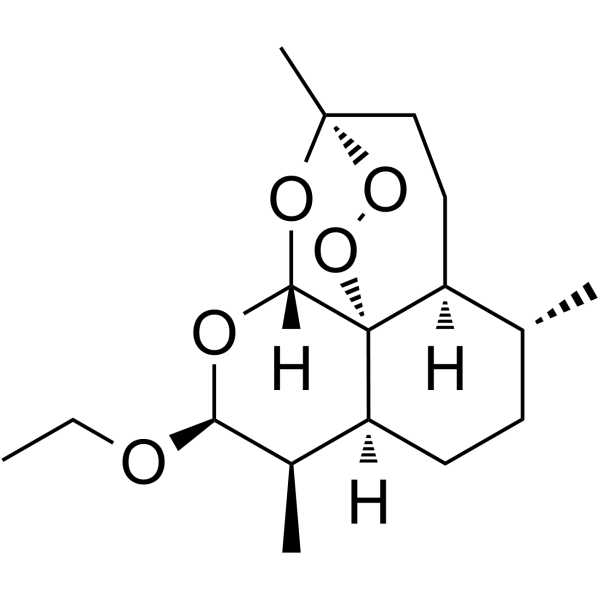
    Artemotil
    1 Publications Verification

    β-Arteether; (+)-Arteether; Arteether

    CXCR Parasite Infection Cancer
    Artemotil (β-Arteether) has antimalarial activity for the treatment of chloroquine-resistant Plasmodium falciparum malaria with an IC50 of 1.61 nM. Artemotil also has central nervous system (CNS) neurotoxicity and anorectic toxicity in rats, dogs and monkeys .
    Artemotil
  • HY-N7648

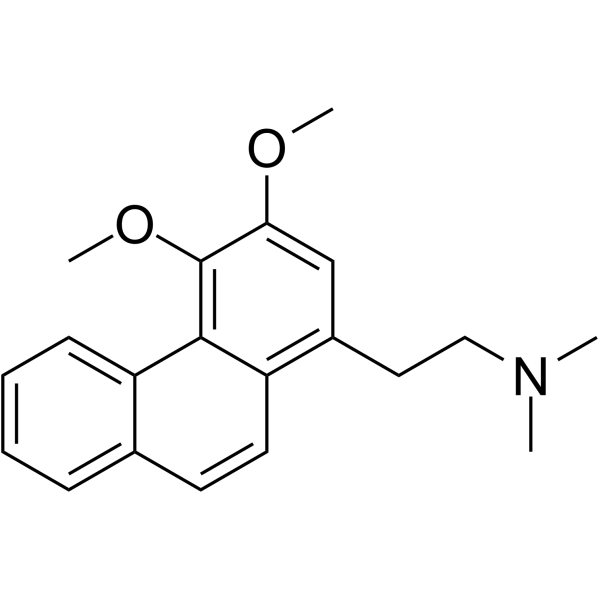
    Atherospermine

    Parasite Phosphodiesterase (PDE) Infection
    Atherosperminine (Atherospermine) is a phosphodiesterase inhibitor. Atherosperminine inhibits growth of chloroquine-resistant Plasmodium falciparum. Atherosperminine scavenges DPPH free radicals, exhibits ferric reducing power, and chelates metal ions. Atherosperminine can be used for the research of malaria .
    Atherosperminine
  • HY-157892

    Parasite Infection
    Antimalarial agent 38 is an orally active antimalarial agent, which inhibits Plasmodium falciparum D6 strain, Chloroquine (HY-17589A)-sensitive Thai strain and Chloroquine-resistant FcB1 strain and K1 strain, with IC50s of 0.5, 13, 1 and 13 μM, respectively. Antimalarial agent 38 is non-cytotoxic for mammalian cells MCR58 (IC50 >140 μM). Antimalarial agent 38 improves the survival rate of Plasmodium yoelii nigeriensis infected mouse model .
    Antimalarial agent 38
  • HY-158721

    Marinamide

    Endogenous Metabolite Parasite Infection Cancer
    Penicinoline (Marinamide) (Compound 1), a pyrrolyl 4-quinolinone alkaloid, is a microbial secondary metabolite. Penicinoline can be isolated from endophytic fungus Penicillium sp. Penicinoline has antimalarial activity against Chloroquine (HY-17589A) sensitive strain (pf3d7) and against Chloroquine resistant strain (pfDd2) of plasmodium falciparum. Penicinoline also has strong insecticidal activity against Aphis gossypii and selective anticancer effect with significant cytotoxicity for 95-D and HepG2 cells .
    Penicinoline
  • HY-116552

    Parasite Infection
    KAR425 is a potent and orally active antimalarial agent. KAR425 shows antimalarial activity against the Chloroquine-sensitive (CQS) D6, the Chloroquine-resistant (CQR) Dd2, and 7G8 strains of Plasmodium falciparum, with IC50 values of 62 nM, 55 nM, and 60 nM, respectively .
    KAR425
  • HY-N8374

    Parasite Infection
    Pheanthine (Compound 2) is an antiplasmodial agent, that inhibits chloroquine-resistant Plasmodium falciparum K-1 (IC50 is 0.8 μM) and chloroquine-sensitive P. falciparum strain NF54 A19A (IC50 of 0.03 μM). Pheanthine exhibits low cytotoxicity in human lung fibrosblast (MRC-5, IC50 is 11.2 μM) and macrophages (PMM, IC50 is 8 μM) .
    Pheanthine
  • HY-W842297

    Parasite Infection
    Epiquinine is a stereoisomer of Quinine (HY-D0143). Epiquinine exhibits activity against chloroquine-sensitive and chloroquine-resistant Plasmodium falciparum parasites. Epiquinine can be used for the research of malaria .
    Epiquinine
  • HY-106515

    WR228258

    Parasite Infection
    Tebuquine (WR228258), a 4-aminoquinoline, is a potent antimalarial agent. Tebuquine is active against the Chloroquine (HY-17589A) sensitive HB3 strain and the Chloroquine resistant K1 strain of Plasmodium falciparum with IC50s of 0.9 nM and 20.8 nM, respectively .
    Tebuquine
  • HY-N20619

    Parasite Cardiovascular Disease Infection
    Sterekunthal B is a naphthoquinone compound and antimalarial agent. Sterekunthal B can be isolated from plants of the Bignoniaceae family, including the root bark of Stereospermum colais. Sterekunthal B inhibits the growth of Chloroquine (HY-17589A)-sensitive Plasmodium falciparum strain PoW with an IC50 of 23.3 μg/mL. Sterekunthal B also inhibits the growth of Chloroquine-resistant Plasmodium falciparum strain Dd2 with an IC50 of 15.2 μg/mL. Sterekunthal B exhibits non-selective cytotoxicity toward endothelial cells. Sterekunthal B can be used in malaria-related research .
    Sterekunthal B
  • HY-N18294

    Parasite Infection Cancer
    (R,R)-Polysphorin is a neolignan antimalarial agent that is isolated from the dried leaves and stems of Rhaphidophora decursiva. (R,R)-Polysphorin inhibits the growth of chloroquine-sensitive and chloroquine-resistant Plasmodium falciparum clones in vitro by mediating free radical damage to key cellular components via conjugated double bonds. (R,R)-Polysphorin also exhibits cytotoxicity against human oral epidermoid carcinoma cells .
    (R,R)-Polysphorin
  • HY-N12700S

    Isotope-Labeled Compounds Parasite Infection
    Puberulic acid- 13C8 is the 13C-labeled Puberulic acid. Puberulic acid possesses anti-malarial activity with an IC50 value of 0.050 μM against Plasmodium falciparum K1 (chloroquine-resistant) .
    Puberulic acid-13C8
  • HY-181864

    Parasite Infection
    Rac1-IN-6 (Compound 5e) is a selective Rac1 inhibitor and antimalarial agent. Rac1-IN-6 inhibits Rac1 activation induced by the Escherichia coli CNF1 toxin. Rac1-IN-6 suppresses the growth of chloroquine-sensitive Plasmodium falciparum D10 (IC50 = 76.0 nM) and chloroquine-resistant Plasmodium falciparum W2 (IC50 = 236.6 nM) .
    Rac1-IN-6
  • HY-N18179

    Parasite Infection
    8-Acetonylidihydrochelerythrine is a benzophenanthridine alkaloid found in the stem bark of Zanthoxylum gilletii. 8-Acetonylidihydrochelerythrine inhibits growth of Chloroquine (HY-17589A)-resistant and Chloroquine-sensitive Plasmodium falciparum strains. 8-Acetonylidihydrochelerythrine can be used for the research of malaria .
    8-Acetonyldihydrochelerythrine
  • HY-182319

    Parasite Infection
    Dehatrine is a dibenzylisoquinoline alkaloid with antiplasmodial activity. Dehatrine can be found in the Indonesian medicinal plant Beilschmiedia madang. Dehatrine is applicable to malaria-related research .
    Dehatrine
  • HY-181544

    Parasite Infection
    SB5-171 is a covalent PfCLK3 inhibitor with IC50 values of 10-12 nM. SB5-171shows antiparasitic activity. SB5-171 can be used for the research of malaria .
    SB5-171
  • HY-181658

    Parasite Infection Cancer
    Antimalarial agent 59 is an antimalarial agent. Antimalarial agent 59 inhibits the growth of Chloroquine (HY-17589A)-resistant FcB1 strain of Plasmodium falciparum with an IC50 of 46 nM. Antimalarial agent 59 also shows cytotoxic activity against cancer cells. Antimalarial agent 59 can be used for the researches of malaria and ovarian cancer .
    Antimalarial agent 59

Inquiry Online

Your information is safe with us. * Required Fields.

Salutation


Country or Region *

Applicant Name *


Organization Name *

Department *


Email Address *


Product Name *

Cat. No.


Requested quantity *

Phone Number *


Remarks

Inquiry Online

Inquiry Information

Product Name:
Cat. No.:
Quantity:
MCE Japan Authorized Agent:

