118 Results for "

zinc binding

" in MedChemExpress (MCE) Product Catalog:
Products (118)

118 Results for "zinc binding" in MCE Product Catalog:

202
202 Publications Verification
Cat. No.: HY-N0565
CAS No.: 564-25-0
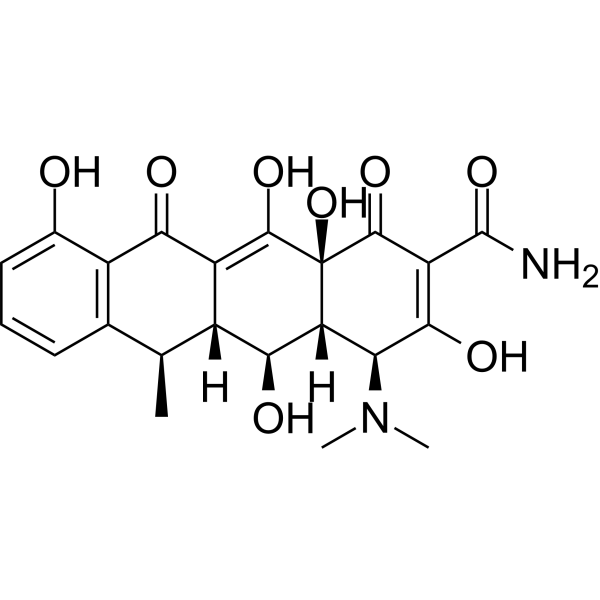
Doxycycline is an orally active, broad-spectrum tetracycline antibiotic that also functions as an MMP inhibitor, exhibiting antibacterial, antiviral, antiparasitic, and antitumor activities. Doxycycline can bind to the classical binding site (CBS) within the mRNA decoding center of the bacterial 70S ribosome's 30S small subunit.Doxycycline blocks bacterial protein synthesis and inhibits the degradation of the extracellular matrix through its interaction with zinc and calcium ions. Doxycycline also inhibits mitochondrial biogenesis, translation, and the expression of respiratory chain proteins. Doxycycline induces apoptosis, inhibits autophagy and EMT, downregulates stem cell markers, and activates the PI3K-AKT pathway, thereby effectively inhibiting the viability and proliferation of cancer cells such as breast cancer cells. Doxycycline can disrupt transthyretin (TTR) amyloid fibrils. Doxycycline also promotes the survival and self-renewal of embryonic stem cells and neural stem cells, and reduces the frequency of medium changes in culture. Doxycycline can be used in research related to cancers—such as breast, prostate, and bladder cancer—as well as neurological disorders .
loading...
    loading...
202
202 Publications Verification
Cat. No.: HY-N0565A
CAS No.: 10592-13-9
Doxycycline hydrochloride is an orally active, broad-spectrum tetracycline antibiotic that also functions as an MMP inhibitor, exhibiting antibacterial, antiviral, antiparasitic, and antitumor activities. Doxycycline hydrochloride can bind to the classical binding site (CBS) within the mRNA decoding center of the 30S small subunit of the bacterial 70S ribosome.Doxycycline hydrochloride blocks bacterial protein synthesis and inhibits the degradation of the extracellular matrix through its interaction with zinc and calcium ions. Doxycycline hydrochloride also inhibits mitochondrial biogenesis, translation, and the expression of respiratory chain proteins. Doxycycline hydrochloride induces apoptosis, inhibits autophagy and EMT, downregulates stem cell markers, and activates the PI3K-AKT pathway, thereby effectively inhibiting the viability and proliferation of cancer cells such as breast cancer cells. Doxycycline hydrochloride can disrupt transthyretin (TTR) amyloid fibrils. Doxycycline hydrochloride also promotes the survival and self-renewal of embryonic stem cells and neural stem cells, and reduces the frequency of medium changes in culture. Doxycycline hydrochloride can be used in research related to cancers—such as breast, prostate, and bladder cancer—as well as neurological disorders .
loading...
    loading...
202
202 Publications Verification
Cat. No.: HY-W008923
CAS No.: 17086-28-1
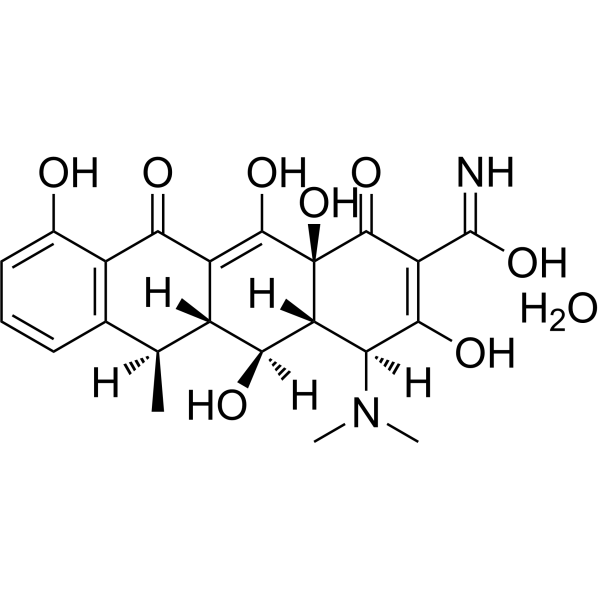
Doxycycline monohydrate (Doxycycline (hydrochloride hemiethanolate hemihydrate); WC2031) is an orally active, broad-spectrum tetracycline antibiotic that also functions as an MMP inhibitor, exhibiting antibacterial, antiviral, antiparasitic, and antitumor activities. Doxycycline monohydrate can bind to the classical binding site (CBS) within the mRNA decoding center of the 30S small subunit of the bacterial 70S ribosome.Doxycycline monohydrate blocks bacterial protein synthesis and inhibits the degradation of the extracellular matrix through its interaction with zinc and calcium ions. Doxycycline monohydrate also inhibits mitochondrial biogenesis, translation, and the expression of respiratory chain proteins. Doxycycline monohydrate induces apoptosis, inhibits autophagy and EMT, downregulates stem cell markers, and activates the PI3K-AKT pathway, thereby effectively inhibiting the viability and proliferation of cancer cells such as breast cancer cells. Doxycycline monohydrate can disrupt transthyretin (TTR) amyloid fibrils. Doxycycline monohydrate also promotes the survival and self-renewal of embryonic stem cells and neural stem cells, and reduces the frequency of medium changes in culture. Doxycycline monohydrate can be used in research related to cancers—such as breast, prostate, and bladder cancer—as well as neurological disorders .
loading...
    loading...
202
202 Publications Verification
Cat. No.: HY-N0565B
CAS No.: 24390-14-5
Synonyms: Doxycycline hydrochloride hemiethanolate hemihydrate; WC2031
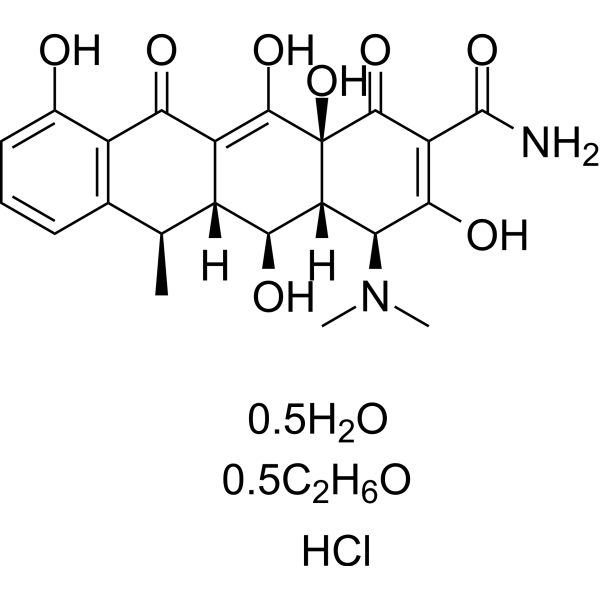
Doxycycline hyclate (Doxycycline (hydrochloride hemiethanolate hemihydrate); WC2031) is an orally active, broad-spectrum tetracycline antibiotic that also functions as an MMP inhibitor, exhibiting antibacterial, antiviral, antiparasitic, and antitumor activities. Doxycycline hyclate can bind to the classical binding site (CBS) within the mRNA decoding center of the 30S small subunit of the bacterial 70S ribosome.Doxycycline hyclate blocks bacterial protein synthesis and inhibits the degradation of the extracellular matrix through its interaction with zinc and calcium ions. Doxycycline hyclate also inhibits mitochondrial biogenesis, translation, and the expression of respiratory chain proteins. Doxycycline hyclate induces apoptosis, inhibits autophagy and EMT, downregulates stem cell markers, and activates the PI3K-AKT pathway, thereby effectively inhibiting the viability and proliferation of cancer cells such as breast cancer cells. Doxycycline hyclate can disrupt transthyretin (TTR) amyloid fibrils. Doxycycline hyclate also promotes the survival and self-renewal of embryonic stem cells and neural stem cells, and reduces the frequency of medium changes in culture. Doxycycline hyclate can be used in research related to cancers—such as breast, prostate, and bladder cancer—as well as neurological disorders .
loading...
    loading...
30
30 Cited Publications
Cat. No.: HY-N0153
CAS No.: 10236-47-2
Synonyms: Naringoside
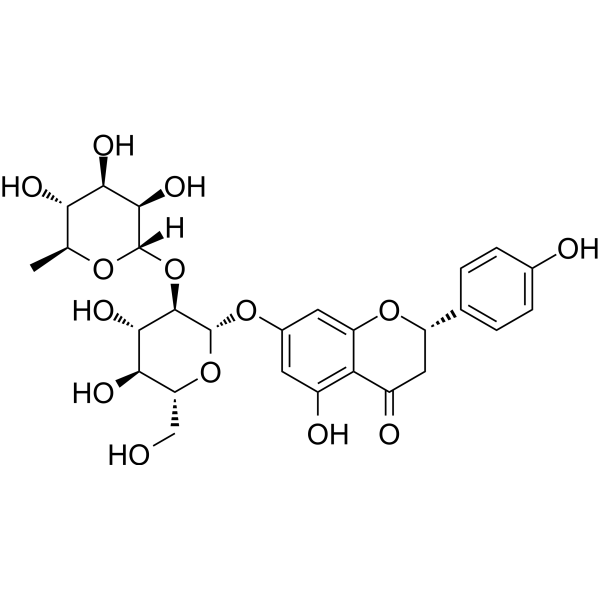
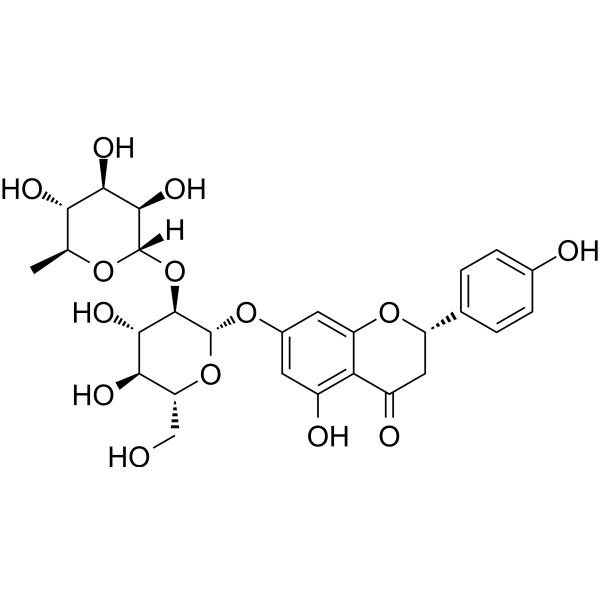
Naringin is a major flavanone glycoside obtained from tomatoes, grapefruits, and many other citrus fruits. Naringin exhibits biological properties such as antioxidant, anti-inflammatory, and antiapoptotic activities. Naringin also inhibits proliferation and invasion and induces apoptosis in human osteosarcoma cells by inhibiting zinc finger E-box binding homeobox 1 (Zeb1) .
loading...
    loading...
4
4 Cited Publications
Cat. No.: HY-D0155
CAS No.: 288574-78-7
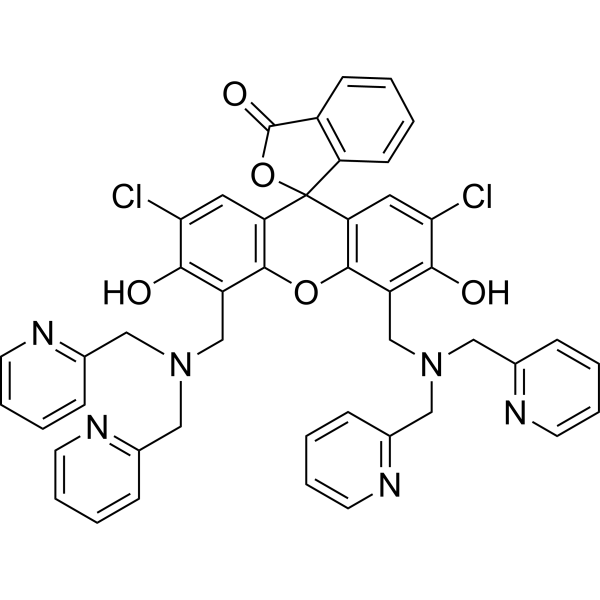
Zinpyr-1 is a zinc-responsive fluorescent indicator and a membrane-permeable metal-binding probe. Zinpyr-1 forms a complex with Mn 2+ ions and generates a fluorescence turn-on signal. Zinpyr-1 binds to free zinc ions in serum, enabling quantitative detection of free zinc concentration. Zinpyr-1 produces fluorescence signals reflecting the relative zinc concentration in plant root cells, localizes to specific layers of plant root cells, and can be used to support analyses related to plant zinc transporter mutations and homeostasis .
loading...
    loading...
3
3 Cited Publications
Cat. No.: HY-163731
CAS No.: 3077196-25-6
Domaines de recherche:  

Inflammation/Immunology

EGR-1-IN-1 is a EGR-1 inhibitor with an IC50 of 1.86 μM. EGR-1-IN-1 binds to the zinc finger DNA-binding domain of EGR-1 and promotes the dissociation of the EGR-1-DNA complex. EGR-1-IN-1 reduces the mRNA expression levels of EGR-1-regulated inflammatory genes induced by TNFα. EGR-1-IN-1 alleviates atopic dermatitis-like lesions in the ear skin of mice. EGR-1-IN-1 serves as a lead compound for the development of targeted compounds for inflammatory skin diseases. EGR-1-IN-1 can be used in studies related to atopic dermatitis .
loading...
    loading...
3
3 Cited Publications
Cat. No.: HY-139979
CAS No.: 2851040-81-6
Pureté:  99.73%
Target:  

Deubiquitinase

Domaines de recherche:  

Cancer

USP5-IN-1 (compound 64) is a selective competitive inhibitor of USP5 zinc finger ubiquitin binding domain (ZnF-UBD) (KD=2.8 μM). USP5-IN-1 competitively blocks the binding of ubiquitin to ZnF-UBD, inhibits the catalytic activity of USP5, and thus hinders the hydrolysis of ubiquitin chains. USP5-IN-1 can inhibit USP5 cleavage of Lys48-linked diubiquitin substrates in vitro and is a potential USP5 chemical probe and potential inhibitor of USP5-related cancers.
loading...
    loading...
2
2 Cited Publications
Cat. No.: HY-B0278
CAS No.: 1405-89-6
Synonyms: zinc bacitracin
Domaines de recherche:  

Infection

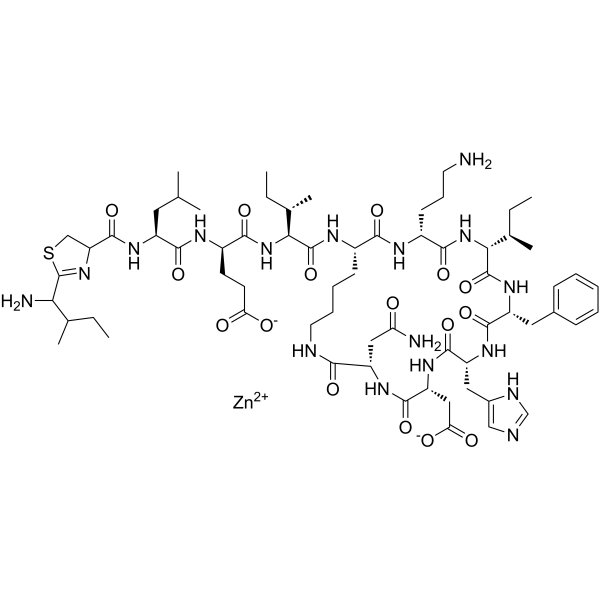
Bacitracin Zinc is a complex formed by the binding of Bacitracin (HY-107193) with zinc ions. Bacitracin Zinc is an orally active polypeptide antibiotic with bactericidal properties. Bacitracin Zinc can cause DNA and deoxyribose damage, as well as improve the gut microbiota of broiler and beef cattle .
loading...
    loading...
1
1 Cited Publications
Cat. No.: HY-N0153R
CAS No.: 10236-47-2
Synonyms: Naringoside (Standard)
Naringin is a major flavanone glycoside obtained from tomatoes, grapefruits, and many other citrus fruits. Naringin exhibits biological properties such as antioxidant, anti-inflammatory, and antiapoptotic activities. Naringin also inhibits proliferation and invasion and induces apoptosis in human osteosarcoma cells by inhibiting zinc finger E-box binding homeobox 1 (Zeb1) .
loading...
    loading...
1
1 Cited Publications
Cat. No.: HY-P70039
Pureté:  ≥ 95%, as determined by reducing SDS-PAGE.
Synonyms: CTCF; CFAP108; CCCTC-binding Factor; FAP108; Transcriptional Repressor CTCF; CCCTC-binding Factor (zinc Finger Protein); 11-zinc Finger Protein; 11 zinc Finger Transcriptional Repressor; CTCFL Paralog; MRD21
Species:  
Human
Source:  
E. coli
loading...
    loading...
1
1 Cited Publications
Cat. No.: HY-P70016
Pureté:  ≥ 95%, as determined by reducing SDS-PAGE.
Synonyms: AZGP1; Testicular Tissue Protein Li 227; Alpha-2-Glycoprotein 1, zinc-binding; Alpha-2-Glycoprotein 1, zinc; ZAG; Alpha-2-Glycoprotein, zinc; zinc-Alpha-2-Glycoprotein; Zn-Alpha2-Glycoprotein; ZA2G; AZGP1 Protein; Zn-Alpha-2-Glycoprotein; ZNGP1; Zn-Alpha-
Species:  
Human
Source:  
HEK293
loading...
    loading...
1
1 Cited Publications
Cat. No.: HY-P86929
Synonyms: KAT6A; MOZ; MYST3; RUNXBP2; ZNF220; Histone acetyltransferase KAT6A; MOZ; YBF2/SAS3; SAS2 and TIP60 protein 3; Monocytic leukemia zinc finger protein; Runt-related transcription factor-binding protein 2; zinc finger protein 220

Host:  

Rabbit

Application:  

ICC/IF, IHC-P, FC, ChIP

Reactivity:  

Human, Mouse, Rat

loading...
    loading...
Cat. No.: HY-168437
Target:  

MicroRNA

Domaines de recherche:  

Cancer

LIN28-IN-2 is a Lin28 inhibitor with activity against Lin28a, Lin28b, and their zinc knuckle domain. LIN28-IN-2 blocks Lin28-RNA substrate binding, perturbs zinc knuckle domain conformation. LIN28-IN-2 inhibits cancer cell proliferation, spheroid growth, and induces G2/M phase arrest. LIN28-IN-2 suppresses cancer stem cell phenotypes, Lin28-mediated stress granule formation, let-7 target genes, cancer stem cell biomarkers, and neuroendocrine biomarkers expression in cancer cells. LIN28-IN-2 can be used for the research of cancer .
loading...
    loading...
Cat. No.: HY-160822
CAS No.: 920289-29-8
Synonyms: PF-5212371
Target:  

ADAMTS MMP

Domaines de recherche:  

Inflammation/Immunology

AGG-523 (PF-5212371) is an orally active, reversible, non-hydroxamate, zinc-binding selective inhibitor of ADAMTS4 and ADAMTS5 with IC50 of <0.03 and 0.04 μM. AGG-523 also inhibits MMP-2, -8, 12 activity AGG-523 attenuates release of aggrecanase-generated ARG-aggrecan fragments into synovial fluid, reduces surgery-induced ARG-aggrecan release in rat joint models, and inhibits aggrecanase activity to slow cartilage degradation. AGG-523 can be used for the research of osteoarthritis .
loading...
    loading...
Cat. No.: HY-109560
CAS No.: 11082-38-5
Synonyms: Zn-DTPA trisodium
Domaines de recherche:  

Others

Pentetate zinc trisodium (Zn-DTPA trisodium) forms stable chelates with metal ions by exchanging zinc for a metal of greater binding capacity .
loading...
    loading...
Cat. No.: HY-157428
CAS No.: 2419322-41-9
Target:  

IKZF Family

Domaines de recherche:  

Others

USP3 ZnF-UBD ligand-1 (compound 59) is a ligand that binds to the zinc finger ubiquitin-binding domain (ZnF-UBD) of USP3 with a KD of 14 μM .
loading...
    loading...
Cat. No.: HY-114611
CAS No.: 2011754-00-8
Target:  

IDE

Domaines de recherche:  

Metabolic Disease

BDM44768 is an insulin-degrading enzyme (IDE) inhibitor (human IC50 = 0.06 μM; Ki = 60 nM). BDM44768 impairs D-Glucose (HY-B0389) tolerance, enhances Insulin (HY-P0035) signaling, and increases Amyloid-β concentration in an IDE-dependent manner by chelating the catalytic zinc, stabilizing the closed conformation, and binding the substrate/catalytic cleft. BDM44768 can be used in research on diabetes and metabolic dysfunction-associated steatotic liver disease (MASLD) .
loading...
    loading...
Cat. No.: HY-179421
CAS No.: 3133307-16-8
PROTAC HDAC6 degrader 7 is an orally active, highly efficient, and selective PROTAC degrader targeting histone deacetylase 6 (HDAC6) (IC50 = 118 nM). PROTAC HDAC6 degrader 7 can eliminate both the catalytic and zinc-finger ubiquitin-binding domain. PROTAC HDAC6 degrader 7 inhibits NLRP3 inflammasome assembly and activation, as well as blocks NF-κB signaling, thereby reducing the transcription and release of key inflammatory factors. PROTAC HDAC6 degrader 7 can reduce the mRNA levels of NLRP3, pro-IL-1β, TNF-α, and IL-6. PROTAC HDAC6 degrader 7 can be used for the study of inflammatory bowel disease (IBD) .
loading...
    loading...
Cat. No.: HY-120465
CAS No.: 1174905-91-9
Target:  

HIV

Domaines de recherche:  

Infection

ZINC36617540 is a novel Nef protein inhibitor with anti-HIV activity. ZINC36617540 exhibits superior binding affinity by binding to Nef protein. ZINC36617540 shows a similar binding mode to the prototype molecule B9 in molecular docking. The mechanism of action of ZINC36617540 mainly depends on its hydrophobic and electrostatic interactions with Nef protein .
loading...
    loading...

