



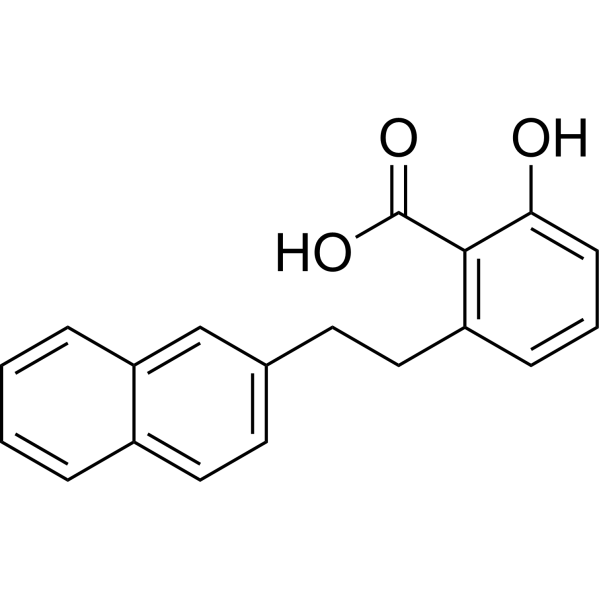
Sm4
Based on 1 publication(s) in Google Scholar
Sm4 is a selective and orally active SOX18 inhibitor. Sm4 inhibits SOX18-DNA binding (IC50 = 97.5 μM); Sm4 disrupts the SOX18-RBPJ protein-protein interaction (IC50 = 42.3 μM). Sm4 blocks SOX18 DNA binding, disrupts multiple SOX18 protein-protein interactions with RBPJ, DDX1, DDX17, ILF3, SOX7 and STAT1, modulates SOX18 chromatin binding dynamics. Sm4 exerts anti‑angiogenic and anti‑lymphangiogenic effects, reduces tumor vascular density, triggers vascular defects in zebrafish, prolongs survival in mouse metastatic cancer models. Sm4 can be used for the research of breast cancer.
Nur für Forschungszwecke. Wir verkaufen nicht an Patienten.
- Reinheit : 99.01%
- CAS. Nr.: 365542-77-4
- Formel: C19H16O3
- Molecular Weight:292.33
-
Speicherung:Powder -20°C, 3 years , 4°C, 2 years ; In solvent -80°C, 6 months , -20°C, 1 month

To place orders, for customer services and technical support, please contact: MedChemExpress USA
Tel: 609-228-6898 E-mail: [email protected] [email protected]


-
 Biologische Aktivität
-
Chemical Information
-
Lösungsmittel & Löslichkeit
- Protokoll
- Reinheit & Dokumentation
- Verweise
-
 Help & FAQs


Publications Citing Use of MedChemExpress (MCE) Sm4
More

Biologische Aktivität
Beschreibung
IC50 & Target
[1]|
STAT1 |
Cellular Effect
|
Cell Line

|
Type | Value | Description | References |
|---|---|---|---|---|
| HEK293 | CC50 |
>100 μM
Compound: 14a
|
Cytotoxicity against HEK293 cells after 24 hrs by resazurin assay
Cytotoxicity against HEK293 cells after 24 hrs by resazurin assay
|
[PMID: 23416004] |
| HepG2 | CC50 |
>100 μM
Compound: 14a
|
Cytotoxicity against human HepG2 cells after 24 hrs by resazurin assay
Cytotoxicity against human HepG2 cells after 24 hrs by resazurin assay
|
[PMID: 23416004] |
In Vitro
Sm4 (0.2 μM-3 mM) inhibits full-length mouse SOX18-DNA binding with an IC50 of 97.5 μM in a FP competition assay, with no aggregation observed up to 1000 μM[1].
Sm4 (0.3-300 μM; 1 h) selectively disrupts SOX18-RBPJ interactions with IC50 values of 42.3 μM[1].
Sm4 inhibits DNA binding of multiple SOX family HMG-box fragments with IC50 values of 200-300 μM, showing a slight preference for SOX18 and SOX15[1].
Sm4 (24 h) inhibits SOX18-dependent Vcam-1 promoter transcriptional activity in COS-7 cells with an IC50 of 5.2 μM, with a CC50 of 117 μM[1].
Sm4 alters SOX18 chromatin binding dynamics in live cells, increasing the specific bound fraction and dwell time of specifically bound SOX18 in a concentration-dependent manner[1].
Sm4 (25 μM) can selectively dysregulate SOX18-mediated transcription in human umbilical vein endothelial cells (HUVECs)[1].
MedChemExpress (MCE) has not independently confirmed the accuracy of these methods. They are for reference only.
In Vivo
Sm4 (5-50 mg/kg; p.o.; daily; 10 days) dose-dependently improves survival and reduces metastasis in a mouse model of breast cancer by inhibiting tumor-induced angiogenesis and lymphangiogenesis[1].
MedChemExpress (MCE) has not independently confirmed the accuracy of these methods. They are for reference only.
-
Animal Model:tg(-6.5kdrl:eGFP); tg(Dll4in3:eGFP); tg(fli1a:eGFP,-6.5kdrl:mCherry); tg(col2a1:YFP)[1]
-
Dosage:1 μM (tg(-6.5kdrl:eGFP) larvae); 2 μM (tg(Dll4in3:eGFP) larvae); 1.5 μM (vascular phenotype assays)
-
Administration:exposure in culture medium; initiated at 20 hpf (tg(-6.5kdrl:eGFP) larvae); initiated at 13 hpf (tg(Dll4in3:eGFP) larvae); initiated at 16 hpf (vascular phenotype assays); continuous from 2 to 6 days post fertilization (tg(col2a1:YFP) larvae)
-
Result:Reduced SOX18-dependent egfp transcript levels by 61% in tg(-6.5kdrl:eGFP) larvae.
Repressed Dll4in3:eGFP reporter activity in tg(Dll4in3:eGFP) larvae.
Caused arteriovenous specification defects and significant reductions in efnb2a, hey1, and efnb4a expression at 24 and 48 hpf in vascular phenotype assays.
Did not perturb Sox9-dependent tg(col2a1:YFP) reporter activity or chondrogenesis.
-
Animal Model:BALB/c wild-type (6-10 weeks old; inoculated with 4T1.2 mammary carcinoma cells)[1]
-
Dosage:5-50 mg/kg/day
-
Administration:p.o.; daily; 10 days (days 3-12)
-
Result:Prolonged median survival of tumor-bearing mice from 33 days (control) to 44 days (25 mg/kg/day) and 73 days (50 mg/kg/day).
Decreased lung metastatic lesions by 67% at day 28 under 25 mg/kg/day administration.
Reduced tumor endothelial cell number by 48%, blood vessel volume by 55%, lymphatic vessel density by 65%, and lymphatic endothelial cell number by 70% with 25 mg/kg/day treatment.
Exerted no significant influence on primary tumor size.


Chemical Information
-
CAS. Nr. 365542-77-4
-
Appearance Solid
-
Molecular Weight 292.33
-
Formel C19H16O3
-
Color Off-white to light brown
-
SMILES
O=C(C1=C(C=CC=C1O)CCC2=CC=C3C=CC=CC3=C2)O
-
Versand
Room temperature in continental US; may vary elsewhere.
-
Speicherung
Powder -20°C 3 years 4°C 2 years In solvent -80°C 6 months -20°C 1 month


Publications (1)
-
Journal Impact Factor
-
Most Recent
-
Adv Sci (Weinh)
Intratumoral Collagen Deposition Supports Angiogenesis Suggesting Anti-angiogenic Therapy in Armored and Cold Tumors. [Abstract]2025 Mar;12(10):e2409147. PMID: 39823457


Lösungsmittel & Löslichkeit
In Vitro:
DMSO : 12.5 mg/mL (42.76 mM; ultrasonic and warming and heat to 60°C; Hygroscopic DMSO has a significant impact on the solubility of product, please use newly opened DMSO)
Please refer to the solubility information to select the appropriate solvent. Once prepared, please aliquot and store the solution to prevent product inactivation from repeated freeze-thaw cycles.
Storage method and period of stock solution: -80°C, 6 months; -20°C, 1 month. When stored at -80°C, please use it within 6 months. When stored at -20°C, please use it within 1 month.
Please refer to the solubility information to select the appropriate solvent. Once prepared, please aliquot and store the solution to prevent product inactivation from repeated freeze-thaw cycles.
Storage method and period of stock solution: -80°C, 6 months; -20°C, 1 month. When stored at -80°C, please use it within 6 months. When stored at -20°C, please use it within 1 month.
Konzentration (Stammlösung) × Volumen (Stammlösung) = Konzentration (Ziellösung) × Volumen (Ziellösung)
In Vivo:
Select the appropriate dissolution method based on your experimental animal and administration route.
- For the following dissolution methods, please ensure to first prepare a clear stock solution using an In Vitro approach and then sequentially add co-solvents:
- To ensure reliable experimental results, the clarified stock solution can be appropriately stored based on storage conditions. As for the working solution for In Vivo experiments, it is recommended to prepare freshly and use it on the same day.
- The percentages shown for the solvents indicate their volumetric ratio in the final prepared solution. If precipitation or phase separation occurs during preparation, heat and/or sonication can be used to aid dissolution.
Add each solvent one by one: 10% DMSO 40% PEG300 5% Tween-80 45% Saline
Solubility: ≥ 1.25 mg/mL (4.28 mM); Clear solution
This protocol yields a clear solution of ≥ 1.25 mg/mL (saturation unknown).
Taking 1 mL working solution as an example, add 100 μL DMSO stock solution (12.5 mg/mL) to 400 μL PEG300, and mix evenly; then add 50 μL Tween-80 and mix evenly; then add 450 μL Saline to adjust the volume to 1 mL.
Preparation of Saline: Dissolve 0.9 g sodium chloride in ddH₂O and dilute to 100 mL to obtain a clear Saline solution.
Add each solvent one by one: 10% DMSO 90% (20% SBE-β-CD in Saline)
Solubility: ≥ 1.25 mg/mL (4.28 mM); Clear solution
This protocol yields a clear solution of ≥ 1.25 mg/mL (saturation unknown).
Taking 1 mL working solution as an example, add 100 μL DMSO stock solution (12.5 mg/mL) to 900 μL 20% SBE-β-CD in Saline, and mix evenly.
Preparation of 20% SBE-β-CD in Saline (4°C, storage for one week): 2 g SBE-β-CD powder is dissolved in 10 mL Saline, completely dissolve until clear.
In Vivo Dissolution Calculator
Please enter the basic information of animal experiments:
-
-
-
-
Recommended: Prepare an additional quantity of animals to account for potential losses during experiments.
Please enter your animal formula composition:
-
%DMSO +
Recommended: Keep the proportion of DMSO in working solution below 2% if your animal is weak.
-
%+
-
+%Tween-80 + +
-
%Saline +
The co-solvents required include: DMSO, . All of co-solvents are available by MedChemExpress (MCE). , Tween 80. All of co-solvents are available by MedChemExpress (MCE).
Working solution concentration: 0.22 mg/mL
Method for preparing stock solution: mg drug dissolved in μL DMSO. Stock solution concentration: mg/mL.
1. Take μL DMSO stock solution;
2. Add μL .
μL , mix evenly;
3. Then add μL Tween 80, mix evenly;
4. Then add μL
Please ensure that the stock solution in the first step is dissolved to a clear state, and add co-solvents in sequence. You can use ultrasonic heating (ultrasonic cleaner, recommended frequency 20-40 kHz), vortexing, etc. to assist dissolution.


Reinheit & Dokumentation
-
Data Sheet (281 KB)
-
SDS (394 KB)
- English - EN (394 KB)
- Français - FR (394 KB)
- Deutsch - DE (394 KB)
- Norwegian - NO (394 KB)
- Español - ES (394 KB)
- Swedish - SV (394 KB)
- Italian - IT (394 KB)
- Korean - KR (394 KB)
- Portuguese - PT (394 KB)
-
Handling Instructions (2659 KB)
Verweise


Complete Stock Solution Preparation Table
Please refer to the solubility information to select the appropriate solvent. Once prepared, please aliquot and store the solution to prevent product inactivation from repeated freeze-thaw cycles.
Storage method and period of stock solution: -80°C, 6 months; -20°C, 1 month. When stored at -80°C, please use it within 6 months. When stored at -20°C, please use it within 1 month.
| Optional Solvent | Concentration Solvent Mass | 1 mg | 5 mg | 10 mg | 25 mg |
|---|---|---|---|---|---|
| DMSO | 1 mM | 3.4208 mL | 17.1040 mL | 34.2079 mL | 85.5198 mL |
| 5 mM | 0.6842 mL | 3.4208 mL | 6.8416 mL | 17.1040 mL | |
| 10 mM | 0.3421 mL | 1.7104 mL | 3.4208 mL | 8.5520 mL | |
| 15 mM | 0.2281 mL | 1.1403 mL | 2.2805 mL | 5.7013 mL | |
| 20 mM | 0.1710 mL | 0.8552 mL | 1.7104 mL | 4.2760 mL | |
| 25 mM | 0.1368 mL | 0.6842 mL | 1.3683 mL | 3.4208 mL | |
| 30 mM | 0.1140 mL | 0.5701 mL | 1.1403 mL | 2.8507 mL | |
| 40 mM | 0.0855 mL | 0.4276 mL | 0.8552 mL | 2.1380 mL |


Sm4 Related Classifications
HY-116940 Related Classifications
 Powered by Bioz