



Amyloid-β Inhibitor
-
GFAP/NF-κB/APOE/NLRP3-IN-1
 0 ImagesCat. No.: HY-183796
GFAP/NF-κB/APOE/NLRP3-IN-1 is an orally active, blood-brain barrier-permeable multi-target inhibitor with an IC50 of 3.50 nM against Acetylcholinesterase. GFAP/NF-κB/APOE/NLRP3-IN-1 inhibits BACE-1 with an IC50 of 14.61 nM. GFAP/NF-κB/APOE/NLRP3-IN-1 inhibits Aβ1-42 aggregation with an IC50 of 8.63 μM. GFAP/NF-κB/APOE/NLRP3-IN-1 reduces the levels of GFAP, NLRP3 inflammasome, NF-κB and APOE. GFAP/NF-κB/APOE/NLRP3-IN-1 is applicable for the research of Alzheimer's disease and neuroblastoma.
-
DSS30
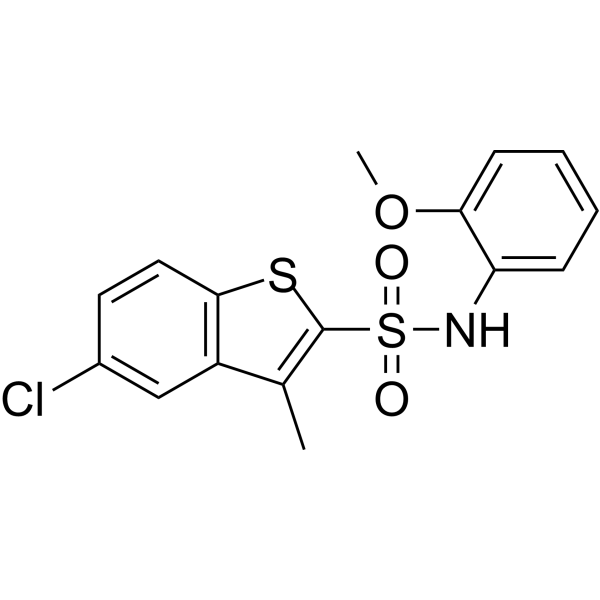 0 ImagesCat. No.: HY-147387CAS No.: 883027-32-5
DSS30 is a P25/CDK5 inhibitor that reduces β-amyloid (Aβ) secretion by inhibiting amyloid precursor protein lyase 1 (BACEl) phosphorylation. DSS30 can be used in the study of neurodegenerative diseases such as Alzheimer's disease.
-
Phytic acid hexalithium
 0 ImagesCat. No.: HY-181448Synonyms: Inositol hexaphosphate hexalithium; SNF472 hexalithium
Phytic acid (Inositol hexaphosphate hexalithium) hexalithium is an orally active compound. Phytic acid hexalithium can be derived from the seeds of legumes. Phytic acid is a [PO4]3- storage depot and precursor for other inositol phosphates and pyrophosphates. Phytic acid hexalithium attenuates Aβ oligomers and upregulates Autophagy protein. Phytic acid hexalithium can be used in cardiovascular disease, metabolic disease, nervous system disease and cancer research.
-
(Mor-Cor)Ag(III)
 0 ImagesCat. No.: HY-181178
(Mor-Cor)Ag(III) is a blood-brain barrier-penetrant silver(III) corrole complex that penetrates the blood-brain barrier. (Mor-Cor)Ag(III) scavenges reactive oxygen species induced by Aβ42 and disrupts Aβ42 aggregation, attenuating Aβ42-induced neuronal hyperactivity. (Mor-Cor)Ag(III) can be used for the research of Alzheimer's disease.
-
Amyloid Bri Protein (1-23)
 0 ImagesCat. No.: HY-P10192CAS No.: 717122-86-6Synonyms: ABri peptide (1-23); ABri23
Amyloid Bri Protein (1-23) (ABri peptide (1-23); ABri23) is a physiological 23-amino-acid peptide released from the C-terminus of the type II transmembrane protein Bri2 (ITM2B, Integral Membrane Protein 2B) following cleavage by the furin protease. Amyloid Bri Protein (1-23) interacts with the extracellular Brichos domain of Bri2 during Bri2 biosynthesis. Amyloid Bri Protein (1-23) interacts with amyloid β peptide (Aβ1-40, thereby inhibiting its aggregation and fibril formation. Amyloid Bri Protein (1-23) can be used in studies related to Alzheimer's disease and familial British dementia.
-
Pellitorine (Standard)
 0 ImagesCat. No.: HY-N3097RCAS No.: 18836-52-7
Pellitorine (Standard) is the analytical standard of Pellitorine (HY-N3097). Pellitorine is a bioactive natural amide compound. Pellitorine can competitively antagonize the activation of TRPV1 by Capsaicin (HY-10448), thereby reducing pain signal transmission. Pellitorine improves cognitive dysfunction by upregulating the BDNF-ERK1/2-CREB and Nrf2-HO-1 pathways. Pellitorine exerts anti-inflammatory and anti-sepsis effects by inhibiting the release of high mobility group protein B1 (HMGB1) and the expression of RAGE/TLR4. Pellitorine exerts its antithrombotic effect by prolonging the clotting time, inhibiting the activity of clotting factors and thrombin. Pellitorine inhibits lipid peroxidation and resists ferroptosis by upregulating GPX4 and DHODH. Pellitorine kills Aedes aegypti mosquito larvae by inhibiting V-type H⁺-ATPase and aquaporin 4 (AaAQP4). Pellitorine exhibits anti-cancer activity (e.g., leukemia and breast cancer) and has inhibitory effects on certain bacteria.
-
Aβ-IN-10
 0 ImagesCat. No.: HY-169268
Aβ-IN-10 (Compound Alz -5) is a bifunctional copper chelator and an inhibitor for beta-amyloid (Aβ), that interacts with Aβ aggregates and reduces the neurotoxicity. Aβ-IN-10 exhibits antioxidant efficacy, reveals moderate cytotoxicity with the presence of CuCl2 in SH-SY5Y and HepG2 with IC50 of 65.5, 31.2 μM. Aβ-IN-10 reduces the increase of cell stiffness caused by Aβ.
-
Aβ/tau aggregation-IN-4
 0 ImagesCat. No.: HY-180843CAS No.: 3105860-83-8
Aβ/tau aggregation-IN-4 (Compound D21) is an Aβ/tau aggregation inhibitor. Aβ/tau aggregation-IN-4 promotes the degradation of Aβ40/42 (Aβ40, IC50 = 2.151 μM; Aβ42, IC50 = 3.622 μM). Aβ/tau aggregation-IN-4 shows selective AChE inhibition (IC50: 5.56 μM). Aβ/tau aggregation-IN-4 inhibits MAO-A and MAO-B with IC50s of 0.59 μM and 0.09 μM, respectively. Aβ/tau aggregation-IN-4 suppresses intracellular ROS levels. Aβ/tau aggregation-IN-4 can be used in the research of Alzheimer's disease.
-
EVP-0015962
 0 ImagesCat. No.: HY-117521CAS No.: 1447811-26-8
EVP-0015962 is an orally active, blood-brain barrier-permeable γ-secretase inhibitor with an IC50 of 3.9 μM. EVP-0015962 alters γ-secretase-mediated cleavage of amyloid precursor protein, reduces Aβ42 production and increases Aβ38 production. EVP-0015962 reduces Aβ aggregates, amyloid plaques and inflammatory markers in the brains of mice, and improves their cognitive impairment. EVP-0015962 can be used for the research of Alzheimer's disease.
-
Aβ-IN-3
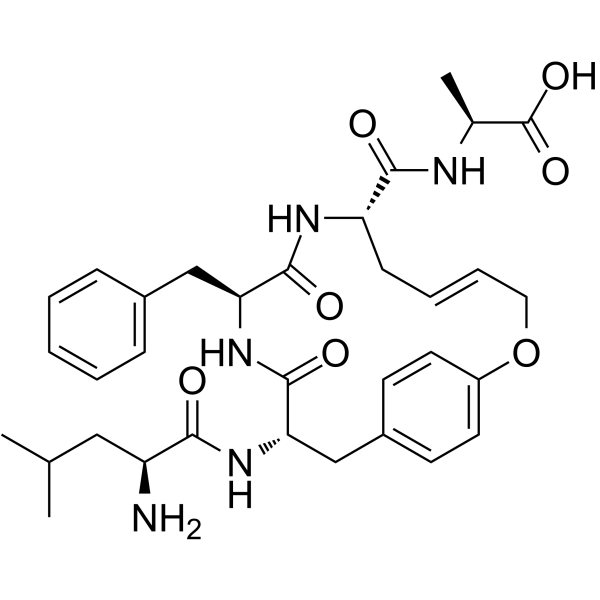 0 ImagesCat. No.: HY-146139CAS No.: 2477606-87-2
Aβ-IN-3 (compound 1) is a potent amyloid β (Aβ) inhibitor. Aβ-IN-3 inhibits Aβ42 aggregation. However, Aβ-IN-3 can not alleviate the neurotoxicity of Aβ42 in SH-SY5Y cells. Aβ-IN-3 can not change the aggregation state of Aβ42 into a nontoxic one.
-
ADH-353
 0 ImagesCat. No.: HY-169025CAS No.: 2711712-81-9
ADH-353 can inhibit Aβ fibrillation and reduce Aβ-induced cytotoxicity in SH-SY5Y and N2a cells. ADH-353 can be used in Alzheimer's disease-related research.
-
Aβ aggregation-IN-5
 0 ImagesCat. No.: HY-180997
Aβ aggregation-IN-5 is a brain-penetrant amyloid-β aggregation inhibitor. Aβ aggregation-IN-5 inhibits Aβ aggregation/oligomerization, rescues cells from AB/ROS toxicity and reduces microglial activation/NO production. Aβ aggregation-IN-5 reduces amyloid burden, neuroinflammation, microglial activation in APP/PSEN1 mice. Aβ aggregation-IN-5 can be used for the research of Alzheimer's disease.
-
Dehydro nicardipine
 0 ImagesCat. No.: HY-W721681CAS No.: 59875-58-0
Dehydro nicardipine is a dihydropyridine metabolite of Nicardipine (HY-12515) and belongs to the dihydropyridine class of compounds. Dehydro nicardipine can selectively inhibit the aggregation of Aβ monomers, specifically regulate the extension and binding of Aβ soluble aggregates, change the morphology of Aβ aggregates, and inhibit the growth of aggregate length. Dehydro nicardipine can be used in the study of Alzheimer's disease (AD).
-
BI 1034020
 0 ImagesCat. No.: HY-P991866
BI 1034020 is a humanized nanobody, targeting two different epitopes of Aβ ( Aβ40 and Aβ42) with high affinity. BI 1034020 reduces the level of free Ab peptide in plasma and thus prevent the formation of new Aβ plaques and clear existing plaques. BI 1034020 can be used for Alzheimer’s disease research.
-
PPI-1019
 0 ImagesCat. No.: HY-123485CAS No.: 290828-45-4
PPI-1019 is an amyloid beta (Aβ) inhibitor. PPI-1019 can be used in the research of neurological diseases and Alzheimer's disease.
-
MAO-B-IN-9
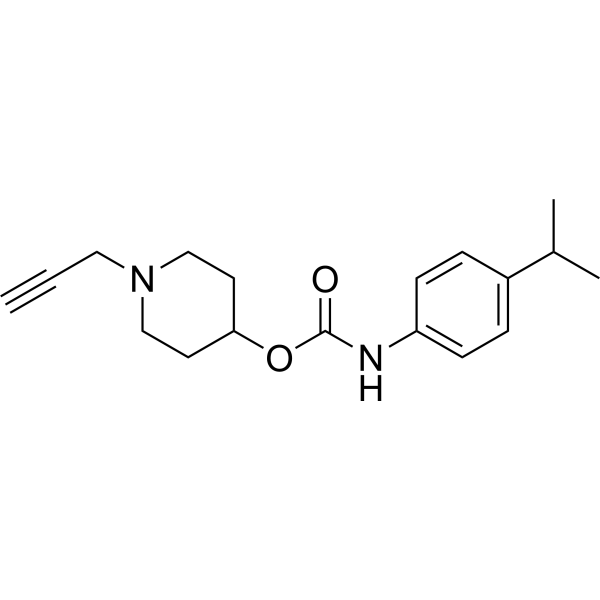 0 Images
MAO-B-IN-9 (compound 16) is a potent, selective, BBB-penetrated, irreversible and time-dependent MAO-B (monoamine oxidase B) inhibitor, with an IC50 of 0.18 μM. MAO-B-IN-9 prevents Aβ1-42-induced neuronal cell death. MAO-B-IN-9 shows neuroprotective effects, which may be the result of its Aβ1-42 anti-aggregation effects. MAO-B-IN-9 is a click chemistry reagent, itcontains an Alkyne group and can undergo copper-catalyzed azide-alkyne cycloaddition (CuAAc) with molecules containing Azide groups.
-
D-520
 0 ImagesCat. No.: HY-120156CAS No.: 1619269-47-4
D-520 is a potent and brain-penetrant dopamine D2/D3 agonist (D2 EC50 = 4.73 nM, Ki = 41.8 nM; D3 EC50 = 2.18 nM, Ki = 0.35 nM). D-520 inhibits the formation of Aβ aggregates in vitro and promotes the disaggregation of both alpha-synuclein (α-syn) and Aβ aggregates. D-520 exhibits efficacious activity in animal models of Parkinson’s disease (PD). D-520 can be used for PD and PD with dementia (PDD) research[1][2].
-
3-O-Methyltolcapone-d7
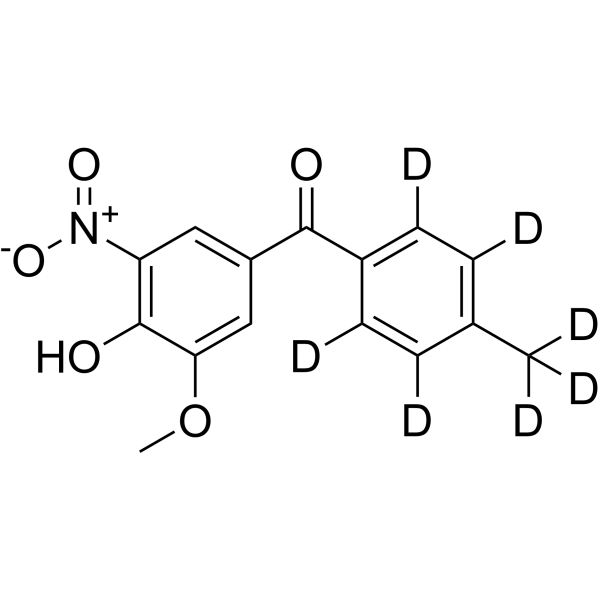 0 ImagesSynonyms: Ro 40-7591 d7
3-O-Methyltolcapone-d7 (Ro 40-7591 d7) is a deuterium labeled 3-O-Methyltolcapone (HY-174062). 3-O-Methyltolcapone (Ro 40-7591) is a metabolite of Tolcapone (HY-17406). Tolcapone (Ro 40-7592) is a selective, potent and orally active COMT inhibitor with an IC50of 773 nM. Tolcapone can inhibits α-syn and Aβ42 oligomerization and fibrillogenesis. Tolcapone can cause oxidative stress and induce cancer cells apoptosis and ROS production. Tolcapone can be used for the researches of cancer and neurological disease, such as Parkinson disease and neuroblastoma.
-
Aβ aggregation-IN-3
 0 ImagesCat. No.: HY-180160
Aβ aggregation-IN-3 (Compound B7) is an Aβ aggregation inhibitor. Aβ aggregation-IN-3 inhibits Aβ aggregation. Aβ aggregation-IN-3 confers protection in both neuronal and microglial models. Aβ aggregation-IN-3 reduces Aβ-induced paralysis in C. elegans. Aβ aggregation-IN-3 improves Alzheimer's disease.




