



HDAC
Histone deacetylases
HDAC (Histone deacetylases) are a class of enzymes that remove acetyl groups (O=C-CH3) from an ε-N-acetyl lysine amino acid on ahistone, allowing the histones to wrap the DNA more tightly. This is important because DNA is wrapped around histones, and DNA expression is regulated by acetylation and de-acetylation. Its action is opposite to that of histone acetyltransferase. HDAC proteins are now also called lysine deacetylases (KDAC), to describe their function rather than their target, which also includes non-histone proteins. Together with the acetylpolyamine amidohydrolases and the acetoin utilization proteins, the histone deacetylases form an ancient protein superfamily known as the histone deacetylase superfamily.
HDAC Isoform Specific Products
-
HDAC
(391)
View all products
-
HDAC1
(317)
View all products
-
HDAC2
(211)
View all products
-
HDAC3
(204)
View all products
-
HDAC4
(72)
View all products
-
HDAC5
(56)
View all products
-
HDAC6
(335)
View all products
-
HDAC7
(53)
View all products
-
HDAC8
(188)
View all products
-
HDAC9
(41)
View all products
-
HDAC10
(67)
View all products
-
HDAC11
(71)
View all products
-
HD1
(3)
View all products
-
HD2
(4)
View all products
All Product Categories
-
HDAC Inhibitors
(780)
View all products
-
HDAC Antagonists
(3)
View all products
-
HDAC Activators
(14)
View all products
-
HDAC Modulators
(4)
View all products
-
HDAC MDM2 Inhibitor
(1)
View all products
-
HDAC Degraders
(44)
View all products
-
HDAC Controls
(4)
View all products
-
HDAC Substrates
(3)
View all products
-
HDAC Ligands
(13)
View all products
-
HDAC Related Products (915)
Related Products (915)

-
Antibodies (16)
-
HDAC Signaling Pathway
-
HDAC Isoform Comparison

-
HDAC3 degrader-2
 0 ImagesCat. No.: HY-182051CAS No.: 3110847-73-6HDAC3 degrader-2 is a selective HDAC3 degrader. HDAC3 degrader-2 inhibits the activation of the NLRP3 inflammasome by degrading HDAC3, thereby reducing the maturation of IL-1β and caspase-1. HDAC3 degrader-2 exhibits anti-inflammatory activity. HDAC3 degrader-2 can be used in research related to endotoxin shock, colitis and gouty arthritis.
-
EGFR/HDAC-IN-2
 0 ImagesCat. No.: HY-175805EGFR/HDAC-IN-2 (Compound 38) is dual-functional inhibitor of EGFR and HDAC3 with IC50s of 20.34 and 1.09 nM for CDK9 and HDAC3, respectively. EGFR/HDAC-IN-2 has superior anti-proliferative activity against cancer cells, inhibits cell migration and induces late-stage cell apoptosis. EGFR/HDAC-IN-2 significantly inhibits triple-negative breast cancer (TNBC) tumor growth in xenograft mouse models. EGFR/HDAC-IN-2 can be used for cancers like TNBC research.
-
HDAC6-IN-80
 0 ImagesCat. No.: HY-182777CAS No.: 3118852-74-4HDAC6-IN-80 is an orally active, selective HDAC6 inhibitor with an IC50 of 8.5 nM. HDAC6-IN-80 inhibits lipopolysaccharide-induced microglial activation, reduces the levels of iNOS, COX-2, TNF-α and IL-6, and alleviates sensory hypersensitivity behaviors. HDAC6-IN-80 can be used for the research of inflammatory pain and chemotherapy-induced peripheral neuropathy.
-
HDAC6-IN-49
 0 ImagesCat. No.: HY-169156HDAC6-IN-49 (Compound 3) is an inhibitor for HDAC with IC50 of 0.012 and 0.735 μM for HDAC6 and HDAC1. HDAC6-IN-49 also exhibits inhibitory activities against MAO-B, cholinesterase (ChE), histamine receptor (H3R) and serotonin 6 receptor (5-HT6R). HDAC6-IN-49 exhibits neuroprotective efficacy on SH-SY5Y cell. HDAC6-IN-49 improves cognitive function and locomotor ability in Drosophila Parkinson's disease models and in C. elegans Alzheimer's disease models.
-
HDAC3-IN-7
 0 ImagesCat. No.: HY-172601CAS No.: 3104610-92-3HDAC3-IN-7 (Compound 8ae) is a selective HDAC3 inhibitor with an IC50 value of 311 nM. HDAC3-IN-7 degrades PD-L1 through the lysosome pathway mediated by Cathepsin B, exerting activities such as inhibiting tumor cell proliferation, migration, and invasion. HDAC3-IN-7 is promising for research of cancers.
-
HDAC-IN-101
 0 ImagesCat. No.: HY-D3167CAS No.: 1616863-09-2HDAC-IN-101 is a HDAC1 inhibitor and nitroreductase/pH-activated fluorescent inducer, with an IC50 of 65 nM against human HDAC1. HDAC-IN-101 blocks cancer cell proliferation by inhibiting HDAC1. HDAC-IN-101 is reduced by overexpressed nitroreductase to generate H6AQ (Ex/Em = 450 nm/500 nm), a product that emits fluorescence under low pH conditions. HDAC-IN-101 is applicable for cancer-related research.
-
HDAC6-IN-74
 0 ImagesCat. No.: HY-181579HDAC6-IN-74 is an orally active, selective histone deacetylase 6 (HDAC6) inhibitor with an IC50 of 0.036 μM. HDAC6-IN-74 induces tumor cell apoptosis, arrests cells at the S phase of the cell cycle, and impairs cell migration, invasion and colony-forming abilities. HDAC6-IN-74 exerts anticancer effects with no obvious toxicity. HDAC6-IN-74 can be used in the research of cancers such as liver cancer.

-
M122
 0 ImagesCat. No.: HY-125645CAS No.: 2127411-50-9
-
ZYJ-34c
 0 ImagesCat. No.: HY-139815CAS No.: 1314556-93-8ZYJ-34c is an orally active and potent histone deacetylase inhibitor (HDACi) with IC50s of 0.056 μM and 0.146 μM for HDAC6 and HDAC8, respectively. ZYJ-34c causes G1 phase arrest in low concentration. ZYJ-34c has antiproliferative activities. ZYJ-34c exhibits antitumor potency in MDA-MB-231 and HCT116 xenograft models and possesses antimetastatic potential in a mouse hepatoma-22 (H22) pulmonary metastasis model.
-
Apicidin C
 0 ImagesCat. No.: HY-177441CAS No.: 366448-28-4Apicidin C (Compound 5a) is a cyclic tetrapeptide. Apicidin C has an antiprotozoal and antimalarial activity against Eimeria tenella (IC50: 6 nM) by reversibly inhibiting HDAC acyivity. Apicidin C can be used for malaria infections research.
-
TH34 (Standard)
 0 ImagesCat. No.: HY-111818RCAS No.: 2196203-96-8
-
RGFP966 (Standard)
 0 ImagesCat. No.: HY-13909RCAS No.: 1357389-11-7RGFP966 (Standard) is the analytical standard of RGFP966 (HY-13909). This product is intended for research and analytical applications. RGFP966 is a highly selective HDAC3 inhibitor with an IC50 of 80 nM and shows no inhibition to other HDACs at concentrations up to 15 μM. RGFP966 can penetrate the blood brain barrier (BBB).
-
Givinostat hydrochloride (Standard)
 0 ImagesCat. No.: HY-14842ARCAS No.: 199657-29-9Synonyms: ITF-2357 hydrochloride (Standard)Givinostat (hydrochloride) (Standard) is the analytical standard of Givinostat (hydrochloride). This product is intended for research and analytical applications. Givinostat (ITF-2357) hydrochloride is a HDAC inhibitor with an IC50 of 198 and 157 nM for HDAC1 and HDAC3, respectively.
-
Splitomicin (Standard)
 0 ImagesCat. No.: HY-100585RCAS No.: 5690-03-9Synonyms: Splitomycin (Standard)Splitomicin (Standard) is the analytical standard of Splitomicin. This product is intended for research and analytical applications. Splitomicin (Splitomycin) is a selective Sir2p inhibitor. Splitomicin inhibits NAD+-dependent HDAC activity of Sir2 protein. Splitomicin induces dose-dependent inhibition of HDAC in the yeast extract with an IC50 of 60 μM.
-
HDAC6-IN-40
 0 ImagesCat. No.: HY-160846CAS No.: 2653254-34-1HDAC6-IN-40 (Compound I-6) is an inhibitor for HDAC6 with IC50 of 0.029 μM.
-
ACY-1083 (Standard)
 0 ImagesCat. No.: HY-111791RCAS No.: 1708113-43-2ACY-1083 (Standard) is the analytical standard of ACY-1083 (HY-111791). This product is intended for research and analytical applications. ACY-1083 is a selective and brain-penetrating HDAC6 inhibitor with an IC50 of 3 nM and is 260-fold more selective for HDAC6 than all other classes of HDAC isoforms. ACY-1083 effectively reverses chemotherapy-induced peripheral neuropathy.
-
MC1742 (Standard)
 0 ImagesCat. No.: HY-110280RCAS No.: 1776116-74-5MC1742 (Standard) is the analytical standard of MC1742 (HY-110280). This product is intended for research and analytical applications. MC1742 is a potent HDAC inhibitor, with IC50s of 0.1 μM, 0.11 μM, 0.02 μM, 0.007 μM, 0.61 μM, 0.04 μM and 0.1 μM for HDAC1, HDAC2, HDAC3, HDAC6, HDAC8, HDAC10 and HDAC11, respectively. MC1742 can increase acetyl-H3 and acetyl-tubulin levels and inhibits cancer stem cells growth. MC1742 can induce growth arrest, apoptosis, and differentiation in sarcoma CSC.
-
KT-531
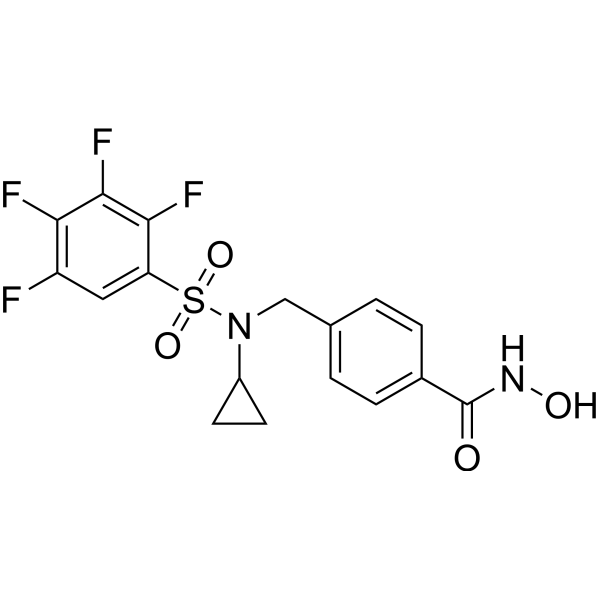 0 ImagesCat. No.: HY-128436CAS No.: 2490284-18-7KT-531 is a potent and selective inhibitor of HDAC6 with an IC50 of 8.5 nM. KT-531 exhibits strong inhibition against SUP-T11 cells with an IC50 of 0.42 μM. KT-531 can be used in study hematological cancers.




