



HDAC
Histone deacetylases
HDAC (Histone deacetylases) are a class of enzymes that remove acetyl groups (O=C-CH3) from an ε-N-acetyl lysine amino acid on ahistone, allowing the histones to wrap the DNA more tightly. This is important because DNA is wrapped around histones, and DNA expression is regulated by acetylation and de-acetylation. Its action is opposite to that of histone acetyltransferase. HDAC proteins are now also called lysine deacetylases (KDAC), to describe their function rather than their target, which also includes non-histone proteins. Together with the acetylpolyamine amidohydrolases and the acetoin utilization proteins, the histone deacetylases form an ancient protein superfamily known as the histone deacetylase superfamily.
HDAC Isoform Specific Products
-
HDAC
(386)
View all products
-
HDAC1
(316)
View all products
-
HDAC2
(211)
View all products
-
HDAC3
(203)
View all products
-
HDAC4
(72)
View all products
-
HDAC5
(56)
View all products
-
HDAC6
(332)
View all products
-
HDAC7
(53)
View all products
-
HDAC8
(187)
View all products
-
HDAC9
(41)
View all products
-
HDAC10
(66)
View all products
-
HDAC11
(71)
View all products
-
HD1
(3)
View all products
-
HD2
(4)
View all products
All Product Categories
-
HDAC Inhibitors
(775)
View all products
-
HDAC Antagonists
(3)
View all products
-
HDAC Activators
(14)
View all products
-
HDAC Modulators
(4)
View all products
-
HDAC MDM2 Inhibitor
(1)
View all products
-
HDAC Degraders
(43)
View all products
-
HDAC Controls
(4)
View all products
-
HDAC Substrates
(3)
View all products
-
HDAC Ligands
(12)
View all products
-
HDAC Related Products (907)
Related Products (907)

-
Antibodies (16)
-
HDAC Signaling Pathway
-
HDAC Isoform Comparison
-
Tasquinimod (Standard)
 0 ImagesSynonyms: ABR-215050 (Standard)Tasquinimod (Standard) is the analytical standard of Tasquinimod. This product is intended for research and analytical applications. Tasquinimod is an oral antiangiogenic agent, which has the potential for castration-resistant prostate cancer treatment. Tasquinimod binds to the regulatory Zn2+ binding domain of HDAC4 with Kd of 10-30 nM. Tasquinimod also is a S100A9 inhibitor.
-
TMU 35435
 0 ImagesCat. No.: HY-164539CAS No.: 2231800-32-9
-
Dihydrochlamydocin analog-1
 0 ImagesCat. No.: HY-P2178CAS No.: 157618-75-2Dihydrochlamydocin analog-1 (compound 2) is a Chlamydocin (HY-115761) analogue that inhibits histone H4 peptide deacetylation with IC50 of 30 nM.
-
Givinostat hydrochloride monohydrate (Standard)
 0 ImagesSynonyms: ITF-2357 hydrochloride monohydrate (Standard)Givinostat (hydrochloride monohydrate) (Standard) is the analytical standard of Givinostat (hydrochloride monohydrate). This product is intended for research and analytical applications. Givinostat hydrochloride monohydrate (ITF-2357 hydrochloride monohydrate) is a HDAC inhibitor with an IC50 of 198 and 157 nM for HDAC1 and HDAC3, respectively.
-
Remetinostat (Standard)
 0 ImagesCat. No.: HY-100365RCAS No.: 946150-57-8Synonyms: SHP-141 (Standard)Remetinostat (Standard) is the analytical standard of Remetinostat (HY-100365). This product is intended for research and analytical applications. Remetinostat (SHP-141) is a hydroxamic acid-based histone deacetylase (HDAC) inhibitor. Remetinostat alleviates Imiquimod (HY-B0180)-induced psoriatic dermatitis. Remetinostat can be used for study of cutaneous T-cell lymphoma.
-
ST7612AA1
 0 ImagesCat. No.: HY-12926CAS No.: 1428535-92-5ST7612AA1 is a histone deacetylase (HDAC) inhibitor that controls chromatin condensation and DNA transcription by removing acetyl groups from histones. ST7612AA1 is also a potent HIV reactivation inducer, and its reactivation activity is exerted without activating or proliferating CD4+T cells, and can be used in the study of HIV reactivation strategies and elimination of viral reservoirs.
-
Z-MAL
 0 ImagesCat. No.: HY-176545CAS No.: 642463-22-7

-
HDAC1-IN-12
 0 ImagesCat. No.: HY-181010HDAC1-IN-12 is a Plasmodium falciparum HDAC1 (PfHDAC1) inhibitor with an IC50 of 4.1 nM against Pf3D7. HDAC1-IN-12 inhibits PfHDAC1, upregulates histone H3 acetylation in P. falciparum parasites, downregulates malaria invasion-related gene expression, and exhibits favorable safety profiles, improved physicochemical properties, and potent in vivo antimalarial activity. HDAC1-IN-12 can be used for the research of malaria.
-
PD-L1/HDAC-IN-1
 0 ImagesCat. No.: HY-172167CAS No.: 2923313-69-1PD-L1/HDAC-IN-1 (Compound 14) is the inhibitor for PD-L1 and HDAC that inhibits PD-1/PD-L1 interaction, HDAC2 and HDAC3 with IC50 of 88.10, 27.98 and 14.47 nM, respectively. PD-L1/HDAC-IN-1 exhibits slight cytotoxicity in MCF-7 (IC50=19.34 μM). PD-L1/HDAC-IN-1 upregulates the expression of PD-L1 and CXCL10, promoting anti-tumour immune response by recruiting T-cell infiltration into TME.
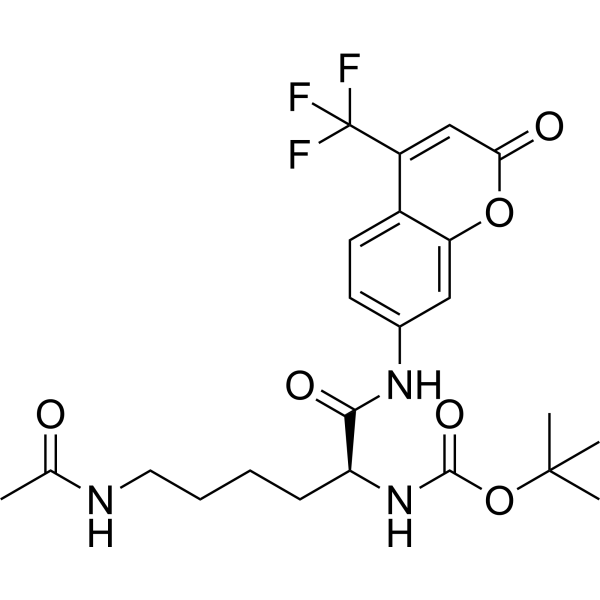
-
Butyrylhydroxamic acid
 0 ImagesButyrylhydroxamic acid (N-Hydroxybutanamide) is a potent inhibitor of histone deacetylase (HDAC). Butyrylhydroxamic acid enhances memory in behavioral models of rodents and can be used as memory enhancers, mood stabilizers, and β-chain hemoglobin disease studies.
-
J1038
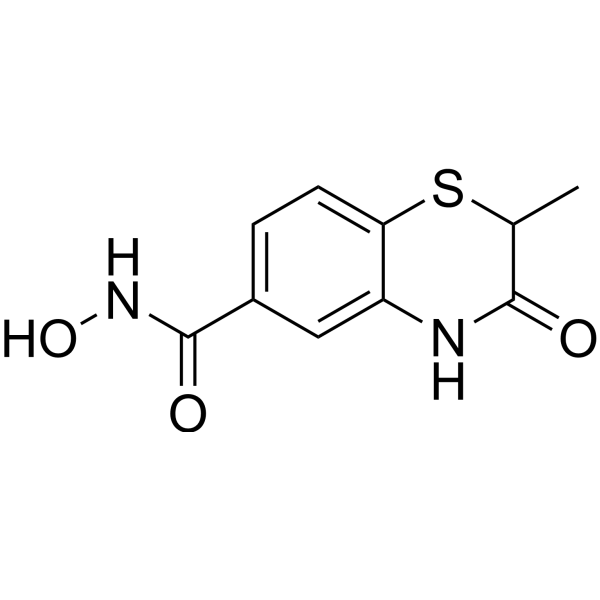 0 ImagesCat. No.: HY-111028CAS No.: 949727-86-0Synonyms: T 5979345
-
WT-161 (Standard)
 0 ImagesCat. No.: HY-100871RCAS No.: 1206731-57-8WT-161 (Standard) is the analytical standard of WT-161 (HY-100871). This product is intended for research and analytical applications. WT-161 is a potent and selective HDAC6 inhibitor with an IC50 of 0.40 nM. WT-161 also inhibits metallo-β-lactamase domain-containing protein 2 (MBLAC2).
-
ACY-957 (Standard)
 0 ImagesCat. No.: HY-104008RCAS No.: 1609389-52-7ACY-957 (Standard) is the analytical standard of ACY-957 (HY-104008). This product is intended for research and analytical applications. ACY-957 is an orally active and selective inhibitor of HDAC1 and HDAC2, with IC50s of 7 nM, 18 nM, and 1300 nM against HDAC1/2/3, respectively, and shows no inhibition on HDAC4/5/6/7/8/9.
-
Givinostat (Standard)
 0 ImagesSynonyms: ITF-2357 (Standard)Givinostat (Standard) is the analytical standard of Givinostat. This product is intended for research and analytical applications. Givinostat (ITF-2357) is a HDAC inhibitor with an IC50 of 198 and 157 nM for HDAC1 and HDAC3, respectively. Givinostat can be used for Duchenne muscular dystrophy (DMD) research.
-
CAY10603 (Standard)
 0 ImagesCat. No.: HY-18613RCAS No.: 1045792-66-2Synonyms: BML-281 (Standard)CAY10603 (Standard) is the analytical standard of CAY10603. This product is intended for research and analytical applications. CAY10603 (BML-281) is a potent and selective HDAC6 inhibitor, with an IC50 of 2 pM; CAY10603 (BML-281) also inhibits HDAC1, HDAC2, HDAC3, HDAC8, HDAC10, with IC50s of 271, 252, 0.42, 6851, 90.7 nM.
-
SR-4370 (Standard)
 0 ImagesCat. No.: HY-111400RCAS No.: 1816294-67-3
-
Ricolinostat (Standard)
 0 ImagesSynonyms: ACY-1215 (Standard); Rocilinostat (Standard)Ricolinostat (Standard) is the analytical standard of Ricolinostat. This product is intended for research and analytical applications. Ricolinostat (ACY-1215) is a potent and selective HDAC6 inhibitor, with an IC50 of 5 nM. ACY-1215 also inhibits HDAC1, HDAC2, and HDAC3 with IC50s of 58, 48, and 51 nM, respectively.
-
Tefinostat (Standard)
 0 ImagesSynonyms: CHR-2845 (Standard)Tefinostat (Standard) is the analytical standard of Tefinostat (HY-106409). This product is intended for research and analytical applications. Tefinostat (CHR-2845) is a monocyte/macrophage targeted histone deacetylase (HDAC) inhibitor. Tefinostat can be cleaved into active acid CHR-2847 by the intracellular esterase human carboxylesterase-1 (hCE-1). Tefinostat can be used for the research of leukaemias.




