



Antibiotic
Antibiotics are a class of secondary metabolites produced from microorganisms, animals or plants. Some of them exhibit anti-bacterial, anti-fungal, anthelmintic, anti-tumor or immunosuppressive activities with a wealth of structural classes such as β-lactams, macrolide and polyether. As major sources of antibiotics, streptomycetes, penicillium and marine organisms produce a wide variety of commercially important polyketide compounds including the well-known macrolide, polyene and polyether antibiotics with wide range of activities. Antibiotics such as penicillin, cephalosporin, streptomycin, and tetracycline can be used in the treatment of human and veterinary diseases. However, antibiotic resistance is also a growing threat to global public health.
Antibiotic Isoform Specific Products
-
Antibiotic
(2782)
View all products
-
Aminoglycoside
(46)
View all products
-
Glycopeptide
(19)
View all products
-
Lipopeptide
(7)
View all products
-
Macrolide
(76)
View all products
-
Oxazolidinone
(16)
View all products
-
Quinolone
(101)
View all products
-
Tetracycline
(42)
View all products
-
β-lactam
(199)
View all products
All Product Categories
-
Antibiotic Related Products (3548)
Related Products (3548)

-
Related Compound Screening Libraries (1)
-
Antibiotic Isoform Comparison
-
Sultamicillin (Standard)
 0 ImagesCat. No.: HY-N7115RCAS No.: 76497-13-7Sultamicillin (Standard) is the analytical standard of Sultamicillin. This product is intended for research and analytical applications. Sultamicillin is a broad-spectrum and orally active beta-lactamase inhibitor, an antibiotic with antibacterial activity.
-
Troleandomycin (Standard)
 0 ImagesCat. No.: HY-108881RCAS No.: 2751-09-9Synonyms: Triacetyloleandomycin (Standard)Eptifibatide (acetate) (Standard) is the analytical standard of Eptifibatide (acetate). This product is intended for research and analytical applications. Eptifibatide acetate is a cyclic heptapeptide, acts as a competitive antagonist for the activated platelet glycoprotein IIb/IIIa receptor, with anti-platelet activity.
-
Cefdinir-13C,15N2
 0 ImagesCat. No.: HY-B0136SSynonyms: FK-482-13C,15N2; CI-983-13C,15N2Cefdinir-13C,15N2 (FK-482-13C,15N2) is 13C and 15N labeled Cefdinir. Cefdinir (FK-482) is a semi-synthetic, broad-spectrum antibiotic in the third generation of the cephalosporin class, which is proved to be effective for infections caused by several Gram-negative and Gram-positive bacteria. Cefdinir can be used for the research of common bacterial infections of the ear, sinus, throat, and skin.
-
Oryzoxymycin
 0 ImagesCat. No.: HY-N14890CAS No.: 12640-81-2Oryzoxymycin is an aromatic derivative antibiotic. Oryzoxymycin has anti - Gram-negative bacteria activity.
-
Glidobactin G
 0 ImagesCat. No.: HY-N14023CAS No.: 119259-71-1Glidobactin G is an anti-tumor antibiotic. Glidobactin G has the activity against pathogenic fungi and yeast. Glidobactin G also extends the survival of mice inoculated with leukemia P388 cells.
-
BO-1165
 0 ImagesCat. No.: HY-118906CAS No.: 89426-64-2BO-1165 is an antibiotic with good antibacterial activity against Gram-negative bacteria, but almost no activity against Gram-positive bacteria and anaerobic bacteria. BO-1165 has high antibacterial activity against Pseudomonas aeruginosa (MIC50=3.12 mg/L) and P. cepacia (MIC50=1.56 mg/L).
-
7-Hydroxyguanine
 0 ImagesCat. No.: HY-N15034CAS No.: 16870-91-07-Hydroxyguanine is an antibiotic that can inhibit the growth of L1210 leukemia cells.
-
Naftifine-d3 hydrochloride
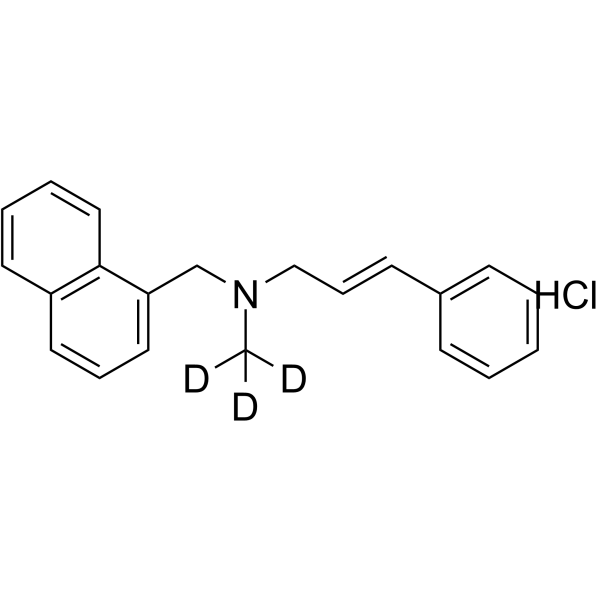 0 ImagesCat. No.: HY-B0518ASCAS No.: 1246833-81-7Naftifine-d3 (hydrochloride) is the deuterium labeled Naftifine hydrochloride. Naftifine hydrochloride is an antibiotic. Naftifine hydrochloride has antifungal activity against dermatophytes, aspergilli, Sporothrix schenckii, and yeasts of the genus Candida. Naftifine hydrochloride can be used for the research of superficial dermatomycoses inhibition.
-
Terbinafine-d5 hydrochloride
 0 ImagesCat. No.: HY-17395S1Synonyms: TDT 067-d5 hydrochlorideTerbinafine-d5 (TDT 067-d5) hydrochloride is deuterium-labeled Terbinafine hydrochloride (HY-17395).
-
Polyoxin H
 0 ImagesCat. No.: HY-N14213CAS No.: 24695-54-3Polyoxin H is a nucleoside antifungal antibiotic and has significant effects on rice sheath blight.
-
Cefteram pivoxil (Standard)
 0 ImagesCat. No.: HY-106571RCAS No.: 82547-81-7Synonyms: Ro 19-5248 (Standard); T-2588 (Standard)Cefteram pivoxil (Standard) is the analytical standard of Cefteram pivoxil. This product is intended for research and analytical applications. Cefteram pivoxil (Ro 19-5248), an orally active cephalosporin antibiotic, is used for bacterial infections.
-
Berberine
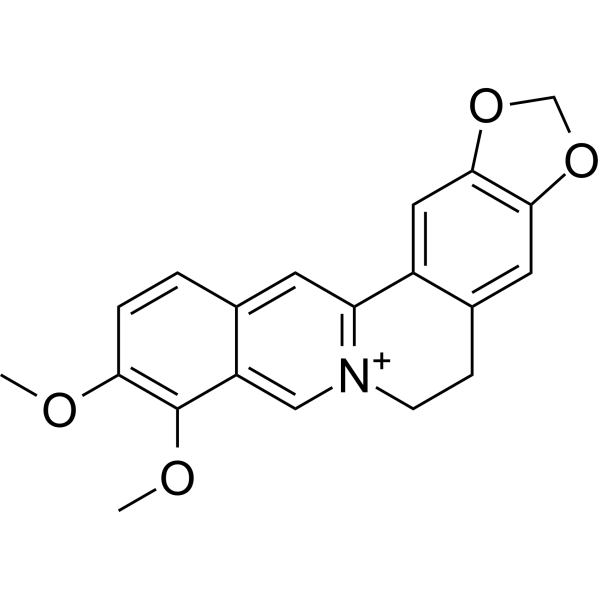 0 ImagesBerberine (Natural Yellow 18) is an alkaloid isolated from the Chinese herbal medicine Huanglian, as an antibiotic. Berberine (Natural Yellow 18) induces reactive oxygen species (ROS) generation and inhibits DNA topoisomerase. Berberine (Natural Yellow 18) has antineoplastic properties. The sulfate form (HY-N0716B) improves bioavailability.
-
3-Desacetyl Cefotaxime lactone (Standard)
 0 ImagesCat. No.: HY-135394RCAS No.: 66340-33-83-Desacetyl Cefotaxime lactone (Standard) is the analytical standard of 3-Desacetyl Cefotaxime lactone. This product is intended for research and analytical applications. 3-Desacetyl Cefotaxime lactone is the active metabolite of Cefotaxime. Cefotaxime sodium salt is a third-generation cephalosporin antibiotic.
-
Antibiotic MX 2
 0 ImagesCat. No.: HY-106289CAS No.: 105026-50-4Antibiotic MX 2 is an orally active antibiotic that can cross the blood-brain barrier. Antibiotic MX 2 inhibits the growth of drug-sensitive and multidrug-resistant tumor cells, prolongs the survival of tumor-bearing mice, induces single-strand and double-strand DNA breaks, suppresses colony formation of fresh human-derived tumor cells, and overcomes multidrug resistance mediated by P-glycoprotein. Antibiotic MX 2 can be used in research related to L1210 leukemia, Lewis lung cancer, colon adenocarcinoma type 26 and type 38, gastric adenocarcinoma, non-small cell lung cancer, mammary adenocarcinoma, drug-resistant P388 leukemia, renal cancer, melanoma, ovarian cancer, breast cancer, small cell lung cancer, and colorectal cancer.
-
Calcimycin (Standard)
 0 ImagesCat. No.: HY-N6687RCAS No.: 52665-69-7Synonyms: A-23187 (Standard); Antibiotic A-23187 (Standard)Calcimycin (Standard) is the analytical standard of Calcimycin. This product is used for research and analytical applications. Calcimycin is an antibiotic and a unique divalent cation ionophore, such as calcium ions and magnesium ions. Calcimycin induces Ca2+ -dependent cell death by increasing the intracellular calcium concentration. Calcimycin inhibits the growth of Gram-positive bacteria and some fungi, and also inhibits the activity of ATPase and uncouples the oxidative phosphorylation (OXPHOS) of mammalian cells, inducing apoptosis and autophagy.
-
Zifanocycline TFA (Standard)
 0 ImagesCat. No.: HY-139554ARSynonyms: KBP-7072 TFA (Standard)Zifanocycline (TFA) (Standard) is the analytical standard of Zifanocycline (TFA). This product is intended for research and analytical applications. Zifanocycline (KBP-7072) TFA is an orally active, semi-synthetic aminomethylcycline antibiotic that inhibits the normal function of bacterial ribosomes. Zifanocycline TFA has broad spectrum in vitro antimicrobial activity against Gram-positive and Gram-negative bacteria, including many multidrug-resistant pathogens. Zifanocycline TFA is indicated for the study of acute bacterial skin and skin structure infections, community-acquired bacterial pneumonia, and complicated intra-abdominal infections[1][2].
-
Radiclonic acid
 0 ImagesCat. No.: HY-N19220CAS No.: 49620-14-6Radiclonic acid acts as an Antibacterial agent, anticancer agent, and root growth promoter. Radiclonic acid is isolable from fungi of the genus Penicillium. Radiclonic acid exhibits antibacterial activity against MRSA with a MIC of 3.13 μg/mL. Radiclonic acid shows anticancer activity against esophageal cancer, bladder cancer, and liver cancer. Radiclonic acid promotes root growth in Chinese cabbage seedlings. Radiclonic acid is inactive against pancreatic cancer and cervical cancer. Radiclonic acid can be used in research related to Staphylococcus aureus infection, bladder cancer, esophageal cancer, and liver cancer.
-
Mikanolide
 0 ImagesCat. No.: HY-N15418CAS No.: 17928-61-9Mikanolide is a sesquiterpene that has antibacterial properties. Mikanolide inhibits the growth of Staphylococcus aureus with a zone of 14 mm at a concentration of 100 μg per disk.
-
Dermadin
 0 ImagesCat. No.: HY-N15395CAS No.: 12698-52-1Dermadin is an antibiotic with antibacterial effects.
-
Polyoxin F
 0 ImagesCat. No.: HY-N14211CAS No.: 23116-76-9Polyoxin F is a nucleoside antifungal antibiotic and has significant effects on rice sheath blight.



