



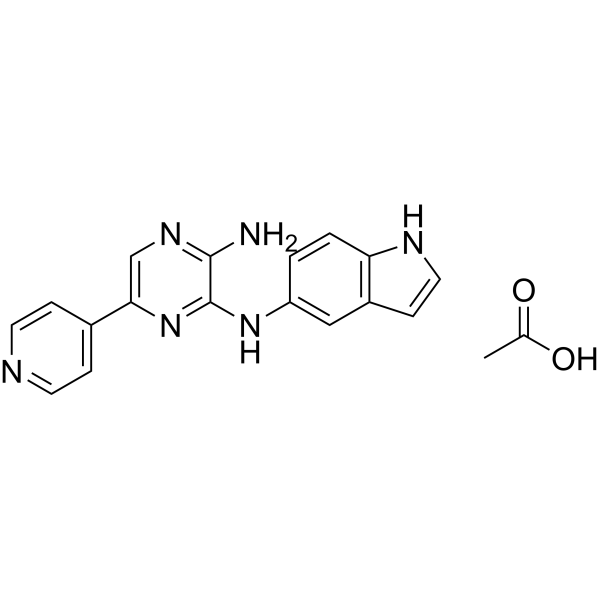
AKN-028 acetate

Based on 1 Customer Validation
AKN-028 acetate, a novel tyrosine kinase (TK) inhibitor, is a potent, orally active FMS-like receptor tyrosine kinase 3 (FLT3) inhibitor with an IC50 value of 6 nM. AKN-028 acetate inhibits FLT3 autophosphorylation. AKN-028 acetate induces dose-dependent cytotoxic response (mean IC50=1 μM). AKN-028 acetate induces apoptosisby activation of caspase 3. AKN-028 acetate can be used in research of acute myeloid leukemia (AML).
연구목적의 판매만을 진행합니다. 환자를 대상으로 한 판매는 하지 않습니다.
- Purity : 98.38%
- 화학식: C19H18N6O2
- 분자량:362.39
-
보관:
4°C, sealed storage, away from moisture
* In solvent : -80°C, 6 months; -20°C, 1 month (sealed storage, away from moisture)

To place orders, for customer services and technical support, please contact: MedChemExpress USA
Tel: 609-228-6898 E-mail: [email protected] [email protected]


-
 Biological Activity
-
Chemical Information
-
용액&용해도
- Protocol
- 순도&문서
- References
-
 Help & FAQs


All Caspase Isoforms
More

Biological Activity
제품 설명
IC50 & Target
IC50: 6 nM (FLT3), 140 nM (CLK1), 220 nM (RPS6KA), 520 nM (VEGFR2), and 120 nM (FGFR2)[1]
In Vitro
AKN-028 (0.1 nM-100 μM; 15 h; mouse embryonal fibroblasts and human acute megakaryoblastic leukemia M07 cells) acetate inhibits FLT3 and KIT autophosphorylation in a dose-dependent manner[1].
AKN-028 (10 μM; 72 h; tumor cell lines) acetate is cytotoxic to AML cell lines and induces apoptosis in the AML cell line MV4-11[1].
MedChemExpress (MCE) has not independently confirmed the accuracy of these methods. They are for reference only. Further protocols information, click here.
-
Cell Line:Tumor cell lines
-
Concentration:10 μM
-
Incubation Time:72 hours
-
Result:Had cytotoxic activity was highest in MV4-11 and MOLM-13 (IC50<50 nM), followed by the three other AML cell lines (IC50=0.5-6 μM).
-
Cell Line:Mouse embryonal fibroblasts either overexpressing FLT-wt, FLT3-TKD or FLT3-ITD and human acute megakaryoblastic leukemia M07 cells overexpressing KIT
-
Concentration:0.1 nM-100 μM
-
Incubation Time:15 hours
-
Result:Inhibited FLT3 and KIT autophosphorylation.
In Vivo
MedChemExpress (MCE) has not independently confirmed the accuracy of these methods. They are for reference only.
-
Animal Model:Male C57 black mice with MV4-11 xenografts[1]
-
Dosage:15 mg/kg
-
Administration:Subcutaneous injection; twice daily, for 6 days
-
Result:Inhibited tumor growth and did not affect body weight.


Chemical Information
-
Appearance Solid
-
분자량 362.39
-
화학식 C19H18N6O2
-
Color Brown to orange
-
SMILES
NC1=NC=C(N=C1NC2=CC3=C(C=C2)NC=C3)C4=CC=NC=C4.CC(O)=O
-
선적
Room temperature in continental US; may vary elsewhere.
-
보관
4°C, sealed storage, away from moisture
* In solvent : -80°C, 6 months; -20°C, 1 month (sealed storage, away from moisture)


용액&용해도
In Vitro:
DMSO : 100 mg/mL (275.95 mM; Need ultrasonic; Hygroscopic DMSO has a significant impact on the solubility of product, please use newly opened DMSO)
Please refer to the solubility information to select the appropriate solvent. Once prepared, please aliquot and store the solution to prevent product inactivation from repeated freeze-thaw cycles.
Storage method and period of stock solution: -80°C, 6 months; -20°C, 1 month (sealed storage, away from moisture). When stored at -80°C, please use it within 6 months. When stored at -20°C, please use it within 1 month.
Please refer to the solubility information to select the appropriate solvent. Once prepared, please aliquot and store the solution to prevent product inactivation from repeated freeze-thaw cycles.
Storage method and period of stock solution: -80°C, 6 months; -20°C, 1 month (sealed storage, away from moisture). When stored at -80°C, please use it within 6 months. When stored at -20°C, please use it within 1 month.
Concentration (start) × Volume (start) = Concentration (final) × Volume (final)

Protocol
-
Apoptosis Solutions
Apoptosis is a regulated, generally non-lytic cell-death pathway that removes unwanted, damaged, infected, or abnormal cells through coordinated morphological changes, caspase activation, DNA fragmentation, and membrane remodeling. The intrinsic apoptosis pathway is controlled mainly by mitochondrial outer membrane permeabilization, BCL-2 family proteins, cytochrome c release, apoptosome formation, caspase-9 activation, and downstream executioner caspase-3/7 activation. The extrinsic apoptosis pathway is initiated by death receptors such as Fas, TNFR, and TRAIL receptors, which recruit adaptor proteins and activate caspase-8 before engaging executioner caspases or mitochondrial amplification through BID cleavage. Apoptosis is linked to many phenotypes, including cancer cell killing, tissue homeostasis, immune regulation, neurodegeneration, infection response, and treatment-induced cytotoxicity; unresolved questions include how apoptosis interacts with necroptosis, pyroptosis, ferroptos
-
Cell Viability Determination by MTT Colorimetric Assay
The following protocol uses the MTT colorimetric assay as a classic literature-established method for assessing cell viability/metabolic activity in cultured mammalian cells. MTT[3-(4,5-dimethylthiazol-2-yl)-2,5-diphenyltetrazolium bromide] is reduced by metabolically active cells to a colored formazan product; the amount of formazan is quantified spectrophotometrically and provides an indirect measure of metabolically active viable cells. Importantly, MTT reduction reflects cellular oxidoreductase/metabolic activity rather than an absolute direct count of living cells, so changes in cellular metabolism can alter the signal independently of cell number.


순도&문서
-
Data Sheet (272 KB)
-
SDS (251 KB)
- English - EN (251 KB)
- Français - FR (251 KB)
- Deutsch - DE (251 KB)
- Norwegian - NO (251 KB)
- Español - ES (251 KB)
- Swedish - SV (251 KB)
- Italian - IT (251 KB)
- Korean - KR (251 KB)
- Portuguese - PT (251 KB)
-
Handling Instructions (2659 KB)
References


Complete Stock Solution Preparation Table
Please refer to the solubility information to select the appropriate solvent. Once prepared, please aliquot and store the solution to prevent product inactivation from repeated freeze-thaw cycles.
Storage method and period of stock solution: -80°C, 6 months; -20°C, 1 month (sealed storage, away from moisture). When stored at -80°C, please use it within 6 months. When stored at -20°C, please use it within 1 month.
| Optional Solvent | Concentration Solvent Mass | 1 mg | 5 mg | 10 mg | 25 mg |
|---|---|---|---|---|---|
| DMSO | 1 mM | 2.7595 mL | 13.7973 mL | 27.5946 mL | 68.9864 mL |
| 5 mM | 0.5519 mL | 2.7595 mL | 5.5189 mL | 13.7973 mL | |
| 10 mM | 0.2759 mL | 1.3797 mL | 2.7595 mL | 6.8986 mL | |
| 15 mM | 0.1840 mL | 0.9198 mL | 1.8396 mL | 4.5991 mL | |
| 20 mM | 0.1380 mL | 0.6899 mL | 1.3797 mL | 3.4493 mL | |
| 25 mM | 0.1104 mL | 0.5519 mL | 1.1038 mL | 2.7595 mL | |
| 30 mM | 0.0920 mL | 0.4599 mL | 0.9198 mL | 2.2995 mL | |
| 40 mM | 0.0690 mL | 0.3449 mL | 0.6899 mL | 1.7247 mL | |
| 50 mM | 0.0552 mL | 0.2759 mL | 0.5519 mL | 1.3797 mL | |
| 60 mM | 0.0460 mL | 0.2300 mL | 0.4599 mL | 1.1498 mL | |
| 80 mM | 0.0345 mL | 0.1725 mL | 0.3449 mL | 0.8623 mL | |
| 100 mM | 0.0276 mL | 0.1380 mL | 0.2759 mL | 0.6899 mL |


AKN-028 acetate Related Classifications
HY-118304B Related Classifications
 Powered by Bioz