



(R)-CR8
Based on 3 publication(s) in Google Scholar
(R)-CR8, a second-generation analog of Roscovitine, is a potent CDK1/2/5/7/9 inhibitor. (R)-CR8 inhibits CDK1/cyclin B (IC50=0.09 μM), CDK2/cyclin A (0.072 μM), CDK2/cyclin E (0.041 μM), CDK5/p25 (0.11 μM), CDK7/cyclin H (1.1 μM), CDK9/cyclin T (0.18 μM) and CK1δ/ε (0.4 μM). (R)-CR8 induces apoptosis and has neuroprotective effect. (R)-CR8 acts as a molecular glue degrader that depletes cyclin K.
Nur für Forschungszwecke. Wir verkaufen nicht an Patienten.
- Reinheit : 99.52%
- CAS. Nr.: 294646-77-8
- Formel: C24H29N7O
- Molecular Weight:431.53
-
Speicherung:Powder -20°C, 3 years , 4°C, 2 years ; In solvent -80°C, 6 months , -20°C, 1 month

To place orders, for customer services and technical support, please contact: MedChemExpress USA
Tel: 609-228-6898 E-mail: [email protected] [email protected]


-
 Biologische Aktivität
-
Chemical Information
-
Lösungsmittel & Löslichkeit
- Protokoll
- Reinheit & Dokumentation
- Verweise
-
 Help & FAQs


-
HY-130250
SR-4835CDK12/13 Inhibitor -
HY-144981
HQ461Cyclin K Degrader -
HY-70062
PevonedistatNAE Inhibitor -
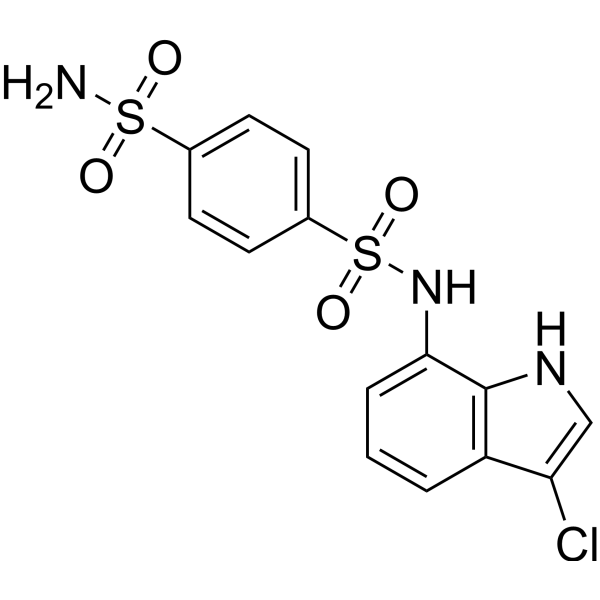
HY-13650
IndisulamCarbonic Anhydrase Inhibitor/RBM39 Molecular Glue Degrader -
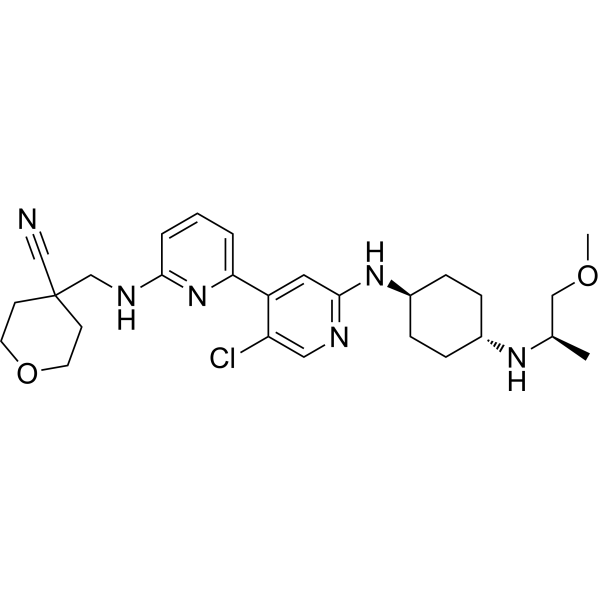
HY-12214A
NVP-2CDK9 Inhibitor -
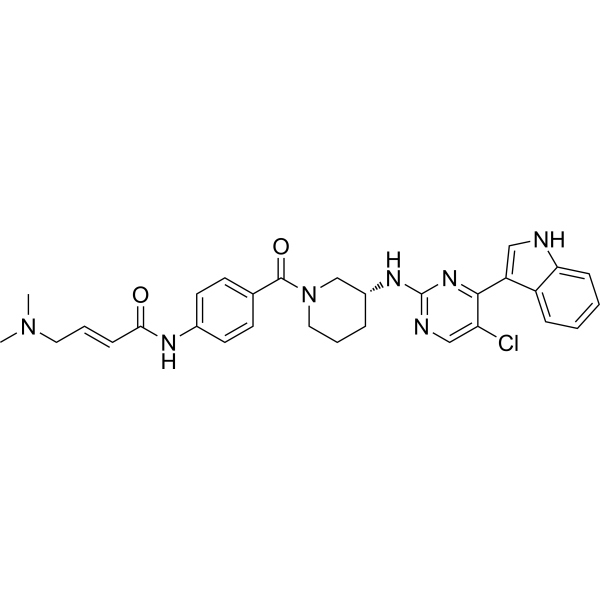
HY-103618
THZ531CDK12/13 Inhibitor -
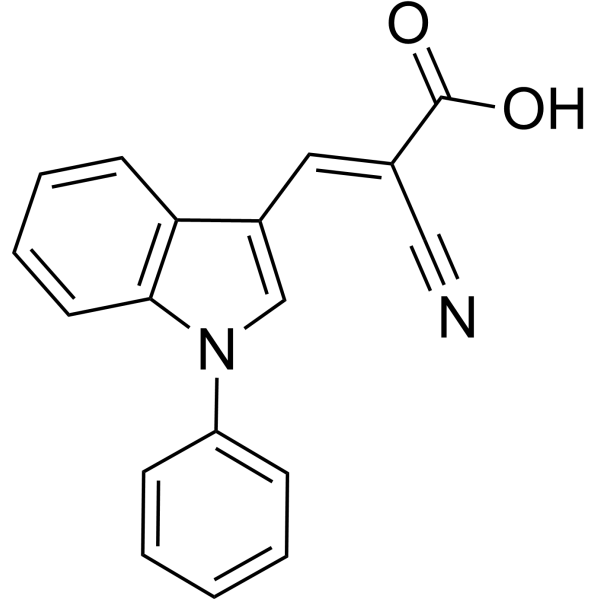
HY-15475
UK-5099Mitochondrial Pyruvate Carrier Inhibitor -
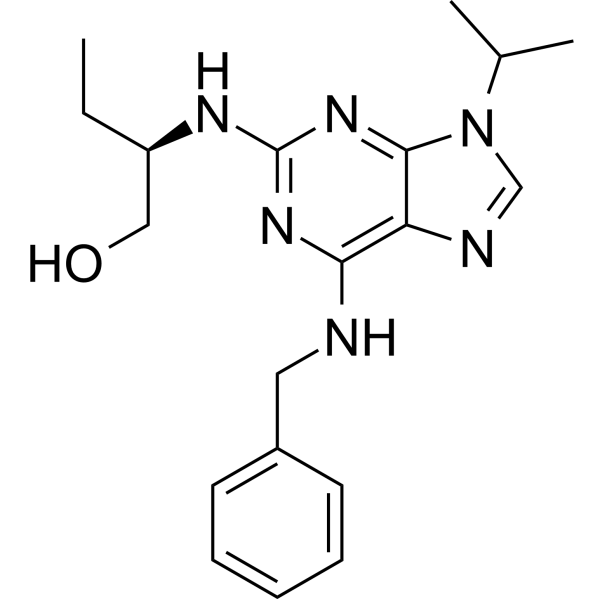
HY-30237
(R)-RoscovitineCDKs Inhibitor -
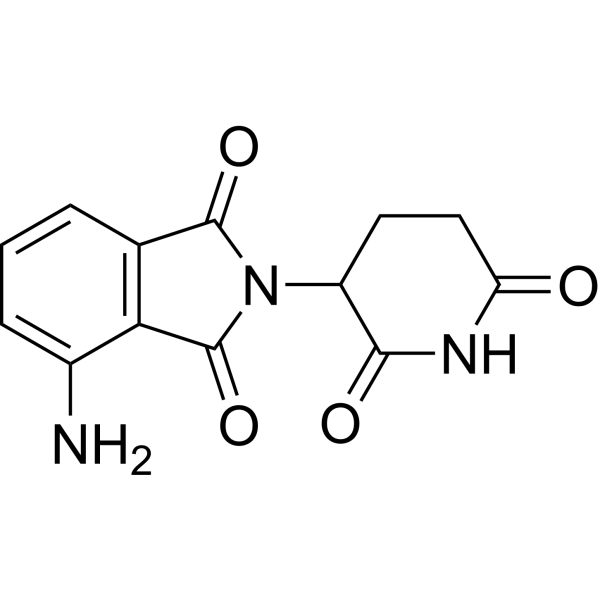
HY-10984
PomalidomideImmunomodulatory Agent -
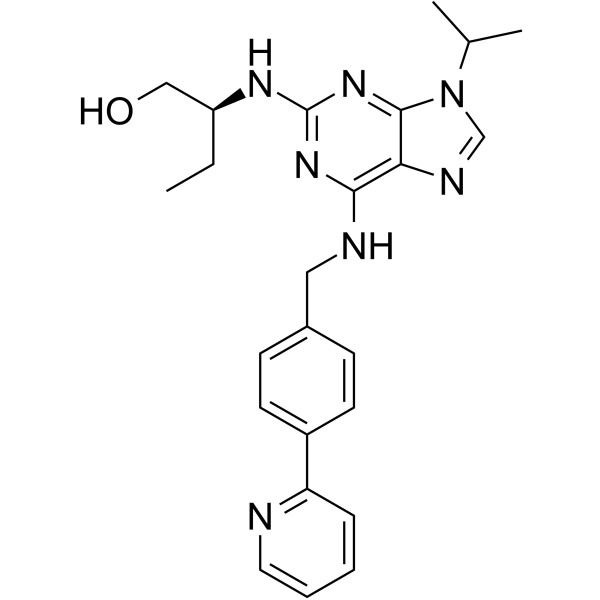
HY-112371
(S)-CR8CDK Inhibitor -
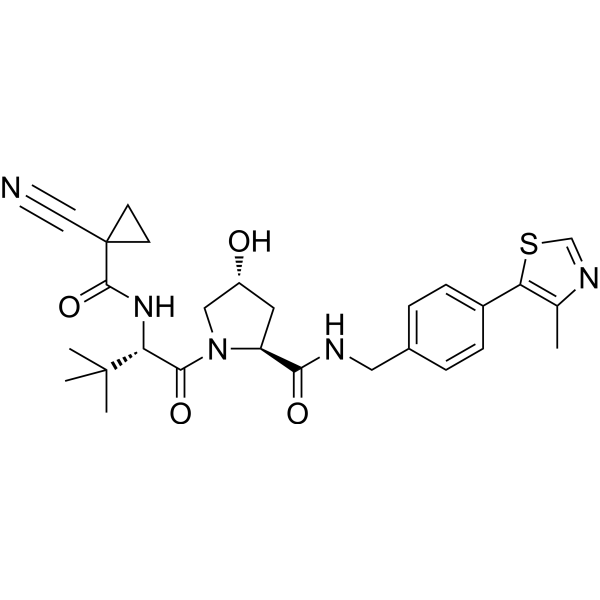
HY-100947
VH-298VHL:HIF-α Interaction Inhibitor -
HY-14571
E7820Angiogenesis Inhibitor
Publications Citing Use of MedChemExpress (MCE) (R)-CR8
More

Biologische Aktivität
Beschreibung
IC50 & Target
[1]|
Cdk1/cyclin B 0.09 μM (IC50) |
cdk2/cyclin A 0.072 μM (IC50) |
CDK2/cyclinE 0.041 μM (IC50) |
Cdk5/p25 0.11 μM (IC50) |
CDK7/cyclin H 1.1 μM (IC50) |
CDK9/Cyclin T 0.18 μM (IC50) |
CK1δ/ε 0.4 μM (IC50) |
Cellular Effect
|
Cell Line

|
Type | Value | Description | References |
|---|---|---|---|---|
| G-361 | IC50 |
0.503 μM
Compound: CR8
|
Cytotoxicity against human G361 cells assessed as reduction in cell viability after 72 hrs by calcein AM staining based fluorescence assay
Cytotoxicity against human G361 cells assessed as reduction in cell viability after 72 hrs by calcein AM staining based fluorescence assay
|
[PMID: 26851505] |
| HCT-116 | IC50 |
0.35 μM
Compound: CR8
|
Cytotoxicity against human HCT116 cells assessed as reduction in cell viability after 72 hrs by calcein AM staining based fluorescence assay
Cytotoxicity against human HCT116 cells assessed as reduction in cell viability after 72 hrs by calcein AM staining based fluorescence assay
|
[PMID: 26851505] |
| HEK293 | IC50 |
0.56 μM
Compound: 8m, (R)-C&R8
|
Antiproliferative activity against HEK293 cells assessed as survival after 48 hrs by MTS reduction assay
Antiproliferative activity against HEK293 cells assessed as survival after 48 hrs by MTS reduction assay
|
[PMID: 18698753] |
| HT | GI50 |
0.263 μM
Compound: CR8
|
Antiproliferative activity against human HT cells measured after 72 hrs by calcein AM dye-based fluorescence assay
Antiproliferative activity against human HT cells measured after 72 hrs by calcein AM dye-based fluorescence assay
|
[PMID: 30943029] |
| K562 | IC50 |
0.175 μM
Compound: CR8
|
Cytotoxicity against human K562 cells assessed as reduction in cell viability after 72 hrs by calcein AM staining based fluorescence assay
Cytotoxicity against human K562 cells assessed as reduction in cell viability after 72 hrs by calcein AM staining based fluorescence assay
|
[PMID: 26851505] |
| MCF7 | IC50 |
0.16 μM
Compound: CR8
|
Cytotoxicity against human MCF7 cells assessed as reduction in cell viability after 72 hrs by calcein AM staining based fluorescence assay
Cytotoxicity against human MCF7 cells assessed as reduction in cell viability after 72 hrs by calcein AM staining based fluorescence assay
|
[PMID: 26851505] |
| Sf9 | IC50 |
0.062 μM
Compound: CR8
|
Inhibition of CDK2/Cyclin E (unknown origin) expressed in sf9 cells using histone H1 as substrate in presence of [gamma33P]-ATP
Inhibition of CDK2/Cyclin E (unknown origin) expressed in sf9 cells using histone H1 as substrate in presence of [gamma33P]-ATP
|
[PMID: 26851505] |
| Sf9 | IC50 |
0.062 μM
Compound: CR8
|
Inhibition of His-tagged CDK2/Cyclin-E1 (unknown origin) expressed in baculovirus infected Sf9 insect cells using histone H1 as substrate measured in presence of [gamma-33P]ATP
Inhibition of His-tagged CDK2/Cyclin-E1 (unknown origin) expressed in baculovirus infected Sf9 insect cells using histone H1 as substrate measured in presence of [gamma-33P]ATP
|
[PMID: 30943029] |
| Sf9 | IC50 |
0.225 μM
Compound: CR8
|
Inhibition of recombinant human full-length N-terminal GST-His6 fused CDK5 (M1 to P292 residues)/N-terminal His6-tagged p25 (A104 to R307 residues) expressed in baculovirus infected Sf9 insect cells using histone H1 as substrate measured in presence of [g
Inhibition of recombinant human full-length N-terminal GST-His6 fused CDK5 (M1 to P292 residues)/N-terminal His6-tagged p25 (A104 to R307 residues) expressed in baculovirus infected Sf9 insect cells using histone H1 as substrate measured in presence of [g
|
[PMID: 30943029] |
| Sf9 | IC50 |
0.272 μM
Compound: CR8
|
Inhibition of recombinant human N-terminal GST-His6-fused CDK9 (M1 to F372 residues)/N-terminal His6-tagged cyclin T1 (M1 to K726 residues) expressed in baculovirus infected Sf9 insect cells using (YSPTSPS)2KK as substrate measured in presence of [gamma-3
Inhibition of recombinant human N-terminal GST-His6-fused CDK9 (M1 to F372 residues)/N-terminal His6-tagged cyclin T1 (M1 to K726 residues) expressed in baculovirus infected Sf9 insect cells using (YSPTSPS)2KK as substrate measured in presence of [gamma-3
|
[PMID: 30943029] |
| Sf9 | IC50 |
0.787 μM
Compound: CR8
|
Inhibition of His-tagged CDK1/Cyclin-B1 (unknown origin) expressed in baculovirus infected Sf9 insect cells using histone H1 as substrate measured in presence of [gamma-33P]ATP
Inhibition of His-tagged CDK1/Cyclin-B1 (unknown origin) expressed in baculovirus infected Sf9 insect cells using histone H1 as substrate measured in presence of [gamma-33P]ATP
|
[PMID: 30943029] |
| Sf9 | IC50 |
1.769 μM
Compound: CR8
|
Inhibition of recombinant human N-terminal GST-His6-fused CDK7 (M1 to F346 residues)/N-terminal His-tagged cyclin H (M1 to L323 residues)/N-terminal His6-tagged MAT1 (M1 to S306 residues) expressed in baculovirus infected Sf9 insect cells using (YSPTSPS)2
Inhibition of recombinant human N-terminal GST-His6-fused CDK7 (M1 to F346 residues)/N-terminal His-tagged cyclin H (M1 to L323 residues)/N-terminal His6-tagged MAT1 (M1 to S306 residues) expressed in baculovirus infected Sf9 insect cells using (YSPTSPS)2
|
[PMID: 30943029] |
| Sf9 | IC50 |
26.09 μM
Compound: CR8
|
Inhibition of recombinant human N-terminal GST-fused CDK4 (S4 to E303 residues)/cyclin D1 (Q4 to I295 residues) expressed in baculovirus infected Sf9 insect cells using RPPTLSPIPHIPR as substrate measured in presence of [gamma-33P]ATP
Inhibition of recombinant human N-terminal GST-fused CDK4 (S4 to E303 residues)/cyclin D1 (Q4 to I295 residues) expressed in baculovirus infected Sf9 insect cells using RPPTLSPIPHIPR as substrate measured in presence of [gamma-33P]ATP
|
[PMID: 30943029] |
| SH-SY5Y | IC50 |
0.43 μM
Compound: 8m, (R)-C&R8
|
Antiproliferative activity against human SH-SY5Y cells assessed as survival after 48 hrs by MTS reduction assay
Antiproliferative activity against human SH-SY5Y cells assessed as survival after 48 hrs by MTS reduction assay
|
[PMID: 18698753] |
In Vitro
(R)-CR8 (CR8) (0.1-100 μM; 48 hours) is a potent inducer of apoptotic cell death with an IC50 of 0.49 μM for SH-SY5Y cell line[1].
(R)-CR8 (0.25-10 μM) induces a dose-dependent induction of poly-(ADP-ribose)polymerase (PARP) cleavage[1].
The CDK-bound form of (R)-CR8 has a solvent-exposed pyridyl moiety that induces the formation of a complex between CDK12-cyclin K and the CUL4 adaptor protein DDB1, bypassing the requirement for a substrate receptor and presenting cyclin K for ubiquitination and degradation[3].
MedChemExpress (MCE) has not independently confirmed the accuracy of these methods. They are for reference only.
-
Cell Line:SH-SY5Y cell line
-
Concentration:0.1, 1, 10, 100 μM
-
Incubation Time:24 hours
-
Result:Reduced cell survival in a dose-dependent manner.
In Vivo
MedChemExpress (MCE) has not independently confirmed the accuracy of these methods. They are for reference only.
-
Animal Model:Adult (10 to 12 weeks old) male Sprague-Dawley rats (310 to 330 g)[2]
-
Dosage:i.p.
-
Administration:5 mg/Kg
-
Result:Resulted in a significant reduction in lesion size.
Clinical Trial
| NCT Number | Sponsor | Condition | Start Date |
Phase
|
|---|---|---|---|---|
| NCT01329991 | Plexxikon| | 2011-05 | PHASE1 |


Chemical Information
-
CAS. Nr. 294646-77-8
-
Appearance Solid
-
Molecular Weight 431.53
-
Formel C24H29N7O
-
Color White to off-white
-
SMILES
CC[C@@H](NC1=NC(NCC2=CC=C(C3=NC=CC=C3)C=C2)=C4N=CN(C(C)C)C4=N1)CO
-
Synonyms
CR8, (R)-Isomer
-
Versand
Room temperature in continental US; may vary elsewhere.
-
Speicherung
Powder -20°C 3 years 4°C 2 years In solvent -80°C 6 months -20°C 1 month


Publications (3)
-
Journal Impact Factor
-
Most Recent
-
Sci Adv
Cyclin K condensates bridge CDK12 to phosphorylate and drive oncogenic YAP activation in hepatocellular carcinoma. [Abstract]2026 Jul 3;12(27):eaec6492. PMID: 42397909 -
-
Structure
CAND1 and CAND2 drive CUL4 substrate receptor exchange with largely comparable biochemical efficiency, unlike their relative effects on CUL1. [Abstract]2026 Mar 20:S0969-2126(26)00056-0. PMID: 41864201


Lösungsmittel & Löslichkeit
In Vitro:
DMSO : 50 mg/mL (115.87 mM; ultrasonic and warming and heat to 60°C; Hygroscopic DMSO has a significant impact on the solubility of product, please use newly opened DMSO)
Please refer to the solubility information to select the appropriate solvent. Once prepared, please aliquot and store the solution to prevent product inactivation from repeated freeze-thaw cycles.
Storage method and period of stock solution: -80°C, 6 months; -20°C, 1 month. When stored at -80°C, please use it within 6 months. When stored at -20°C, please use it within 1 month.
Please refer to the solubility information to select the appropriate solvent. Once prepared, please aliquot and store the solution to prevent product inactivation from repeated freeze-thaw cycles.
Storage method and period of stock solution: -80°C, 6 months; -20°C, 1 month. When stored at -80°C, please use it within 6 months. When stored at -20°C, please use it within 1 month.
Konzentration (Stammlösung) × Volumen (Stammlösung) = Konzentration (Ziellösung) × Volumen (Ziellösung)


Reinheit & Dokumentation
-
Data Sheet (277 KB)
-
SDS (393 KB)
- English - EN (393 KB)
- Français - FR (393 KB)
- Deutsch - DE (393 KB)
- Norwegian - NO (393 KB)
- Español - ES (393 KB)
- Swedish - SV (393 KB)
- Italian - IT (393 KB)
- Korean - KR (393 KB)
- Portuguese - PT (393 KB)
-
Handling Instructions (2659 KB)
Verweise
[1]. Bettayeb K, et al. CR8, a potent and selective, roscovitine-derived inhibitor of cyclin-dependent kinases. Oncogene. 2008 Oct 2;27(44):5797-807. [Content Brief]
[2]. Kabadi SV, et al. CR8, a novel inhibitor of CDK, limits microglial activation, astrocytosis, neuronal loss, and neurologic dysfunction after experimental traumatic brain injury. J Cereb Blood Flow Metab. 2014 Mar;34(3):502-13. [Content Brief]
[3]. Słabicki M, et al. The CDK inhibitor CR8 acts as a molecular glue degrader that depletes cyclin K [published online ahead of print, 2020 Jun 3]. Nature. 2020;10.1038/s41586-020-2374-x. [Content Brief]


Complete Stock Solution Preparation Table
Please refer to the solubility information to select the appropriate solvent. Once prepared, please aliquot and store the solution to prevent product inactivation from repeated freeze-thaw cycles.
Storage method and period of stock solution: -80°C, 6 months; -20°C, 1 month. When stored at -80°C, please use it within 6 months. When stored at -20°C, please use it within 1 month.
| Optional Solvent | Concentration Solvent Mass | 1 mg | 5 mg | 10 mg | 25 mg |
|---|---|---|---|---|---|
| DMSO | 1 mM | 2.3173 mL | 11.5867 mL | 23.1734 mL | 57.9334 mL |
| 5 mM | 0.4635 mL | 2.3173 mL | 4.6347 mL | 11.5867 mL | |
| 10 mM | 0.2317 mL | 1.1587 mL | 2.3173 mL | 5.7933 mL | |
| 15 mM | 0.1545 mL | 0.7724 mL | 1.5449 mL | 3.8622 mL | |
| 20 mM | 0.1159 mL | 0.5793 mL | 1.1587 mL | 2.8967 mL | |
| 25 mM | 0.0927 mL | 0.4635 mL | 0.9269 mL | 2.3173 mL | |
| 30 mM | 0.0772 mL | 0.3862 mL | 0.7724 mL | 1.9311 mL | |
| 40 mM | 0.0579 mL | 0.2897 mL | 0.5793 mL | 1.4483 mL | |
| 50 mM | 0.0463 mL | 0.2317 mL | 0.4635 mL | 1.1587 mL | |
| 60 mM | 0.0386 mL | 0.1931 mL | 0.3862 mL | 0.9656 mL | |
| 80 mM | 0.0290 mL | 0.1448 mL | 0.2897 mL | 0.7242 mL | |
| 100 mM | 0.0232 mL | 0.1159 mL | 0.2317 mL | 0.5793 mL |


(R)-CR8 Related Classifications
HY-18340 Related Classifications
 Powered by Bioz