



Anethole
Based on 2 publication(s) in Google Scholar
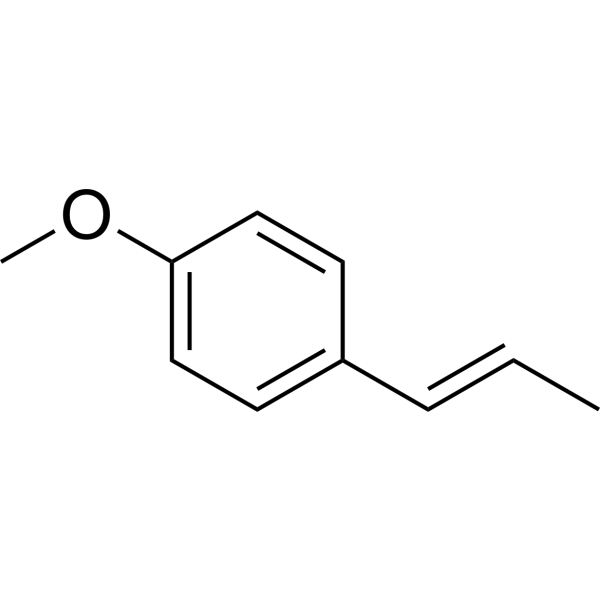
Anethole is a type of orally active aromatic compound that is widely found in nature and used as a flavoring agent. Anethole possesses anticancer, anti-inflammatory, antioxidant, antibacterial, antifungal, anesthetic, estrogenic, central nervous system depressant, hypnotic, insecticidal, and gastroprotective effects. Anethole can be used in the study of oxidative stress-related skin diseases and prostate cancer.
For research use only. We do not sell to patients.
- Purity : 99.81%
- CAS No.: 104-46-1
- Formula: C10H12O
- Molecular Weight:148.21
-
Storage:Pure form -20°C, 3 years , 4°C, 2 years ; In solvent -80°C, 6 months , -20°C, 1 month

To place orders, for customer services and technical support, please contact: MedChemExpress USA
Tel: 609-228-6898 E-mail: [email protected] [email protected]


-
 Biological Activity
-
Chemical Information
-
Solvent & Solubility
- Protocols
- Purity & Documentation
- References
-
 Help & FAQs




Publications Citing Use of MedChemExpress (MCE) Anethole
More

Biological Activity
Description
IC50 & Target
|
MMP-9 |
Cellular Effect
|
Cell Line

|
Type | Value | Description | References |
|---|---|---|---|---|
| MG-63 | GI50 |
60.25 μM
Compound: 32
|
Antiproliferative activity against human MG-63 cells assessed as growth inhibition by MTT assay
Antiproliferative activity against human MG-63 cells assessed as growth inhibition by MTT assay
|
[PMID: 36858050] |
In Vitro
Anethole (0.5-1 μM; 1 h) can inhibit H2O2 (300 Μm; 24 h)-induced apoptosis and viability loss in human skin fibroblasts CRL1474[2].
Anethole has synergistic effects on the antifungal activities of phytochemicals including polygodial and 2E-undecenal against Saccharomyces cerevisiae and Candida albicans[3].
MedChemExpress (MCE) has not independently confirmed the accuracy of these methods. They are for reference only.
-
Cell Line:CRL1474 (human skin fibroblasts)
-
Concentration:0.5 µM, 1 µM, 10 µM. After H2O2treatment (300 μM; 24 h)
-
Incubation Time:1 h
-
Result:Inhibited H2O2-induced cytotoxicity.
In Vivo
Anethole (250-1000 mg/kg; P.O.; Once every other day for 60 consecutive days) has anti-tumor effects in Ehrlich ascites tumor Swiss albino mice[5].
MedChemExpress (MCE) has not independently confirmed the accuracy of these methods. They are for reference only.
-
Animal Model:BALB/C mice model induced by LPS[4]
-
Dosage:62.5 mg/kg, 125 mg/kg, 250 mg/kg, 500 mg/kg
-
Administration:Intraperitoneal injection (i.p.), single dose. After LPS treatment (1.5 mg/kg; intratracheal injection, single dose).
-
Result:Decreased total protein concentration.
Decreased numbers of inflammatory cells including neutrophils and macrophages.
Decreased the inflammatory mediators MMP-9, TNF-α, NO.
Decreased LPS-induced histopathological changes.
Suppressed the activation of NF-κB by blocking IκB-α degradation.
-
Animal Model:Ehrlich ascites tumour (ETC) Swiss albino mouse model[5]
-
Dosage:250 mg/kg; 500 mg/kg; 1000 mg/kg
-
Administration:Oral gavage (p.o.); Once every other day for 60 consecutive days. After implantation of ETC cells (2.5×10⁶ cells/mouse) into the right hind paw muscle of mice.
-
Result:Reduced tumor weight and volume in mice.
Prolonged the survival time of ETC mice.


Chemical Information
-
CAS No. 104-46-1
-
Appearance <20°C Solid,>21°C Liquid
-
Molecular Weight 148.21
-
Formula C10H12O
-
Color Colorless to off-white
-
SMILES
C/C=C/C1=CC=C(OC)C=C1
-
Synonyms
Anise camphor; p-Propenylanisole; Isoestragole
-
Structure Classification
-
Shipping
Room temperature in continental US; may vary elsewhere.
-
Storage
Pure form -20°C 3 years 4°C 2 years In solvent -80°C 6 months -20°C 1 month


Publications (2)
-
Journal Impact Factor
-
Most Recent
-
Int Immunopharmacol
Anethole inhibits RANKL-induced osteoclastogenesis by downregulating ERK/AKT signaling and prevents ovariectomy-induced bone loss in vivo. [Abstract]2021 Nov:100:108113. PMID: 34530203 -
Toxicol In Vitro
Inhibitory potential of phytochemicals on species-specific breast cancer resistance protein transport activity. [Abstract]2025 Dec:109:106128. PMID: 40796067


Solvent & Solubility
In Vitro:
DMSO : 100 mg/mL (674.72 mM; Need ultrasonic; Hygroscopic DMSO has a significant impact on the solubility of product, please use newly opened DMSO)
Please refer to the solubility information to select the appropriate solvent. Once prepared, please aliquot and store the solution to prevent product inactivation from repeated freeze-thaw cycles.
Storage method and period of stock solution: -80°C, 6 months; -20°C, 1 month. When stored at -80°C, please use it within 6 months. When stored at -20°C, please use it within 1 month.
Please refer to the solubility information to select the appropriate solvent. Once prepared, please aliquot and store the solution to prevent product inactivation from repeated freeze-thaw cycles.
Storage method and period of stock solution: -80°C, 6 months; -20°C, 1 month. When stored at -80°C, please use it within 6 months. When stored at -20°C, please use it within 1 month.
Concentration (start) × Volume (start) = Concentration (final) × Volume (final)
In Vivo:
Select the appropriate dissolution method based on your experimental animal and administration route.
- For the following dissolution methods, please ensure to first prepare a clear stock solution using an In Vitro approach and then sequentially add co-solvents:
- To ensure reliable experimental results, the clarified stock solution can be appropriately stored based on storage conditions. As for the working solution for In Vivo experiments, it is recommended to prepare freshly and use it on the same day.
- The percentages shown for the solvents indicate their volumetric ratio in the final prepared solution. If precipitation or phase separation occurs during preparation, heat and/or sonication can be used to aid dissolution.
Add each solvent one by one: 10% DMSO 40% PEG300 5% Tween-80 45% Saline
Solubility: ≥ 2.5 mg/mL (16.87 mM); Clear solution
This protocol yields a clear solution of ≥ 2.5 mg/mL (saturation unknown).
Taking 1 mL working solution as an example, add 100 μL DMSO stock solution (25.0 mg/mL) to 400 μL PEG300, and mix evenly; then add 50 μL Tween-80 and mix evenly; then add 450 μL Saline to adjust the volume to 1 mL.
Preparation of Saline: Dissolve 0.9 g sodium chloride in ddH₂O and dilute to 100 mL to obtain a clear Saline solution.
Add each solvent one by one: 10% DMSO 90% (20% SBE-β-CD in Saline)
Solubility: ≥ 2.5 mg/mL (16.87 mM); Clear solution
This protocol yields a clear solution of ≥ 2.5 mg/mL (saturation unknown).
Taking 1 mL working solution as an example, add 100 μL DMSO stock solution (25.0 mg/mL) to 900 μL 20% SBE-β-CD in Saline, and mix evenly.
Preparation of 20% SBE-β-CD in Saline (4°C, storage for one week): 2 g SBE-β-CD powder is dissolved in 10 mL Saline, completely dissolve until clear.
In Vivo Dissolution Calculator
Please enter the basic information of animal experiments:
-
-
-
-
Recommended: Prepare an additional quantity of animals to account for potential losses during experiments.
Please enter your animal formula composition:
-
%DMSO +
Recommended: Keep the proportion of DMSO in working solution below 2% if your animal is weak.
-
%+
-
+%Tween-80 + +
-
%Saline +
The co-solvents required include: DMSO, . All of co-solvents are available by MedChemExpress (MCE). , Tween 80. All of co-solvents are available by MedChemExpress (MCE).
Working solution concentration: 0.22 mg/mL
Method for preparing stock solution: mg drug dissolved in μL DMSO. Stock solution concentration: mg/mL.
1. Take μL DMSO stock solution;
2. Add μL .
μL , mix evenly;
3. Then add μL Tween 80, mix evenly;
4. Then add μL
Please ensure that the stock solution in the first step is dissolved to a clear state, and add co-solvents in sequence. You can use ultrasonic heating (ultrasonic cleaner, recommended frequency 20-40 kHz), vortexing, etc. to assist dissolution.


Purity & Documentation
-
Data Sheet (277 KB)
-
SDS (393 KB)
- English - EN (393 KB)
- Français - FR (393 KB)
- Deutsch - DE (393 KB)
- Norwegian - NO (393 KB)
- Español - ES (393 KB)
- Swedish - SV (393 KB)
- Italian - IT (393 KB)
- Korean - KR (393 KB)
- Portuguese - PT (393 KB)
-
Handling Instructions (2659 KB)
References
[1]. Freire R S, et al. Synthesis and antioxidant, anti-inflammatory and gastroprotector activities of anethole and related compounds[J]. Bioorganic & medicinal chemistry, 2005, 13(13): 4353-4358. [Content Brief]
[2]. Galicka A, Krętowski R, Nazaruk J, et al. Anethole prevents hydrogen peroxide-induced apoptosis and collagen metabolism alterations in human skin fibroblasts[J]. Molecular and Cellular Biochemistry, 2014, 394: 217-224. [Content Brief]
[3]. Fujita K, et al. Anethole, a potential antimicrobial synergist, converts a fungistatic dodecanol to a fungicidal agent[J]. Phytotherapy Research: An International Journal Devoted to Pharmacological and Toxicological Evaluation of Natural Product Derivatives, 2007, 21(1): 47-51. [Content Brief]
[4]. Kang P, et al. Anti-inflammatory effects of anethole in lipopolysaccharide-induced acute lung injury in mice[J]. Life sciences, 2013, 93(24): 955-961. [Content Brief]
[5]. Al-Harbi M M, et al. Influence of anethole treatment on the tumour induced by Ehrlich ascites carcinoma cells in paw of Swiss albino mice[J]. European Journal of Cancer Prevention, 1995, 4(4): 307-318. [Content Brief]


Complete Stock Solution Preparation Table
Please refer to the solubility information to select the appropriate solvent. Once prepared, please aliquot and store the solution to prevent product inactivation from repeated freeze-thaw cycles.
Storage method and period of stock solution: -80°C, 6 months; -20°C, 1 month. When stored at -80°C, please use it within 6 months. When stored at -20°C, please use it within 1 month.
| Optional Solvent | Concentration Solvent Mass | 1 mg | 5 mg | 10 mg | 25 mg |
|---|---|---|---|---|---|
| DMSO | 1 mM | 6.7472 mL | 33.7359 mL | 67.4718 mL | 168.6796 mL |
| 5 mM | 1.3494 mL | 6.7472 mL | 13.4944 mL | 33.7359 mL | |
| 10 mM | 0.6747 mL | 3.3736 mL | 6.7472 mL | 16.8680 mL | |
| 15 mM | 0.4498 mL | 2.2491 mL | 4.4981 mL | 11.2453 mL | |
| 20 mM | 0.3374 mL | 1.6868 mL | 3.3736 mL | 8.4340 mL | |
| 25 mM | 0.2699 mL | 1.3494 mL | 2.6989 mL | 6.7472 mL | |
| 30 mM | 0.2249 mL | 1.1245 mL | 2.2491 mL | 5.6227 mL | |
| 40 mM | 0.1687 mL | 0.8434 mL | 1.6868 mL | 4.2170 mL | |
| 50 mM | 0.1349 mL | 0.6747 mL | 1.3494 mL | 3.3736 mL | |
| 60 mM | 0.1125 mL | 0.5623 mL | 1.1245 mL | 2.8113 mL | |
| 80 mM | 0.0843 mL | 0.4217 mL | 0.8434 mL | 2.1085 mL | |
| 100 mM | 0.0675 mL | 0.3374 mL | 0.6747 mL | 1.6868 mL |


Anethole Related Classifications
HY-B0900 Related Classifications
 Powered by Bioz
Keywords
- Anethole
- 104-46-1
- Anise camphor
- p-Propenylanisole
- Isoestragole
- Environmental Pollutants
- Fungal
- NF-κB
- MMP
- Apoptosis
- Bacterial
- CRL1474
- oxidative stress
- Skin diseases
- prostate cancer
- cancer
- Swiss albino mice
- Ehrlich ascites tumour
- food processing
- inflammation
- stomach protection
- bacteriological inhibition
- nervous system inhibition
- Inhibitor
- inhibitor
- inhibit