



Buparvaquone
Based on 8 publication(s) in Google Scholar
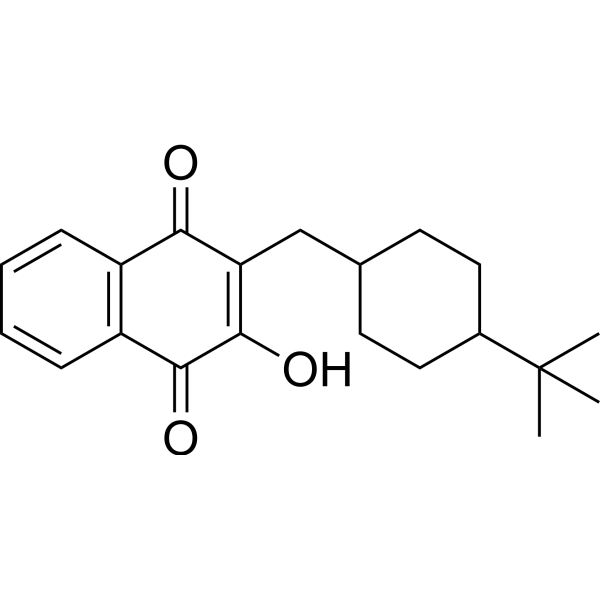
Buparvaquone is a hydroxynaphthoquinone antiprotozoal agent related to parvaquone and atovaquone.
Nos produits utilisent uniquement pour la recherche. Nous ne vendons pas aux patients.
- Pureté : 99.64%
- CAS No.: 88426-33-9
- Formule: C21H26O3
- Masse moléculaire:326.43
-
Stockage:Powder -20°C, 3 years , 4°C, 2 years ; In solvent -80°C, 2 years , -20°C, 1 year

To place orders, for customer services and technical support, please contact: MedChemExpress USA
Tel: 609-228-6898 E-mail: [email protected] [email protected]


-
 Activité biologique
-
Chemical Information
-
Solvant et solubilité
- Pureté et documentation
- Références
-
 Help & FAQs




Publications Citing Use of MedChemExpress (MCE) Buparvaquone
More- Antiviral Res. 2026 Jun:250:106417. [Abstract]
- Microb Pathog. 2025 Feb:199:107252. [Abstract]
- Parasit Vectors. 2022 Aug 30;15(1):308. [Abstract]
- Int J Parasitol Drugs Drug Resist. 2026 Aug:31:100657.
- Int J Parasitol Drugs Drug Resist. 2026 Apr 22:31:100646. [Abstract]
- PLoS One. 2024 Apr 16;19(4):e0299002. [Abstract]
- Free University of Berlin. 2025 Aug 4.
- Patent. US20210230642 A1.
Voir tous les produits spécifiques à Isoform Parasite
MoreVoir tous les produits spécifiques à Isoform Antibiotic
More

Activité biologique
Description
In Vitro
In 4-day proliferation assays, buparvaquone efficiently inhibits N. caninum tachyzoite replication(IC50=4.9 nM; IC100=100 nM)[1]. Buparvaquone is significantly selective against L. (L.) infantum chagasi intracellular amastigotes, with an IC50 value of 1.5 μM. Other cutaneous species are also susceptible to buparvaquone, with IC50 values in the range 1-4 μM[2].
MedChemExpress (MCE) has not independently confirmed the accuracy of these methods. They are for reference only.
In Vivo
MedChemExpress (MCE) has not independently confirmed the accuracy of these methods. They are for reference only.


Chemical Information
-
CAS No. 88426-33-9
-
Appearance Solid
-
Masse moléculaire 326.43
-
Formule C21H26O3
-
Color White to off-white
-
SMILES
O=C1C(CC2CCC(C(C)(C)C)CC2)=C(O)C(C3=C1C=CC=C3)=O
-
Livraison
Room temperature in continental US; may vary elsewhere.
-
Stockage
Powder -20°C 3 years 4°C 2 years In solvent -80°C 2 years -20°C 1 year


Publications (8)
-
Journal Impact Factor
-
Most Recent
-
Antiviral Res
Repurposing screen using a robust human rhinovirus infectious clone identifies pyrvinium pamoate with antiviral activity. [Abstract]2026 Jun:250:106417. PMID: 42025967 -
Microb Pathog
Upregulation of haematopoetic cell kinase (Hck) activity by a secreted parasite effector protein (Ta9) drives proliferation of Theileria annulata-transformed leukocytes. [Abstract]2025 Feb:199:107252. PMID: 39730099 -
Parasit Vectors
2022 Aug 30;15(1):308. PMID: 36042502 -
-
Int J Parasitol Drugs Drug Resist
In vitro and in vivo anti-piroplasm activity of PBT2 against Theileria annulata and Babesia microti. [Abstract]2026 Apr 22:31:100646. PMID: 42030593 -
PLoS One
A Theileria annulata parasite with a single mutation, methionine 128 to isoleucine (M128I), in cytochrome B is resistant to buparvaquone. [Abstract]2024 Apr 16;19(4):e0299002. PMID: 38626086 -
-


Solvant et solubilité
In Vitro:
DMSO : 25 mg/mL (76.59 mM; ultrasonic and warming and heat to 60°C; Hygroscopic DMSO has a significant impact on the solubility of product, please use newly opened DMSO)
DMF : 25 mg/mL (76.59 mM; Need ultrasonic)
Ethanol : 2 mg/mL (6.13 mM; Need ultrasonic)
H2O : < 0.1 mg/mL (insoluble)
Please refer to the solubility information to select the appropriate solvent. Once prepared, please aliquot and store the solution to prevent product inactivation from repeated freeze-thaw cycles.
Storage method and period of stock solution: -80°C, 2 years; -20°C, 1 year. When stored at -80°C, please use it within 2 years. When stored at -20°C, please use it within 1 year.
Please refer to the solubility information to select the appropriate solvent. Once prepared, please aliquot and store the solution to prevent product inactivation from repeated freeze-thaw cycles.
Storage method and period of stock solution: -80°C, 2 years; -20°C, 1 year. When stored at -80°C, please use it within 2 years. When stored at -20°C, please use it within 1 year.
Concentration (start) × Volume (start) = Concentration (final) × Volume (final)
In Vivo:
Select the appropriate dissolution method based on your experimental animal and administration route.
- For the following dissolution methods, please ensure to first prepare a clear stock solution using an In Vitro approach and then sequentially add co-solvents:
- To ensure reliable experimental results, the clarified stock solution can be appropriately stored based on storage conditions. As for the working solution for In Vivo experiments, it is recommended to prepare freshly and use it on the same day.
- The percentages shown for the solvents indicate their volumetric ratio in the final prepared solution. If precipitation or phase separation occurs during preparation, heat and/or sonication can be used to aid dissolution.
Add each solvent one by one: 10% DMF 90% (20% SBE-β-CD in Saline)
Solubility: ≥ 2.5 mg/mL (7.66 mM); Clear solution
In Vivo Dissolution Calculator
Please enter the basic information of animal experiments:
-
-
-
-
Recommended: Prepare an additional quantity of animals to account for potential losses during experiments.
Please enter your animal formula composition:
-
%DMSO +
Recommended: Keep the proportion of DMSO in working solution below 2% if your animal is weak.
-
%+
-
+%Tween-80 + +
-
%Saline +
The co-solvents required include: DMSO, . All of co-solvents are available by MedChemExpress (MCE). , Tween 80. All of co-solvents are available by MedChemExpress (MCE).
Working solution concentration: 0.22 mg/mL
Method for preparing stock solution: mg drug dissolved in μL DMSO. Stock solution concentration: mg/mL.
1. Take μL DMSO stock solution;
2. Add μL .
μL , mix evenly;
3. Then add μL Tween 80, mix evenly;
4. Then add μL
Please ensure that the stock solution in the first step is dissolved to a clear state, and add co-solvents in sequence. You can use ultrasonic heating (ultrasonic cleaner, recommended frequency 20-40 kHz), vortexing, etc. to assist dissolution.


Pureté et documentation
-
Fiche technique (276 KB)
-
SDS (393 KB)
- English - EN (393 KB)
- Français - FR (393 KB)
- Deutsch - DE (393 KB)
- Norwegian - NO (393 KB)
- Español - ES (393 KB)
- Swedish - SV (393 KB)
- Italian - IT (393 KB)
- Korean - KR (393 KB)
- Portuguese - PT (393 KB)
-
Instruction de manipulation (2659 KB)
Références
[1]. Müller J, et al. Buparvaquone is active against Neospora caninum in vitro and in experimentally infected mice. Int J Parasitol Drugs Drug Resist. 2015 Feb 13;5(1):16-25. [Content Brief]
[2]. Reimão JQ, et al. Effectiveness of liposomal buparvaquone in an experimental hamster model of Leishmania (L.) infantum chagasi. Exp Parasitol. 2012 Mar;130(3):195-9. [Content Brief]
[3]. Garnier T, et al. In vivo studies on the antileishmanial activity of buparvaquone and its prodrugs. J Antimicrob Chemother. 2007 Oct;60(4):802-10. [Content Brief]


Complete Stock Solution Preparation Table
Please refer to the solubility information to select the appropriate solvent. Once prepared, please aliquot and store the solution to prevent product inactivation from repeated freeze-thaw cycles.
Storage method and period of stock solution: -80°C, 2 years; -20°C, 1 year. When stored at -80°C, please use it within 2 years. When stored at -20°C, please use it within 1 year.
| Optional Solvent | Concentration Solvent Mass | 1 mg | 5 mg | 10 mg | 25 mg |
|---|---|---|---|---|---|
| Ethanol / DMSO / DMF | 1 mM | 3.0634 mL | 15.3172 mL | 30.6344 mL | 76.5861 mL |
| 5 mM | 0.6127 mL | 3.0634 mL | 6.1269 mL | 15.3172 mL | |
| DMSO / DMF | 10 mM | 0.3063 mL | 1.5317 mL | 3.0634 mL | 7.6586 mL |
| 15 mM | 0.2042 mL | 1.0211 mL | 2.0423 mL | 5.1057 mL | |
| 20 mM | 0.1532 mL | 0.7659 mL | 1.5317 mL | 3.8293 mL | |
| 25 mM | 0.1225 mL | 0.6127 mL | 1.2254 mL | 3.0634 mL | |
| 30 mM | 0.1021 mL | 0.5106 mL | 1.0211 mL | 2.5529 mL | |
| 40 mM | 0.0766 mL | 0.3829 mL | 0.7659 mL | 1.9147 mL | |
| 50 mM | 0.0613 mL | 0.3063 mL | 0.6127 mL | 1.5317 mL | |
| 60 mM | 0.0511 mL | 0.2553 mL | 0.5106 mL | 1.2764 mL |


Buparvaquone Related Classifications
HY-17581 Related Classifications
 Powered by Bioz