



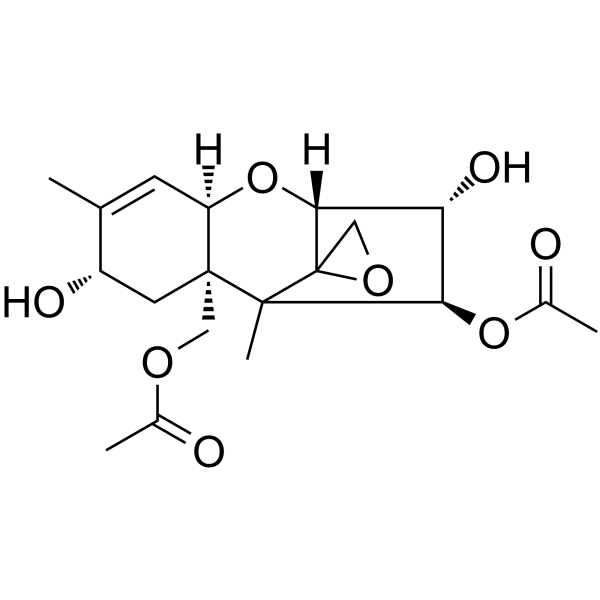
Neosolaniol

Based on 1 Customer Validation
Neosolaniol is an orally active type A trichothecene mycotoxin, and it is a metabolite of T-2 Toxin (HY-N6792) in human cancer cells and renal epithelial cells. Neosolaniol targets Bax, Bcl-2, caspase 3, caspase 8, and cytochrome c, thereby inducing apoptosis, emesis and anorexia. Neosolaniol reduces intracellular ATP levels, elevates ROS levels, decreases mitochondrial membrane potential, induces mitochondrial damage, and exerts toxicity on Leydig cells. Neosolaniol downregulates the expression of intestinal tight junction proteins in broilers and increases the load of Salmonella enteritidis in the cecum of broilers. Neosolaniol can be used in research related to anorexia, lymphoma, Fusarium melonis rot, and Salmonella infection.
Nos produits utilisent uniquement pour la recherche. Nous ne vendons pas aux patients.
- Pureté : 99.72%
- CAS No.: 36519-25-2
- Formule: C19H26O8
- Masse moléculaire:382.40
-
Stockage:Powder -20°C, 3 years ; In solvent -80°C, 6 months , -20°C, 1 month

To place orders, for customer services and technical support, please contact: MedChemExpress USA
Tel: 609-228-6898 E-mail: [email protected] [email protected]


-
 Activité biologique
-
Chemical Information
-
Solvant et solubilité
- Protocole
- Pureté et documentation
- Références
-
 Help & FAQs


Voir tous les produits spécifiques à Isoform Caspase
More

Activité biologique
Description
IC50 & Target
[1]|
Caspase 3 |
Caspase 8 |
Bax |
Bcl-2 |
In Vitro
Neosolaniol (NEO) (0.375 μM; 24 h) significantly reduces intracellular ATP content in porcine Leydig cells when cell viability decreases to 50%, significantly increases intracellular ROS levels, and significantly reduces mitochondrial membrane potential[1].
Neosolaniol (0.375 μM; 24 h) significantly increases the apoptosis rate of porcine Leydig cells under the condition of 50% cell viability; it regulates the expression of apoptosis-related genes, significantly upregulates the expression of caspase 3, caspase 8 and Cytc, and decreases the Bax/Bcl-2 ratio[1].
Combined treatment with Neosolaniol (0.1875 μM; 24 h) and T-2 toxin (0.0625 μM) significantly reduces intracellular ATP content in porcine Leydig cells when cell viability is maintained at 50%, increases intracellular ROS levels, significantly elevates the apoptosis rate of porcine Leydig cells, and regulates the expression of apoptosis-related genes in porcine Leydig cells, with significant upregulation of Bax, Bcl-2, caspase 3, caspase 8 and Cytc expression[1].
Neosolaniol (compound 4) (100 nM-10 μM; 24-48 h) exhibites no sub G1 peak at 1 μM with 48 h incubation, yet induced cellular apoptosis after 48 h incubation at 10 μM[6].
Neosolaniol (5×10⁻¹⁰-5×10⁻⁵ g/mL; 3 days) exhibits cytotoxicity against mouse lymphoma L5178Y cells, with a potency 20-fold lower than that of T-2 Toxin (HY-N6792) and diacetoxyscirpenol[7].
Neosolaniol (0.1 nM-10 μM; 48 h) reduces the viability of primary human renal proximal tubule epithelial cells (RPTEC), with an IC50 of 3.0 μM after 48 h of incubation; it also reduces the viability of primary normal human lung fibroblasts (NHLF), with an IC50 of 2.0 μM after 48 h of incubation[8].
Neosolaniol (10 nM-10 μM; 24 h) induces caspase-3 activation (apoptosis) in primary human renal proximal tubule epithelial cells (RPTEC) and primary normal human lung fibroblasts (NHLF)[8].
MedChemExpress (MCE) has not independently confirmed the accuracy of these methods. They are for reference only.
-
Cell Line:porcine Leydig cells
-
Concentration:0.375 μM
-
Incubation Time:24 h
-
Result:Significantly increased apoptosis rate under 50% cell activity compared with the control group.
Showed significantly lower apoptosis rate than the T-2+HT-2+Neosolaniol group and no significant difference from the T-2+Neosolaniol group.
-
Cell Line:porcine Leydig cells
-
Concentration:0.375 μM
-
Incubation Time:24 h
-
Result:Detected no obvious alteration in Bax expression relative to controls.
Detected no obvious alteration in Bcl-2 expression relative to controls.
Reduced the Bax/Bcl-2 ratio markedly relative to controls.
Elevated caspase 3 expression markedly relative to controls; its expression surpassed that of T-2, T-2+HT-2, HT-2+Neosolaniol and T-2+HT-2+Neosolaniol groups, while no obvious difference existed versus the HT-2 group.
Elevated caspase 8 expression markedly relative to controls; its expression exceeded that of most other single and combined treatment groups.
Elevated Cytc expression markedly relative to controls; its expression was higher than that of all remaining single and combined treatment groups.
-
Cell Line:primary human renal proximal tubule epithelial cells (RPTEC)
-
Concentration:100 nM, 1 μM, 10 μM
-
Incubation Time:24, 48 h
-
Result:Exhibited no sub G1 peak at 1 μM with 48 h incubation, yet induced cellular apoptosis after 48 h incubation at 10 μM.
-
Cell Line:mouse lymphoma L5178Y cells
-
Concentration:5×10⁻¹⁰-5×10⁻⁵ g/mL
-
Incubation Time:3 days
-
Result:Showed cytotoxicity to L5178Y cells, with a significant 20-fold reduction in cytotoxicity compared to T-2 toxin and diacetoxyscirpenol.
-
Cell Line:primary human renal proximal tubule epithelial cells (RPTEC), human fibroblasts (NHLF)
-
Concentration:0.1 nM, 1 nM, 10 nM, 50 nM, 100 nM, 1 μM, 10 μM
-
Incubation Time:48 h
-
Result:Reduced the viability of primary human renal proximal tubule epithelial cells (RPTEC), with an IC50 of 3.0 μM after 48 h of incubation; it also reduces the viability of primary normal human lung fibroblasts (NHLF), with an IC50 of 2.0 μM after 48 h of incubation.
-
Cell Line:primary human renal proximal tubule epithelial cells (RPTEC), human fibroblasts (NHLF)
-
Concentration:10 nM, 100 nM, 1 μM, 10 μM
-
Incubation Time:24
-
Result:Induced caspase-3 activation (apoptosis) in primary human renal proximal tubule epithelial cells (RPTEC) and primary normal human lung fibroblasts (NHLF).
In Vivo
Neosolaniol (NEO) (1 mg/kg BW; p.o., i.p.; single dose) administered via oral gavage or intraperitoneal injection induces anorexia in female B6C3F1 mice, with transient (up to 6 h) effects for oral exposure and prolonged (up to 24 h) effects for IP exposure, and these anorectic responses correspond to significant, time-dependent elevations in plasma 5-HT and SP concentrations[3].
Neosolaniol (NEOS) (0.01-1 mg/kg BW; i.p./p.o.; single dose) induces dose-dependent anorexia in female B6C3F1 mice, with an anorectic potency equivalent to T-2 Toxin (HY-N6792) and HT-2 Toxin (HY-N6729), a NOAEL of 0.01 mg/kg BW, and a LOAEL of 0.1 mg/kg BW[5].
MedChemExpress (MCE) has not independently confirmed the accuracy of these methods. They are for reference only.
-
Animal Model:Neovison vison (female, 1-2 years old)[2]
-
Dosage:0.1-2.5 mg/kg bw (i.p.); 0.01-0.5 mg/kg bw (p.o.)
-
Administration:i.p.; p.o.
-
Result:Produced no emesis at 0.1 mg/kg bw i.p. and 0.01 mg/kg bw p.o.
Triggered dose-dependent emesis in mink via i.p. injection: 60% response at 0.5 mg/kg bw, full response at 1 and 2.5 mg/kg bw with rising total emetic episodes and longer response duration.
Raised plasma PYY at multiple timepoints at 1 mg/kg bw i.p., and elevated both plasma PYY and 5-HT at delayed timepoints at 2.5 mg/kg bw i.p.
Evoked mild emesis at low oral doses and full emetic response at 0.5 mg/kg bw p.o., increasing plasma PYY and 5-HT at corresponding detection timepoints.
Cut emetic episodes by roughly two-thirds with NPY2R inhibitor JNJ-31020028 pretreatment under both i.p. and p.o. routes.
Eliminated all emetic episodes entirely after pretreatment with 5-HT3R antagonist granisetron regardless of administration route.
Yielded an intraperitoneal ED50 of 0.4 mg/kg bw and an oral ED50 of 0.09 mg/kg bw.
-
Animal Model:B6C3F1 (female, 10-12 weeks old, average weight 20 g)[3]
-
Dosage:1 mg/kg BW (oral exposure); 1 mg/kg BW (IP exposure)
-
Administration:p.o.; single dose; i.p.; single dose
-
Result:Induced short-term food intake suppression up to 6 h with marked drops at 0, 0.5, 2 and 6 h after oral treatment.
Boosted plasma 5-HT by 57.18% and plasma SP by 45.04% at 2 h post oral exposure, with both biomarkers recovering to baseline at 6 h.
Triggered sustained food intake decline lasting 24 h with significant reductions at 0, 0.5, 6 and 24 h after intraperitoneal injection.
Raised plasma 5-HT by 41.45% (0.5 h) and 137.86% (2 h), and plasma SP by 30.72% (0.5 h) and 87.36% (2 h) post intraperitoneal administration; both mediators returned to normal levels by 6 h.
-
Animal Model:B6C3F1 (female, average weight 20 g)[5]
-
Dosage:0.01 mg/kg BW; 0.1 mg/kg BW; 0.5 mg/kg BW; 1 mg/kg BW
-
Administration:p.o.; single dose
-
Result:Exerted no influence on food consumption at 0.01 mg/kg BW.
Cut food consumption by 56% (0.5 h), 46% (1 h) and 45% (2 h) at 0.1 mg/kg BW, with no visible impacts after 3 h.
Lowered food consumption by 77% (0.5 h), 38% (1 h), 46% (2 h) and 37% (3 h) at 0.5 mg/kg BW, with effects vanishing after 6 h.
Suppressed food consumption by 96% (0.5 h), 90% (1 h), 87% (2 h), 86% (3 h) and 58% (6 h) at 1 mg/kg BW, and showed no inhibitory effect at 16 h post administration.
Set a NOAEL at 0.01 mg/kg BW and a LOAEL at 0.1 mg/kg BW.
-
Animal Model:B6C3F1 (female, average weight 20 g)[5]
-
Dosage:0.01 mg/kg BW; 0.1 mg/kg BW; 0.5 mg/kg BW; 1 mg/kg BW
-
Administration:i.p.; single dose
-
Result:Showed zero feeding inhibition at 0.01 mg/kg BW, defined as NOAEL, while 0.1 mg/kg BW served as LOAEL with brief food intake reduction peaking at 0.5 h and resolving after 3 h.
Evoked longer-lasting dose-dependent feeding suppression at 0.5 mg/kg BW, with intake decline persisting up to 16 h and returning to baseline at 24 h.
Generated the strongest cumulative food intake suppression at 1 mg/kg BW; partial feeding recovery occurred from 24 h to 48 h to offset early feeding loss entirely.
- RNA extraction experimental
- Research Protocol for Infectious Diseases
- Detection of Apoptosis
- TUNEL staining for apoptotic DNA fragmentation
- Mitochondrial membrane-potential fluorescent assay
- Annexin V plus membrane-impermeant dye apoptosis staining
- ROS/oxidative-stress fluorescent staining
- Fluorescent plasma-membrane potential dye assay
- Mitochondrial membrane-potential and mitochondrial mass staining
- Apoptosis Solutions


Chemical Information
-
CAS No. 36519-25-2
-
Appearance Solid
-
Masse moléculaire 382.40
-
Formule C19H26O8
-
Color White to off-white
-
SMILES
CC12C3(CO3)[C@@](O[C@@]4([H])[C@@]2(C[C@H](O)C(C)=C4)COC(C)=O)([H])[C@H](O)[C@H]1OC(C)=O
-
Structure Classification
-
Initial Source
Fusarium
-
Livraison
Room temperature in continental US; may vary elsewhere.
-
Stockage
Powder -20°C 3 years In solvent -80°C 6 months -20°C 1 month


Solvant et solubilité
In Vitro:
DMSO : ≥ 30 mg/mL (78.45 mM; Hygroscopic DMSO has a significant impact on the solubility of product, please use newly opened DMSO)
* "≥" means soluble, but saturation unknown.
Please refer to the solubility information to select the appropriate solvent. Once prepared, please aliquot and store the solution to prevent product inactivation from repeated freeze-thaw cycles.
Storage method and period of stock solution: -80°C, 6 months; -20°C, 1 month. When stored at -80°C, please use it within 6 months. When stored at -20°C, please use it within 1 month.
Please refer to the solubility information to select the appropriate solvent. Once prepared, please aliquot and store the solution to prevent product inactivation from repeated freeze-thaw cycles.
Storage method and period of stock solution: -80°C, 6 months; -20°C, 1 month. When stored at -80°C, please use it within 6 months. When stored at -20°C, please use it within 1 month.
Concentration (start) × Volume (start) = Concentration (final) × Volume (final)


Pureté et documentation
-
Fiche technique (303 KB)
-
SDS (251 KB)
- English - EN (251 KB)
- Français - FR (251 KB)
- Deutsch - DE (251 KB)
- Norwegian - NO (251 KB)
- Español - ES (251 KB)
- Swedish - SV (251 KB)
- Italian - IT (251 KB)
- Korean - KR (251 KB)
- Portuguese - PT (251 KB)
-
Instruction de manipulation (2659 KB)
Références
[1]. Xu J, et al. Potential Role of Individual and Combined Effects of T-2 Toxin, HT-2 Toxin and Neosolaniol on the Apoptosis of Porcine Leydig Cells. Toxins (Basel). 2022;14(2):145. Published 2022 Feb 16. [Content Brief]
[2]. Wu Q, et al. The trichothecene neosolaniol stimulates an emetic response through neuropeptide Y2 and serotonin 3 receptors in mink. Toxicology. 2021;452:152718. [Content Brief]
[3]. Zhang J, et al. Anorectic responses to T-2 toxin, HT-2 toxin, diacetoxyscirpenol and neosolaniol correspond to plasma elevations of neurotransmitters 5-hydroxytryptamine and substance P. Ecotoxicol Environ Saf. 2018;161:451-458. [Content Brief]
[4]. Janse van Rensburg DF, et al. Short-term effects of two fusarium toxins, diacetoxyscirpenol and neosolaniol monoacetate, in male Wistar rats. Food Chem Toxicol. 1987;25(10):767-771. [Content Brief]
[5]. Zhang J, et al. Comparison of Anorectic Potencies of Type A Trichothecenes T-2 Toxin, HT-2 Toxin, Diacetoxyscirpenol, and Neosolaniol. Toxins (Basel). 2018;10(5):179. Published 2018 Apr 29. [Content Brief]
[6]. Weidner M, et al. Identification and apoptotic potential of T-2 toxin metabolites in human cells. J Agric Food Chem. 2012;60(22):5676-5684. [Content Brief]
[7]. Anderson DW, et al. Structure-activity studies of trichothecenes: cytotoxicity of analogues and reaction products derived from T-2 toxin and neosolaniol. J Med Chem. 1989;32(3):555-562. [Content Brief]
[8]. Königs M, et al. Metabolism and cytotoxic effects of T-2 toxin and its metabolites on human cells in primary culture. Toxicology. 2009;258(2-3):106-115. [Content Brief]
[9]. Xue H, et al. Acetylsalicylic acid treatment reduce Fusarium rot development and neosolaniol accumulation in muskmelon fruit. Food Chem. 2019;289:278-284. [Content Brief]
[10]. Liu JD, et al. Short-term exposure to fumonisins and deoxynivalenol, on broiler growth performance and cecal Salmonella load during experimental Salmonella Enteritidis infection. Poult Sci. 2023;102(6):102677. [Content Brief]


Complete Stock Solution Preparation Table
Please refer to the solubility information to select the appropriate solvent. Once prepared, please aliquot and store the solution to prevent product inactivation from repeated freeze-thaw cycles.
Storage method and period of stock solution: -80°C, 6 months; -20°C, 1 month. When stored at -80°C, please use it within 6 months. When stored at -20°C, please use it within 1 month.
| Optional Solvent | Concentration Solvent Mass | 1 mg | 5 mg | 10 mg | 25 mg |
|---|---|---|---|---|---|
| DMSO | 1 mM | 2.6151 mL | 13.0753 mL | 26.1506 mL | 65.3766 mL |
| 5 mM | 0.5230 mL | 2.6151 mL | 5.2301 mL | 13.0753 mL | |
| 10 mM | 0.2615 mL | 1.3075 mL | 2.6151 mL | 6.5377 mL | |
| 15 mM | 0.1743 mL | 0.8717 mL | 1.7434 mL | 4.3584 mL | |
| 20 mM | 0.1308 mL | 0.6538 mL | 1.3075 mL | 3.2688 mL | |
| 25 mM | 0.1046 mL | 0.5230 mL | 1.0460 mL | 2.6151 mL | |
| 30 mM | 0.0872 mL | 0.4358 mL | 0.8717 mL | 2.1792 mL | |
| 40 mM | 0.0654 mL | 0.3269 mL | 0.6538 mL | 1.6344 mL | |
| 50 mM | 0.0523 mL | 0.2615 mL | 0.5230 mL | 1.3075 mL | |
| 60 mM | 0.0436 mL | 0.2179 mL | 0.4358 mL | 1.0896 mL |


Neosolaniol Related Classifications
HY-N6799 Related Classifications
 Powered by Bioz