



Nitrofurazone
Based on 3 publication(s) in Google Scholar
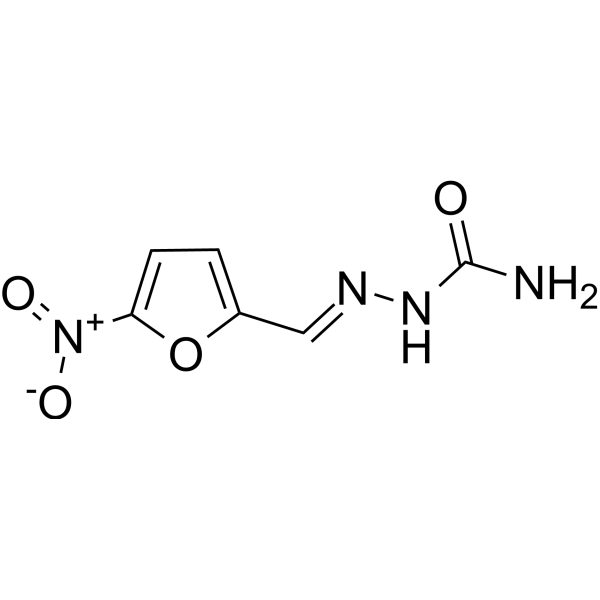
Nitrofurazone (Nitrofural) is a broad spectrum antibiotic that has oral activity. Nitrofurazone is a nitro-aromatic drug. Nitrofurazone is active against both Gram-positive and Gram-negative bacteria.
Nos produits utilisent uniquement pour la recherche. Nous ne vendons pas aux patients.
- Pureté : 99.96%
- CAS No.: 59-87-0
- Formule: C6H6N4O4
- Masse moléculaire:198.14
-
Stockage:Powder -20°C, 3 years , 4°C, 2 years ; In solvent -80°C, 2 years , -20°C, 1 year

To place orders, for customer services and technical support, please contact: MedChemExpress USA
Tel: 609-228-6898 E-mail: [email protected] [email protected]


-
 Activité biologique
-
Chemical Information
-
Solvant et solubilité
- Protocole
- Pureté et documentation
- Références
-
 Help & FAQs



Publications Citing Use of MedChemExpress (MCE) Nitrofurazone
MoreVoir tous les produits spécifiques à Isoform Antibiotic
More

Activité biologique
Description
Cellular Effect
|
Cell Line

|
Type | Value | Description | References |
|---|---|---|---|---|
| THP-1 | IC50 |
>100 μM
Compound: NFZ
|
Cytotoxicity against human THP-1 cells assessed as inhibition of cell growth incubated for 48 hrs by resazurin dye based assay
Cytotoxicity against human THP-1 cells assessed as inhibition of cell growth incubated for 48 hrs by resazurin dye based assay
|
[PMID: 36516584] |
| THP-1 | IC50 |
>100 μM
Compound: NFZ
|
Cytotoxicity against human THP-1 cells assessed as inhibition of cell growth incubated for 72 hrs by resazurin staining based analysis
Cytotoxicity against human THP-1 cells assessed as inhibition of cell growth incubated for 72 hrs by resazurin staining based analysis
|
[PMID: 37859713] |
| V79 | IC50 |
270 μM
Compound: Nitrofurazone
|
Differential hypoxic cytotoxicity towards chinese hamster cells (V79) using MTT assay under anaerobic conditions
Differential hypoxic cytotoxicity towards chinese hamster cells (V79) using MTT assay under anaerobic conditions
|
10.1016/0960-894X(95)00352-T |
| V79 | IC50 |
740 μM
Compound: Nitrofurazone
|
Differential hypoxic cytotoxicity towards chinese hamster cells (V79) using MTT assay under aerobic conditions
Differential hypoxic cytotoxicity towards chinese hamster cells (V79) using MTT assay under aerobic conditions
|
10.1016/0960-894X(95)00352-T |
| Vero | IC50 |
>100 μM
Compound: NFZ
|
Cytotoxicity against African green monkey Vero cells assessed as inhibition of cell growth incubated for 48 hrs by resazurin dye based assay
Cytotoxicity against African green monkey Vero cells assessed as inhibition of cell growth incubated for 48 hrs by resazurin dye based assay
|
[PMID: 36516584] |
| Vero | IC50 |
>100 μM
Compound: NFZ
|
Cytotoxicity against African green monkey Vero cells assessed as inhibition of cell growth incubated for 48 hrs by resazurin staining based analysis
Cytotoxicity against African green monkey Vero cells assessed as inhibition of cell growth incubated for 48 hrs by resazurin staining based analysis
|
[PMID: 37859713] |
In Vitro
Nitrofurazone (10-20 μg/mL) can make E. coli strain B/r triple resistant mutants, increasing drug resistance by 6 to 7 times[2].
Nitrofurazone (50 μg/mL, 30 min) inhibits the synthesis of all color RNA and ribosomal subunits and the formation of polysomes in E. coli strain B/r[3].
MedChemExpress (MCE) has not independently confirmed the accuracy of these methods. They are for reference only. Further protocols information, click here.
-
Cell Line:E. Coli stratin B/r
-
Concentration:50 μg/mL
-
Incubation Time:30 min
-
Result:Inhibited the synthesis of 16 and 23s ribosomal RNA and 45 RNA.
Induced Disease Models
Please do not refer to only one article to determine the experimental conditions. It is recommended to determine the optimal experimental conditions (animal strain, age, dosage, frequency and cycle, detection time and indicators, etc.) through preliminary experiments before the formal experiment.
Nitrofurazone can be used to create breast tumor models. The pharmacokinetic characteristics of Nitrofurazone in male white rabbits show a high clearance constant (0.04) and a short elimination half-life (17.32 minutes) with an AUC0-∞ of 844.79 when administered intravenously. When given orally, Nitrofurazone exhibits a lower clearance constant (0.002), a longer elimination half-life (276.09 minutes), and an AUC0-∞ of 566.44. After oral administration, the mean residence time of Nitrofurazone is 956.1 minutes, significantly longer than the 496.3 minutes observed after intravenous administration[4][5][6][7].
Administration: diets containing 1000 ppm of Nitrofurazone • po • once daily, between 8 and 27 weeks of age
1. At 7 weeks of age, each rat is administered a single dose of 20 mg of DMBA (9,10-dimethyl-1,2-benzanthracene) orally. DMBA is dissolved in sesame oil at a concentration of 2% before use.
2. From 8 to 27 weeks of age, each rat is given a diet containing 1000 ppm of Nitrofurazone daily (ppm: parts per million, indicating the amount of Nitrofurazone per million units of the diet; for example, a concentration of 1000 ppm means 1 g of Nitrofurazone in 1 kg of feed).
MedChemExpress (MCE) has not independently confirmed the accuracy of these methods. They are for reference only.
Essai clinique
| NCT Number | Sponsor | Condition | Start Date |
Phase
|
|---|---|---|---|---|
| NCT01329991 | Plexxikon| | 2011-05 | PHASE1 |


Chemical Information
-
CAS No. 59-87-0
-
Appearance Solid
-
Masse moléculaire 198.14
-
Formule C6H6N4O4
-
Color Light yellow to yellow
-
SMILES
O=C(N/N=C/C1=CC=C([N+]([O-])=O)O1)N
-
Synonyms
Nitrofural
-
Livraison
Room temperature in continental US; may vary elsewhere.
-
Stockage
Powder -20°C 3 years 4°C 2 years In solvent -80°C 2 years -20°C 1 year


Publications (3)
-
Journal Impact Factor
-
Most Recent
-
Chem Biol Interact
Discovery and characterization of the flavonoids in Cortex Mori Radicis as naturally occurring inhibitors against intestinal nitroreductases. [Abstract]2022 Dec 1:368:110222. PMID: 36244406 -
-


Solvant et solubilité
In Vitro:
DMSO : ≥ 155 mg/mL (782.28 mM; Hygroscopic DMSO has a significant impact on the solubility of product, please use newly opened DMSO)
* "≥" means soluble, but saturation unknown.
Please refer to the solubility information to select the appropriate solvent. Once prepared, please aliquot and store the solution to prevent product inactivation from repeated freeze-thaw cycles.
Storage method and period of stock solution: -80°C, 2 years; -20°C, 1 year. When stored at -80°C, please use it within 2 years. When stored at -20°C, please use it within 1 year.
Please refer to the solubility information to select the appropriate solvent. Once prepared, please aliquot and store the solution to prevent product inactivation from repeated freeze-thaw cycles.
Storage method and period of stock solution: -80°C, 2 years; -20°C, 1 year. When stored at -80°C, please use it within 2 years. When stored at -20°C, please use it within 1 year.
Concentration (start) × Volume (start) = Concentration (final) × Volume (final)
In Vivo:
Select the appropriate dissolution method based on your experimental animal and administration route.
- For the following dissolution methods, please ensure to first prepare a clear stock solution using an In Vitro approach and then sequentially add co-solvents:
- To ensure reliable experimental results, the clarified stock solution can be appropriately stored based on storage conditions. As for the working solution for In Vivo experiments, it is recommended to prepare freshly and use it on the same day.
- The percentages shown for the solvents indicate their volumetric ratio in the final prepared solution. If precipitation or phase separation occurs during preparation, heat and/or sonication can be used to aid dissolution.
Add each solvent one by one: 10% DMSO 40% PEG300 5% Tween-80 45% Saline
Solubility: ≥ 2.58 mg/mL (13.02 mM); Clear solution
This protocol yields a clear solution of ≥ 2.58 mg/mL (saturation unknown).
Taking 1 mL working solution as an example, add 100 μL DMSO stock solution (25.8 mg/mL) to 400 μL PEG300, and mix evenly; then add 50 μL Tween-80 and mix evenly; then add 450 μL Saline to adjust the volume to 1 mL.
Preparation of Saline: Dissolve 0.9 g sodium chloride in ddH₂O and dilute to 100 mL to obtain a clear Saline solution.
In Vivo Dissolution Calculator
Please enter the basic information of animal experiments:
-
-
-
-
Recommended: Prepare an additional quantity of animals to account for potential losses during experiments.
Please enter your animal formula composition:
-
%DMSO +
Recommended: Keep the proportion of DMSO in working solution below 2% if your animal is weak.
-
%+
-
+%Tween-80 + +
-
%Saline +
The co-solvents required include: DMSO, . All of co-solvents are available by MedChemExpress (MCE). , Tween 80. All of co-solvents are available by MedChemExpress (MCE).
Working solution concentration: 0.22 mg/mL
Method for preparing stock solution: mg drug dissolved in μL DMSO. Stock solution concentration: mg/mL.
1. Take μL DMSO stock solution;
2. Add μL .
μL , mix evenly;
3. Then add μL Tween 80, mix evenly;
4. Then add μL
Please ensure that the stock solution in the first step is dissolved to a clear state, and add co-solvents in sequence. You can use ultrasonic heating (ultrasonic cleaner, recommended frequency 20-40 kHz), vortexing, etc. to assist dissolution.

Protocole
-
Gram Staining of Tissue Sections
Gram staining of tissue sections is a histochemical technique used to differentiate Gram-positive and Gram-negative bacteria within histological specimens based on differences in bacterial cell wall structure and dye retention, adapted from classical bacteriological Gram staining into tissue-compatible “histological Gram stain” variants. In tissue applications, modifications of the Brown-Hopps and Brown-Brenn methods are commonly used to improve differentiation of microorganisms embedded within host connective tissue and to reduce overstaining or loss of Gram-negative signal, which are known limitations of earlier approaches. The principle relies on crystal violet-iodine complex retention in Gram-positive organisms and subsequent decolorization and counterstaining steps that allow contrast visualization of Gram-negative organisms against tissue background.


Pureté et documentation
-
Fiche technique (280 KB)
-
SDS (419 KB)
- English - EN (419 KB)
- Français - FR (419 KB)
- Deutsch - DE (419 KB)
- Norwegian - NO (419 KB)
- Español - ES (419 KB)
- Swedish - SV (419 KB)
- Italian - IT (419 KB)
- Korean - KR (419 KB)
- Portuguese - PT (419 KB)
-
Instruction de manipulation (2659 KB)
Références
[1]. Ryan A, et al. Activation of nitrofurazone by azoreductases: multiple activities in one enzyme. Sci Rep. 2011;1:63. [Content Brief]
[2]. McCalla DR, et al. Mode of action of nitrofurazone. J Bacteriol. 1970 Dec;104(3):1126-34. [Content Brief]
[3]. Tu Y, et al. Effect of nitrofurazone on bacterial RNA and ribosome synthesis and on the function of ribosomes. Chem Biol Interact. 1976 Jul;14(1-2):81-91. [Content Brief]
[4]. Z Kari FW, et al. Toxicity and carcinogenicity of nitrofurazone in F344/N rats and B6C3F1 mice. Food Chem Toxicol. 1989 Feb;27(2):129-37. [Content Brief]
[5]. Neal RA, et al. The activity of nitrofurazone and furazolidone against Leishmania donovani, L. major and L. enriettii in vitro and in vivo. Ann Trop Med Parasitol. 1988 Oct;82(5):453-6. [Content Brief]


Complete Stock Solution Preparation Table
Please refer to the solubility information to select the appropriate solvent. Once prepared, please aliquot and store the solution to prevent product inactivation from repeated freeze-thaw cycles.
Storage method and period of stock solution: -80°C, 2 years; -20°C, 1 year. When stored at -80°C, please use it within 2 years. When stored at -20°C, please use it within 1 year.
| Optional Solvent | Concentration Solvent Mass | 1 mg | 5 mg | 10 mg | 25 mg |
|---|---|---|---|---|---|
| DMSO | 1 mM | 5.0469 mL | 25.2347 mL | 50.4694 mL | 126.1734 mL |
| 5 mM | 1.0094 mL | 5.0469 mL | 10.0939 mL | 25.2347 mL | |
| 10 mM | 0.5047 mL | 2.5235 mL | 5.0469 mL | 12.6173 mL | |
| 15 mM | 0.3365 mL | 1.6823 mL | 3.3646 mL | 8.4116 mL | |
| 20 mM | 0.2523 mL | 1.2617 mL | 2.5235 mL | 6.3087 mL | |
| 25 mM | 0.2019 mL | 1.0094 mL | 2.0188 mL | 5.0469 mL | |
| 30 mM | 0.1682 mL | 0.8412 mL | 1.6823 mL | 4.2058 mL | |
| 40 mM | 0.1262 mL | 0.6309 mL | 1.2617 mL | 3.1543 mL | |
| 50 mM | 0.1009 mL | 0.5047 mL | 1.0094 mL | 2.5235 mL | |
| 60 mM | 0.0841 mL | 0.4206 mL | 0.8412 mL | 2.1029 mL | |
| 80 mM | 0.0631 mL | 0.3154 mL | 0.6309 mL | 1.5772 mL | |
| 100 mM | 0.0505 mL | 0.2523 mL | 0.5047 mL | 1.2617 mL |


Nitrofurazone Related Classifications
HY-B0226 Related Classifications
 Powered by Bioz