



ZXH-3-26
Based on 3 publication(s) in Google Scholar
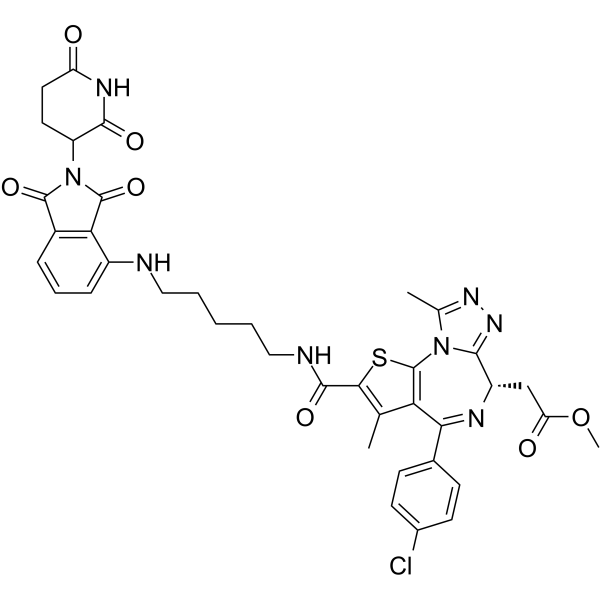
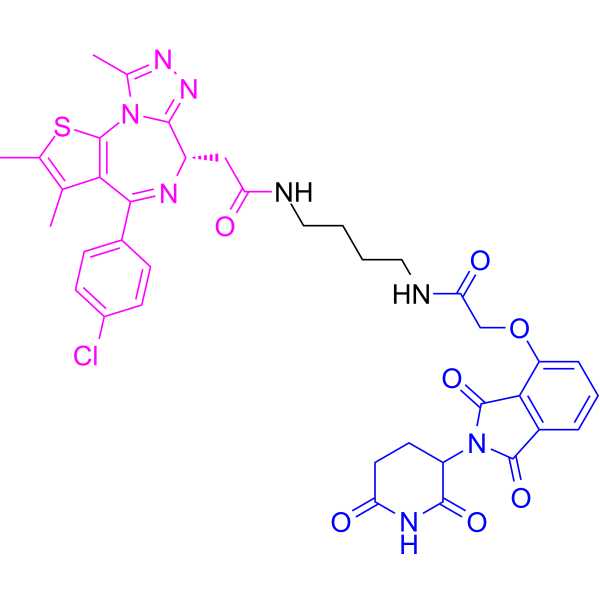
ZXH-3-26 is a CRBN-recruiting BRD4 PROTAC degrader with a DC50/5h of approximately 5 nM. ZXH-3-26 drives the ubiquitination and degradation of BRD4 by recruiting BRD4BD1 to the CRL4CRBN E3 ubiquitin ligase complex, thereby inhibiting the dynamic distribution of super-enhancers. ZXH-3-26 reverses TNF-α-induced impairment of the immunosuppressive function of mesenchymal stem cells, and affects RNA synthesis and the transcriptional elongation process of Pol II. ZXH-3-26 can be used in studies related to inflammatory arthritis, malignant tumors, and HIV latency.
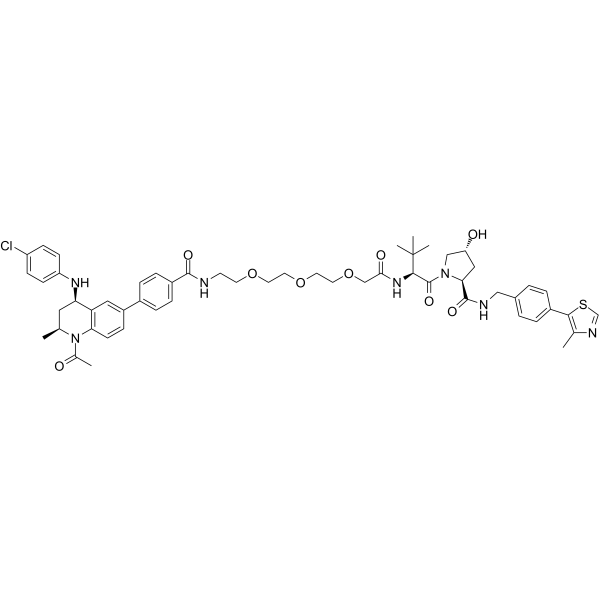
(Pink: BRD4 ligand (HY-43723); Blue: Cereblon ligand (HY-10984); Black: linker (HY-W012971)).
Nur für Forschungszwecke. Wir verkaufen nicht an Patienten.
- Reinheit : 99.53%
- CAS. Nr.: 2243076-67-5
- Formel: C38H37ClN8O7S
- Molecular Weight:785.27
-
Speicherung:
-20°C, stored under nitrogen
* In solvent : -80°C, 6 months; -20°C, 1 month (stored under nitrogen)

To place orders, for customer services and technical support, please contact: MedChemExpress USA
Tel: 609-228-6898 E-mail: [email protected] [email protected]


-
 Biologische Aktivität
-
Chemical Information
-
Lösungsmittel & Löslichkeit
- Protokoll
- Reinheit & Dokumentation
- Verweise
-
 Help & FAQs


-
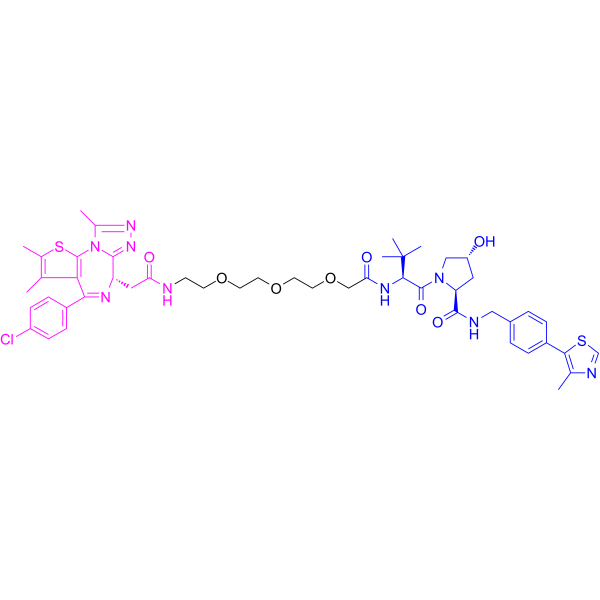
HY-107425
MZ 1PROTAC BRD4 Degrader -
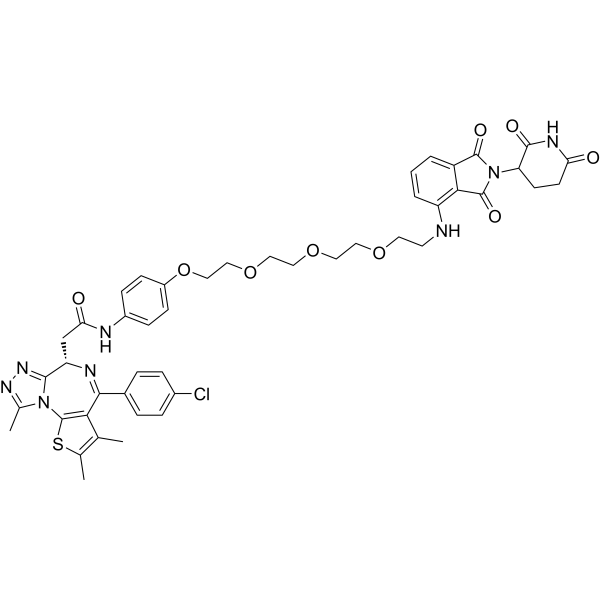
HY-16954
ARV-825PROTAC BRD2/BRD3/BRD4 Degrader -
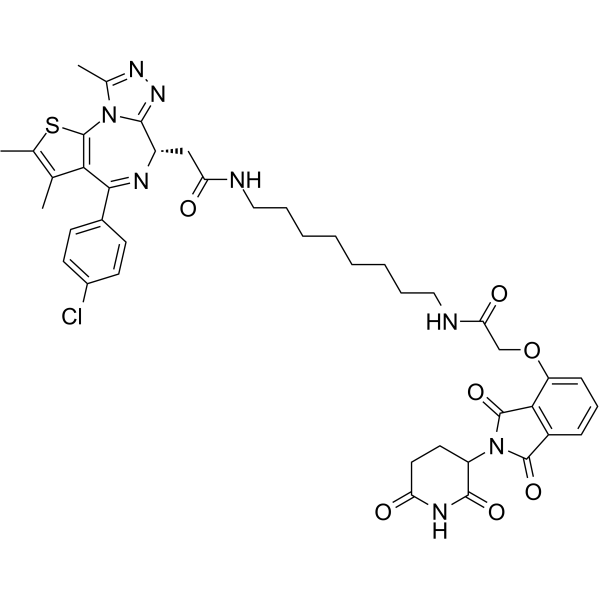
HY-112588
dBET6PROTAC BET Degrader -
HY-111433
BRD4 degrader AT1BRD4 PROTAC Degrader -
HY-100972
ARV-771BET PROTAC Degrader -
HY-13030
(+)-JQ-1BET Inhibitor -
HY-101838
dBET1PROTAC BRD4 Degrader -
HY-123937
THAL-SNS-032CDK9 PROTAC Degrader -
HY-111519
dTRIM24PROTAC TRIM24 Degrader -
HY-10984
PomalidomideImmunomodulatory Agent -
HY-A0003
LenalidomideImmunomodulator -
HY-112376
MZP-54BRD3/BRD4 PROTAC Degrader
Publications Citing Use of MedChemExpress (MCE) ZXH-3-26
More Customer Validation & Images

-
WB
-
WB
-
IF
-
IF
Alle PROTACs Isoform-spezifische Produkte anzeigen
More

Biologische Aktivität
Beschreibung
IC50 & Target
[2]|
BRD4 5 nM (DC50, 5 hours of treatment) |
In Vitro
ZXH-3-26 (0.01 μM; 24 h) efficiently degrades BRD4L at a concentration of 0.01 μM, but does not induce upregulation of HEXIM1 protein after 24 h of incubation with resting and total primary CD4+ T cells from healthy donors[4].
ZXH-3-26 (0.001-20 μM; 24 h) does not induce HIV latency reversal in JLatA2 cells at BRD4-selective concentrations (0.005-0.05 μM), and GFP induction occurs only at higher non-selective concentrations[4].
ZXH-3-26 (0.001-20 μM; 24 h) does not induce HIV latency reversal in JLat10.6 cells at any of the tested concentrations[4].
ZXH-3-26 (0.005-0.5 μM; 24 h) does not exhibit synergistic latency-reversing activity against HIV at any of the tested concentration combinations when used in combination with AZD5582 in JLat10.6 cells[4].
ZXH-3-26 (100 nM; 3 h) efficiently depletes BRD4 in Tir1+ WT26 mouse embryonic cells expressing the BRD2 degrader, triggering severe defects in RNA synthesis and Pol II pausing near promoters; when used in combination with auxin to co-deplete BRD2, it further inhibits RNA synthesis, reverses the accumulation of paused Pol II, and reduces transcription initiation[7].
ZXH-3-26 (1 nM-10 μM; 5 h) potently degrades BRD4BD1 in Flip-In 293 reporter cells, with a DC50/5h value of approximately 5 nM; moreover, it exhibits no detectable activity against BRD2BD1, BRD3BD1 and BRD4BD2 at concentrations > 10 μM[2].
ZXH-3-26 (1 nM-10 μM; 5 h) effectively degrades endogenous full-length BRD4 in HEK293T cells without affecting the levels of endogenous BRD2 and BRD3 [2].
ZXH-3-26 (0.1 μM; 5 h) selectively downregulates BRD4 in MM.1s cells after treatment at a concentration of 0.1 μM for 5 h, while exerting no significant effects on other proteins in the proteome[2].
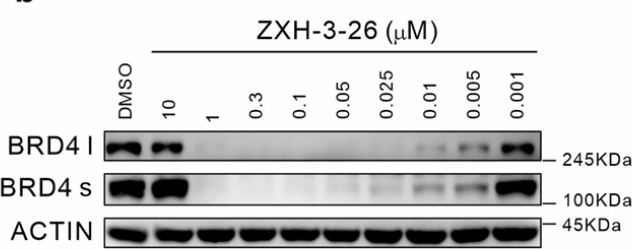
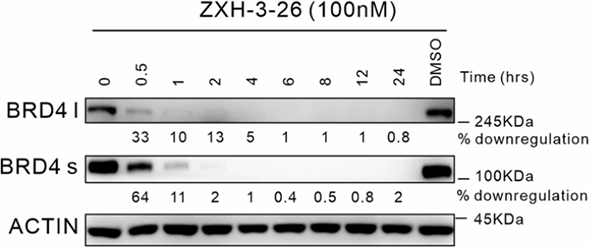
ZXH-3-26 (0.001-10 μM; 0.5-24 h) degrades both BRD4 isoforms in HeLa cells in a dose- and time-dependent manner, achieving complete depletion of BRD4 after 4 h of treatment at a concentration of 100 nM[3].
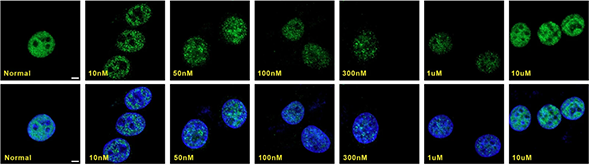
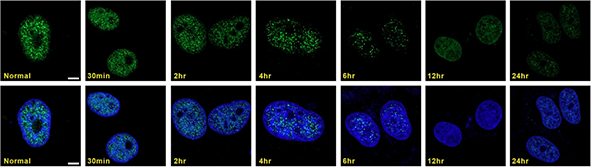
ZXH-3-26 (100 nM; 2 h) reduces the number of BRD4 condensates and the fluorescence intensity of EGFP-BRD4 in HeLa cells expressing EGFP-BRD4[3].
After washout of ZXH-3-26 (100 nM; 6 h treatment followed by 18 h recovery), BRD4 condensates in HeLa cells preferentially and fully recover within 18 h, despite only partial restoration of BRD4 protein levels[3].
ZXH-3-26 (100 nM; 6 h treatment, 18-42 h wash-out) reduces the BRD4 binding level at SE regions in HeLa cells; after wash-out, BRD4 condensates preferentially recover at SE regions, which is correlated with the restoration of gene expression to the levels observed in the control group[3].
ZXH-3-26 (100 nM; 6 h) reduces the number of CYCT1 and MED1 condensates in HeLa cells[3].
ZXH-3-26 (0.05 μM; 24 h) disrupts the BRD4-CyclinT1 interaction, but does not induce the upregulation of HEXIM1 protein in Jurkat cells treated with 0.05 μM for 24 h[4].
ZXH-3-26 (0.01-0.1 μM; 24 h) does not induce the upregulation of HEXIM1 protein in JLatA2 cells[4].
ZXH-3-26 (0.05-0.25 μM; 24 h) does not induce HEXIM1 promoter-driven luciferase activity in 293T-HEXIMpr104 cells, and only a weak inductive effect is observed after incubation for 24 h at the non-selective concentration of 0.25 μM[4].
MedChemExpress (MCE) has not independently confirmed the accuracy of these methods. They are for reference only.
-
Cell Line:HeLa cells
-
Concentration:0.001, 0.005, 0.01, 0.025, 0.05, 0.1, 0.3, 1, 10 μM (6 h incubation); 100 nM (0.5, 1, 2, 4, 6, 8, 12, 24 h incubation)
-
Incubation Time:6 h (0.001-10 μM); 0.5, 1, 2, 4, 6, 12, 24 h (100 nM)
-
Result:Degraded both BRD4 long and short isoforms simultaneously in a dose-dependent manner, with degradation efficiency decreasing at higher concentrations due to the "hook effect".
Induced obvious BRD4 degradation after 0.5 h of 100 nM treatment, and complete depletion occurred after 4 h.
Reduced BRD4 by 90% and BRD4 s by 90% after 6 h of 100 nM treatment.
Reduced BRD4 by 92% and BRD4 s by 80% after 24 h of 100 nM treatment.
-
Cell Line:HeLa cells
-
Concentration:0.001, 0.005, 0.01, 0.025, 0.05, 0.1, 0.3, 1, 10 μM (6 h incubation); 100 nM (0.5, 1, 2, 4, 6, 8, 12, 24 h incubation)
-
Incubation Time:6 h (0.001-10 μM); 0.5, 2, 4, 6, 12, 24 h (100 nM)
-
Result:Decreased the number of BRD4 condensates per cell in a dose-dependent manner correlating with BRD4 protein degradation.
Reduced BRD4 condensate number over time at 100 nM treatment, reaching a minimum by 6 h, then showed partial recovery with longer incubation.
-
Cell Line:Jurkat cells
-
Concentration:0.05 μM
-
Incubation Time:24 h
-
Result:Reduced BRD4L association with CyclinT1 to 0.28 relative to DMSO.
Did not induce upregulation of HEXIM1 protein levels.
-
Cell Line:JLatA2 cells
-
Concentration:0.01, 0.025, 0.05, 0.075, 0.1 μM
-
Incubation Time:24 h
-
Result:Did not increase HEXIM1 protein levels, with levels ranging from 0.56 to 0.81 relative to DMSO.


Chemical Information
-
CAS. Nr. 2243076-67-5
-
Appearance Solid
-
Molecular Weight 785.27
-
Formel C38H37ClN8O7S
-
Color Light yellow to yellow
-
SMILES
O=C(OC)C[C@H]1C2=NN=C(C)N2C3=C(C(C)=C(C(NCCCCCNC4=CC=CC(C(N5C(CC6)C(NC6=O)=O)=O)=C4C5=O)=O)S3)C(C7=CC=C(Cl)C=C7)=N1
-
Versand
Room temperature in continental US; may vary elsewhere.
-
Speicherung
-20°C, stored under nitrogen
* In solvent : -80°C, 6 months; -20°C, 1 month (stored under nitrogen)


Publications (3)
-
Journal Impact Factor
-
Most Recent
-
Cell Discov
2023 May 9;9(1):47. PMID: 37156794
ZXH-3-26 purchased from MedChemExpress. Usage Cited in: Cell Discov. 2023 May 9;9(1):47. [Abstract]
ZXH-3-26 (0.001, 0.005, 0.01, 0.025, 0.05, 0.1, 0.3, 1, 10 μM; 6 h) inhibits the expression of the long (BRD4 l) and the short (BRD4 s) isoform in HeLa cells.
ZXH-3-26 purchased from MedChemExpress. Usage Cited in: Cell Discov. 2023 May 9;9(1):47. [Abstract]
ZXH-3-26 (100 nM; 0.5, 1, 2, 4, 6, 8, 12, 24 h) inhibits the expression of the long (BRD4 l) and the short (BRD4 s) isoform in HeLa cells.
ZXH-3-26 purchased from MedChemExpress. Usage Cited in: Cell Discov. 2023 May 9;9(1):47. [Abstract]
ZXH-3-26 (0.01, 0.05, 0.1, 0.3, 1, 0.3, 10 μM; 6 h) inhibits the expression of the long (BRD4 l) and the short (BRD4 s) isoform in HeLa cells.
ZXH-3-26 purchased from MedChemExpress. Usage Cited in: Cell Discov. 2023 May 9;9(1):47. [Abstract]
ZXH-3-26 (100 nM; 0.5, 2, 4, 6, 12, 24 h) inhibits the expression of the long (BRD4 l) and the short (BRD4 s) isoform in HeLa cells.
-
Structure
PROTAC-mediated activation, rather than degradation, of a nuclear receptor reveals complex ligand-receptor interaction network. [Abstract]2024 Dec 5;32(12):2352-2363.e8. PMID: 39389062 -


Lösungsmittel & Löslichkeit
In Vitro:
DMSO : 50 mg/mL (63.67 mM; Need ultrasonic; Hygroscopic DMSO has a significant impact on the solubility of product, please use newly opened DMSO)
Please refer to the solubility information to select the appropriate solvent. Once prepared, please aliquot and store the solution to prevent product inactivation from repeated freeze-thaw cycles.
Storage method and period of stock solution: -80°C, 6 months; -20°C, 1 month (stored under nitrogen). When stored at -80°C, please use it within 6 months. When stored at -20°C, please use it within 1 month.
Please refer to the solubility information to select the appropriate solvent. Once prepared, please aliquot and store the solution to prevent product inactivation from repeated freeze-thaw cycles.
Storage method and period of stock solution: -80°C, 6 months; -20°C, 1 month (stored under nitrogen). When stored at -80°C, please use it within 6 months. When stored at -20°C, please use it within 1 month.
Konzentration (Stammlösung) × Volumen (Stammlösung) = Konzentration (Ziellösung) × Volumen (Ziellösung)
In Vivo:
Select the appropriate dissolution method based on your experimental animal and administration route.
- For the following dissolution methods, please ensure to first prepare a clear stock solution using an In Vitro approach and then sequentially add co-solvents:
- To ensure reliable experimental results, the clarified stock solution can be appropriately stored based on storage conditions. As for the working solution for In Vivo experiments, it is recommended to prepare freshly and use it on the same day.
- The percentages shown for the solvents indicate their volumetric ratio in the final prepared solution. If precipitation or phase separation occurs during preparation, heat and/or sonication can be used to aid dissolution.
Add each solvent one by one: 10% DMSO 40% PEG300 5% Tween-80 45% Saline
Solubility: ≥ 5 mg/mL (6.37 mM); Clear solution
This protocol yields a clear solution of ≥ 5 mg/mL (saturation unknown).
Taking 1 mL working solution as an example, add 100 μL DMSO stock solution (50.0 mg/mL) to 400 μL PEG300, and mix evenly; then add 50 μL Tween-80 and mix evenly; then add 450 μL Saline to adjust the volume to 1 mL.
Preparation of Saline: Dissolve 0.9 g sodium chloride in ddH₂O and dilute to 100 mL to obtain a clear Saline solution.
In Vivo Dissolution Calculator
Please enter the basic information of animal experiments:
-
-
-
-
Recommended: Prepare an additional quantity of animals to account for potential losses during experiments.
Please enter your animal formula composition:
-
%DMSO +
Recommended: Keep the proportion of DMSO in working solution below 2% if your animal is weak.
-
%+
-
+%Tween-80 + +
-
%Saline +
The co-solvents required include: DMSO, . All of co-solvents are available by MedChemExpress (MCE). , Tween 80. All of co-solvents are available by MedChemExpress (MCE).
Working solution concentration: 0.22 mg/mL
Method for preparing stock solution: mg drug dissolved in μL DMSO. Stock solution concentration: mg/mL. * In solvent : -80°C, 6 months; -20°C, 1 month (stored under nitrogen)
1. Take μL DMSO stock solution;
2. Add μL .
μL , mix evenly;
3. Then add μL Tween 80, mix evenly;
4. Then add μL
Please ensure that the stock solution in the first step is dissolved to a clear state, and add co-solvents in sequence. You can use ultrasonic heating (ultrasonic cleaner, recommended frequency 20-40 kHz), vortexing, etc. to assist dissolution.


Reinheit & Dokumentation
-
Data Sheet (296 KB)
-
SDS (393 KB)
- English - EN (393 KB)
- Français - FR (393 KB)
- Deutsch - DE (393 KB)
- Norwegian - NO (393 KB)
- Español - ES (393 KB)
- Swedish - SV (393 KB)
- Italian - IT (393 KB)
- Korean - KR (393 KB)
- Portuguese - PT (393 KB)
-
Handling Instructions (2659 KB)
Verweise
[2]. Nowak RP, et al. Plasticity in binding confers selectivity in ligand-induced protein degradation. Nature chemical biology. 2018 Jul;14(7):706-714. [Content Brief]
[3]. Shi Y, et al. BRD4-targeting PROTAC as a unique tool to study biomolecular condensates. Cell Discov. 2023 May 9;9(1):47. [Content Brief]
[7]. Erdogdu NU, et al. Histone acetylation-dependent clustering of BRD2 instructs transcription dynamics. Nature genetics. 2026 Apr;58(4):854-868. [Content Brief]


Complete Stock Solution Preparation Table
Please refer to the solubility information to select the appropriate solvent. Once prepared, please aliquot and store the solution to prevent product inactivation from repeated freeze-thaw cycles.
Storage method and period of stock solution: -80°C, 6 months; -20°C, 1 month (stored under nitrogen). When stored at -80°C, please use it within 6 months. When stored at -20°C, please use it within 1 month.
| Optional Solvent | Concentration Solvent Mass | 1 mg | 5 mg | 10 mg | 25 mg |
|---|---|---|---|---|---|
| DMSO | 1 mM | 1.2734 mL | 6.3672 mL | 12.7345 mL | 31.8362 mL |
| 5 mM | 0.2547 mL | 1.2734 mL | 2.5469 mL | 6.3672 mL | |
| 10 mM | 0.1273 mL | 0.6367 mL | 1.2734 mL | 3.1836 mL | |
| 15 mM | 0.0849 mL | 0.4245 mL | 0.8490 mL | 2.1224 mL | |
| 20 mM | 0.0637 mL | 0.3184 mL | 0.6367 mL | 1.5918 mL | |
| 25 mM | 0.0509 mL | 0.2547 mL | 0.5094 mL | 1.2734 mL | |
| 30 mM | 0.0424 mL | 0.2122 mL | 0.4245 mL | 1.0612 mL | |
| 40 mM | 0.0318 mL | 0.1592 mL | 0.3184 mL | 0.7959 mL | |
| 50 mM | 0.0255 mL | 0.1273 mL | 0.2547 mL | 0.6367 mL | |
| 60 mM | 0.0212 mL | 0.1061 mL | 0.2122 mL | 0.5306 mL |


ZXH-3-26 Related Classifications
HY-122826 Related Classifications
 Powered by Bioz