



Zeprumetostat
Based on 1 publication(s) in Google Scholar
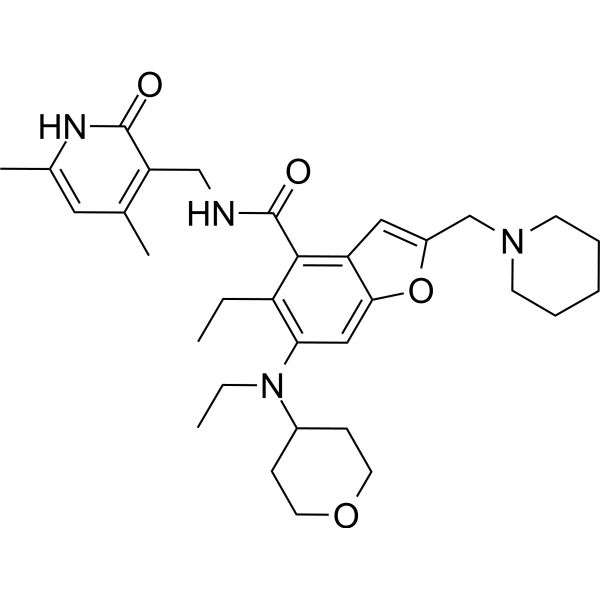
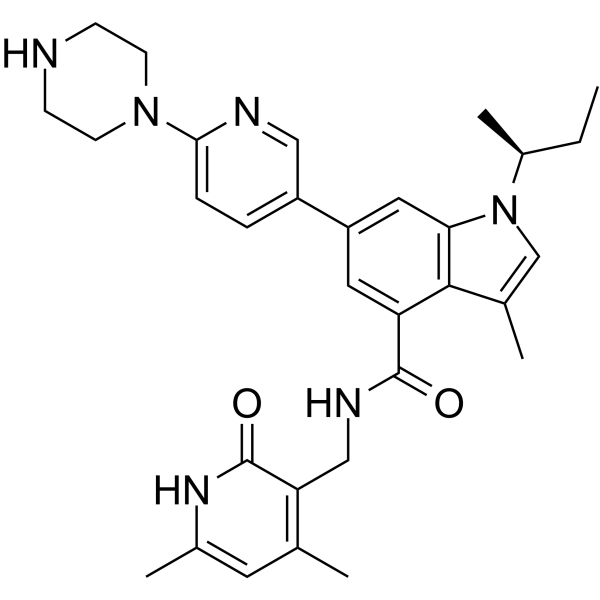
Zeprumetostat is an orally active EZH2 inhibitor. Zeprumetostat inhibits wild-type and Y641F mutant EZH2 with IC50 values of 0.87 nM and 2.68 nM, respectively. Zeprumetostat induces cell cycle arrest and apoptosis, inhibits tumor cell proliferation, reduces target protein levels, and modulates oncogenic signaling pathway genes. Zeprumetostat combined with Tucidinostat (HY-109015) enhances antitumor efficacy through STAT1 and inhibits tumor growth in xenograft models. Zeprumetostat can be used for lymphoma-related research.
For research use only. We do not sell to patients.
- Purity : 99.18%
- CAS No.: 2098545-98-1
- Formula: C32H44N4O4
- Molecular Weight:548.72
-
Storage:Powder -20°C, 3 years , 4°C, 2 years ; In solvent -80°C, 6 months , -20°C, 1 month

To place orders, for customer services and technical support, please contact: MedChemExpress USA
Tel: 609-228-6898 E-mail: [email protected] [email protected]


-
 Biological Activity
-
Chemical Information
-
Solvent & Solubility
- Protocols
- Purity & Documentation
- References
-
 Help & FAQs



Publications Citing Use of MedChemExpress (MCE) Zeprumetostat
MoreAll Histone Methyltransferase Isoforms
More

Biological Activity
Description
IC50 & Target
[1]|
EZH2 0.87 nM (IC50) |
EZH2 Y641N 2.68 nM (IC50) |
Cellular Effect
|
Cell Line

|
Type | Value | Description | References |
|---|---|---|---|---|
| H9 | IC50 |
0.365 μM
|
Antiproliferative activity against human H9 TCL cells assessed as viability reduction incubated 144 hrs by CellTiter-Glo assay.
Antiproliferative activity against human H9 TCL cells assessed as viability reduction incubated 144 hrs by CellTiter-Glo assay.
|
s40265-025-02271-0 |
| HH | IC50 |
0.443 μM
|
Antiproliferative activity against human HH TCL cells assessed as viability reduction incubated 144 hrs by CellTiter-Glo assay.
Antiproliferative activity against human HH TCL cells assessed as viability reduction incubated 144 hrs by CellTiter-Glo assay.
|
s40265-025-02271-0 |
| HuT78 | IC50 |
5.810 μM
|
Antiproliferative activity against human HUT78 TCL cells assessed as viability reduction incubated 144 hrs by CellTiter-Glo assay.
Antiproliferative activity against human HUT78 TCL cells assessed as viability reduction incubated 144 hrs by CellTiter-Glo assay.
|
s40265-025-02271-0 |
| KARPAS-299 | IC50 |
2.954 μM
|
Antiproliferative activity against human Karpas 299 TCL cells assessed as viability reduction incubated 144 hrs by CellTiter-Glo assay.
Antiproliferative activity against human Karpas 299 TCL cells assessed as viability reduction incubated 144 hrs by CellTiter-Glo assay.
|
s40265-025-02271-0 |
| Jurkat | IC50 |
3.001 μM
|
Antiproliferative activity against human Jurkat TCL cells assessed as viability reduction incubated 144 hrs by CellTiter-Glo assay.
Antiproliferative activity against human Jurkat TCL cells assessed as viability reduction incubated 144 hrs by CellTiter-Glo assay.
|
s40265-025-02271-0 |
In Vitro
Zeprumetostat (5-10 μM; 72 h) decreases H3K27me3 and increases H3K27ac in H9 and Karpas 299 TCL cells[1].
Zeprumetostat (5 μM; 72 h) reprograms H9 TCL gene expression, increases H3K27me3 target genes, and decreases H3K27me3 at tumor suppressor loci such as PERP and INPP4B[1].
Zeprumetostat (H9: 4.8-8.0 μM; HH: 2-10 μM; HUT78: 12-20 μM; Karpas 299: 12-20 μM; Jurkat: 8-40 μM; 48 h) acts synergistically with Chidamide (HY-109015) in H9, HH, HUT78, Karpas 299, and Jurkat TCL cells, with CI values below 1[1].
Zeprumetostat (5-20 μM) combined with Chidamide sensitizes STAT1-overexpressing H9, Karpas 299, and HUT78 TCL cells[1].
Zeprumetostat (8 μM; 48 h) reduces H3K27me3 at IFNGR1 in H9 cells, and in combination with Chidamide it additionally reduces H3K27me3 at IFNG[1].
Zeprumetostat (compound 9) potently inhibits wild-type EZH2 and EZH2Y641F with IC50 values of 0.87 and 2.68 nM, respectively, and induces G1 phase arrest and promotes apoptosis in DLBCL cell lines[2].
Zeprumetostat (8-20 μM; 48 h) in combination with Chidamide enhances apoptosis, p21 induction, H3K27me3 reduction, and migration inhibition in H9 and Karpas 299 cells; it increases STAT1 and p-STAT1 expression in H9 and Karpas 299 TCL cells[1].
MedChemExpress (MCE) has not independently confirmed the accuracy of these methods. They are for reference only.
-
Cell Line:TCL cell lines H9, HH, HUT78, Karpas 299, and Jurkat
-
Concentration:0.01, 0.1, 1, 2, 5, 10, 50 μM
-
Incubation Time:144 h
-
Result:Inhibited TCL cell viability with IC50 values ranging from 0.365 μM in H9 to 5.810 μM in HUT78 cells.
-
Cell Line:H9 and Karpas 299 TCL cells
-
Concentration:5 and 10 μM
-
Incubation Time:72 h
-
Result:Reduced H3K27me3 levels and increased H3K27ac levels at 5 and 10 μM in both H9 and Karpas 299 cells.
-
Cell Line:H9 and Karpas 299 cells
-
Concentration:5, 10, 15 μM
-
Incubation Time:72 h
-
Result:Induced apoptosis and G1 cell-cycle accumulation in H9 and Karpas 299 cells.
-
Cell Line:H9 and Karpas 299 cells
-
Concentration:5, 10, 15 μM
-
Incubation Time:72 h
-
Result:Increased cleaved PARP and decreased XIAP and MCL1 at 10 and 15 μM; CDK6, CDK4, and CDK2 were downregulated; EZH2 was reduced at higher concentrations.
-
Cell Line:H9, HH, HUT78, Karpas 299, and Jurkat TCL cells
-
Concentration:H9: 4.8, 5.2, 5.6, 6.0, 6.4, 6.8, 7.2, 7.6, 8.0 μM
HH: 2, 3, 4, 5, 6, 7, 8, 9, 10 μM
HUT78: 12, 13, 14, 15, 16, 17, 18, 19, 20 μM
Karpas 299: 12, 13, 14, 15, 16, 17, 18, 19, 20 μM
Jurkat: 8, 12, 16, 20, 24, 28, 32, 36, 40 μM -
Incubation Time:48 h
-
Result:Acted synergistically with Chidamide in H9, HH, HUT78, Karpas 299, and Jurkat TCL cells, with a combination index (CI) value of less than 1.
-
Cell Line:H9 and Karpas 299 cells
-
Concentration:H9: 8 μM
Karpas 299: 20 μM; with Chidamide 0.2 μM -
Incubation Time:48 h
-
Result:Enhanced apoptosis in H9 and Karpas 299 cells when combined with Chidamide.
-
Cell Line:H9 and Karpas 299 cells
-
Concentration:H9: 8 μM
Karpas 299: 20 μM; with Chidamide 0.2 μM -
Incubation Time:48 h
-
Result:Enhanced migration inhibition in H9 and Karpas 299 cells when combined with Chidamide.
-
Cell Line:H9 and Karpas 299 cells
-
Concentration:H9: 8 μM
Karpas 299: 20 μM; with Chidamide 0.2 μM -
Incubation Time:48 h
-
Result:Enhanced p21 induction in H9 and Karpas 299 cells when combined with Chidamide.
Combined with Chidamide increased STAT1 and p-STAT1 expression in H9 and Karpas 299 TCL cells.
-
Cell Line:H9 and Karpas 299 cells
-
Concentration:H9: 8 μM with Chidamide 0.2 μM; AX-024 (HY-107390) 10 ng/mL
Karpas 299: 10 μM with Chidamide 0.2 μM; AX-024 10 ng/mL -
Incubation Time:48 h
-
Result:Increased IFN‑γ protein and IFNG mRNA were observed, with further elevations upon combination treatment.
Suppressed IFN‑γ expression was achieved by AX‑024, and the combination‑triggered upregulation of STAT1 was abolished.
In Vivo
Zeprumetostat (50-100 mg/kg; i.g.; twice daily) as a single agent inhibits ALK-negative ALCL PDX tumor growth, and its efficacy in combination with Chidamide is superior to that of single-agent administration[1].
MedChemExpress (MCE) has not independently confirmed the accuracy of these methods. They are for reference only.
-
Animal Model:NCG (NOD.Cg-Prkdc^scid Il2rg^tm1Sug/Jic; female; 5-6 weeks; 5 × 10⁶ H9 cells)[1]
-
Dosage:50 mg/kg (single agent); 100 mg/kg (single agent); 50 mg/kg + Chidamide 5 mg/kg; 100 mg/kg + Chidamide 5 mg/kg
-
Administration:i.g.; twice daily; 12 days
-
Result:Yielded suppressed tumour‑growth curves at 50 and 100 mg/kg single‑agent doses in H9 CDX mice (img‑p8‑b4‑1).
Attained further tumour‑volume reduction upon chidamide combination, with 50.9 % and 68.1 % tumour‑inhibition rates for high‑ and low‑dose combination groups, respectively.
Reduced relative H3K27me3 levels in H9 CDX tumours as validated by Western blot (img‑p8‑b13‑1, img‑p8‑b11‑1).
Elevated relative H3K27ac abundance at the 100 mg/kg dose (img‑p8‑b11‑1, img‑p8‑b15‑1).
Blocked chidamide‑induced H3K27me3 upregulation and diminished Ki‑67 staining in combination‑treated tumours (img‑p8‑b14‑1, img‑p8‑b16‑1, img‑p8‑b17‑1).
-
Animal Model:NCG (NOD.Cg-Prkdc^scid Il2rg^tm1Sug/Jic; female; 5-6 weeks)[1]
-
Dosage:50 mg/kg (single agent); 100 mg/kg (single agent); 50 mg/kg + Chidamide 5 mg/kg; 100 mg/kg + Chidamide 5 mg/kg
-
Administration:i.g.; twice daily; 10 days
-
Result:Yielded tumor‑growth curves inferior to the control group following 50 and 100 mg/kg single‑agent dosing in the ALK‑negative ALCL PDX model (img‑p8‑b6‑1).
Achieved markedly enhanced therapeutic efficacy upon combination with chidamide relative to single‑agent treatment in this PDX model (img‑p8‑b6‑1).
- Somatic Cell Culture
- Detection of Apoptosis
- TUNEL staining for apoptotic DNA fragmentation
- Flow cytometric DNA-content cell-cycle staining
- Apoptosis Solutions
- MTT Cell Proliferation Assay
- Annexin V plus membrane-impermeant dye apoptosis staining
- BrdU Incorporation Assay
- CFSE Dye Dilution Proliferation Assay
- Dye-dilution cell tracking and proliferation staining
- Patient-Derived Orthotopic Xenograft (PDOX)
- Protocol for Cell Cycle
- CCK-8/WST-8 Cell Proliferation Assay
- Cell Counting-Based Growth Curve Assay
- Colony Formation (Clonogenic) Assay
- Cell Viability Determination by MTT Colorimetric Assay
- EdU Incorporation Assay (Click Chemistry-Based DNA Synthesis Measurement)
- Ki-67 Immunostaining Proliferation Assay
- PCNA Immunodetection Proliferation Assay
- Protocol for Cell Counting and Cell Density Analysis
- Patient-Derived Xenograft (PDX)
- Splenic/Portal-Vein Liver Metastasis Xenograft
- Subcutaneous Cell-Line-Derived Xenograft
- Orthotopic Cell-Line Xenograft
- Intraperitoneal/Peritoneal Dissemination Xenograft
Clinical Trial
| NCT Number | Sponsor | Condition | Start Date |
Phase
|
|---|---|---|---|---|
| NCT01329991 | 2011-05 | PHASE1 |


Chemical Information
-
CAS No. 2098545-98-1
-
Appearance Solid
-
Molecular Weight 548.72
-
Formula C32H44N4O4
-
Color Off-white to yellow
-
SMILES
O=C1NC(C)=CC(C)=C1CNC(C2=C3C=C(CN4CCCCC4)OC3=CC(N(C5CCOCC5)CC)=C2CC)=O
-
Shipping
Room temperature in continental US; may vary elsewhere.
-
Storage
Powder -20°C 3 years 4°C 2 years In solvent -80°C 6 months -20°C 1 month


Publications (1)
-
Journal Impact Factor
-
Most Recent
-
Cell Death Dis
EZH2 inhibitor SHR2554 enhances the anti-tumor efficacy of HDAC inhibitor Chidamide through STAT1 in T-cell lymphoma. [Abstract]2025 Jul 14;16(1):522. PMID: 40659662


Solvent & Solubility
In Vitro:
DMSO : 100 mg/mL (182.24 mM; Need ultrasonic; Hygroscopic DMSO has a significant impact on the solubility of product, please use newly opened DMSO)
Please refer to the solubility information to select the appropriate solvent. Once prepared, please aliquot and store the solution to prevent product inactivation from repeated freeze-thaw cycles.
Storage method and period of stock solution: -80°C, 6 months; -20°C, 1 month. When stored at -80°C, please use it within 6 months. When stored at -20°C, please use it within 1 month.
Concentration (start) × Volume (start) = Concentration (final) × Volume (final)
In Vivo Dissolution Calculator
Please enter the basic information of animal experiments:
-
-
-
-
Recommended: Prepare an additional quantity of animals to account for potential losses during experiments.
Working solution concentration: 0.22 mg/mL


Purity & Documentation
-
Data Sheet (305 KB)
-
SDS (396 KB)
- English - EN (396 KB)
- Français - FR (396 KB)
- Deutsch - DE (396 KB)
- Norwegian - NO (396 KB)
- Español - ES (396 KB)
- Swedish - SV (396 KB)
- Italian - IT (396 KB)
- Korean - KR (396 KB)
- Portuguese - PT (396 KB)
-
Handling Instructions (2659 KB)
References


Complete Stock Solution Preparation Table
Please refer to the solubility information to select the appropriate solvent. Once prepared, please aliquot and store the solution to prevent product inactivation from repeated freeze-thaw cycles.
Storage method and period of stock solution: -80°C, 6 months; -20°C, 1 month. When stored at -80°C, please use it within 6 months. When stored at -20°C, please use it within 1 month.
| Optional Solvent | Concentration Solvent Mass | 1 mg | 5 mg | 10 mg | 25 mg |
|---|---|---|---|---|---|
| DMSO | 1 mM | 1.8224 mL | 9.1121 mL | 18.2242 mL | 45.5606 mL |
| 5 mM | 0.3645 mL | 1.8224 mL | 3.6448 mL | 9.1121 mL | |
| 10 mM | 0.1822 mL | 0.9112 mL | 1.8224 mL | 4.5561 mL | |
| 15 mM | 0.1215 mL | 0.6075 mL | 1.2149 mL | 3.0374 mL | |
| 20 mM | 0.0911 mL | 0.4556 mL | 0.9112 mL | 2.2780 mL | |
| 25 mM | 0.0729 mL | 0.3645 mL | 0.7290 mL | 1.8224 mL | |
| 30 mM | 0.0607 mL | 0.3037 mL | 0.6075 mL | 1.5187 mL | |
| 40 mM | 0.0456 mL | 0.2278 mL | 0.4556 mL | 1.1390 mL | |
| 50 mM | 0.0364 mL | 0.1822 mL | 0.3645 mL | 0.9112 mL | |
| 60 mM | 0.0304 mL | 0.1519 mL | 0.3037 mL | 0.7593 mL | |
| 80 mM | 0.0228 mL | 0.1139 mL | 0.2278 mL | 0.5695 mL | |
| 100 mM | 0.0182 mL | 0.0911 mL | 0.1822 mL | 0.4556 mL |


Zeprumetostat Related Classifications
HY-153191 Related Classifications
 Powered by Bioz