



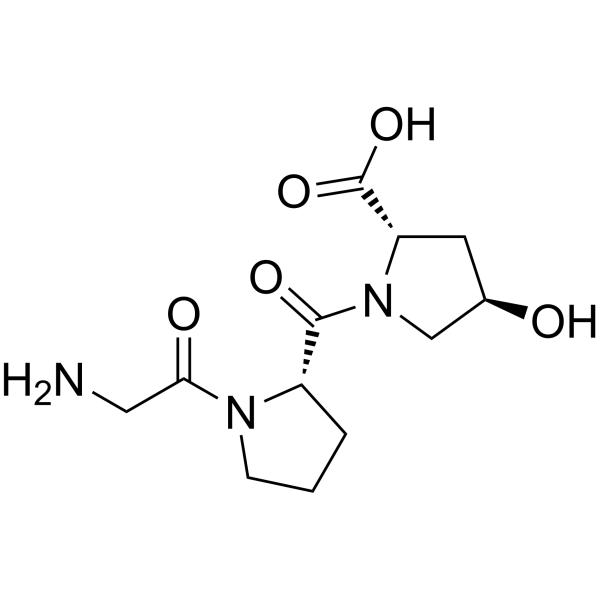
H-Gly-Pro-Hyp-OH

Based on 1 Customer Validation
H-Gly-Pro-Hyp-OH is a collagen-derived peptide and also a dipeptidyl peptidase-4 inhibitor.\nH-Gly-Pro-Hyp-OH inhibits the activity of dipeptidyl peptidase-4 in vitro. H-Gly-Pro-Hyp-OH binds to the DNA-binding site of the JUN/FOS complex, blocks the formation of the DNA-JUN/FOS complex, and inhibits transcriptional activity. H-Gly-Pro-Hyp-OH is applicable to research related to skin photoaging, UVB-induced skin aging/photoaging, and thrombosis.
For research use only. We do not sell to patients.
- Purity : 99.52%
- CAS No.: 2239-67-0
- Formula: C12H19N3O5
- Molecular Weight:285.30
-
Storage:
Sealed storage, away from moisture.
Powder -80°C, 2 years , -20°C, 1 year* In solvent : -80°C, 6 months; -20°C, 1 month (sealed storage, away from moisture)

To place orders, for customer services and technical support, please contact: MedChemExpress USA
Tel: 609-228-6898 E-mail: [email protected] [email protected]


-
 Biological Activity
-
Chemical Information
-
Solvent & Solubility
- Purity & Documentation
- References
-
 Help & FAQs




Biological Activity
Description
In Vitro
In Vivo
H-Gly-Pro-Hyp-OH (31.36 mg/kg per day; p.o.) exerts potent anti-photoaging activity in UV-irradiated Kunming mice, restoring skin elasticity, increasing hyaluronic acid and collagen content, reducing epidermal thickening, alleviating inflammation, and decreasing matrix metalloproteinase levels to a degree comparable to the high-Gly-Pro-Xaa collagen hydrolysate (HCH)[2].
H-Gly-Pro-Hyp-OH (Metabolite after 1000 mg/kg CPNS; p.o.; single dose) shows only minimal, non-significant increases in plasma concentrations in Sprague-Dawley rats, with an AUC0-t of 98.41 min∙nmol/mL over 180 minutes[3].
H-Gly-Pro-Hyp-OH (Metabolite after 300-500 mg/kg/day CPNS; p.o.; daily; 12 weeks) has no direct pharmacodynamic outcomes specific to it reported for this UVB-induced photoaging mouse model[3].
MedChemExpress (MCE) has not independently confirmed the accuracy of these methods. They are for reference only.
-
Animal Model:Kunming mice (female, 4 weeks old, 18-22 g, UV-induced photoaging model)[2]
-
Dosage:31.36 mg/kg per day
-
Administration:p.o.
-
Result:Reduced skin stretching recovery time to 3.35 s at week 4 and shortened it similarly at week 6, restoring skin elasticity to a level comparable to the HCH group.
Increased skin hyaluronic acid content to a level comparable to the HCH group, reversing UV-induced depletion.
Reduced UV-induced epidermal thickening to 96.91 μm, significantly lower than the UV group.
Increased collagen volume fraction to 41.43%, significantly higher than the UV group and comparable to the HCH group.
Reduced UV-induced elevations of pro-inflammatory cytokines IL-1β, IL-6, and TNF-α to levels comparable to the HCH group, with reductions of 29.50%, 22.83%, and 28.94% respectively relative to the UV group.
Reduced UV-induced elevations of MMP-1 and MMP-3 to levels comparable to the HCH group.


Chemical Information
-
CAS No. 2239-67-0
-
Appearance Solid
-
Molecular Weight 285.30
-
Formula C12H19N3O5
-
Color White to off-white
-
Synonyms
Tripeptide 29
-
Sequence
Gly-Pro-{Hyp}
-
Sequence Shortening
GP-{Hyp}
-
Shipping
Room temperature in continental US; may vary elsewhere.
-
Storage
Sealed storage, away from moisture
Powder -80°C 2 years -20°C 1 year * In solvent : -80°C, 6 months; -20°C, 1 month (sealed storage, away from moisture)


Solvent & Solubility
In Vitro:
H2O : ≥ 50 mg/mL (175.25 mM)
* "≥" means soluble, but saturation unknown.
Please refer to the solubility information to select the appropriate solvent. Once prepared, please aliquot and store the solution to prevent product inactivation from repeated freeze-thaw cycles.
Storage method and period of stock solution: -80°C, 6 months; -20°C, 1 month (sealed storage, away from moisture). When stored at -80°C, please use it within 6 months. When stored at -20°C, please use it within 1 month.
* Note: If you choose water as the stock solution, please dilute it to the working solution, then filter and sterilize it with a 0.22 μm filter before use.
Please refer to the solubility information to select the appropriate solvent. Once prepared, please aliquot and store the solution to prevent product inactivation from repeated freeze-thaw cycles.
Storage method and period of stock solution: -80°C, 6 months; -20°C, 1 month (sealed storage, away from moisture). When stored at -80°C, please use it within 6 months. When stored at -20°C, please use it within 1 month.
* Note: If you choose water as the stock solution, please dilute it to the working solution, then filter and sterilize it with a 0.22 μm filter before use.
Concentration (start) × Volume (start) = Concentration (final) × Volume (final)


Purity & Documentation
-
Data Sheet (277 KB)
-
SDS (252 KB)
- English - EN (252 KB)
- Français - FR (252 KB)
- Deutsch - DE (252 KB)
- Norwegian - NO (252 KB)
- Español - ES (252 KB)
- Swedish - SV (252 KB)
- Italian - IT (252 KB)
- Korean - KR (252 KB)
- Portuguese - PT (252 KB)
-
Handling Instructions (2659 KB)
References
[1]. Yazaki M, et al. Oral Ingestion of Collagen Hydrolysate Leads to the Transportation of Highly Concentrated Gly-Pro-Hyp and Its Hydrolyzed Form of Pro-Hyp into the Bloodstream and Skin. J Agric Food Chem. 2017;65(11):2315-2322. [Content Brief]
[2]. Yang D, et al. Effects of collagen hydrolysates on UV-induced photoaging mice: Gly-Pro-Hyp as a potent anti-photoaging peptide. Food Funct. 2024;15(6):3008-3022. Published 2024 Mar 18. [Content Brief]
[3]. Lee HJ, et al. Orally administered collagen peptide protects against UVB-induced skin aging through the absorption of dipeptide forms, Gly-Pro and Pro-Hyp. Biosci Biotechnol Biochem. 2019;83(6):1146-1156. [Content Brief]
[4]. Knight CG, et al. Collagen-platelet interaction: Gly-Pro-Hyp is uniquely specific for platelet Gp VI and mediates platelet activation by collagen. Cardiovasc Res. 1999;41(2):450-457. [Content Brief]


Complete Stock Solution Preparation Table
Please refer to the solubility information to select the appropriate solvent. Once prepared, please aliquot and store the solution to prevent product inactivation from repeated freeze-thaw cycles.
Storage method and period of stock solution: -80°C, 6 months; -20°C, 1 month (sealed storage, away from moisture). When stored at -80°C, please use it within 6 months. When stored at -20°C, please use it within 1 month.
| Optional Solvent | Concentration Solvent Mass | 1 mg | 5 mg | 10 mg | 25 mg |
|---|---|---|---|---|---|
| H2O | 1 mM | 3.5051 mL | 17.5254 mL | 35.0508 mL | 87.6271 mL |
| 5 mM | 0.7010 mL | 3.5051 mL | 7.0102 mL | 17.5254 mL | |
| 10 mM | 0.3505 mL | 1.7525 mL | 3.5051 mL | 8.7627 mL | |
| 15 mM | 0.2337 mL | 1.1684 mL | 2.3367 mL | 5.8418 mL | |
| 20 mM | 0.1753 mL | 0.8763 mL | 1.7525 mL | 4.3814 mL | |
| 25 mM | 0.1402 mL | 0.7010 mL | 1.4020 mL | 3.5051 mL | |
| 30 mM | 0.1168 mL | 0.5842 mL | 1.1684 mL | 2.9209 mL | |
| 40 mM | 0.0876 mL | 0.4381 mL | 0.8763 mL | 2.1907 mL | |
| 50 mM | 0.0701 mL | 0.3505 mL | 0.7010 mL | 1.7525 mL | |
| 60 mM | 0.0584 mL | 0.2921 mL | 0.5842 mL | 1.4605 mL | |
| 80 mM | 0.0438 mL | 0.2191 mL | 0.4381 mL | 1.0953 mL | |
| 100 mM | 0.0351 mL | 0.1753 mL | 0.3505 mL | 0.8763 mL |
* Note: If you choose water as the stock solution, please dilute it to the working solution, then filter and sterilize it with a 0.22 μm filter before use.


H-Gly-Pro-Hyp-OH Related Classifications
HY-A0299 Related Classifications
 Powered by Bioz