



Pristinamycin

Based on 1 Customer Validation
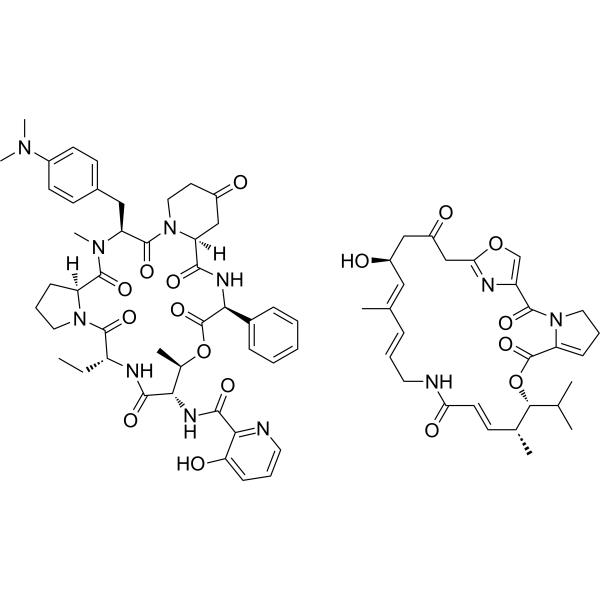
Pristinamycin, produced by Streptomyces pristinaespiralis, is an orally active streptogramin-like antibiotic consisting of two chemically unrelated components: Pristinamycin I (PI) and Pristinamycin II (PII). Pristinamycin is highly active against many antibiotic-resistant pathogens, particularly Gram-positive bacteria, including Methicillin-resistant Staphylococcus aureus (MRSA), Vancomycin-resistant S. aureus (VRSA) and Enterococcus faecium (VREF).
商品は「研究用試薬」です。人や動物の医療用・臨床診断用・食品用の製品ではありません。
研究用途以外に使用した場合、当社は一切の責任を負いかねます。
- 純度 : 99.11%
- CAS 番号: 270076-60-3
- 分子式: C73H89N11O17
- 分子量:1392.55
-
保管条件:Powder -20°C, 3 years ; In solvent -80°C, 6 months , -20°C, 1 month

To place orders, for customer services and technical support, please contact: MedChemExpress USA
Tel: 609-228-6898 E-mail: [email protected] [email protected]


-
 生物活性
生物活性
-
化学情報
-
溶剤 & 溶解度
- プロトコル
- 純度とドキュメンテーション
- 参考文献
-
 Help & FAQs


Antibiotic アイソフォーム固有の製品をすべて表示
More

生物活性
製品説明
体外実験
In-vitro studies show pristinamycin to inhibit Staphylococci and Streptococci, including Erythromycin highly-resistant organisms, at a concentration of less than or equal to 0.78 mg/l[2].
MedChemExpress (MCE) has not independently confirmed the accuracy of these methods. They are for reference only.
体内実験
MedChemExpress (MCE) has not independently confirmed the accuracy of these methods. They are for reference only.
臨床実験
| NCT Number | Sponsor | Condition | Start Date |
Phase

|
|---|---|---|---|---|
| NCT01329991 | Plexxikon| | 2011-05 | PHASE1 |


化学情報
-
CAS 番号 270076-60-3
-
性状 Solid
-
分子量 1392.55
-
分子式 C73H89N11O17
-
Color Light yellow to yellow
-
SMILES
O=C(N[C@@H]1C(N[C@H](CC)C(N2[C@](CCC2)([H])C(N(C)[C@@H](CC3=CC=C(N(C)C)C=C3)C(N4[C@](CC(CC4)=O)([H])C(N[C@@H](C5=CC=CC=C5)C(O[C@@H]1C)=O)=O)=O)=O)=O)=O)C6=NC=CC=C6O.O=C7N8C(C(O[C@@H]([C@@H](/C=C/C(NC/C=C/C(C)=C/[C@H](CC(CC9=NC7=CO9)=O)O)=O)C)C(C)C)=O)=CCC8
-
別名
Pristinamycine
-
Structure Classification
-
Initial Source
streptogramin
-
輸送条件
Room temperature in continental US; may vary elsewhere.
-
保管条件
Powder -20°C 3 years In solvent -80°C 6 months -20°C 1 month


溶剤 & 溶解度
体外:
DMSO : 100 mg/mL (71.81 mM; Need ultrasonic; Hygroscopic DMSO has a significant impact on the solubility of product, please use newly opened DMSO)
Please refer to the solubility information to select the appropriate solvent. Once prepared, please aliquot and store the solution to prevent product inactivation from repeated freeze-thaw cycles.
Storage method and period of stock solution: -80°C, 6 months; -20°C, 1 month. When stored at -80°C, please use it within 6 months. When stored at -20°C, please use it within 1 month.
Please refer to the solubility information to select the appropriate solvent. Once prepared, please aliquot and store the solution to prevent product inactivation from repeated freeze-thaw cycles.
Storage method and period of stock solution: -80°C, 6 months; -20°C, 1 month. When stored at -80°C, please use it within 6 months. When stored at -20°C, please use it within 1 month.
濃度 (開始) × 体積 (開始) = 濃度 (終了) × 体積 (終了)


純度とドキュメンテーション
-
データシート (279 KB)
-
SDS (251 KB)
- English - EN (251 KB)
- Français - FR (251 KB)
- Deutsch - DE (251 KB)
- Norwegian - NO (251 KB)
- Español - ES (251 KB)
- Swedish - SV (251 KB)
- Italian - IT (251 KB)
- Korean - KR (251 KB)
- Portuguese - PT (251 KB)
-
取扱説明書 (2659 KB)
参考文献
[1]. Meng J, et al. Improvement of pristinamycin I (PI) production in Streptomyces pristinaespiralis by metabolic engineering approaches. Synth Syst Biotechnol. 2017;2(2):130-136. Published 2017 Jun 8. [Content Brief]
[2]. Maskell JP, et al. Comparative in-vitro activity of erythromycin, vancomycin and pristinamycin. Infection. 1988;16(6):365-370. [Content Brief]
[3]. Orfila J, Haider F. Action de la pristinamycine sur les Chlamydia [Action of pristinamycin on Chlamydia]. Pathol Biol (Paris). 1984;32(5):443-445. [Content Brief]


Complete Stock Solution Preparation Table
Please refer to the solubility information to select the appropriate solvent. Once prepared, please aliquot and store the solution to prevent product inactivation from repeated freeze-thaw cycles.
Storage method and period of stock solution: -80°C, 6 months; -20°C, 1 month. When stored at -80°C, please use it within 6 months. When stored at -20°C, please use it within 1 month.
| Optional Solvent | Concentration Solvent Mass | 1 mg | 5 mg | 10 mg | 25 mg |
|---|---|---|---|---|---|
| DMSO | 1 mM | 0.7181 mL | 3.5905 mL | 7.1811 mL | 17.9527 mL |
| 5 mM | 0.1436 mL | 0.7181 mL | 1.4362 mL | 3.5905 mL | |
| 10 mM | 0.0718 mL | 0.3591 mL | 0.7181 mL | 1.7953 mL | |
| 15 mM | 0.0479 mL | 0.2394 mL | 0.4787 mL | 1.1968 mL | |
| 20 mM | 0.0359 mL | 0.1795 mL | 0.3591 mL | 0.8976 mL | |
| 25 mM | 0.0287 mL | 0.1436 mL | 0.2872 mL | 0.7181 mL | |
| 30 mM | 0.0239 mL | 0.1197 mL | 0.2394 mL | 0.5984 mL | |
| 40 mM | 0.0180 mL | 0.0898 mL | 0.1795 mL | 0.4488 mL | |
| 50 mM | 0.0144 mL | 0.0718 mL | 0.1436 mL | 0.3591 mL | |
| 60 mM | 0.0120 mL | 0.0598 mL | 0.1197 mL | 0.2992 mL |


Pristinamycin 関連分類
HY-A0279 関連分類
 Powered by Bioz