



Carbadox
Based on 1 publication(s) in Google Scholar
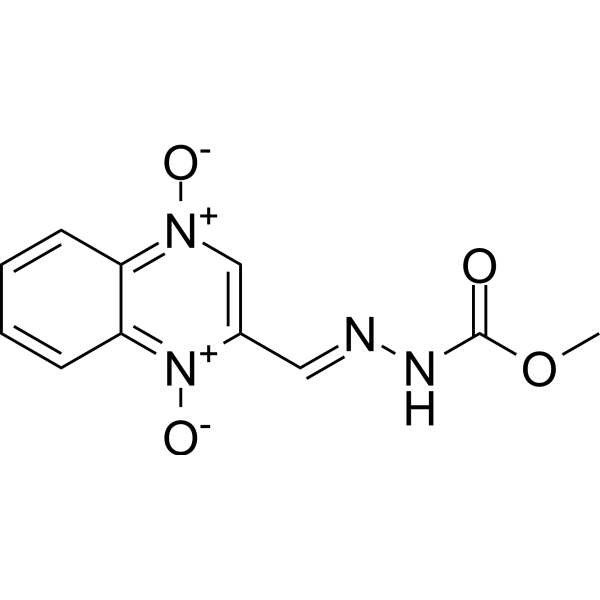
Carbadox is a quinoxaline-di-N-oxide antibiotic compound which is widely fed to nursery-age pigs to control enteric diseases and improve feed efficiency.
For research use only. We do not sell to patients.
- Purity : 98.0%
- CAS No.: 6804-07-5
- Formula: C11H10N4O4
- Molecular Weight:262.22
-
Storage:Powder -20°C, 3 years , 4°C, 2 years ; In solvent -80°C, 2 years , -20°C, 1 year

To place orders, for customer services and technical support, please contact: MedChemExpress USA
Tel: 609-228-6898 E-mail: [email protected] [email protected]


-
 Biological Activity
-
Chemical Information
-
Solvent & Solubility
- Purity & Documentation
- References
-
 Help & FAQs



Publications Citing Use of MedChemExpress (MCE) Carbadox
MoreAll Antibiotic Isoforms
MoreAll Endogenous Metabolite Isoforms
More

Biological Activity
Description
IC50 & Target
Bacterial[1]
In Vitro
The results of MTT assay demonstrate a dose-dependent decrease in mitochondrial activity in Vero cells at all concentrations of Carbadox. Treatment with Carbadox at the highest concentration of 160 μg/mL results in cell viability down to only 12%. Cells following Carbadox treatment show a dose-dependent increase of the DNA migration (p<0.01). The nuclear division index (NDI) reduces markedly with the increase doses of Carbadox[1].
MedChemExpress (MCE) has not independently confirmed the accuracy of these methods. They are for reference only.
In Vivo
MedChemExpress (MCE) has not independently confirmed the accuracy of these methods. They are for reference only.


Chemical Information
-
CAS No. 6804-07-5
-
Appearance Solid
-
Molecular Weight 262.22
-
Formula C11H10N4O4
-
Color Light yellow to yellow
-
SMILES
[O-][N+]1=C2C=CC=CC2=[N+]([O-])C(/C=N/NC(OC)=O)=C1
-
Structure Classification
-
Initial Source
-
Shipping
Room temperature in continental US; may vary elsewhere.
-
Storage
Powder -20°C 3 years 4°C 2 years In solvent -80°C 2 years -20°C 1 year


Publications (1)
-
Journal Impact Factor
-
Most Recent
-
J Agric Food Chem
2025 Oct 1;73(39):25057-25064. PMID: 40968650


Solvent & Solubility
In Vitro:
DMSO : 3.57 mg/mL (13.61 mM; Need ultrasonic; Hygroscopic DMSO has a significant impact on the solubility of product, please use newly opened DMSO)
H2O : < 0.1 mg/mL (insoluble)
Please refer to the solubility information to select the appropriate solvent. Once prepared, please aliquot and store the solution to prevent product inactivation from repeated freeze-thaw cycles.
Storage method and period of stock solution: -80°C, 2 years; -20°C, 1 year. When stored at -80°C, please use it within 2 years. When stored at -20°C, please use it within 1 year.
Please refer to the solubility information to select the appropriate solvent. Once prepared, please aliquot and store the solution to prevent product inactivation from repeated freeze-thaw cycles.
Storage method and period of stock solution: -80°C, 2 years; -20°C, 1 year. When stored at -80°C, please use it within 2 years. When stored at -20°C, please use it within 1 year.
Concentration (start) × Volume (start) = Concentration (final) × Volume (final)


Purity & Documentation
-
Data Sheet (275 KB)
-
SDS (570 KB)
- English - EN (570 KB)
- Français - FR (570 KB)
- Deutsch - DE (570 KB)
- Norwegian - NO (570 KB)
- Español - ES (570 KB)
- Swedish - SV (570 KB)
- Italian - IT (570 KB)
- Korean - KR (570 KB)
- Portuguese - PT (570 KB)
-
Handling Instructions (2659 KB)
References
[1]. Chen Q, et al. Investigation of the genotoxicity of quinocetone, carbadox and olaquindox in vitro using Vero cells. Food Chem Toxicol. 2009 Feb;47(2):328-34. [Content Brief]
[2]. Looft T, et al. Carbadox has both temporary and lasting effects on the swine gut microbiota. Front Microbiol. 2014 Jun 10;5:276. [Content Brief]


Complete Stock Solution Preparation Table
Please refer to the solubility information to select the appropriate solvent. Once prepared, please aliquot and store the solution to prevent product inactivation from repeated freeze-thaw cycles.
Storage method and period of stock solution: -80°C, 2 years; -20°C, 1 year. When stored at -80°C, please use it within 2 years. When stored at -20°C, please use it within 1 year.
| Optional Solvent | Concentration Solvent Mass | 1 mg | 5 mg | 10 mg | 25 mg |
|---|---|---|---|---|---|
| DMSO | 1 mM | 3.8136 mL | 19.0680 mL | 38.1359 mL | 95.3398 mL |
| 5 mM | 0.7627 mL | 3.8136 mL | 7.6272 mL | 19.0680 mL | |
| 10 mM | 0.3814 mL | 1.9068 mL | 3.8136 mL | 9.5340 mL |


Carbadox Related Classifications
HY-B1340 Related Classifications
 Powered by Bioz