



Oxytetracycline calcium
Based on 10 publication(s) in Google Scholar
Oxytetracycline calcium is an antibiotic belonging to the tetracycline class. Oxytetracycline calcium potently inhibits Gram-negative and Gram-positive bacteria. Oxytetracycline calcium is a protein synthesis inhibitor and prevents the binding from aminoacil-tRNA to the complex m-ribosomal RNA. Oxytetracycline calcium also possesses anti-HSV-1 activity.
For research use only. We do not sell to patients.
- CAS No.: 7179-50-2
- Formula: C22H24CaN2O9
- Molecular Weight:500.51
-
Storage:
Please store the product under the recommended conditions in the Certificate of Analysis.

To place orders, for customer services and technical support, please contact: MedChemExpress USA
Tel: 609-228-6898 E-mail: [email protected] [email protected]


-
 Biological Activity
-
Chemical Information
- Protocols
- Purity & Documentation
- References
-
 Help & FAQs


Publications Citing Use of MedChemExpress (MCE) Oxytetracycline calcium
More- Theranostics. 2022 Jan 1;12(3):1187-1203. [Abstract]
- Water Res. 2023 Jul 15:240:120110. [Abstract]
- Food Chem X. 2026 Feb 8:34:103646. [Abstract]
- J Hazard Mater Adv. 2025 Nov 12;20:100939.
- ACS Omega. 2025 Sep 10;10(37):42791-42805. [Abstract]
- Sci Rep. 2022 Aug 25;12(1):14502. [Abstract]
- Saudi Pharm J. 2021 Jun;29(6):566-575. [Abstract]
- Water. 2025 Jun 6.
- SSRN. 2025 Dec 31.
- Chemosphere. 2019 Jun:225:378-387. [Abstract]
All Antibiotic Isoforms
MoreAll Endogenous Metabolite Isoforms
More

Biological Activity
Description
IC50 & Target
|
HSV-1 |
Tetracycline |
Human Endogenous Metabolite |
Microbial Metabolite |
In Vitro
Oxytetracycline calcium is an important member of the bacterial aromatic polyketide family, which is a structurally diverse class of natural products. Oxytetracycline calcium is synthesized by a type II polyketide synthase that generates the poly-beta-ketone backbone through successive decarboxylative condensation of malonyl-CoA extender units, followed by modifications by cyclases, oxygenases, transferases, and additional tailoring enzymes[2].
MedChemExpress (MCE) has not independently confirmed the accuracy of these methods. They are for reference only. Further protocols information, click here.
In Vivo
For Oxytetracycline calcium, the limits are 100 μg/kg in muscle and milk, 200 μg/kg in egg, 300 μg/kg in liver and 600 μg/kg in kidney. Oxytetracycline calcium is administered to fish as medicated feed at concentrations ranging from 35 to 75 mg a.i kg-1 biomass day-1 for 7-14 days[1].
MedChemExpress (MCE) has not independently confirmed the accuracy of these methods. They are for reference only.


Chemical Information
-
CAS No. 7179-50-2
-
Molecular Weight 500.51
-
Formula C22H24CaN2O9
-
SMILES
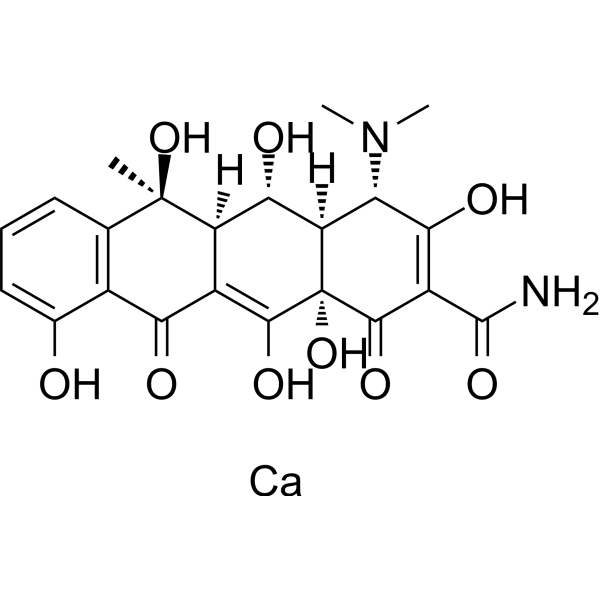
O=C(C(C1=O)=C(O)[C@@H](N(C)C)[C@]2([H])[C@@H](O)[C@]3([H])[C@](C)(O)C4=C(C(C3=C(O)[C@@]21O)=O)C(O)=CC=C4)N.[Ca]
-
Structure Classification
-
Initial Source
-
Shipping
Room temperature in continental US; may vary elsewhere.
-
Storage
Please store the product under the recommended conditions in the Certificate of Analysis.


Publications (10)
-
Journal Impact Factor
-
Most Recent
-
Theranostics
Antibiotic Azithromycin inhibits brown/beige fat functionality and promotes obesity in human and rodents. [Abstract]2022 Jan 1;12(3):1187-1203. PMID: 35154482 -
Water Res
Quantifying community-wide antibiotic usage via urban water fingerprinting: Focus on contrasting resource settings in South Africa. [Abstract]2023 Jul 15:240:120110. PMID: 37247434 -
Food Chem X
Machine learning prioritization of antibiotic residues in aquatic foods reveals exposure-driven genotoxic risk mediated by BCL2. [Abstract]2026 Feb 8:34:103646. PMID: 41756597 -
-
ACS Omega
Solvothermal Synthesis of Functionalized UiO-66/Fe3O4@CNCs for Selective Removal of Oxytetracycline. [Abstract]2025 Sep 10;10(37):42791-42805. PMID: 41018641 -
Sci Rep
Qualitative immunoassay for the determination of tetracycline antibiotic residues in milk samples followed by a quantitative improved HPLC-DAD method. [Abstract]2022 Aug 25;12(1):14502. PMID: 36008564 -
Saudi Pharm J
Determination of tetracycline, oxytetracycline and chlortetracycline residues in seafood products of Saudi Arabia using high performance liquid chromatography-Photo diode array detection. [Abstract]2021 Jun;29(6):566-575. PMID: 34194263 -
-
-
Chemosphere
Mass-balance-model-based evaluation of sewage treatment plant contribution to residual pharmaceuticals in environmental waters. [Abstract]2019 Jun:225:378-387. PMID: 30884299

Protocols
-
Gram Staining of Tissue Sections
Gram staining of tissue sections is a histochemical technique used to differentiate Gram-positive and Gram-negative bacteria within histological specimens based on differences in bacterial cell wall structure and dye retention, adapted from classical bacteriological Gram staining into tissue-compatible “histological Gram stain” variants. In tissue applications, modifications of the Brown-Hopps and Brown-Brenn methods are commonly used to improve differentiation of microorganisms embedded within host connective tissue and to reduce overstaining or loss of Gram-negative signal, which are known limitations of earlier approaches. The principle relies on crystal violet-iodine complex retention in Gram-positive organisms and subsequent decolorization and counterstaining steps that allow contrast visualization of Gram-negative organisms against tissue background.


Purity & Documentation
References
[1]. Elia, A.C., et al., Transferability of oxytetracycline (OTC) from feed to carp muscle and evaluation of the antibiotic effects on antioxidant systems in liver and kidney. Fish Physiol Biochem, 2014. [Content Brief]
[2]. Pickens LB, et al. Oxytetracycline biosynthesis. J Biol Chem. 2010 Sep 3;285(36):27509-15. [Content Brief]

Calculators
Concentration (start) × Volume (start) = Concentration (final) × Volume (final)


Oxytetracycline calcium Related Classifications
HY-B0275C Related Classifications
 Powered by Bioz