



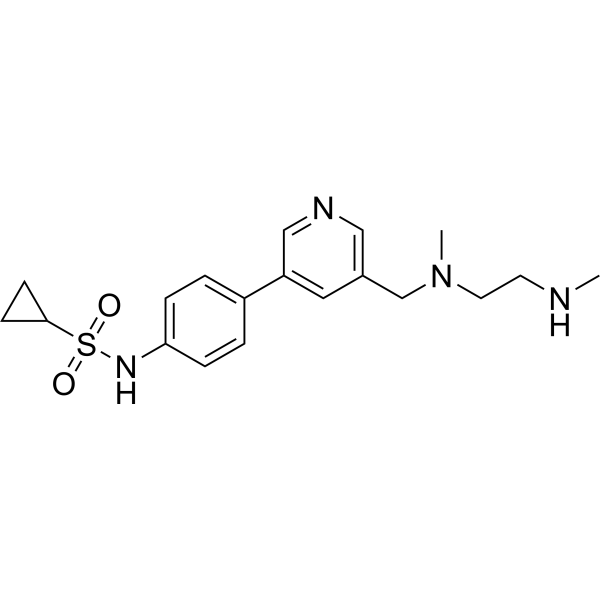
PRMT6-IN-3

Based on 1 Customer Validation
PRMT6-IN-3 (compound 25) is a selective PRMT6 inhibitor with an IC50 value of 192 nM. PRMT6-IN-3 can induce apoptosis in cancer cells and has anticancer activity.
For research use only. We do not sell to patients.
- Purity : 99.66%
- CAS No.: 2890765-10-1
- Formula: C19H26N4O2S
- Molecular Weight:374.50
-
Storage:Powder -20°C, 3 years , 4°C, 2 years ; In solvent -80°C, 6 months , -20°C, 1 month

To place orders, for customer services and technical support, please contact: MedChemExpress USA
Tel: 609-228-6898 E-mail: [email protected] [email protected]


-
 Biological Activity
-
Chemical Information
-
Solvent & Solubility
- Protocols
- Purity & Documentation
- References
-
 Help & FAQs


All Histone Methyltransferase Isoforms
More

Biological Activity
Description
Cellular Effect
|
Cell Line

|
Type | Value | Description | References |
|---|---|---|---|---|
| HCC827 | IC50 |
14.83 μM
Compound: a25
|
Antiproliferative activity against human HCC827 cells for 5 days by MTT assay
Antiproliferative activity against human HCC827 cells for 5 days by MTT assay
|
[PMID: 36566712] |
| HCC827 | IC50 |
17.91 μM
Compound: a25
|
Antiproliferative activity against human HCC827 cells for 3 days by MTT assay
Antiproliferative activity against human HCC827 cells for 3 days by MTT assay
|
[PMID: 36566712] |
| HCC827 | IC50 |
9.84 μM
Compound: a25
|
Antiproliferative activity against human HCC827 cells for 7 days by MTT assay
Antiproliferative activity against human HCC827 cells for 7 days by MTT assay
|
[PMID: 36566712] |
| MDA-MB-435 | IC50 |
12.03 μM
Compound: a25
|
Antiproliferative activity against human MDA-MB-435 cells for 5 days by MTT assay
Antiproliferative activity against human MDA-MB-435 cells for 5 days by MTT assay
|
[PMID: 36566712] |
| MDA-MB-435 | IC50 |
16.67 μM
Compound: a25
|
Antiproliferative activity against human MDA-MB-435 cells for 3 days by MTT assay
Antiproliferative activity against human MDA-MB-435 cells for 3 days by MTT assay
|
[PMID: 36566712] |
| MDA-MB-435 | IC50 |
3.98 μM
Compound: a25
|
Antiproliferative activity against human MDA-MB-435 cells for 7 days by MTT assay
Antiproliferative activity against human MDA-MB-435 cells for 7 days by MTT assay
|
[PMID: 36566712] |
In Vitro
PRMT6-IN-3(compound 25) (80 μM, 3-7 days) has anti-proliferative activity against HCC827 and MDA-MB-435 cells[1].
PRMT6-IN-3(compound 25) (0-40 μM, 72 h) significantly induces apoptosis of cancer cells in a dose-dependent manner. Among them, a concentration of 40 μM could induce apoptosis in 43.44% and 35.08% of HCC827 and MDA-MB-435 cells, respectively[1].
MedChemExpress (MCE) has not independently confirmed the accuracy of these methods. They are for reference only.
In Vivo
| Parameters | iv (2 mg/kg) | po (10 mg/kg) |
| Tmax (h) | 0.08 | 0.33 |
| T1/2 (h) | 1.46 | 1.63 |
| AUC(0-t)(ng*h/mL) | 661.50 | 123.53 |
| MRT(0-t) (h) | 1.24 | 1.86 |
| Cmax (ng/mL) | - | 88.32 |
| F (%) | - | 3.73 |
MedChemExpress (MCE) has not independently confirmed the accuracy of these methods. They are for reference only.


Chemical Information
-
CAS No. 2890765-10-1
-
Appearance Solid
-
Molecular Weight 374.50
-
Formula C19H26N4O2S
-
Color White to yellow
-
SMILES
O=S(C1CC1)(NC2=CC=C(C3=CC(CN(C)CCNC)=CN=C3)C=C2)=O
-
Shipping
Room temperature in continental US; may vary elsewhere.
-
Storage
Powder -20°C 3 years 4°C 2 years In solvent -80°C 6 months -20°C 1 month


Solvent & Solubility
In Vitro:
DMSO : 55 mg/mL (146.86 mM; Need ultrasonic and warming; Hygroscopic DMSO has a significant impact on the solubility of product, please use newly opened DMSO)
Please refer to the solubility information to select the appropriate solvent. Once prepared, please aliquot and store the solution to prevent product inactivation from repeated freeze-thaw cycles.
Storage method and period of stock solution: -80°C, 6 months; -20°C, 1 month. When stored at -80°C, please use it within 6 months. When stored at -20°C, please use it within 1 month.
Please refer to the solubility information to select the appropriate solvent. Once prepared, please aliquot and store the solution to prevent product inactivation from repeated freeze-thaw cycles.
Storage method and period of stock solution: -80°C, 6 months; -20°C, 1 month. When stored at -80°C, please use it within 6 months. When stored at -20°C, please use it within 1 month.
Concentration (start) × Volume (start) = Concentration (final) × Volume (final)


Purity & Documentation
-
Data Sheet (269 KB)
-
SDS (393 KB)
- English - EN (393 KB)
- Français - FR (393 KB)
- Deutsch - DE (393 KB)
- Norwegian - NO (393 KB)
- Español - ES (393 KB)
- Swedish - SV (393 KB)
- Italian - IT (393 KB)
- Korean - KR (393 KB)
- Portuguese - PT (393 KB)
-
Handling Instructions (2659 KB)
References


Complete Stock Solution Preparation Table
Please refer to the solubility information to select the appropriate solvent. Once prepared, please aliquot and store the solution to prevent product inactivation from repeated freeze-thaw cycles.
Storage method and period of stock solution: -80°C, 6 months; -20°C, 1 month. When stored at -80°C, please use it within 6 months. When stored at -20°C, please use it within 1 month.
| Optional Solvent | Concentration Solvent Mass | 1 mg | 5 mg | 10 mg | 25 mg |
|---|---|---|---|---|---|
| DMSO | 1 mM | 2.6702 mL | 13.3511 mL | 26.7023 mL | 66.7557 mL |
| 5 mM | 0.5340 mL | 2.6702 mL | 5.3405 mL | 13.3511 mL | |
| 10 mM | 0.2670 mL | 1.3351 mL | 2.6702 mL | 6.6756 mL | |
| 15 mM | 0.1780 mL | 0.8901 mL | 1.7802 mL | 4.4504 mL | |
| 20 mM | 0.1335 mL | 0.6676 mL | 1.3351 mL | 3.3378 mL | |
| 25 mM | 0.1068 mL | 0.5340 mL | 1.0681 mL | 2.6702 mL | |
| 30 mM | 0.0890 mL | 0.4450 mL | 0.8901 mL | 2.2252 mL | |
| 40 mM | 0.0668 mL | 0.3338 mL | 0.6676 mL | 1.6689 mL | |
| 50 mM | 0.0534 mL | 0.2670 mL | 0.5340 mL | 1.3351 mL | |
| 60 mM | 0.0445 mL | 0.2225 mL | 0.4450 mL | 1.1126 mL | |
| 80 mM | 0.0334 mL | 0.1669 mL | 0.3338 mL | 0.8344 mL | |
| 100 mM | 0.0267 mL | 0.1335 mL | 0.2670 mL | 0.6676 mL |


PRMT6-IN-3 Related Classifications
HY-152236 Related Classifications
 Powered by Bioz