



Rhodionin
Based on 1 publication(s) in Google Scholar
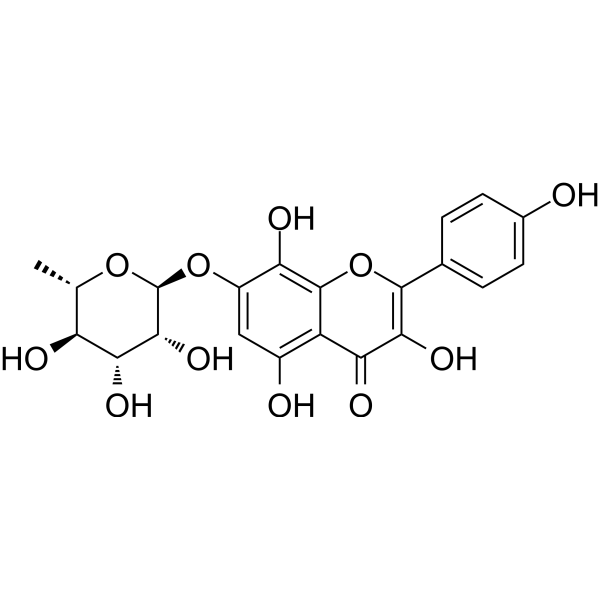
Rhodionin is an orally active, multifunctional antivirulence and cytoprotective agent that targets and inhibits Lipase, sortase A (SrtA), CYP2D6 (IC50=0.761 μM), AChE (IC50=2.43-57.5 μM), and DPPH free radicals (IC50=19.49 μM). Rhodionin is isolable from the roots of Rhodiola crenulata. Rhodionin reduces postprandial serum triglyceride levels in mice by inhibiting lipase activity. Rhodionin also binds directly to SrtA to inhibit its transpeptidase activity, thereby reducing the fibrinogen adhesion and surface protein A levels of MRSA, effectively inhibiting biofilm formation and protecting against MRSA-induced cell damage. Rhodionin improves the survival rate of infected mice without affecting MRSA growth, and finds wide application in studies related to hyperlipidemia, exogenous obesity, and pneumonia induced by methicillin-resistant Staphylococcus aureus (MRSA).
Nur für Forschungszwecke. Wir verkaufen nicht an Patienten.
- Reinheit : 99.73%
- CAS. Nr.: 85571-15-9
- Formel: C21H20O11
- Molecular Weight:448.38
-
Speicherung:
4°C, protect from light
* In solvent : -80°C, 6 months; -20°C, 1 month (protect from light)

To place orders, for customer services and technical support, please contact: MedChemExpress USA
Tel: 609-228-6898 E-mail: [email protected] [email protected]


-
 Biologische Aktivität
-
Chemical Information
-
Lösungsmittel & Löslichkeit
- Protokoll
- Reinheit & Dokumentation
- Verweise
-
 Help & FAQs


Publications Citing Use of MedChemExpress (MCE) Rhodionin
More

Biologische Aktivität
Beschreibung
|
CYP2D6 0.761 μM (IC50) |
CYP2D6 0.769 μM (Ki) |
AChE 2.43-57.5 μM (IC50) |
In Vitro
Rhodionin (0-256 μg/mL; 1 h) potently inhibits the activity of purified recombinant SrtA ΔN59 protein with an IC50 of 22.85 μg/mL, achieving 84.24% inhibition at 64 μg/mL[2].
Rhodionin (64 μg/mL; 24 h) has no effect on the growth of S. aureus USA300, and its MIC against this strain is greater than 512 μg/mL[2].
Rhodionin (16-128 μg/mL; 24 h viability, 5 h infection protection) is non-toxic to A549 cells at concentrations up to 128 μg/mL and provides dose-dependent protection against S. aureus USA300-induced A549 cell injury[2].
Rhodionin (16-128 μg/mL) does not affect the expression of SrtA protein in S. aureus USA300 at concentrations up to 128 μg/mL[2].
MedChemExpress (MCE) has not independently confirmed the accuracy of these methods. They are for reference only.
-
Cell Line:A549
-
Concentration:16-128 μg/mL (viability assay); 16-128 μg/mL (infection protection assay)
-
Incubation Time:24 h (viability assay); 5 h (infection protection assay)
-
Result:Was non-toxic to A549 cells at concentrations up to 128 μg/mL, with viability matching untreated controls.
Protected A549 cells from S. aureus-induced damage in a dose-dependent manner, reducing red PI-stained dead cells and decreasing LDH release into the supernatant.
In Vivo
Rhodionin (100 mg/kg; s.c.; every 12 hours) confers significant protection against MRSA-induced pneumonia in C57BL/6J mice, increasing the 96-hour survival rate to 50% while reducing bacterial load, pulmonary edema, and inflammatory responses[2].
MedChemExpress (MCE) has not independently confirmed the accuracy of these methods. They are for reference only.
-
Animal Model:C57BL/6J mice with Pneumonia (6-8 weeks old, SPF grade)[2]
-
Dosage:100 mg/kg
-
Administration:s.c.; every 12 hours
-
Result:Increased 96-hour survival rate to 50% and significantly reduced lung tissue bacterial load.
Alleviated pulmonary edema and reduced lung hyperemia and swelling.
Diminished inflammatory cell infiltration.
Preserved alveolar structure.
Decreased lung perfusate levels of IFN-γ, IL-6, and TNF-α relative to untreated infected mice.


Chemical Information
-
CAS. Nr. 85571-15-9
-
Appearance Solid
-
Molecular Weight 448.38
-
Formel C21H20O11
-
Color Off-white to yellow
-
SMILES
O=C1C(O)=C(C2=CC=C(O)C=C2)OC3=C(O)C(O[C@H]4[C@@H]([C@@H]([C@H]([C@H](C)O4)O)O)O)=CC(O)=C13
-
Structure Classification
-
Versand
Room temperature in continental US; may vary elsewhere.
-
Speicherung
4°C, protect from light
* In solvent : -80°C, 6 months; -20°C, 1 month (protect from light)


Publications (1)
-
Journal Impact Factor
-
Most Recent
-
iScience
Natural senolytic activity of Rhodiola rosea extract alleviates age-associated phenotypes via paraptosis. [Abstract]2026 Apr 4;29(5):115607. PMID: 42028013


Lösungsmittel & Löslichkeit
In Vitro:
DMSO : 16.67 mg/mL (37.18 mM; Need ultrasonic; Hygroscopic DMSO has a significant impact on the solubility of product, please use newly opened DMSO)
Please refer to the solubility information to select the appropriate solvent. Once prepared, please aliquot and store the solution to prevent product inactivation from repeated freeze-thaw cycles.
Storage method and period of stock solution: -80°C, 6 months; -20°C, 1 month (protect from light). When stored at -80°C, please use it within 6 months. When stored at -20°C, please use it within 1 month.
Please refer to the solubility information to select the appropriate solvent. Once prepared, please aliquot and store the solution to prevent product inactivation from repeated freeze-thaw cycles.
Storage method and period of stock solution: -80°C, 6 months; -20°C, 1 month (protect from light). When stored at -80°C, please use it within 6 months. When stored at -20°C, please use it within 1 month.
Konzentration (Stammlösung) × Volumen (Stammlösung) = Konzentration (Ziellösung) × Volumen (Ziellösung)
In Vivo:
Select the appropriate dissolution method based on your experimental animal and administration route.
- For the following dissolution methods, please ensure to first prepare a clear stock solution using an In Vitro approach and then sequentially add co-solvents:
- To ensure reliable experimental results, the clarified stock solution can be appropriately stored based on storage conditions. As for the working solution for In Vivo experiments, it is recommended to prepare freshly and use it on the same day.
- The percentages shown for the solvents indicate their volumetric ratio in the final prepared solution. If precipitation or phase separation occurs during preparation, heat and/or sonication can be used to aid dissolution.
Add each solvent one by one: 10% DMSO 90% (20% SBE-β-CD in Saline)
Solubility: ≥ 1.67 mg/mL (3.72 mM); Clear solution
This protocol yields a clear solution of ≥ 1.67 mg/mL (saturation unknown).
Taking 1 mL working solution as an example, add 100 μL DMSO stock solution (16.7 mg/mL) to 900 μL 20% SBE-β-CD in Saline, and mix evenly.
Preparation of 20% SBE-β-CD in Saline (4°C, storage for one week): 2 g SBE-β-CD powder is dissolved in 10 mL Saline, completely dissolve until clear.
In Vivo Dissolution Calculator
Please enter the basic information of animal experiments:
-
-
-
-
Recommended: Prepare an additional quantity of animals to account for potential losses during experiments.
Please enter your animal formula composition:
-
%DMSO +
Recommended: Keep the proportion of DMSO in working solution below 2% if your animal is weak.
-
%+
-
+%Tween-80 + +
-
%Saline +
The co-solvents required include: DMSO, . All of co-solvents are available by MedChemExpress (MCE). , Tween 80. All of co-solvents are available by MedChemExpress (MCE).
Working solution concentration: 0.22 mg/mL
Method for preparing stock solution: mg drug dissolved in μL DMSO. Stock solution concentration: mg/mL. * In solvent : -80°C, 6 months; -20°C, 1 month (protect from light)
1. Take μL DMSO stock solution;
2. Add μL .
μL , mix evenly;
3. Then add μL Tween 80, mix evenly;
4. Then add μL
Please ensure that the stock solution in the first step is dissolved to a clear state, and add co-solvents in sequence. You can use ultrasonic heating (ultrasonic cleaner, recommended frequency 20-40 kHz), vortexing, etc. to assist dissolution.


Reinheit & Dokumentation
-
Data Sheet (291 KB)
-
SDS (252 KB)
- English - EN (252 KB)
- Français - FR (252 KB)
- Deutsch - DE (252 KB)
- Norwegian - NO (252 KB)
- Español - ES (252 KB)
- Swedish - SV (252 KB)
- Italian - IT (252 KB)
- Korean - KR (252 KB)
- Portuguese - PT (252 KB)
-
Handling Instructions (2659 KB)
Verweise
[1]. Kobayashi K, et al. Constituents of Rhodiola rosea showing inhibitory effect on lipase activity in mouse plasma and alimentary canal. Planta Med. 2008;74(14):1716-1719. [Content Brief]
[2]. Wang X, et al. The protection effect of rhodionin against methicillin-resistant Staphylococcus aureus-induced pneumonia through sortase A inhibition. World J Microbiol Biotechnol. 2022;39(1):18. Published 2022 Nov 21. [Content Brief]
[3]. Xu W, et al. Two potent cytochrome P450 2D6 inhibitors found in Rhodiola rosea. Pharmazie. 2013 Dec;68(12):974-6. [Content Brief]
[4]. Li FJ, et al. Molecular interaction studies of acetylcholinesterase with potential acetylcholinesterase inhibitors from the root of Rhodiola crenulata using molecular docking and isothermal titration calorimetry methods. Int J Biol Macromol. 2017 Nov;104(Pt A):527-532. [Content Brief]
[5]. Choe KI, et al. The antioxidant and anti-inflammatory effects of phenolic compounds isolated from the root of Rhodiola sachalinensis A. BOR. Molecules. 2012 Sep 27;17(10):11484-94. [Content Brief]


Complete Stock Solution Preparation Table
Please refer to the solubility information to select the appropriate solvent. Once prepared, please aliquot and store the solution to prevent product inactivation from repeated freeze-thaw cycles.
Storage method and period of stock solution: -80°C, 6 months; -20°C, 1 month (protect from light). When stored at -80°C, please use it within 6 months. When stored at -20°C, please use it within 1 month.
| Optional Solvent | Concentration Solvent Mass | 1 mg | 5 mg | 10 mg | 25 mg |
|---|---|---|---|---|---|
| DMSO | 1 mM | 2.2303 mL | 11.1513 mL | 22.3025 mL | 55.7563 mL |
| 5 mM | 0.4461 mL | 2.2303 mL | 4.4605 mL | 11.1513 mL | |
| 10 mM | 0.2230 mL | 1.1151 mL | 2.2303 mL | 5.5756 mL | |
| 15 mM | 0.1487 mL | 0.7434 mL | 1.4868 mL | 3.7171 mL | |
| 20 mM | 0.1115 mL | 0.5576 mL | 1.1151 mL | 2.7878 mL | |
| 25 mM | 0.0892 mL | 0.4461 mL | 0.8921 mL | 2.2303 mL | |
| 30 mM | 0.0743 mL | 0.3717 mL | 0.7434 mL | 1.8585 mL |


Rhodionin Related Classifications
HY-N0241 Related Classifications
 Powered by Bioz
Keywords