
1. Search Result
Search Result
Results for "

lung cancer PDX models

" in MedChemExpress (MCE) Product Catalog:

13

Inhibitors & Agonists

1

Fluorescent Dyes

4

Inhibitory Antibodies

1

Natural
Products

Targets Recommended:
Cat. No. Product Name Target Research Areas Chemical Structure
  • HY-141598
    Datopotamab deruxtecan (solution)
    2 Publications Verification

    DS-1062 (solution); Dato-DXd (solution)

    TROP2 Antibody-Drug Conjugates (ADCs) Topoisomerase Cancer
    Datopotamab deruxtecan (DS-1062) solution is a TROP2-targeted antibody-drug conjugate (ADC) with human TROP2 Kd of 0.74 nmol/L. Datopotamab deruxtecan solution consists of the antibody Datopotamab (HY-P99843) and the toxic molecule-linker conjugate Deruxtecan (HY-13631E). Datopotamab deruxtecan solution binds TROP2, triggers internalization and lysosomal trafficking and releases DXd topoisomerase I inhibitor payload. Datopotamab deruxtecan solution disrupts DNA function, induces DNA damage, apoptosis, and bystander killing of tumor microenvironment cells. Datopotamab deruxtecan solution can be used in research related to triple-negative breast cancer, gastric cancer, and non-small cell lung cancer .
    Datopotamab deruxtecan (solution)
  • HY-P991372

    RN927C antibody

    TROP2 Cancer
    Anti-TROP2 Antibody (RN927C antibody) is a human monoclonal antibody targeting Trop-2. Anti-TROP2 Antibody exerts in vitro inhibitory effects on a variety of tumor cell lines. Anti-TROP2 Antibody exhibits anti-tumor activity in mouse pancreatic PDX, ovarian PDX, lung PDX and triple-negative breast cancer (TNB) PDX models. Anti-TROP2 Antibody can be used for research on pancreatic cancer, ovarian cancer, lung cancer and triple-negative breast cancer .
    Anti-TROP2 Antibody
  • HY-N5112A
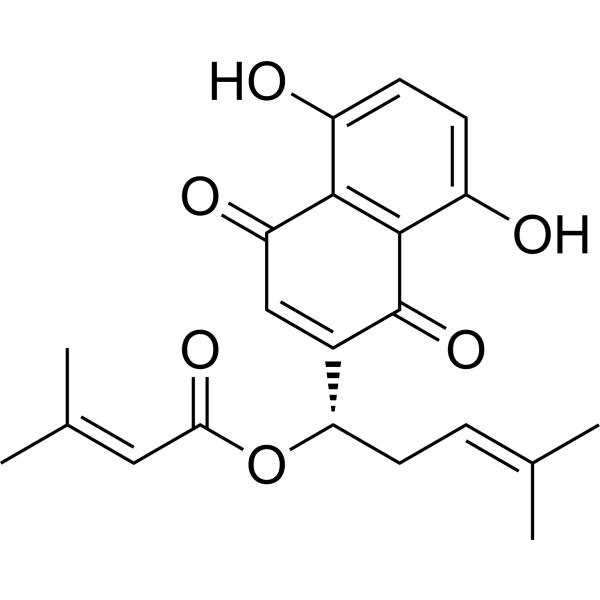
    β,β-Dimethylacrylalkannin
    3 Publications Verification

    Arnebin 1

    FGFR Necroptosis Apoptosis CDK JNK Inflammation/Immunology
    β,β-Dimethylacrylalkannin (Arnebin 1) is an orally active FGFR1 inhibitor (IC50=2.5 μM) and the main active component of Lithospermum erythrorhizon. β,β-Dimethylacrylalkannin blocks downstream signaling by binding to the ATP pocket of FGFR1, and regulates the CDK1/Cdc25C pathway and ROS-JNK axis, thereby inducing G2/M phase arrest, necrosis and apoptosis in cancer cells, and inhibiting tumor proliferation. β,β-Dimethylacrylalkannin also acts as a colistin adjuvant to disrupt the cell membrane of Gram-negative bacteria. β,β-Dimethylacrylalkannin exhibits significant tumor-inhibitory effects with no obvious toxicity in PDX models, but chronic exposure to high doses may alter the relative lung/liver weights of rats, while acute exposure to high doses causes responses such as reduced motor activity. β,β-Dimethylacrylalkannin finds wide application in studies related to hepatocellular carcinoma, colorectal cancer, colistin-resistant bacterial infections, hepatitis and psoriasis .
    β,β-Dimethylacrylalkannin
  • HY-157229
    STX-721
    1 Publications Verification

    EGFR ERK Cancer
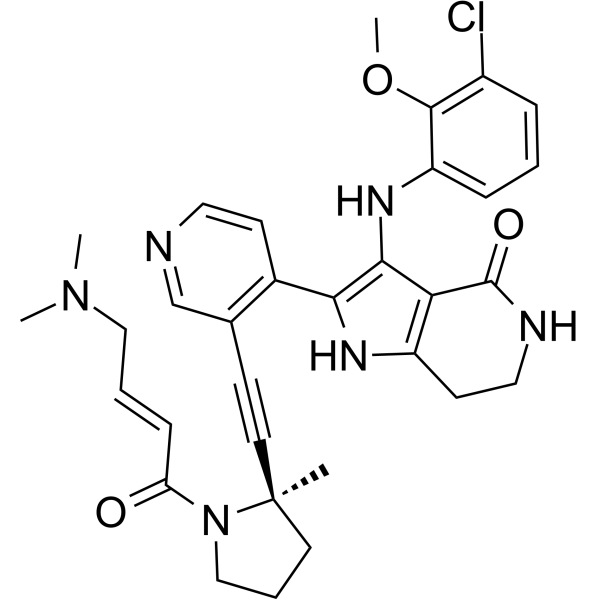
    STX-721 is an orally active, irreversible, covalent EGFR exon 20 insertion (ex20ins) inhibitor that selectively targets ex20ins-mutant dynamic protein states. STX-721 potently inhibits the kinase activity of EGFR ex20ins mutants (NPG, ASV, SVD). STX-721 inhibits phosphorylation of EGFR (pEGFR Y1068) and downstream ERK (pERK Thr202/Tyr204), and suppresses proliferation of ex20ins-mutant Ba/F3 cells and human NSCLC cell lines (NCI-H2073 ASV KI, CUTO-14 ASV). STX-721 induces tumor regression in EGFR ex20ins-mutant PDX/CDX models. STX-721 can be used for the study of non-small cell lung cancer (NSCLC) harboring EGFR or HER2 ex20ins mutations .
    STX-721
  • HY-P990953

    Gen1047

    CD3 Cancer
    Zubotamig (Gen1047) is an CD3E/VTCN1-targeting Ig(G1 -κ_G1 -λ2) type chimeric human antibody. The recommed isotype control is Human IgG1 kappa, Isotype Control (HY-P99001). Zubotamig induces T-cell mediated cytotoxicity of B7H4-positive tumor cells, triggers T-cell activation, and induces cytokine release from T cells in the presence of B7H4-expressing tumor cells. Zubotamig demonstrates antitumor activity in mouse patient-derived xenograft (PDX) models. Zubotamig can be used for the research of solid cancers (including breast, ovarian and lung cancer) .
    Zubotamig
  • HY-149040

    (S)-OBI-3424; (S)-TH-3424; AST-3424

    17β-HSD Cancer
    Odafosfamide ((S)-OBI-3424) is a highly selective prodrug bis-alkylating agent activated by aldehyde-keto reductase 1C3 (AKR1C3(). Odafosfamide is highly cytotoxic to cell lines with high AKR1C3 expression. Odafosfamide exhibits antitumor activity in a variety of tumors with high AKR1C3 expression (such as liver cancer, non-small cell lung cancer, and leukemia). Odafosfamide can be used in cancer research .
    Odafosfamide
  • HY-158143

    Histone Methyltransferase Apoptosis Cancer
    AZD3470 is an orally active MTA-cooperative PRMT5 inhibitor, selective for MTAP-deficient tumors. AZD3470 induces cell cycle G2/M phase alterations, DNA damage, apoptosis, and symmetric dimethylarginine reduction. AZD3470 alters alternative splicing, increases skipped exon events in DNA repair and cell cycle pathways, and inhibits cancer cell proliferation and tumor growth. AZD3470 can be used for the research of non-small cell lung cancer and MTAP-deleted solid tumors .
    AZD3470
  • HY-149695

    EGFR Cancer
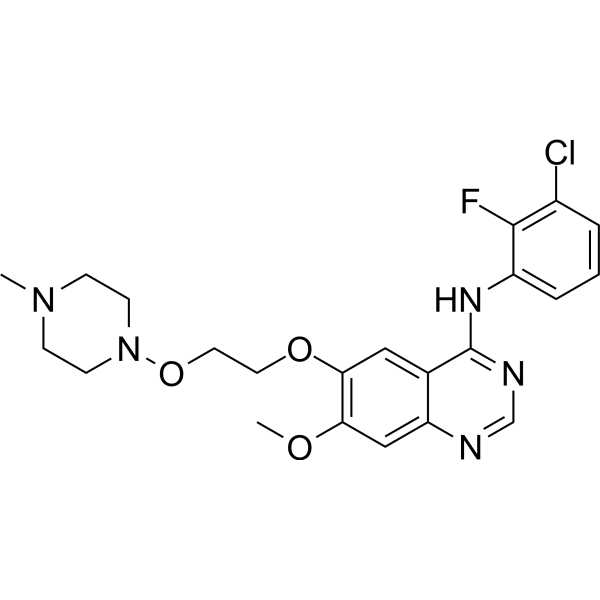
    EGFR-IN-91 (compound 9) is an orally available EGFR inhibitor with blood-brain barrier penetrability. EGFR-IN-91 inhibits EGFR L858R/C797S and EGFR exon 19del/C797S, inducing tumor regression in xenograft (PDX) mouse models. EGFR-IN-91 has the potential to inhibit localized and metastatic non-small cell lung cancer (NSCLC) driven by EGFR mutants .
    EGFR-IN-91
  • HY-171509

    Drug-Linker Conjugates for ADC Apoptosis Cancer
    Mal-N(Me)-C6-N(Me)-PNU-159682 (Compound 27), an agent-linker conjugate for ADC, consists the ADC linker Mal-N(Me)-C6-N(Me) and a potent ADC cytotoxin PNU-159682. Mal-N(Me)-C6-N(Me)-PNU-159682 (Compound 27) selectively delivers the payload to CD46-expressing cells, where the linker is cleaved by cathepsin B to release PNU-159682, inducing DNA damage and apoptosis. Mal-N(Me)-C6-N(Me)-PNU-159682 shows durable tumor regression in xenograft (PDX) models of non-small cell lung cancer (NSCLC) and colorectal cancer (CRC) .
    Mal-N(Me)-C6-N(Me)-PNU-159682
  • HY-182918

    Drug Intermediate Apoptosis Ferroptosis Cuproptosis Cancer
    DMAPT-DTCs-1,3-diaminopropane-DTCs-DMAPT dimethanesulfonate is an orally active prodrug of MMB-DTCs-1,3-diaminopropane-DTCs-MMB (HY-182917). DMAPT-DTCs-1,3-diaminopropane-DTCs-DMAPT dimethanesulfonate induces apoptosis, ferroptosis, and cuproptosis in lung cancer cells. DMAPT-DTCs-1,3-diaminopropane-DTCs-DMAPT dimethanesulfonate can be used in the research of lung cancer .
    DMAPT-DTCs-1,3-diaminopropane-DTCs-DMAPT dimethanesulfonate
  • HY-P992163

    Fc Receptor (FcR) C-type Lectin-like Receptors (CTLRs) Inflammation/Immunology Cancer
    23ME-01473 is an anti-ULBP6/2/5 antibody with enhanced Fc effector function, with a Kd of 0.053 nmol/L against hULBP6, 0.23 nmol/L against hULBP2, and 1.92 nmol/L against hULBP5. 23ME-01473 restores anti-tumor immunity by activating NKG2D and FcγRIIIa. 23ME-01473 exerts anti-cancer activity in non-small cell lung cancer PDX models. 23ME-01473 can be used for the research of non-small cell lung cancer .
    23ME-01473
  • HY-P991995

    OMTX705 antibody

    ADC Antibody FAP Cancer
    OMTX005 (OMTX705 antibody) is a humanized anti-FAP IgG1 monoclonal antibody that specifically binds to human (EC50: 0.33 nM)/mouse (EC50: 0.14 nM) FAP proteins and FAP-positive cells. OMTX005 exhibits no cytotoxicity when used alone and fails to induce an increase in caspase 3/7 activity in relevant cells. OMTX005 can be used to synthesize the ADC molecule OMTX705 for tumor research .
    OMTX005
  • HY-185426

    SC-011

    Antibody-Drug Conjugates (ADCs) Cancer
    ABBV-011 (SC-011) is a SEZ6-targeted, antibody-drug conjugate (ADC). ABBV-011 binds cell surface-expressed SEZ6 by anti-SEZ6 antibody Turmetabart (HY-P991041), triggers ADC-receptor complex internalization into lysosomes, releases Calicheamicin (HY-19609) payload, and mediates cytotoxicity. ABBV-011 induces tumor regression and mediates selective killing of SEZ6-positive cells. ABBV-011 can be used for the research of small cell lung cancer .
    ABBV-011

Inquiry Online

Your information is safe with us. * Required Fields.

Salutation


Country or Region *

Applicant Name *


Organization Name *

Department *


Email Address *


Product Name *

Cat. No.


Requested quantity *

Phone Number *


Remarks

Inquiry Online

Inquiry Information

Product Name:
Cat. No.:
Quantity:
MCE Japan Authorized Agent:

