



Shizukaol B

Based on 1 Customer Validation
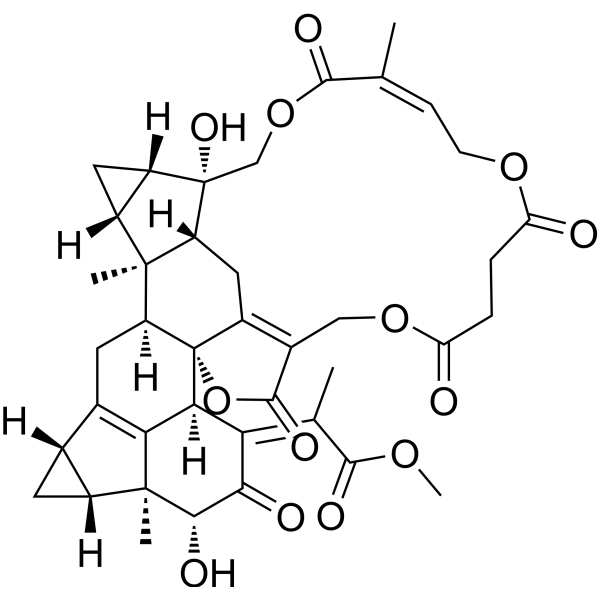
Shizukaol B is a lindenane-type dimeric sesquiterpene, used to be isolated from the whole plant of Chloranthus henryi. Shizukaol B has anti-inflammatory effect against lipopolysaccharide (LPS)-induced activation of BV2 microglial cells. Shizukaol B inhibits iNOS and COX-2, and suppresses NO production, TNF-α, and IL-1β expression.
Nur für Forschungszwecke. Wir verkaufen nicht an Patienten.
- Reinheit : 96%
- CAS. Nr.: 142279-40-1
- Formel: C40H44O13
- Molecular Weight:732.77
-
Speicherung:
-20°C, sealed storage, away from moisture
* In solvent : -80°C, 6 months; -20°C, 1 month (sealed storage, away from moisture)

To place orders, for customer services and technical support, please contact: MedChemExpress USA
Tel: 609-228-6898 E-mail: [email protected] [email protected]


-
 Biologische Aktivität
-
Chemical Information
- Protokoll
- Reinheit & Dokumentation
- Verweise
-
 Help & FAQs


Alle TNF Receptor Isoform-spezifische Produkte anzeigen
More

Biologische Aktivität
Beschreibung
IC50 & Target
[1]|
COX-2 |
iNOS |
IL-1β |
Cellular Effect
|
Cell Line

|
Type | Value | Description | References |
|---|---|---|---|---|
| C8166 | CC50 |
0.02 μM
Compound: 8
|
Cytotoxicity against human C8166 cells by MTT assay
Cytotoxicity against human C8166 cells by MTT assay
|
[PMID: 21650224] |
| RAW264.7 | IC50 |
>50 μM
Compound: 4
|
Anti-inflammatory activity in mouse RAW264.7 cells assessed as inhibition of LPS-induced NO production preincubated for 30 mins followed by LPS stimulation and measured after 24 hrs by Griess reagent based colorimetric method
Anti-inflammatory activity in mouse RAW264.7 cells assessed as inhibition of LPS-induced NO production preincubated for 30 mins followed by LPS stimulation and measured after 24 hrs by Griess reagent based colorimetric method
|
[PMID: 30724564] |
| RAW264.7 | IC50 |
0.15 μM
Compound: shizukaol B
|
Antiinflammatory activity in mouse RAW264.7 cells assessed as inhibition of LPS-stimulated nitric oxide production pretreated for 2 hrs before LPS challenge measured after 18 hrs by Griess method
Antiinflammatory activity in mouse RAW264.7 cells assessed as inhibition of LPS-stimulated nitric oxide production pretreated for 2 hrs before LPS challenge measured after 18 hrs by Griess method
|
[PMID: 22372956] |
| RAW264.7 | IC50 |
14.79 μM
Compound: 11
|
Inhibition of LPS-induced NO production in mouse RAW264.7 cells after 24 hrs by Griess assay
Inhibition of LPS-induced NO production in mouse RAW264.7 cells after 24 hrs by Griess assay
|
[PMID: 27177824] |
| WI-38 | IC50 |
16.7 μM
Compound: 30
|
Cytotoxicity against human WI38 cells after 72 hrs by CCK8 assay
Cytotoxicity against human WI38 cells after 72 hrs by CCK8 assay
|
[PMID: 27997206] |
In Vitro
Shizukaol B (25 μM; 0-60 min) inhibits LPS-mediated (1 μg/mL; 0-60 min) c-Jun N-terminal kinase 1/2 (JNK) activation, without affecting ERK1/2 or p38 phosphorylation[1].
Shizukaol B (12.5-50 μM; 4 h) inhibits LPS-induced (1 μg/mL; 24 h) NO production and expression of iNOS and COX-2 in BV2 cells[1].
MedChemExpress (MCE) has not independently confirmed the accuracy of these methods. They are for reference only.


Chemical Information
-
CAS. Nr. 142279-40-1
-
Appearance Solid
-
Molecular Weight 732.77
-
Formel C40H44O13
-
Color Off-white to light yellow
-
SMILES
COC(/C(C)=C1[C@]2([H])[C@@]34[C@](CC5=C2[C@]([C@@]6([H])[C@]5([H])C6)([C@H](C/1=O)O)C)([H])[C@]7([C@@]8([H])[C@]([C@@]9([C@]7([H])CC3=C(COC(CCC(OC/C=C(C(OC9)=O)/C)=O)=O)C(O4)=O)O)([H])C8)C)=O
-
Structure Classification
-
Initial Source
-
Versand
Room temperature in continental US; may vary elsewhere.
-
Speicherung
-20°C, sealed storage, away from moisture
* In solvent : -80°C, 6 months; -20°C, 1 month (sealed storage, away from moisture)


Reinheit & Dokumentation
-
Data Sheet (282 KB)
-
SDS (252 KB)
- English - EN (252 KB)
- Français - FR (252 KB)
- Deutsch - DE (252 KB)
- Norwegian - NO (252 KB)
- Español - ES (252 KB)
- Swedish - SV (252 KB)
- Italian - IT (252 KB)
- Korean - KR (252 KB)
- Portuguese - PT (252 KB)
-
Handling Instructions (2659 KB)
Verweise

Calculators
Konzentration (Stammlösung) × Volumen (Stammlösung) = Konzentration (Ziellösung) × Volumen (Ziellösung)


Shizukaol B Related Classifications
HY-N8371 Related Classifications
 Powered by Bioz