



Sulopenem sodium
Based on 2 publication(s) in Google Scholar
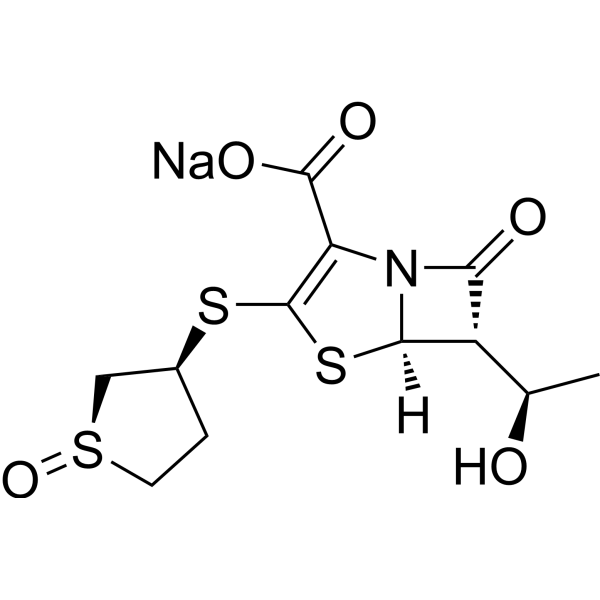
Sulopenem (sodium)(CP-70429 (sodium)) is an orally active, parenteral penem antibiotic with broad-spectrum activities against Gram-positive and Gram-negative bacteria. Sulopenem has the potential for urinary tract infections and intra-abdominal infections treatment. Sulopenem is inactive against Pseudomonas aeruginosa and Xanthomonas maltophilia.
For research use only. We do not sell to patients.
- CAS No.: 112294-81-2
- Formula: C12H14NNaO5S3
- Molecular Weight:371.43
-
Storage:
Please store the product under the recommended conditions in the Certificate of Analysis.

To place orders, for customer services and technical support, please contact: MedChemExpress USA
Tel: 609-228-6898 E-mail: [email protected] [email protected]


-
 Biological Activity
-
Chemical Information
- Protocols
- Purity & Documentation
- References
-
 Help & FAQs


Publications Citing Use of MedChemExpress (MCE) Sulopenem sodium
MoreAll Antibiotic Isoforms
More

Biological Activity
Description
Clinical Trial
| NCT Number | Sponsor | Condition | Start Date |
Phase

|
|---|---|---|---|---|
| NCT01329991 | Plexxikon| | 2011-05 | PHASE1 |


Chemical Information
-
CAS No. 112294-81-2
-
Molecular Weight 371.43
-
Formula C12H14NNaO5S3
-
SMILES
O=C(C(N12)=C(S[C@@H](CC3)C[S@@]3=O)S[C@]2([H])[C@@H]([C@H](O)C)C1=O)O[Na]
-
Synonyms
CP-70429 sodium
-
Shipping
Room temperature in continental US; may vary elsewhere.
-
Storage
Please store the product under the recommended conditions in the Certificate of Analysis.


Publications (2)
-
Journal Impact Factor
-
Most Recent
-
Nat Microbiol
Characterization of antibiotic resistomes by reprogrammed bacteriophage-enabled functional metagenomics in clinical strains. [Abstract]2023 Mar;8(3):410-423. PMID: 36759752 -
J Glob Antimicrob Resist
Susceptibility of multidrug-resistant Escherichia coli and Klebsiella pneumoniae to oral antibiotics in Australia. [Abstract]2025 Aug 8:44:435-441. PMID: 40784378

Protocols
-
Gram Staining of Tissue Sections
Gram staining of tissue sections is a histochemical technique used to differentiate Gram-positive and Gram-negative bacteria within histological specimens based on differences in bacterial cell wall structure and dye retention, adapted from classical bacteriological Gram staining into tissue-compatible “histological Gram stain” variants. In tissue applications, modifications of the Brown-Hopps and Brown-Brenn methods are commonly used to improve differentiation of microorganisms embedded within host connective tissue and to reduce overstaining or loss of Gram-negative signal, which are known limitations of earlier approaches. The principle relies on crystal violet-iodine complex retention in Gram-positive organisms and subsequent decolorization and counterstaining steps that allow contrast visualization of Gram-negative organisms against tissue background.


Purity & Documentation
References
[1]. Karlowsky JA, et al. In Vitro Activity of Sulopenem, an Oral Penem, against Urinary Isolates of Escherichia coli. Antimicrob Agents Chemother. 2018;63(1):e01832-18. Published 2018 Dec 21. [Content Brief]
[2]. Minamimura M, et al. In vitro antibacterial activity and beta-lactamase stability of CP-70,429 a new penem antibiotic. Antimicrob Agents Chemother. 1993;37(7):1547-1551. [Content Brief]
[3]. Nagashima M, et al. In vitro and in vivo activities of sulopenem compared with those of imipenem and cephalosporins. Jpn J Antibiot. 1996;49(4):303-323. [Content Brief]

Calculators
Concentration (start) × Volume (start) = Concentration (final) × Volume (final)


Sulopenem sodium Related Classifications
HY-105284A Related Classifications
 Powered by Bioz