



Urocortin II, human TFA
Urocortin II, human TFA is a selective endogenous peptide agonist of type-2 corticotropin-releasing factor (CRF2) receptor. Urocortin II, human TFA has an effect of promoting satiet and neuroprotective effect. Urocortin II, human TFA also has bactericidal, antiparasitic and pro-inflammation activity. Urocortin II, human TFA can activate NF-κB pathway and ERK1/2 MAP kinase. Urocortin II, human TFA can reduce pulmonary arterial hypertension and shows cardiac protection effect. Urocortin II, human TFA can be used for the researches of infection, inflammation, metabolic, neurological and cardiovascular disease.
For research use only. We do not sell to patients.
- Formula: C183H324N58O51.xC2HF3O2
- Molecular Weight:4152.89 (free base)
-
Storage:
Please store the product under the recommended conditions in the Certificate of Analysis.

To place orders, for customer services and technical support, please contact: MedChemExpress USA
Tel: 609-228-6898 E-mail: [email protected] [email protected]


-
 Biological Activity
-
Chemical Information
- Protocols
- Purity & Documentation
- References
-
 Help & FAQs


All Parasite Isoforms
More

Biological Activity
Description
|
CRFR2 |
ERK1 |
ERK2 |
NF-κB |
In Vitro
Urocortin II, human TFA shows bactericidal activity against E. coli, P. pseudoalcaligenes and M. luteus with EC50 values of 2.81, 1.16 and 4.92 μM[3].
Urocortin II, human TFA shows antiparasitic activity against L. major, L. tropica and L. infantum with EC50 values of 9.20, 22.41 and 12.47 μM[3].
Urocortin II, human TFA (0.1-1000 nM, 6-24 h) induces IL-8 mRNA and protein expression, activates the NF-κB pathway (IkBα degradation, p65 phosphorylation) and ERK1/2 MAP kinase in human colonic epithelial NCM460 cells overexpressing CRHR2α[5].
MedChemExpress (MCE) has not independently confirmed the accuracy of these methods. They are for reference only. Further protocols information, click here.
In Vivo
Urocortin II, human TFA (2.5 μg/kg; i.p.; single dose) shows neuroprotective effect in intracerebral hemorrhage of rats[2].
Urocortin II, human TFA (1 nM/mouse, i.p., administered at 1, 12, and 24 h after cecal ligation and puncture) improves survival rate, reduces bacterial load and inflammatory mediator levels in blood and peritoneal fluid, and alleviates tissue pathological damage in female BALB/c mouse models of sepsis[3].
Urocortin II, human TFA (5 μg/kg, i.p., twice a day for 10 days) reduces pulmonary arterial hypertension, improves exercise capacity and attenuates pulmonary arterial and right ventricular remodelling and dysfunction in Monocrotaline (HY-0750)-induced rats[4].
MedChemExpress (MCE) has not independently confirmed the accuracy of these methods. They are for reference only.
-
Animal Model:ICH rats induced by infusing bacterial collagenase VII[2]
-
Dosage:2.5 μg/kg
-
Administration:Intraperitoneally injection, single dose
-
Result:Reduced modified Neurological Severity Scores from 8.4 on day 1 to 8.0 and 6.6 on days 3 and 7.


Chemical Information
-
Molecular Weight 4152.89 (free base)
-
Formula C183H324N58O51.xC2HF3O2
-
Sequence
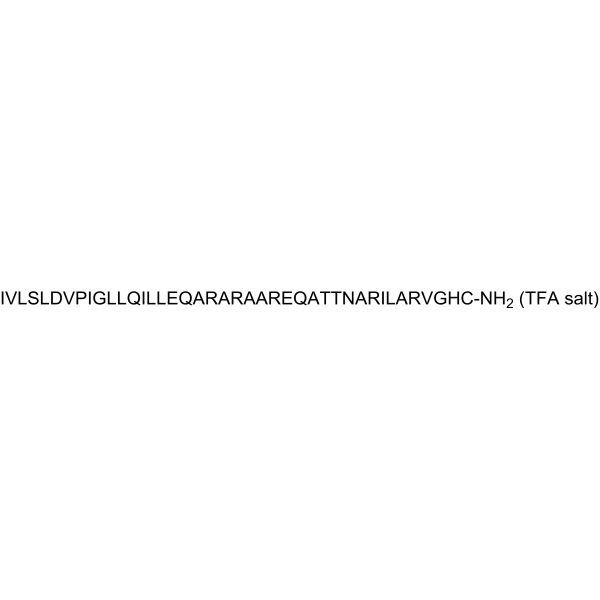
Ile-Val-Leu-Ser-Leu-Asp-Val-Pro-Ile-Gly-Leu-Leu-Gln-Ile-Leu-Leu-Glu-Gln-Ala-Arg-Ala-Arg-Ala-Ala-Arg-Glu-Gln-Ala-Thr-Thr-Asn-Ala-Arg-Ile-Leu-Ala-Arg-Val-NH2
-
Sequence Shortening
IVLSLDVPIGLLQILLEQARARAAREQATTNARILARV-NH2
-
Shipping
Room temperature in continental US; may vary elsewhere.
-
Storage
Please store the product under the recommended conditions in the Certificate of Analysis.

Protocols
-
Research Protocol for Infectious Diseases
Infectious-disease experiments test how pathogens interact with host barriers, innate immune receptors, inflammatory signaling, pathogen replication, and tissue injury; pattern-recognition receptors such as TLRs, RIG-I-like receptors, NOD-like receptors, and inflammasomes detect microbial molecules and activate NF-κB, interferon, and cytokine responses. The central hypothesis is that infection severity reflects the balance between pathogen burden and host response: protective inflammation restricts pathogen growth, whereas excessive or mislocalized inflammation contributes to tissue damage and disease phenotype. Unresolved questions include which host pathways are protective versus pathogenic, why some infection models fail to translate to human disease, and which combined readouts best predict clinically relevant infection outcomes.
-
Research Protocol for Cardiovascular Diseases
Cardiovascular disease can be modeled as maladaptive cardiac remodeling, where ischemic injury or pressure overload activates inflammatory signaling, fibroblast activation, extracellular-matrix deposition, cardiomyocyte hypertrophy, vascular remodeling, and progressive ventricular dysfunction. The TGF-β/SMAD axis is a central profibrotic pathway after myocardial injury and pressure overload, while innate immune and cytokine pathways regulate leukocyte recruitment, scar formation, and adverse remodeling. Key unresolved questions include which inflammatory signals are reparative versus harmful, when fibrosis is protective versus maladaptive, and whether pathway inhibition improves function without weakening necessary infarct healing or compensatory remodeling.
-
Research Protocol for Inflammation-related Diseases
The NLRP3 inflammasome is a cytosolic innate immune signaling platform that integrates priming signals and danger-signal activation to promote caspase-1 activation, maturation of IL-1β and IL-18, and gasdermin D-mediated pyroptotic cell death. The core experimental logic is to determine whether inflammatory disease phenotypes are driven by increased NLRP3 expression, ASC-containing inflammasome assembly, caspase-1 cleavage, GSDMD cleavage, and extracellular release of IL-1β/IL-18 rather than by nonspecific cell injury alone. The pathway is strongly linked to inflammation-related disease phenotypes because monosodium urate crystals activate NALP3/NLRP3 inflammasome signaling in gout-like crystal inflammation, cholesterol crystals activate NLRP3 inflammasomes in atherogenesis models, and DSS-induced intestinal inflammation has been reported to involve NLRP3 inflammasome activity. However, experimental colitis studies also show context-dependent protective effects of NLRP3 inflammasome co


Purity & Documentation
References
[1]. Zorrilla EP,et al. Human urocortin 2, a corticotropin-releasing factor (CRF)2 agonist, and ovine CRF, a CRF1 agonist, differentially alter feeding and motor activity. J Pharmacol Exp Ther. 2004 Sep;310(3):1027-34. [Content Brief]
[2]. Liew HK, et al. Therapeutic effects of human urocortin-1, -2 and -3 in intracerebral hemorrhage of rats. Neuropeptides. 2015 Aug;52:89-96. [Content Brief]
[3]. Campos-Salinas J, et al. Protective role of the neuropeptide urocortin II against experimental sepsis and leishmaniasis by direct killing of pathogens. J Immunol. 2013 Dec 15;191(12):6040-51. [Content Brief]
[4]. Adão R, et al. Urocortin-2 improves right ventricular function and attenuates pulmonary arterial hypertension. [Content Brief]
[5]. Moss AC, et al. Urocortin II mediates pro-inflammatory effects in human colonocytes via corticotropin-releasing hormone receptor 2alpha. Gut. 2007 Sep;56(9):1210-7. [Content Brief]

Calculators
Concentration (start) × Volume (start) = Concentration (final) × Volume (final)


Urocortin II, human TFA Related Classifications
HY-P1752A Related Classifications
 Powered by Bioz