Infection
-
Infection Related Products (18904)
Related Products (18904)

-
Antibodies (22)
-
Parvodicin C3
 0 ImagesCat. No.: HY-N5181CAS No.: 110882-86-5
Parvodicin C3 is a glycopeptide antibiotic. Parvodicin C3 has inhibitory effect on Staphylococcus aureus, Staphylococcus furfur, Staphylococcus hemolyticus and Enterococcus faecalis.
-
Xanthosine-5'-triphosphate lithium
 0 ImagesCat. No.: HY-115736BCAS No.: 3056945-74-2Synonyms: 5'-XTP lithium
Xanthosine-5'-triphosphate (5'-XTP) lithium is a purine nucleotide that stimulates Adenylate Cyclase to induce Cyclic AMP (cAMP) (HY-B1511) biosynthesis, binds to the AL1 allosteric site of the D137N-SAMHD1 mutant to activate dNTP triphosphohydrolase activity, and stimulates P2Y/P2U purinergic receptor-coupled phosphoinositide-specific phospholipase C with Michaelis-Menten kinetics. Xanthosine-5'-triphosphate lithium can be used for HIV-1 research.
-
Thunberginol C
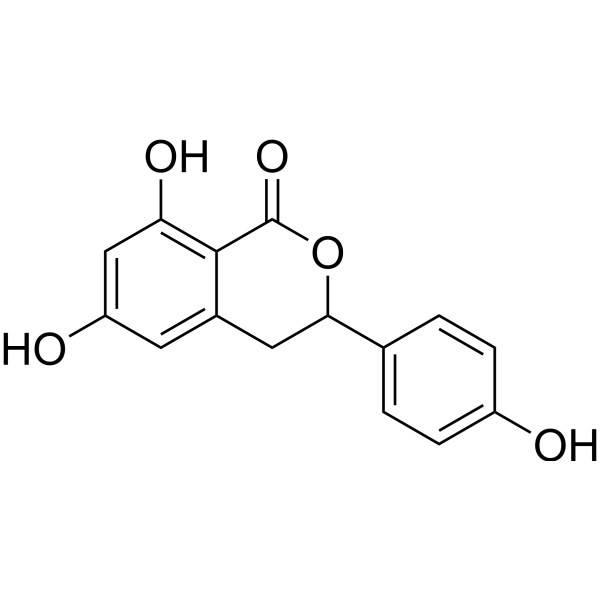 0 ImagesCat. No.: HY-N1151CAS No.: 147517-06-4
Thunberginol C is an orally active, selective, and non-competitive inhibitor of AChE and BChE, with IC50 values of 41.96 and 42.36 μM, respectively. Thunberginol C exerts cytoprotective, pro-collagen type I restorative, MMP-1 inhibitory, hyaluronic acid restorative, anti-photoaging effects in skin cells. Thunberginol C exerts neuroprotective, anxiolytic, TNF-α inhibitory, neuroinflammation inhibitory, and oxidative stress inhibitory effects. Thunberginol C can be used for the research of Alzheimer’s disease, UVB-induced skin photoaging, allergic reactions, oral bacterial infections, and stress-induced anxiety.
-
3-Aminobutanoic acid (Standard)
 0 ImagesCat. No.: HY-W008833RCAS No.: 541-48-0
3-Aminobutanoic acid is a β-amino acid. 3-Aminobutanoic acid can protect plant against a challenge infection with P. infestans. 3-Aminobutanoic acid has various levels of susceptibility for the pathogen.
-
Neoviridogrisein Ⅰ
 0 ImagesCat. No.: HY-N14494CAS No.: 66002-39-9
Neoviridogrisein I has been used to resist Gram-positive bacteria and mycoplasma.
-
Auramycin B
 0 ImagesCat. No.: HY-N13895CAS No.: 78173-91-8
Auramycin B, an anthracycline antibiotic that shows marked antibacterial activity against Gram-positive bacteria. Auramycin B also exhibits antitumor activity against P388 and L1210 leukemia in mice.
-
IMB-XMA0038
 0 ImagesCat. No.: HY-W026339CAS No.: 921812-26-2
IMB-XMA0038 is a MtASADH inhibitor with an IC50 value of 0.59 μg/mL. IMB-XMA0038 inhibits various agent-resistant Mycobacteria tuberculosis potently with MICs of 0.25-0.5 μg/mL. IMB-XMA0038 shows anti-tuberculosis activity.
-
Calceolarioside A
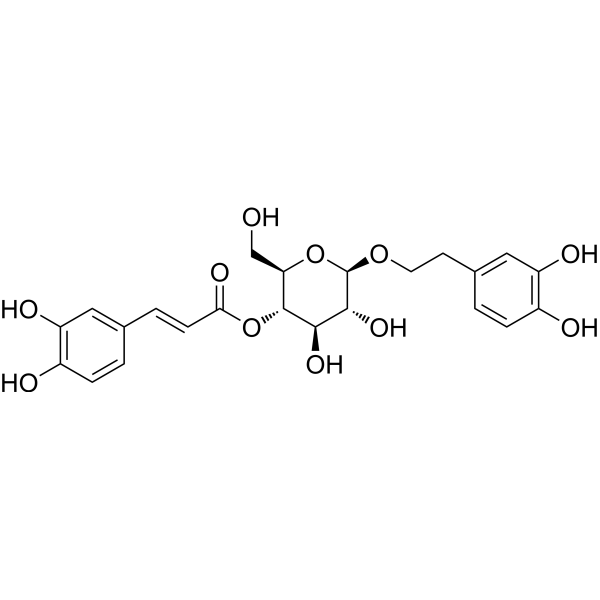 0 ImagesCat. No.: HY-123896CAS No.: 84744-28-5
Calceolarioside A is phenylethanoid glycoside with moderate binding affinity on HIV gp41.
-
Inpyrfluxam
 0 Images
Inpyrfluxam is a succinate dehydrogenase (SDH) inhibitor. Inpyrfluxam targets the ubiquinone binding pocket of mitochondrial SDH complex subunits ViSDHB, ViSDHC, ViSDHD, interfering with cellular respiration. Inpyrfluxam inhibits conidial germination and mycelial growth of Venturia inaequalis in vitro. Inpyrfluxam can be used for the research of apple scab.
-
Antimicrobial-IN-1
 0 ImagesCat. No.: HY-170312
Antimicrobial-IN-1 (compound 17) exhibits strong antibacterial activity against S. aureus and E. coli, with the inhibition zone diameter of 18 , 16 mm/mg, respectively.


-
Oudemansin A
 0 ImagesCat. No.: HY-165494CAS No.: 73341-71-6
Oudemansin A is an antibiotic. Oudemansin A acts on fungi to inhibit protein, RNA and DNA synthesis.
-
Oberadilol (monoethyl maleate)
 0 ImagesCat. No.: HY-19088ACAS No.: 114856-47-2Synonyms: CID-3047798 (monoethyl maleate); TZC 5665
Oberadilol monoethyl maleate (CID-3047798 monoethyl maleate) is a Phosphodiesterase III inhibitor, non-selective β-adrenergic receptor blocker, vasodilator and positive inotropic agent. Oberadilol monoethyl maleate reduces left ventricular end-diastolic volume. Oberadilol monoethyl maleate is used in research related to chronic congestive heart failure and SARS-CoV-2 infection.
-
Monorden B
 0 ImagesCat. No.: HY-N14866CAS No.: 88929-18-4
Monorden B has the effect of arresting the cell cycle of Jurket cells in G1 and G2/M phases. Monorden B has anti-Aspergillus niger activity.
-
Sulfadimethoxine 1000 µg/mL in methanol
 0 Images
Sulfadimethoxine (Sulphadimethoxine) 1000 µg/mL in methanol is an orally active sulfonamide antibiotic. Sulfadimethoxine 1000 µg/mL in methanol reduces Eimeria-related mortality, weight loss, and lesions. Sulfadimethoxine 1000 µg/mL in methanol can be used for the research of avian coccidiosis.
-
Diperamycin
 0 ImagesCat. No.: HY-N14163CAS No.: 220766-06-3
Diperamycin has activity against Gram-positive bacteria, including Enterococcus seriolicida and MRSA (MICs of 0.10-0.20 μg/mL). Diperamycin also strongly inhibits the activity of L1210, P388, LS-180, KB, HeLaS3, Meth A and B16-BL6 (IC50s of 0.009-0.098 μg/mL).
-
Didanosine (Standard)
 0 ImagesSynonyms: 2',3'-Dideoxyinosine (Standard); ddI (Standard)
Didanosine (Standard) is the analytical standard of Didanosine. This product is intended for research and analytical applications. Didanosine (2',3'-Dideoxyinosine; ddI) is a a potent and orally active dideoxynucleoside analogue, and also is a potent nucleoside reverse transcriptase inhibitor. Didanosine shows antiretroviral activity for HIV.
-
Anti-MRSA agent 41
 0 ImagesCat. No.: HY-179719
Anti-MRSA agent 41 (Compound 3d) is a prodrug of Mupirocin (HY-B0958), being a cholesterol disulfide conjugate of Mupirocin. Anti-MRSA agent 41 shows no antibacterial activity or cytotoxicity in vitro. Anti-MRSA agent 41 demonstrates strong anti-MRSA infection efficacy in systemic bacteremia and pneumonia mouse models. Anti-MRSA agent 41 can be used in antibiotic resistance research.
-
Cefaclor (Standard)
 0 Images
Cefaclor (Standard) is the analytical standard of Cefaclor. This product is intended for research and analytical applications. Cefaclor is a well-absorbed orally active cephalosporin antibiotic. Cefaclor can specifically bind to specific for penicillin-binding protein 3 (PBP3). Cefaclor can be used for the research kinds of infections caused by bacteria, such as respiratory tract infections, bacterial bronchitis, pharyngitis and skin infections.