Metabolic Disease
-
Metabolic Disease Related Products (16328)
Related Products (16328)

-
Antibodies (62)
-
Related Compound Screening Libraries (3)
-
Rosolic acid
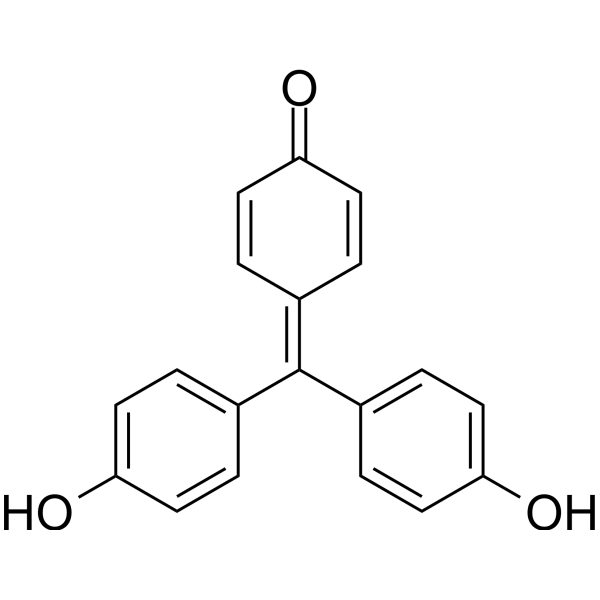 0 ImagesCat. No.: HY-W104821CAS No.: 603-45-2
Rosolic acid is a Michael acceptor molecule isolated from the rhizomes of Plantago asiatica L. Rosolic acid inhibits Keap1, promotes Nrf2 nuclear translocation, and upregulates HO-1 and NQO-1. Rosolic acid reduces ER stress markers PERK, ATF-6, GRP78, and CHOP, as well as oxidative stress, ROS production, inflammation, and apoptosis. Rosolic acid upregulates SOD, CAT, and GPx activities, induces angiogenesis and insulin secretion, and restores endothelial function and pancreatic beta cell protection under ER stress. Rosolic acid can be used in research on diabetes and endothelial dysfunction.
-
3,5-Dimethoxyphenol (Standard)
 0 ImagesCat. No.: HY-W001117RCAS No.: 500-99-2
3,5-Dimethoxyphenol is a toxin metabolite, found in human consuming yew leaves.
-
Ramiprilat acyl-β-D-glucuronide
 0 ImagesCat. No.: HY-186081CAS No.: 1357570-22-9
Ramiprilat acyl-β-D-glucuronide is an acyl glucuronide metabolite of Ramiprilat (HY-B0279). Ramiprilat acyl-β-D-glucuronide undergoes methylation on its glucuronic acid moiety during solid phase extraction with strong cation exchanger cartridges, forming a methylated derivative. Ramiprilat acyl-β-D-glucuronide undergoes in-source conversion to Ramiprilat in mass spectrometry, with conversion extent proportional to declustering potential voltage.
-
L-770644
 0 ImagesCat. No.: HY-124208CAS No.: 173901-95-6
L-770644 is an orally active, potent and selective agonist of the human β3 adrenergic receptor (EC50 = 13 nM).
-
8-Bromo-2'-deoxy-ATP tetrasodium
 0 ImagesCat. No.: HY-134272ACAS No.: 1188369-62-1Synonyms: 8-Bromo-dATP tetrasodium
8-Bromo-2'-deoxy-ATP (8-Bromo-dATP) tetrasodium is a derivative of the nucleoside triphosphate 2'-Deoxyadenosine-5'-triphosphate (dATP, HY-136648).
-
L-Palmitoylcarnitine-d9
 0 Images
L-Palmitoylcarnitine-d9 is deuterium labeled L-Palmitoylcarnitine. L-Palmitoylcarnitine, a long-chain acylcarnitine and a fatty acid metabolite, accumulates in the sarcolemma and deranges the membrane lipid environment during ischaemia. L-Palmitoylcarnitine inhibits KATP channel activity, without affecting the single channel conductance, through interaction with Kir6.2.
-
1,2,3,4,7,8,9-Heptachlorodibenzofuran
 0 ImagesCat. No.: HY-W517092CAS No.: 55673-89-7Synonyms: 1,2,3,4,7,8,9-HpCDF
1,2,3,4,7,8,9-Heptachlorodibenzofuran (1,2,3,4,7,8,9-HpCDF) is a compound that induces the expression of CYP1A1 and CYP1B1 genes in human peripheral blood lymphocytes, while also promoting the expression of the aryl hydrocarbon receptor repressor (AhRR). 1,2,3,4,7,8,9-Heptachlorodibenzofuran can increase ethoxyresorufin-O-deethylase (EROD) activity in isolated human peripheral blood lymphocytes in a concentration-dependent manner, which serves as a marker of CYP1A1 activity. Furthermore, 1,2,3,4,7,8,9-Heptachlorodibenzofuran exhibits immunosuppressive effects by reducing the number of splenic plaque-forming cells in mice and increasing aryl hydrocarbon hydroxylase (AHH) activity in liver microsomes of mice injected with sheep red blood cells. 1,2,3,4,7,8,9-Heptachlorodibenzofuran can be used in research in the fields of immunology, metabolic diseases, and environmental toxicology.
-
Oxypurinol-13C,15N2-1
 0 ImagesCat. No.: HY-W777649CAS No.: 1217036-71-9Synonyms: Oxipurinol-13C,15N2-1
Oxypurinol-13C,15N2-1 (Oxipurinol-13C,15N2-1) is 15N and 13C labeled Oxypurinol (HY-19657). Oxipurinol, the major active metabolite of Allopurinoll (HY-B0219), is an inhibitor of xanthine oxidase. Oxipurinol can be used to regulate blood urate levels and treat gout.
-
GLP-1R agonist 29
 0 ImagesCat. No.: HY-172411CAS No.: 3076770-93-6
GLP-1R agonist 29 (Compound 20) is the agonist for GLP-1R that induces hGLP-1R mediated cAMP stimulation with an EC50 of 0.018 nM. GLP-1R agonist 29 exhibits good pharmacokinetics characteristics with good body exposure of AUC0-∞,sc of 77688 ng·h/mL.
-
2,5-Diamino-6-hydroxy-4-(5-phosphoribosylamino)pyrimidine
 0 ImagesCat. No.: HY-W720429CAS No.: 73477-63-1
2,5-Diamino-6-hydroxy-4-(5-phosphoribosylamino)pyrimidine is a metabolite in the biosynthesis pathway (purine metabolism process) of Riboflavin (HY-B0456).
-
Aloin (mixture of A&B) (Standard)
 0 Images
Aloin (mixture of A&B) (Standard) is the analytical standard of Aloin (mixture of A&B) (HY-N6013). This product is intended for research and analytical applications. Aloin (mixture of A&B) is an orally active anthraquinone derivative isolated from Aloe vera. Aloin (mixture of A&B) mitigates airway impairment and exerts neuroprotective, anti-inflammatory, antioxidant, antibacterial, antifungal, antiviral and antitumor effects. Aloin (mixture of A&B) inhibits Clostridium histolyticum collagenase, granulocyte matrix metalloproteinases and human 20S proteasome. Aloin (mixture of A&B) upregulates the Nrf2/HO-1 pathway, suppresses the TGF-β/Smad2/3 pathway. Aloin (mixture of A&B) reduces IL-4/IL-5/IL-13 levels, and reverses oxidative stress markers (MDA, SOD, GSH). Aloin (mixture of A&B) can be used for research on chronic ulcers, burns, wounds, inflammatory and degenerative disorders, asthma and neuroblastoma.
-
1,2-Didecanoyl-3-chloropropanediol
 0 ImagesCat. No.: HY-W718033CAS No.: 2241680-20-4
1,2-Didecanoyl-3-chloropropanediol is an ester product.
-
L 152804 (Standard)
 0 ImagesCat. No.: HY-107734RCAS No.: 6508-43-6
L 152804 (Standard) is the analytical standard of L 152804 (HY-107734). This product is intended for research and analytical applications. L 152804 is an orally active and selective neuropeptide Y Y5 receptor (NPY5-R) antagonist, with a Ki of 26 nM for hY5. L 152804 causes weight loss in diet-induced obese mice by modulating food intake and energy expenditure.
-
Anti-Mouse TIM-4 Antibody (RMT4-54)
 0 ImagesCat. No.: HY-P990152
Anti-Mouse TIM-4 Antibody (RMT4-54) is a rat-derived IgG2a κ type antibody inhibitor, targeting to mouse TIM-4. Anti-Mouse TIM-4 Antibody (RMT4-54) reacts with mouse T cell immunoglobulin and mucin domain 4 (TIM-4) and blocks TIM-4 signaling. Anti-Mouse TIM-4 Antibody (RMT4-54) inhibits phagocytosis of apoptotic cells. Anti-Mouse TIM-4 Antibody (RMT4-54) can be used for the researches of immunology and metabolic disease.
-
Dodecyl methane sulfonate
 0 Images
Dodecyl methane sulfonate is an ester product.
-
trans-Cyclohexane-1,2-diol (Standard)
 0 ImagesCat. No.: HY-W010514RCAS No.: 1460-57-7
trans-Cyclohexane-1,2-diol (Standard) is the analytical standard of trans-Cyclohexane-1,2-diol (HY-W010514). This product is intended for research and analytical applications. trans-Cyclohexane-1,2-diol (TCHD) is a transient dilator of the nuclear pore complex (NPC). By interacting with the hydrophobic core (FG nucleoporin) of the NPC, trans-Cyclohexane-1,2-diol can disrupt the NPC structure and reversibly increase the permeability of the nuclear pore, allowing macromolecules larger than 40 kDa (such as plasmid DNA) to enter the cell nucleus by passive diffusion, thereby enhancing the nuclear import efficiency of non-viral vectors. trans-Cyclohexane-1,2-diol can improve the efficiency of in vitro electrotransfection or lipid-mediated gene transfection, especially significantly increasing gene expression in differentiated airway epithelial cells.
-
5,7-Dihydroxychromone (Standard)
 0 ImagesCat. No.: HY-N1970RCAS No.: 31721-94-5
5,7-Dihydroxychromone (Standard) is the analytical standard of 5,7-Dihydroxychromone (HY-N1970). This product is intended for research and analytical applications. 5,7-Dihydroxychromone is a flavonoid compound with antioxidant properties. 5,7-Dihydroxychromone induces Nrf2 nuclear translocation, increases Nrf2/ARE binding activity, and up-regulates Nrf2-dependent antioxidant genes HO-1, NQO1, GCLc. 5,7-Dihydroxychromone attenuates excessive ROS generation, inhibits activated caspase-3, caspase-9, cleaved PARP expression, and prevents neuronal apoptosis and cell death. 5,7-Dihydroxychromone increases LXRα and PPARγ mRNA expression, induces preadipocyte differentiation, and regulates blood glucose levels. 5,7-Dihydroxychromone inhibits radial growth of soil pathogenic fungi, radicle elongation of select seedlings, and transiently inhibits Bradyrhizobium sp. growth in high mannitol medium. 5,7-Dihydroxychromone can be used for the research of Parkinson’s disease, type 2 diabetes mellitus and pathogenic fungal infection.
-
(R)-Coriolic acid
 0 ImagesCat. No.: HY-113884CAS No.: 10219-69-9Synonyms: 13(R)-HODE
13(R)-HODE is the opposite enantiomer of the 13(S)-HODE produced when linoleic acid is incubated with soybean lipoxygenase. The presence of 13(R)-HODE in the supernatants and membranes of cultured bovine endothelial cells has been attributed to COX metabolism.1 13(R)-HODE is a weak (IC50=2.7 μM) inhibitor of U-46619-induced platelet aggregation.
-
13(Z),16(Z),19(Z)-Docosatrienoyl chloride
 0 ImagesCat. No.: HY-165937CAS No.: 960593-68-4
13(Z),16(Z),19(Z)-Docosatrienoyl chloride is an ester product.