



Riviciclib
Based on 3 publication(s) in Google Scholar
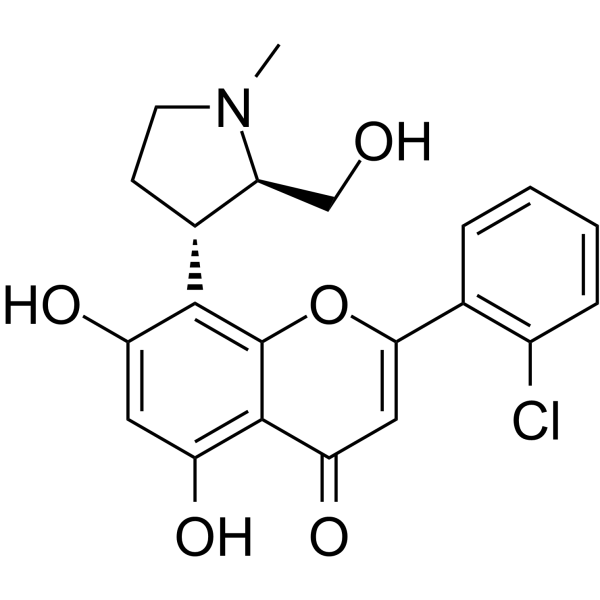
Riviciclib (P276-00 free base) is a potent cyclin-dependent kinase (CDK) inhibitor, which inhibits CDK9-cyclinT1, CDK4-cyclin D1, and CDK1-cyclinB with IC50s of 20 nM, 63 nM, and 79 nM, respectively. Riviciclib shows antitumor activity on cisplatin-resistant cells.
For research use only. We do not sell to patients.
- CAS No.: 920113-02-6
- Formula: C21H20ClNO5
- Molecular Weight:401.84
-
Storage:
Please store the product under the recommended conditions in the Certificate of Analysis.

To place orders, for customer services and technical support, please contact: MedChemExpress USA
Tel: 609-228-6898 E-mail: [email protected] [email protected]


-
 Biological Activity
-
Chemical Information
- Protocols
- Purity & Documentation
- References
-
 Help & FAQs


Publications Citing Use of MedChemExpress (MCE) Riviciclib
More

Biological Activity
Description
IC50 & Target
[1]|
CDK9- Cyclin T1 0.020 μM (IC50) |
cdk4-cyclin D1 0.063 μM (IC50) |
CDK1-Cyclin B 0.079 μM (IC50) |
cdk2-cyclin A 0.224 μM (IC50) |
cdk2-cyclin E 2.540 μM (IC50) |
cdk6-cyclin D3 0.396 μM (IC50) |
CDK9-cyclin H 2.900 μM (IC50) |
Cellular Effect
|
Cell Line

|
Type | Value | Description | References |
|---|---|---|---|---|
| HT-29 | IC50 |
0.58 μM
Compound: 28; P276-00
|
Antiproliferative activity against human HT-29 cells assessed as reduction in [3H]-thymidine incorporation after 48 hrs by liquid scintillation assay
Antiproliferative activity against human HT-29 cells assessed as reduction in [3H]-thymidine incorporation after 48 hrs by liquid scintillation assay
|
[PMID: 30733087] |
| Sf9 | IC50 |
2540 nM
Compound: 9; P276-00
|
Inhibition of human CDK2/cyclin E expressed in baculovirus infected Sf9 insect cells using retinoblastoma (792 to 928 residues) as substrate after 30 mins by gamma32P-ATP based scintillation counting analysis
Inhibition of human CDK2/cyclin E expressed in baculovirus infected Sf9 insect cells using retinoblastoma (792 to 928 residues) as substrate after 30 mins by gamma32P-ATP based scintillation counting analysis
|
[PMID: 27171036] |
| Sf9 | IC50 |
63 nM
Compound: 9; P276-00
|
Inhibition of human N-terminal GST-tagged CDK4/cyclin D1 expressed in baculovirus infected Sf9 insect cells using retinoblastoma (792 to 928 residues) as substrate after 30 mins by gamma32P-ATP based scintillation counting analysis
Inhibition of human N-terminal GST-tagged CDK4/cyclin D1 expressed in baculovirus infected Sf9 insect cells using retinoblastoma (792 to 928 residues) as substrate after 30 mins by gamma32P-ATP based scintillation counting analysis
|
[PMID: 27171036] |
In Vitro
Riviciclib (1.5-5 μM; 72 hours) shows no detectable cells in G1 and G2 in promyelocytic leukemia cells and arrest of cells in G1 in synchronized human non-small cell lung carcinoma (H-460) and human normal lung fibroblast (WI-38) cells[3].
Riviciclib (3-24 hours; 1.5 μM) reduces cyclin D1, Cdk4, and Rb levels in H-460 cells. Rb (retinoblastoma) phosphorylation at Ser780 decrease at 3 h[2].
Riviciclib shows activity in human cancer cell lines, such as colon carcinoma, osteosarcomal, cervical carcinoma, and bladder carcinoma cells[2].
MedChemExpress (MCE) has not independently confirmed the accuracy of these methods. They are for reference only.
-
Cell Line:Promyelocytic leukemia cells (HL-60 cells), non-small cell carcinoma (H-460) cells, human normal lung fibroblast (WI-38) cells
-
Concentration:1.5, 5 μM
-
Incubation Time:72 hours
-
Result:Showed apoptosis at the end of 24 h and no detectable cells were present in G1 and G2 in HL-60 cells. Caused an exclusive G1 arrest of synchronous population of cancerous cells H-460 cells and normal cells WI-38.
-
Cell Line:H-460 cells; MCF-7 cells
-
Concentration:1.5 μM
-
Incubation Time:3, 6, 9, 12, 24 hours
-
Result:Reduced cyclin D1, Cdk4, and Rb levels in H-460 cells. Rb (retinoblastoma) phosphorylation at Ser780 decrease at 3 h. Decreased protein levels of cyclin D1 and Cdk4 levels staring at 6 and 9 h in MCF-7 cells, respectively, and accompanied by a decrease in phosphorylation of Rb at Ser780 from 6 h onward, followed by reduced Rb levels at 24 h.
In Vivo
Riviciclib (administered via i.p.; 50 mg/kg once daily; 30 mg/kg twice daily for 18 treatments, in human xenograft mode with severe combined immunodeficient mice) significantly inhibits growth[3].
MedChemExpress (MCE) has not independently confirmed the accuracy of these methods. They are for reference only.
-
Animal Model:Human xenograft mode with HCT-116 tumor model (severe combined immunodeficient mice)[3]
-
Dosage:35 mg/kg
-
Administration:Administered i.p.; daily for 10 days
-
Result:Given 35 mg/kg showed significant inhibition in the growth.
-
Animal Model:Human xenograft model with H-460 tumor xenograft (severe combined immunodeficient mice)[3]
-
Dosage:50 mg/kg; 30 mg/kg
-
Administration:Administered i.p.; 50 mg/kg once daily for 20 days; Administered i.p.; 30 mg/kg twice daily for 18 treatments
-
Result:Given 50 mg/kg and 30 mg/kg twice daily significantly inhibited growth.
Clinical Trial
| NCT Number | Sponsor | Condition | Start Date |
Phase
|
|---|---|---|---|---|
| NCT01329991 | 2011-05 | PHASE1 |


Chemical Information
-
CAS No. 920113-02-6
-
Molecular Weight 401.84
-
Formula C21H20ClNO5
-
SMILES
O=C1C=C(C2=C(Cl)C=CC=C2)OC3=C([C@H]4[C@H](CO)N(C)CC4)C(O)=CC(O)=C13
-
Synonyms
P276-00 free base
-
Shipping
Room temperature in continental US; may vary elsewhere.
-
Storage
Please store the product under the recommended conditions in the Certificate of Analysis.


Publications (3)
-
Journal Impact Factor
-
Most Recent
-
Pharmaceuticals (Basel)
Computational Modeling to Identify Drugs Targeting Metastatic Castration-Resistant Prostate Cancer Characterized by Heightened Glycolysis. [Abstract]2024 Apr 29;17(5):569. PMID: 38794139 -
Int J Mol Sci
Cyclin-Dependent Kinases (CDKs) and the Human Cytomegalovirus-Encoded CDK Ortholog pUL97 Represent Highly Attractive Targets for Synergistic Drug Combinations. [Abstract]2022 Feb 24;23(5):2493. PMID: 35269635 -
Elife
2020 Dec 7:9:e61405. PMID: 33284104


Purity & Documentation
References
[1]. Roskoski R Jr,Cyclin-dependent protein kinase inhibitors including palbociclib as anticancer drugs.Pharmacol Res. 2016 May;107:249-275. [Content Brief]
[2]. Joshi KS, et al. In vitro antitumor properties of a novel cyclin-dependent kinase inhibitor, P276-00. Mol Cancer Ther. 2007 Mar;6(3):918-25. [Content Brief]
[3]. Joshi KS,et al. P276-00, a novel cyclin-dependent inhibitor induces G1-G2 arrest, shows antitumor activity on cisplatin-resistant cells and significant in vivo efficacy in tumor models. Mol Cancer Ther. 2007 Mar;6(3):926-34. [Content Brief]

Calculators
Concentration (start) × Volume (start) = Concentration (final) × Volume (final)


Riviciclib Related Classifications
HY-16559A Related Classifications
 Powered by Bioz