



Apoptosis
Apoptosis
Apoptosis is a distinctive form of cell death exhibiting specific morphological and biochemical characteristics, including cell membrane blebbing, chromatin condensation, genomic DNA fragmentation, and exposure of specific phagocytosis signaling molecules on the cell surface. Cells undergoing apoptosis differ from those dying through necrosis. Necrotic cells are usually recognized by the immune system as a danger signal and, thus, resulting in inflammation; in contrast, apoptotic death is quiet and orderly.
There are two major pathways of apoptotic cell death induction: The intrinsic pathway, also called the Bcl-2-regulated or mitochondrial pathway, is activated by various developmental cues or cytotoxic insults, such as viral infection, DNA damage and growth-factor deprivation, and is strictly controlled by the BCL-2 family of proteins. The extrinsic or death-receptor pathway is triggered by ligation of death receptors (members of the tumor necrosis factor (TNF) receptor family, such as Fas or TNF receptor-1 (TNFR1)) that contain an intracellular death domain, which can recruit and activate caspase-8 through the adaptor protein Fas-associated death domain (FADD; also known as MORT1) at the cell surface. This recruitment causes subsequent activation of downstream (effector) caspases, such as caspase-3, -6 or -7, without any involvement of the BCL-2 family.
Studies suggest that alterations in cell survival contribute to the pathogenesis of a number of human diseases, including cancer, viral infections, autoimmune diseases, neurodegenerative disorders, and AIDS (acquired immunodeficiency syndrome). Treatments designed to specifically alter the apoptotic threshold may have the potential to change the natural progression of some of these diseases.
All Product Categories
-
Apoptosis Inhibitors
(904)
View all products
-
Apoptosis Agonists
(7)
View all products
-
Apoptosis Antagonists
(9)
View all products
-
Apoptosis Activators
(363)
View all products
-
Apoptosis Modulators
(60)
View all products
-
Apoptosis Inducers
(7944)
View all products
-
Apoptosis Degrader
(1)
View all products
-
Apoptosis Controls
(33)
View all products
-
Apoptosis Related Products (9888)
Related Products (9888)

-
Antibodies (120)
-
C646 (Standard)
 0 ImagesCat. No.: HY-13823RCAS No.: 328968-36-1C646 (Standard) is the analytical standard of C646 (HY-13823). This product is intended for research and analytical applications. C646 is a selective and competitive histone acetyltransferase p300 inhibitor with Ki of 400 nM, and is less potent for other acetyltransferases.
-
CHS-828 (Standard)
 0 ImagesSynonyms: GMX1778 (Standard)CHS-828 (Standard) is the analytical standard of CHS-828. This product is intended for research and analytical applications. CHS-828 (GMX1778) is a competitive inhibitor of nicotinamide phosphoribosyltransferase (NAMPT), with an IC50 less than 25 nM. CHS-828 (GMX1778) exerts a cytotoxic effect by decreasing the cellular level of NAD+ and exhibits a potent anticancer activity.
-
Oleoylestrone
 0 ImagesCat. No.: HY-125088CAS No.: 180003-17-2Oleoylestrone, an adipose tissue-derived hormonal signal, is a slimming agent that decreases food intake and maintains energy expenditure.
-
Alda-1 (Standard)
 0 ImagesAlda-1 (Standard) is the analytical standard of Alda-1. This product is intended for research and analytical applications. Alda-1 is a potent and selective ALDH2 agonist, which activates wild-type ALDH2 and restores near wild-type activity to ALDH2*2.
-
Oxythiamine chloride hydrochloride (Standard)
 0 ImagesCat. No.: HY-107430ARCAS No.: 614-05-1Synonyms: Hydroxythiamine chloride hydrochloride (Standard)Oxythiamine chloride hydrochloride (Standard) is the analytical standard of Oxythiamine chloride hydrochloride (HY-107430A). This product is intended for research and analytical applications. Oxythiamine (Hydroxythiamine) chloride hydrochloride, an analogue of anti-metabolite, can suppress the non-oxidative synthesis of ribose and induce cell apoptosis. Oxythiamine chloride hydrochloride is a thiamine antagonist and inhibits transketolase (TK). Oxythiamine chloride hydrochloride inhibits cancer cell apoptosis and inhibits cell proliferation.
-
Jacaric acid
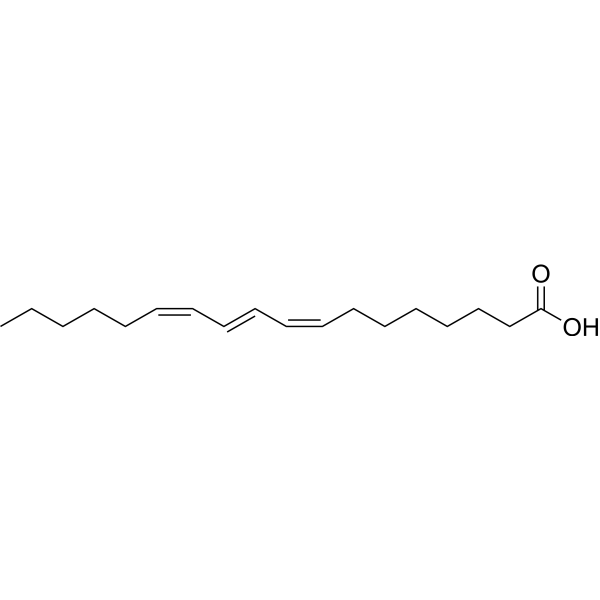 0 ImagesCat. No.: HY-121619CAS No.: 28872-28-8Jacaric acid is a conjugated linolenic acid, which inhibits viability in cells PC-3 (IC50 is 11.8 μM), LNCaP (IC50 is 2.2 μM) and DLD-1, induces apoptosis and necrosis. Jacaric acid exhibits anticaner activity against prostate cancer and adenocarcinoma. Jacaric acid exhibits immunomodulating activity in murine peritoneal macrophages as an immunopotentiator. Jacaric acid is orally active.
-
SCH79797 dihydrochloride (Standard)
 0 ImagesCat. No.: HY-14994RCAS No.: 1216720-69-2SCH79797 (dihydrochloride) (Standard) is the analytical standard of SCH79797 (dihydrochloride). This product is intended for research and analytical applications. SCH79797 dihydrochloride is a highly potent, selective nonpeptide protease activated receptor 1 (PAR1) antagonist. SCH79797 dihydrochloride inhibits binding of a high-affinity thrombin receptor-activating peptide to PAR1 with an IC50 of 70 nM and a Ki of 35 nM. SCH79797 dihydrochloride inhibits thrombin-induced platelet aggregation with an IC50 of 3 μM. SCH79797 dihydrochloride has antiproliferative and pro-apoptotic effects, and limits myocardial ischemia/reperfusion injury in rat hearts. SCH79797 dihydrochloride also potently prevents PAR1 activation in vascular smooth muscle cells, endothelial cells, and astrocytes.
-
CX-5461 (Standard)
 0 ImagesCX-5461 (Standard) is the analytical standard of CX-5461 (HY-13323). This product is intended for research and analytical applications. CX-5461 is a selective, orally active RNA polymerase I inhibitor. CX-5461 disrupts the formation of the SL1-rDNA complex, thereby blocking the transcription initiation of ribosomal RNA without altering the activity of RNA polymerase II, DNA replication, or protein translation processes. CX-5461 upregulates the expression of p21, MDM2, Sestrin1/2, and phosphorylated AMPKα, and reduces the level of phosphorylated Akt. CX-5461 induces G2/G2/M cell cycle arrest, Autophagy, Apoptosis, and cellular senescence, and activates CHK1, CHK2, and RPA. CX-5461 can be used in research related to osteosarcoma, cervical cancer, hematologic malignancies, high-grade serous ovarian cancer, and solid tumors.
-
PF-7006
 0 ImagesCat. No.: HY-164519CAS No.: 2771955-09-8PF-7006 is an Mps1 kinase inhibitor with a Ki value of 0.27 nM and an IC50 value of 2.5 nM. PF-7006 interferes with cell cycle checkpoints by inhibiting the catalytic activity of Mps1, reducing histone H3 levels, and shortening the duration of mitosis, leading to apoptosis in cancer cells. Combined use of PF-7006 with Palbociclib (HY-50767) increases cancer cell tolerance to PF-7006. PF-7006 can be used for breast cancer research.
-
Panobinostat lactate (Standard)
 0 ImagesSynonyms: LBH589 lactate (Standard); NVP-LBH589 lactate (Standard)Panobinostat lactate (Standard) is the analytical standard of Panobinostat lactate (HY-10224A). This product is intended for research and analytical applications. Panobinostat lactate is a potent and orally active non-selective HDAC inhibitor. Panobinostat lactate has antineoplastic activities. Panobinostat lactate effectively disrupts HIV latency. Panobinostat lactate induces cell apoptosis and autophagy. Panobinostat lactate can be used for the study of refractory or relapsed multiple myeloma.
-
7β-Hydroxycholesterol (Standard)
 0 ImagesCat. No.: HY-113341RCAS No.: 566-27-87β-Hydroxycholesterol (Standard) is the analytical standard of 7β-Hydroxycholesterol. This product is intended for research and analytical applications. 7β-Hydroxycholesterol is an oxysterol that derived by the oxidation of cholesterol. 7β-hydroxycholesterol can induce cellular oxidative stress, apoptosis, and necrosis, resulting in cytotoxicity. 7β-hydroxycholesterol has antitumor activity.
-
Fedratinib (Standard)
 0 ImagesSynonyms: TG-101348 (Standard); SAR 302503 (Standard)Fedratinib (Standard) is the analytical standard of Fedratinib. This product is intended for research and analytical applications. Fedratinib (TG-101348) is a potent, selective, ATP-competitive and orally active JAK2 inhibitor with IC50s of 3 nM for both JAK2 and JAK2V617F kinase. Fedratinib shows 35- and 334-fold selectivity over JAK1 and JAK3, respectively. Fedratinib induces cancer cell apoptosis and has the potential for myeloproliferative disorders research.
-
Tioxolone (Standard)
 0 ImagesTioxolone (Standard) is the analytical standard of Tioxolone. This product is intended for research and analytical applications. Tioxolone is an inhibitor for the carbonic anhydrase. Tioxolone exhibits anti-leishmanial, antitumor, and anti-inflammatory activities. Tioxolone can be used in research of acne and psoriasis.
-
Aceanthrenequinone
 0 ImagesAceanthrenequinone is a polycyclic aromatic hydrocarbon quinone organic compound that belongs to the category of free radical photoinitiators. Aceanthrenequinone serves as an intermediate for dyes and pigments, and also acts as a substrate for organic synthesis and polymer materials. Aceanthrenequinone activates the Aryl Hydrocarbon Receptor pathway, induces the expression of CYP1A protein in the vascular system of zebrafish embryos, and causes the death of embryos at 120 hpf. Aceanthrenequinone is applicable to research related to industrial or biomedical applications.
-
GSK 3 Inhibitor IX (Standard)
 0 ImagesSynonyms: 6-Bromoindirubin-3'-oxime (Standard); BIO (Standard); MLS 2052 (Standard)GSK 3 Inhibitor IX (Standard) is the analytical standard of GSK 3 Inhibitor IX (HY-10580). This product is intended for research and analytical applications. GSK 3 Inhibitor IX (6-Bromoindirubin-3'-oxime; BIO) is a potent, selective, reversible and ATP-competitive inhibitor of GSK-3α/β and CDK1-cyclinB complex with IC50s of 5 nM/320 nM/80 nM for (GSK-3α/β)/CDK1/CDK5, respectively.
-
Ciprofloxacin-d4
 0 ImagesCat. No.: HY-B0356S2Synonyms: Bay-09867-d4Ciprofloxacin-d4 (Bay-09867-d4) is deuterium labeled Ciprofloxacin. Ciprofloxacin (Bay-09867) is a potent, orally active topoisomerase IV inhibitor. Ciprofloxacin induces mitochondrial DNA and nuclear DNA damage and lead to mitochondrial dysfunction, ROS production. Ciprofloxacin has anti-proliferative activity and induces apoptosis. Ciprofloxacin is a fluoroquinolone antibiotic, exhibiting potent antibacterial activity.
-
KTX-582 intermediate-2
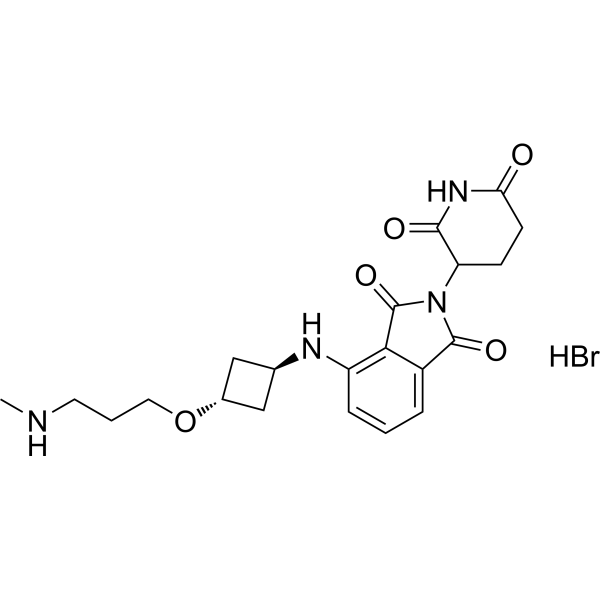 0 ImagesCat. No.: HY-49432CAS No.: 2434850-07-2
-
TAT-GluR6-9c
 0 ImagesCat. No.: HY-P10401TAT-GluR6-9c is a GluR6-PSD95 interaction blocker. By regulating the GluR6 mediated signaling pathway, TAT-GluR6-9c inhibits the activation of JNK and phosphorylation of c-Jun, reduces the expression of Fas L and thus reduces the occurrence of apoptosis. TAT-GluR6-9c can be used to study cerebral ischemia and neuroprotective strategies .
-
PD173074 (Standard)
 0 ImagesPD173074 (Standard) is the analytical standard of PD173074. This product is intended for research and analytical applications. PD173074 is a potent FGFR1 inhibitor with an IC50 of 25 nM and also inhibits VEGFR2 with an IC50 of 100-200 nM, showing 1000-fold selectivity for FGFR1 over PDGFR and c-Src.




