



Collagen
Collagen
Collagens are the most abundant proteins in mammals. The collagen family comprises 28 members that contain at least one triple-helical domain. Beyond the existence of 28 collagen types, further diversity occurs in the collagen family because of the existence of several molecular isoforms for the same collagen type (e.g., collagens IV and VI) and of hybrid isoforms comprised of a chains belonging to two different collagen types (type V/XI molecules). Collagens are deposited in the extracellular matrix where most of them form supramolecular assemblies. Four collagens are type II membrane proteins that also exist in a soluble form released from the cell surface by shedding. Collagens play structural roles and contribute to mechanical properties, organization, and shape of tissues. They interact with cells via several receptor families and regulate their proliferation, migration, and differentiation[1].
All Product Categories
-
Collagen Related Products (97)
Related Products (97)

-
12-O-Tiglyl-phorbol 13-dodecanoate
 0 ImagesCat. No.: HY-N11736CAS No.: 37394-32-412-O-Tiglyl-phorbol 13-dodecanoate (TD13) is a potential inhibitor with anti-hepatic fibrosis activity, and it belongs to a series of derivatives of oral APOL2 inhibitors and anti-hepatic fibrosis agents. It shows no obvious toxicity in preclinical models. Compounds of the 12-O-Tiglyl-phorbol 13-dodecanoate series inhibit the expression of fibronectin, type I collagen and α-smooth muscle actin in hepatic stellate cells. 12-O-Tiglyl-phorbol 13-dodecanoate can be isolated from the Euphorbiaceae plant Euphorbia fischeriana, and it is applicable to the research of hepatic fibrosis.
-
α-Neoendorphin (porcine)
 0 ImagesCat. No.: HY-P11656CAS No.: 77739-20-9α-Neoendorphin porcine is a peptide. α-Neoendorphin porcine effectively alleviates UVB-induced skin photoaging via activating mTOR-Beclin-1-mediated autophagy, reducing UVB-triggered ROS production, inhibiting the MAPK pathway and MMP activity, and promoting type I procollagen synthesis. α-Neoendorphin porcine exerts anti-aging and anti-wrinkle effects on skin cells. α-Neoendorphin porcine can be used in studies related to skin photoaging.
-
Porphyra 334
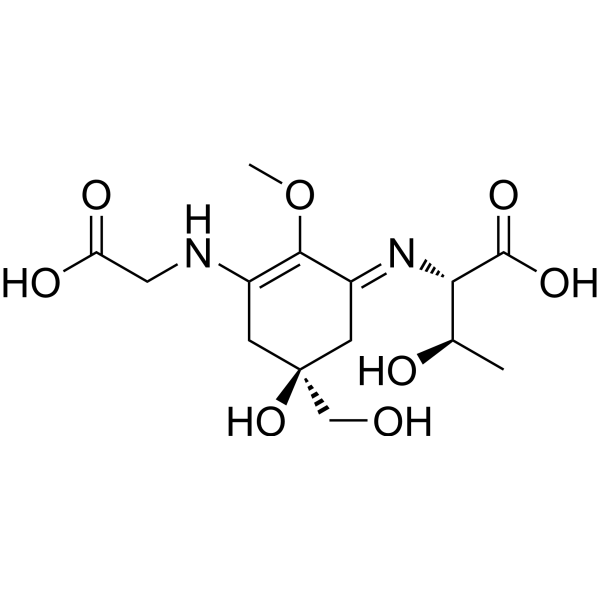 0 ImagesPorphyra 334 is a carnosine-like amino acid and a natural photoprotective agent and antioxidant. Porphyra-334 exerts its photoprotective effects by scavenging ROS, inhibiting the expression and activity of MMP-1/8, and promoting the synthesis of collagen and elastin. Porphyra 334 effectively inhibits linoleic acid oxidation induced by alkyl radicals (AAPH) and singlet oxygen. Porphyra 334 has anti-obesity potential by inhibiting the expression of PPARγ2 and C/EBPα. Porphyra 334 protects cells against UV-induced DNA damage and apoptosis by inhibiting the activation of caspase-3.
-
COLIV-peptide
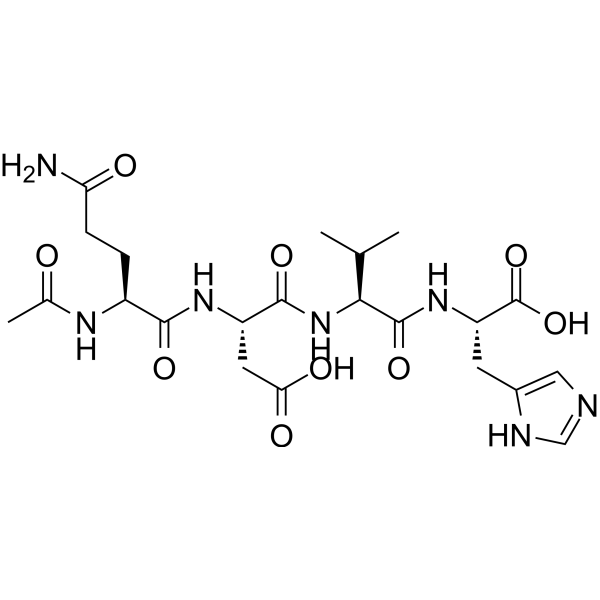
 0 ImagesCat. No.: HY-P11447CAS No.: 2121574-86-3COLIV-peptide is a type of specific binding peptide that can recognize and bind to Collagen Ⅳ, a key non-cellular component in atherosclerotic plaques. COLIV-peptide can be used for the study of atherosclerotic.
-
Sapanisertib (Standard)
 0 ImagesSynonyms: INK-128 (Standard); MLN0128 (Standard); TAK-228 (Standard)Sapanisertib (INK-128; MLN0128; TAK-228) Standard is the analytical standard of Sapanisertib (HY-13328). This product is intended for research and analytical applications. Sapanisertib (INK-128; MLN0128; TAK-228) is an orally active dual mTORC1/mTORC2 inhibitor. Sapanisertib directly and simultaneously inhibits mTORC1/2 activity through competitive binding with ATP, thereby comprehensively blocking downstream processes such as protein and lipid synthesis and cytoskeletal reorganization, consequently suppressing tumor cell proliferation and promoting apoptosis. Sapanisertib is applicable to research on melanoma, ovarian cancer, pulmonary fibrosis, and hematological malignancies.
-
1-Bromo-2,5-pyrrolidinedione (Standard)
 0 Images1-Bromo-2,5-pyrrolidinedione (Standard) is the analytical standard of 1-Bromo-2,5-pyrrolidinedione (HY-Y0775). This product is intended for research and analytical applications. 1-Bromo-2,5-pyrrolidinedione is a collagen protein ligand in docking experiments. 1-Bromo-2,5-pyrrolidinedione can be used to study wound healing-related diseases.
-
L-Ascorbate sulfate disodium
 0 ImagesCat. No.: HY-148854CAS No.: 53910-28-4
-
680C91 (Standard)
 0 ImagesCat. No.: HY-108681RCAS No.: 163239-22-3680C91 (Standard) is the analytical standard of 680C91 (HY-108681). This product is intended for research and analytical applications. 680C91 is an orally active, selective tryptophan 2,3-dioxygenase (TDO) inhibitor with a Ki of 51 nM. TDO is the key enzyme of tryptophan catabolism. 680C91 can be used for the research of cancer immunotherapy and Alzheimer’s Disease.
-
Calcium glucoheptonate
 0 ImagesCat. No.: HY-W404758CAS No.: 23351-51-1Calcium glucoheptonate is a highly water-soluble calcium supplement. Calcium glucoheptonate can increase the proliferation rate and Calcium intake of MG-63 cells and increase the activity of alkaline phosphatase (ALP). Calcium glucoheptonate can upregulate the expression of osteogenic-related genes and proteins,such as collagen-1, osteocalcin and osteocalcin. Calcium glucoheptonate can be used for the researches of osteoporosis and hypocalcemia.
-
Antibacterial agent 284
 0 ImagesCat. No.: HY-174313Antibacterial agent 284 (Compound 7) is an Antibacterial agent. Antibacterial agent 284 has a zinc-binding structure and potent inhibitory activity against Legionella pneumophila metalloprotease ProA (IC50: 0.96 μM) with zinc-binding structure. Antibacterial agent 284 significantly inactivates the cleavage of collagen IV and flagellin (ProA substrates) and reduces immune evasion from the TLR5-NF-κB pathway and PMN-mediated inflammation in human lung tissue explants. Antibacterial agent 284 is promising for Legionnaires' disease research.
-
Methylophiopogonone A (Standard)
 0 ImagesCat. No.: HY-N2441RCAS No.: 74805-90-6Methylophiopogonone A (Standard) is the analytical standard of Methylophiopogonone A (HY-N2441). This product is intended for research and analytical applications. Methylophiopogonone A is a homoisoflavonoid compound found in the tuberous roots of Ophiopogon japonicus. Methylophiopogonone A inhibits lipopolysaccharide-induced NO production in mouse microglia with an IC50 of 19.2 μM. Methylophiopogonone A blocks the proliferation of LX-2 hepatic stellate cells and downregulates TGF-β1-induced expressions of type I collagen and α-SMA. Methylophiopogonone A blocks RELA/EGFR-mediated hepatic stellate cell activation, inhibits the MAPK12 pathway to reduce extracellular matrix accumulation, and simultaneously suppresses inflammatory signal transduction. Methylophiopogonone A can be used in studies related to chronic hepatitis B-associated hepatic fibrosis and neuroinflammation.
-
(+)-Columbianetin (Standard)
 0 Images(+)-Columbianetin (Standard) is the analytical standard of (+)-Columbianetin (HY-N0363). This product is intended for research and analytical applications. (+)-Columbianetin ((S)-Columbianetin) acts as an inhibitor of JNK/ERK. (+)-Columbianetin inhibits UVA-induced phosphorylation of JNK and ERK, reduces the production of MMP-1, reverses UVA-induced Collagen (HY-NP003) degradation, and alleviates UVA-mediated inhibition of Smad2/3 phosphorylation and translocation. (+)-Columbianetin regulates the AP-1 and ASK1-MAPK signaling pathways, inhibits the production of ROS and blocks sub-G1 cell cycle arrest. (+)-Columbianetin is applicable to research related to skin aging.
-
Fenclozine dimaleate
 0 ImagesCat. No.: HY-19017BCAS No.: 76823-82-0Fenclozine dimaleate is a non-steroidal antiinflammatory agent.
-
Pentifylline
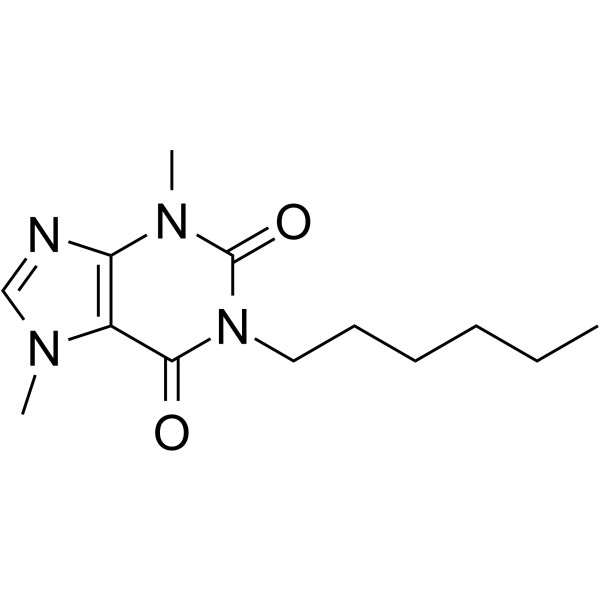 0 ImagesSynonyms: 1-Hexyltheobromine; Hexyltheobromine
-
2ccPA
 0 ImagesCat. No.: HY-167201CAS No.: 633278-53-2Synonyms: 2ccPA18:12ccPA (2ccPA18:1) is a metabolically stabilized carba analog of cyclic phosphatidic acid (cPA). 2ccPA inhibits autotaxin (ATX)‑mediated lysophosphatidic acid (LPA) production, suppresses extracellular matrix biosynthesis and elevates intracellular cAMP in fibrogenic skin fibroblasts. 2ccPA protects oligodendrocytes from mitochondrial‑driven apoptosis, suppresses neuroinflammation and demyelination, modulates microglial polarization and promotes rapid‑platelet/fibrin‑dependent hemostasis and subsequent fibrinolytic transition following brain injury.
-
Sapanisertib phosphate
 0 ImagesCat. No.: HY-13328ACAS No.: 1422006-47-0Synonyms: INK-128 phosphate; MLN0128 phosphate; TAK-228 phosphateSapanisertib (INK-128; MLN0128; TAK-228) phosphate is an orally active dual mTORC1/mTORC2 inhibitor. Sapanisertib phosphate directly and simultaneously inhibits mTORC1/2 activity through competitive binding with ATP, thereby comprehensively blocking downstream processes such as protein and lipid synthesis and cytoskeletal reorganization, consequently suppressing tumor cell proliferation and promoting apoptosis. Sapanisertib phosphate is applicable to research on melanoma, ovarian cancer, pulmonary fibrosis, and hematological malignancies.



