



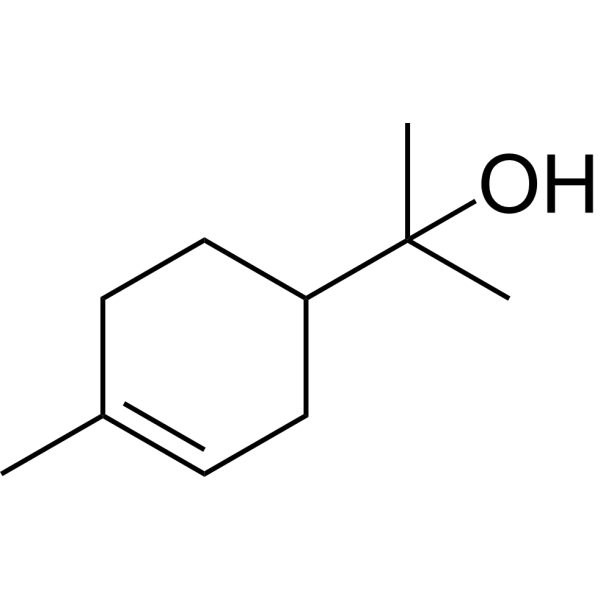
α-Terpineol
Based on 2 publication(s) in Google Scholar
α-Terpineol (with oral activity) can be found in Eucalyptus globulus Labill. α-Terpineol exhibits strong antimicrobial activity against periodontopathic and cariogenic bacteria.α-Terpineol possesses antifungal activity against T. mentagrophytes, and the activity might lead to irreversible cellular disruption. In addition, α-Terpineol exhibits antineuropathic and anti-inflammatory activities. α-Terpineol can be utilized in research related to diarrhea, neuropathic pain, infections, and inflammation.
Nos produits utilisent uniquement pour la recherche. Nous ne vendons pas aux patients.
- Pureté : 99.74%
- CAS No.: 98-55-5
- Formule: C10H18O
- Masse moléculaire:154.25
-
Stockage:Pure form -20°C, 3 years , 4°C, 2 years ; In solvent -80°C, 2 years , -20°C, 1 year

To place orders, for customer services and technical support, please contact: MedChemExpress USA
Tel: 609-228-6898 E-mail: [email protected] [email protected]


-
 Activité biologique
-
Chemical Information
-
Solvant et solubilité
- Protocole
- Pureté et documentation
- Références
-
 Help & FAQs




Publications Citing Use of MedChemExpress (MCE) α-Terpineol
MoreVoir tous les produits spécifiques à Isoform Antibiotic
MoreVoir tous les produits spécifiques à Isoform AMPK
More

Activité biologique
Description
In Vitro
α-Terpineol (1-10 µM, 20 h) exerts anti-inflammatory effects in LPS-stimulated mouse peritoneal macrophages by inhibiting the NF-κB signaling pathway[4]. α-Terpineol (0.06-0.125% v/v, 48 h) inhibits the growth of G. vaginalis (MIC = 0.06%) and C. albicans (MIC = 0.125%), showing antimicrobial activity comparable to Clotrimazole (HY-10882) ((v/v) represents volume/volume concentration, indicating the proportion of α-Terpineol in the culture medium)[4]. α-Terpineol (1-100 μM, 24 h) inhibits AMPK phosphorylation, activates SREBP-1, and promotes lipid synthesis in HepG2 cells[7].
MedChemExpress (MCE) has not independently confirmed the accuracy of these methods. They are for reference only.
-
Cell Line:HepG2 cells (hepatocellular carcinoma)
-
Concentration:1, 10, 100 μM
-
Incubation Time:24 h
-
Result:Inhibited AMPK phosphorylation, promoted p70S6K phosphorylation, and increased SREBP-1 maturation.
-
Cell Line:HepG2 cells (hepatocellular carcinoma)
-
Concentration:1, 10, 100 μM
-
Incubation Time:24 h
-
Result:Upregulated lipid synthesis-related genes Srebf-1c, Acc, Fasn, Scd-1.
In Vivo
MedChemExpress (MCE) has not independently confirmed the accuracy of these methods. They are for reference only.
-
Animal Model:Castor oil-induced acute diarrhea Swiss mouse model[5]
-
Dosage:6.25, 12.5, 25, 50 mg/kg
-
Administration:Oral gavage (p.o.), single dose
-
Result:Significantly reduced total stool amount (55%, 48%, 44%, 24%) and diarrhea rate (47%, 66%; 56%, 10%). All doses significantly decreased castor oil-induced enteropooling (46%, 78%, 66%, 41%)
-
Animal Model:Neuropathic pain C57BL/6 mouse model induced by Chronic Constriction Injury[6]
-
Dosage:56 mg/kg
-
Administration:ntraperitoneal injection (i.p.), single dose
-
Result:Complete reversal of mechanical allodynia at 30 min, returning to baseline at 2 h, partial reversal at 3 h, no significant effect at 6 h.
-
Animal Model:C57BL/6 mice[7]
-
Dosage:100 mg/kg and 500 mg/kg
-
Administration:Oral gavage (p.o.), once daily, for 2 weeks
-
Result:Increased hepatic triglyceride (TG) levels by 2-fold and serum TG levels by 25% (500 mg/kg); Induced microvesicular steatosis in the liver, and enhanced neutral lipid accumulation as revealed by Oil Red O staining.


Chemical Information
-
CAS No. 98-55-5
-
Appearance <31°C Solid,>35°C Liquid
-
Masse moléculaire 154.25
-
Formule C10H18O
-
Color Colorless to off-white
-
SMILES
OC(C)(C)C1CC=C(C)CC1
-
Structure Classification
-
Initial Source
-
Livraison
Room temperature in continental US; may vary elsewhere.
-
Stockage
Pure form -20°C 3 years 4°C 2 years In solvent -80°C 2 years -20°C 1 year


Publications (2)
-
Journal Impact Factor
-
Most Recent
-
Sci Rep
2026 Jan 3;16(1):4278. PMID: 41484167 -
Microbiol Spectr
Restoring colistin sensitivity in colistin-resistant gram-negative bacteria: combinatorial use of α-terpineol and colistin. [Abstract]2025 Sep 30:e0082525. PMID: 41025831


Solvant et solubilité
In Vitro:
DMSO : 200 mg/mL (1296.60 mM; Need ultrasonic; Hygroscopic DMSO has a significant impact on the solubility of product, please use newly opened DMSO)
Please refer to the solubility information to select the appropriate solvent. Once prepared, please aliquot and store the solution to prevent product inactivation from repeated freeze-thaw cycles.
Storage method and period of stock solution: -80°C, 2 years; -20°C, 1 year. When stored at -80°C, please use it within 2 years. When stored at -20°C, please use it within 1 year.
Please refer to the solubility information to select the appropriate solvent. Once prepared, please aliquot and store the solution to prevent product inactivation from repeated freeze-thaw cycles.
Storage method and period of stock solution: -80°C, 2 years; -20°C, 1 year. When stored at -80°C, please use it within 2 years. When stored at -20°C, please use it within 1 year.
Concentration (start) × Volume (start) = Concentration (final) × Volume (final)
In Vivo:
Select the appropriate dissolution method based on your experimental animal and administration route.
- For the following dissolution methods, please ensure to first prepare a clear stock solution using an In Vitro approach and then sequentially add co-solvents:
- To ensure reliable experimental results, the clarified stock solution can be appropriately stored based on storage conditions. As for the working solution for In Vivo experiments, it is recommended to prepare freshly and use it on the same day.
- The percentages shown for the solvents indicate their volumetric ratio in the final prepared solution. If precipitation or phase separation occurs during preparation, heat and/or sonication can be used to aid dissolution.
Add each solvent one by one: 10% DMSO 40% PEG300 5% Tween-80 45% Saline
Solubility: ≥ 5 mg/mL (32.41 mM); Clear solution
This protocol yields a clear solution of ≥ 5 mg/mL (saturation unknown).
Taking 1 mL working solution as an example, add 100 μL DMSO stock solution (50.0 mg/mL) to 400 μL PEG300, and mix evenly; then add 50 μL Tween-80 and mix evenly; then add 450 μL Saline to adjust the volume to 1 mL.
Preparation of Saline: Dissolve 0.9 g sodium chloride in ddH₂O and dilute to 100 mL to obtain a clear Saline solution.
Add each solvent one by one: 10% DMSO 90% (20% SBE-β-CD in Saline)
Solubility: ≥ 5 mg/mL (32.41 mM); Clear solution
This protocol yields a clear solution of ≥ 5 mg/mL (saturation unknown).
Taking 1 mL working solution as an example, add 100 μL DMSO stock solution (50.0 mg/mL) to 900 μL 20% SBE-β-CD in Saline, and mix evenly.
Preparation of 20% SBE-β-CD in Saline (4°C, storage for one week): 2 g SBE-β-CD powder is dissolved in 10 mL Saline, completely dissolve until clear.
In Vivo Dissolution Calculator
Please enter the basic information of animal experiments:
-
-
-
-
Recommended: Prepare an additional quantity of animals to account for potential losses during experiments.
Please enter your animal formula composition:
-
%DMSO +
Recommended: Keep the proportion of DMSO in working solution below 2% if your animal is weak.
-
%+
-
+%Tween-80 + +
-
%Saline +
The co-solvents required include: DMSO, . All of co-solvents are available by MedChemExpress (MCE). , Tween 80. All of co-solvents are available by MedChemExpress (MCE).
Working solution concentration: 0.22 mg/mL
Method for preparing stock solution: mg drug dissolved in μL DMSO. Stock solution concentration: mg/mL.
1. Take μL DMSO stock solution;
2. Add μL .
μL , mix evenly;
3. Then add μL Tween 80, mix evenly;
4. Then add μL
Please ensure that the stock solution in the first step is dissolved to a clear state, and add co-solvents in sequence. You can use ultrasonic heating (ultrasonic cleaner, recommended frequency 20-40 kHz), vortexing, etc. to assist dissolution.


Pureté et documentation
-
Fiche technique (280 KB)
-
SDS (394 KB)
- English - EN (394 KB)
- Français - FR (394 KB)
- Deutsch - DE (394 KB)
- Norwegian - NO (394 KB)
- Español - ES (394 KB)
- Swedish - SV (394 KB)
- Italian - IT (394 KB)
- Korean - KR (394 KB)
- Portuguese - PT (394 KB)
-
Instruction de manipulation (2659 KB)
Références
[1]. Park SN, et al. Antimicrobial effect of linalool and α-terpineol against periodontopathic and cariogenic bacteria. Anaerobe. 2012 Jun;18(3):369-72. [Content Brief]
[2]. Park MJ, et al. Effect of citral, eugenol, nerolidol and alpha-terpineol on the ultrastructural changes of Trichophyton mentagrophytes. Fitoterapia. 2009 Jul;80(5):290-6. [Content Brief]
[3]. Held S, et al. Characterization of alpha-terpineol as an anti-inflammatory component of orange juice by in vitro studies using oral buccal cells. J Agric Food Chem. 2007 Oct 3;55(20):8040-6. [Content Brief]
[4]. Trinh HT, et al. Artemisia princeps Pamp. Essential oil and its constituents eucalyptol and α-terpineol ameliorate bacterial vaginosis and vulvovaginal candidiasis in mice by inhibiting bacterial growth and NF-κB activation. Planta Med. 2011 Dec;77(18):1996-2002. [Content Brief]
[5]. Dos Santos Negreiros P, et al. Antidiarrheal activity of α-terpineol in mice. Biomed Pharmacother. 2019 Feb;110:631-640. [Content Brief]
[6]. Bilbrey JA, et al. Evaluation of the terpenes β-caryophyllene, α-terpineol, and γ-terpinene in the mouse chronic constriction injury model of neuropathic pain: possible cannabinoid receptor involvement. Psychopharmacology (Berl). 2022 May;239(5):1475-1486. [Content Brief]
[7]. Choi YJ, et al. α-Terpineol induces fatty liver in mice mediated by the AMP-activated kinase and sterol response element binding protein pathway. Food Chem Toxicol. 2013 May;55:129-36. [Content Brief]


Complete Stock Solution Preparation Table
Please refer to the solubility information to select the appropriate solvent. Once prepared, please aliquot and store the solution to prevent product inactivation from repeated freeze-thaw cycles.
Storage method and period of stock solution: -80°C, 2 years; -20°C, 1 year. When stored at -80°C, please use it within 2 years. When stored at -20°C, please use it within 1 year.
| Optional Solvent | Concentration Solvent Mass | 1 mg | 5 mg | 10 mg | 25 mg |
|---|---|---|---|---|---|
| DMSO | 1 mM | 6.4830 mL | 32.4149 mL | 64.8298 mL | 162.0746 mL |
| 5 mM | 1.2966 mL | 6.4830 mL | 12.9660 mL | 32.4149 mL | |
| 10 mM | 0.6483 mL | 3.2415 mL | 6.4830 mL | 16.2075 mL | |
| 15 mM | 0.4322 mL | 2.1610 mL | 4.3220 mL | 10.8050 mL | |
| 20 mM | 0.3241 mL | 1.6207 mL | 3.2415 mL | 8.1037 mL | |
| 25 mM | 0.2593 mL | 1.2966 mL | 2.5932 mL | 6.4830 mL | |
| 30 mM | 0.2161 mL | 1.0805 mL | 2.1610 mL | 5.4025 mL | |
| 40 mM | 0.1621 mL | 0.8104 mL | 1.6207 mL | 4.0519 mL | |
| 50 mM | 0.1297 mL | 0.6483 mL | 1.2966 mL | 3.2415 mL | |
| 60 mM | 0.1080 mL | 0.5402 mL | 1.0805 mL | 2.7012 mL | |
| 80 mM | 0.0810 mL | 0.4052 mL | 0.8104 mL | 2.0259 mL | |
| 100 mM | 0.0648 mL | 0.3241 mL | 0.6483 mL | 1.6207 mL |


α-Terpineol Related Classifications
HY-N5142 Related Classifications
 Powered by Bioz