



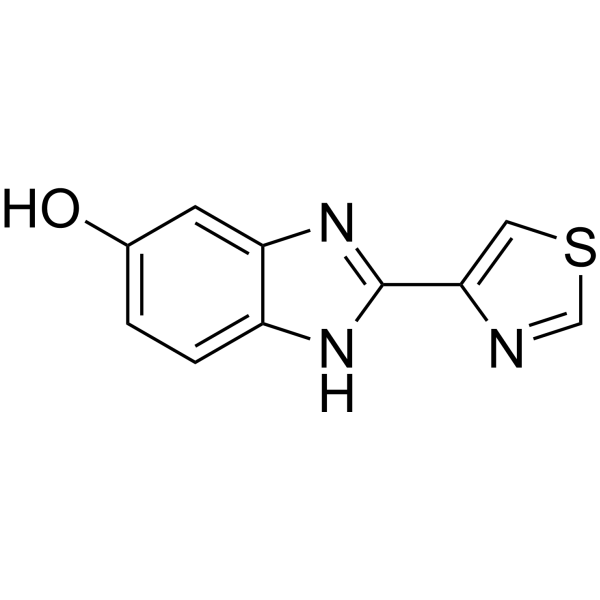
5-Hydroxythiabendazole

Based on 1 Customer Validation
5-Hydroxythiabendazole (5-OHTBZ) is a CYP1A2 substrate and a metabolite of Thiabendazole (HY-B0263). 5-Hydroxythiabendazole can generate a quinone imine under CYP1A2-catalyzed oxidation; it can also undergo bioactivation via prostaglandin H synthase, Peroxidase, Horseradish (HY-125859), and Myeloperoxidase, human white blood cells (HY-125859A) to produce reactive intermediates, which subsequently form covalent protein adducts. 5-Hydroxythiabendazole exhibits teratogenic potential and can be used for research on thiabendazole-related toxicity mechanisms.
Nur für Forschungszwecke. Wir verkaufen nicht an Patienten.
- Reinheit : 99.16%
- CAS. Nr.: 948-71-0
- Formel: C10H7N3OS
- Molecular Weight:217.25
-
Speicherung:
4°C, stored under nitrogen
* In solvent : -80°C, 6 months; -20°C, 1 month (stored under nitrogen)

To place orders, for customer services and technical support, please contact: MedChemExpress USA
Tel: 609-228-6898 E-mail: [email protected] [email protected]


-
 Biologische Aktivität
-
Chemical Information
-
Lösungsmittel & Löslichkeit
- Reinheit & Dokumentation
- Verweise
-
 Help & FAQs


-

HY-116787R
5-Hydroxythiabendazole (Standard)Reference Standard -

HY-117605R
N-Desmethyl Sildenafil (Standard)Sildenafil Metabolite -
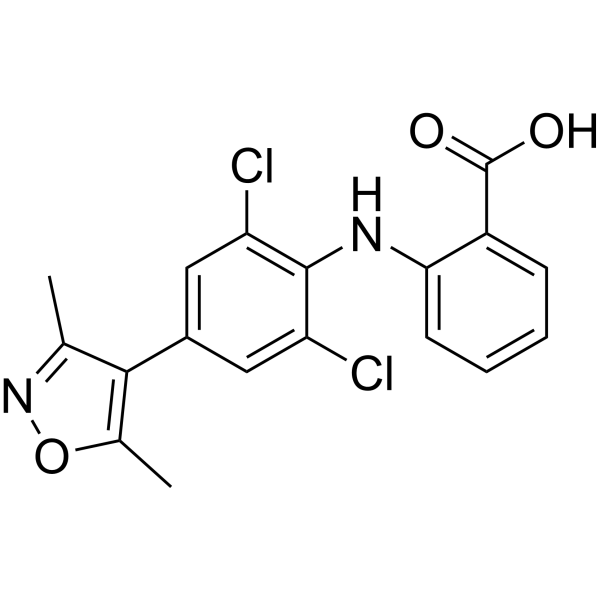
HY-137187
FB23FTO Inhibitor -
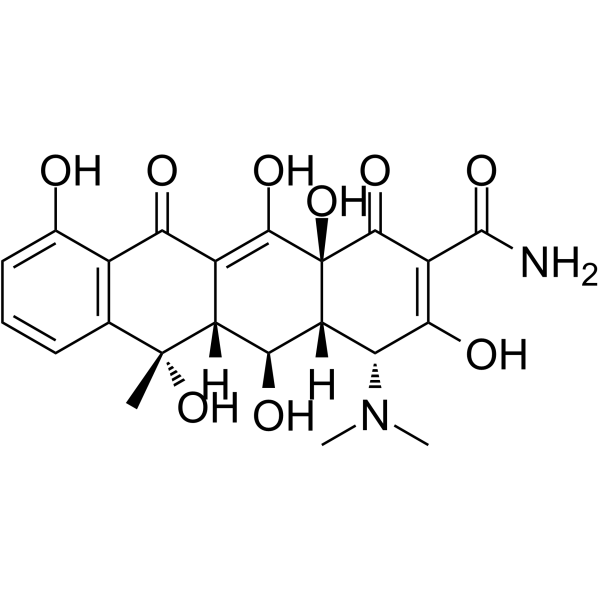
HY-125947
4-EpioxytetracyclineOxytetracycline Metabolite -
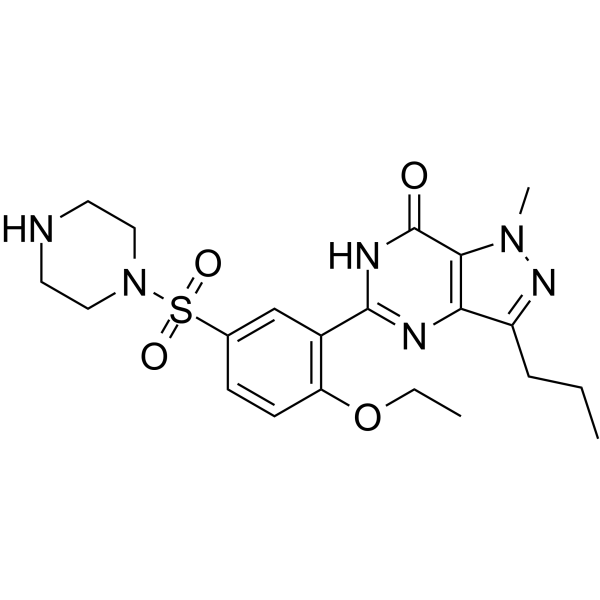
HY-117605
N-Desmethyl SildenafilSildenafil Metabolite -
HY-103056
DDD85646NMT Inhibitor -
HY-B0413S
Fenbendazole-d3Stable Isotope -
HY-133694
2-AminoflubendazoleDrug Metabolite -
HY-130221
(25S)-Δ7-Dafachronic acidDAF-12 Ligand -

HY-125947R
4-Epioxytetracycline (Standard)Oxytetracycline Metabolite -

HY-122522
2-Methylcardol trienePhenol


Biologische Aktivität
Beschreibung
IC50 & Target
[1]|
CYP1A2 |
Cellular Effect
|
Cell Line

|
Type | Value | Description | References |
|---|---|---|---|---|
| NRK-52E | LC50 |
200 μM
|
LC50 greater than 200 μM for viability reduction in NRK-52E rat proximal tubule cells after 24 hrs exposure to 5-hydroxythiabendazole assessed by CellTiter-Glo total cellular ATP assay.
LC50 greater than 200 μM for viability reduction in NRK-52E rat proximal tubule cells after 24 hrs exposure to 5-hydroxythiabendazole assessed by CellTiter-Glo total cellular ATP assay.
|
21513789 |
| H9c2 | LC50 |
200 μM
|
LC50 greater than 200 μM for viability reduction in H9C2 rat myocardial cells after 24 hrs exposure to 5-hydroxythiabendazole assessed by CellTiter-Glo total cellular ATP assay.
LC50 greater than 200 μM for viability reduction in H9C2 rat myocardial cells after 24 hrs exposure to 5-hydroxythiabendazole assessed by CellTiter-Glo total cellular ATP assay.
|
21513789 |
| NRK-52E | LC50 |
23.30 μM
|
LC50 of 23.30 μM for viability reduction in NRK-52E rat proximal tubule cells after 24 hrs exposure to 5-hydroxythiabendazole with myeloperoxidase/glucose oxidase activation assessed by CellTiter-Glo total cellular ATP assay.
LC50 of 23.30 μM for viability reduction in NRK-52E rat proximal tubule cells after 24 hrs exposure to 5-hydroxythiabendazole with myeloperoxidase/glucose oxidase activation assessed by CellTiter-Glo total cellular ATP assay.
|
21513789 |
| H9c2 | LC50 |
24.67 μM
|
LC50 of 24.67 μM for viability reduction in H9C2 rat myocardial cells after 24 hrs exposure to 5-hydroxythiabendazole with myeloperoxidase/glucose oxidase activation assessed by CellTiter-Glo total cellular ATP assay.
LC50 of 24.67 μM for viability reduction in H9C2 rat myocardial cells after 24 hrs exposure to 5-hydroxythiabendazole with myeloperoxidase/glucose oxidase activation assessed by CellTiter-Glo total cellular ATP assay.
|
21513789 |
| NRK-52E | LC50 |
30.65 μM
|
LC50 of 30.65 μM for viability reduction in NRK-52E rat proximal tubule cells after 12 hrs exposure to 5-hydroxythiabendazole with myeloperoxidase/glucose oxidase activation assessed by CellTiter-Glo total cellular ATP assay.
LC50 of 30.65 μM for viability reduction in NRK-52E rat proximal tubule cells after 12 hrs exposure to 5-hydroxythiabendazole with myeloperoxidase/glucose oxidase activation assessed by CellTiter-Glo total cellular ATP assay.
|
21513789 |
| NRK-52E | LC50 |
29.81 μM
|
LC50 of 29.81 μM for viability reduction in NRK-52E rat proximal tubule cells after 18 hrs exposure to 5-hydroxythiabendazole with myeloperoxidase/glucose oxidase activation assessed by CellTiter-Glo total cellular ATP assay.
LC50 of 29.81 μM for viability reduction in NRK-52E rat proximal tubule cells after 18 hrs exposure to 5-hydroxythiabendazole with myeloperoxidase/glucose oxidase activation assessed by CellTiter-Glo total cellular ATP assay.
|
21513789 |
| NRK-52E | LC50 |
20.77 μM
|
LC50 of 20.77 μM for viability reduction in NRK-52E rat proximal tubule cells after 48 hrs exposure to 5-hydroxythiabendazole with myeloperoxidase/glucose oxidase activation assessed by CellTiter-Glo total cellular ATP assay.
LC50 of 20.77 μM for viability reduction in NRK-52E rat proximal tubule cells after 48 hrs exposure to 5-hydroxythiabendazole with myeloperoxidase/glucose oxidase activation assessed by CellTiter-Glo total cellular ATP assay.
|
21513789 |
| NRK-52E | LC50 |
52.34 μM
|
LC50 of 52.34 μM for viability reduction in NRK-52E rat proximal tubule cells after 24 hrs exposure to 5-hydroxythiabendazole with myeloperoxidase/glucose oxidase activation in the presence of 20 μM rutin assessed by total cellular ATP viability assay.
LC50 of 52.34 μM for viability reduction in NRK-52E rat proximal tubule cells after 24 hrs exposure to 5-hydroxythiabendazole with myeloperoxidase/glucose oxidase activation in the presence of 20 μM rutin assessed by total cellular ATP viability assay.
|
21513789 |
| NRK-52E | LC50 |
56.19 μM
|
LC50 of 56.19 μM for viability reduction in NRK-52E rat proximal tubule cells after 24 hrs exposure to 5-hydroxythiabendazole with myeloperoxidase/glucose oxidase activation in the presence of 40 μM rutin assessed by total cellular ATP viability assay.
LC50 of 56.19 μM for viability reduction in NRK-52E rat proximal tubule cells after 24 hrs exposure to 5-hydroxythiabendazole with myeloperoxidase/glucose oxidase activation in the presence of 40 μM rutin assessed by total cellular ATP viability assay.
|
21513789 |
| NRK-52E | LC50 |
86.61 μM
|
LC50 of 86.61 μM for viability reduction in NRK-52E rat proximal tubule cells after 24 hrs exposure to 5-hydroxythiabendazole with myeloperoxidase/glucose oxidase activation in the presence of 50 μM rutin assessed by total cellular ATP viability assay.
LC50 of 86.61 μM for viability reduction in NRK-52E rat proximal tubule cells after 24 hrs exposure to 5-hydroxythiabendazole with myeloperoxidase/glucose oxidase activation in the presence of 50 μM rutin assessed by total cellular ATP viability assay.
|
21513789 |
| NRK-52E | LC50 |
116.70 μM
|
LC50 of 116.70 μM for viability reduction in NRK-52E rat proximal tubule cells after 24 hrs exposure to 5-hydroxythiabendazole with myeloperoxidase/glucose oxidase activation in the presence of 60 μM rutin assessed by total cellular ATP viability assay.
LC50 of 116.70 μM for viability reduction in NRK-52E rat proximal tubule cells after 24 hrs exposure to 5-hydroxythiabendazole with myeloperoxidase/glucose oxidase activation in the presence of 60 μM rutin assessed by total cellular ATP viability assay.
|
21513789 |
In Vitro
5-Hydroxythiabendazole (2.4 units/mL MPO; 5.9 IU/mL GOx; 15-30 min) is rapidly converted by MPO/GOx in cell-culture media, with complete disappearance reported within 15-30 min[3].
5-Hydroxythiabendazole (6.25-200 µM with MPO; 1-48 h; NRK-52E) had LC50 values >200 µM through 9 h, 30.65 µM at 12 h, and 23.30 µM at 24 h[3].
5-Hydroxythiabendazole (25 μM 14C-TBZ; 24 h) formation in THLE-5 liver epithelial cells required CYP1A2 expression among the tested P450s, reaching 35% of parent 14C-TBZ at 24 h with 50% conjugation[4].
5-Hydroxythiabendazole (25 μM 14C-TBZ; 24 h) formation in BEAS-2B bronchial epithelial cells was supported by CYP1A2 expression at 17% of parent 14C-TBZ at 24 h without detectable conjugation[4].
MedChemExpress (MCE) has not independently confirmed the accuracy of these methods. They are for reference only.
-
Cell Line:NRK-52E rat proximal tubule cells
-
Concentration:6.25, 12.5, 25, 50, 100, 200 µM (with MPO)
-
Incubation Time:1, 3, 6, 9, 12, 18, 24, and 48 h
-
Result:LC50 values were > 200 µM at 1, 3, 6, and 9 h; 30.65 µM at 12 h; 29.81 µM at 18 h; 23.30 µM at 24 h; and 20.77 µM at 48 h.
Cell viability increased during the first 6 h as the reactive intermediate was generated, followed by decreasing LC50 over time until a near-minimal value by 18 h.
No significant change was observed between 24 and 48 h.
-
Cell Line:NRK-52E rat proximal tubule cells
-
Concentration:12.5, 25, 50, 100, 200 µM
-
Incubation Time:24 h (exposure); 5 min (rutin preincubation)
-
Result:In the MPO reaction, mean LC50 values were 52.34 µM with 20 µM rutin, 56.19 µM with 40 µM rutin, 86.61 µM with 50 µM rutin, 116.70 µM with 60 µM rutin, and > 200 µM with 80, 100, and 320 µM rutin.
20 µM rutin was sufficient to increase the LC50 2.4-fold.
At 100 µM rutin, the concentration-response curve was not significantly affected by the presence of MPO.


Chemical Information
-
CAS. Nr. 948-71-0
-
Appearance Solid
-
Molecular Weight 217.25
-
Formel C10H7N3OS
-
Color Brown to black
-
SMILES
OC1=CC=C2NC(C3=CSC=N3)=NC2=C1
-
Synonyms
5-OHTBZ
-
Versand
Room temperature in continental US; may vary elsewhere.
-
Speicherung
4°C, stored under nitrogen
* In solvent : -80°C, 6 months; -20°C, 1 month (stored under nitrogen)


Lösungsmittel & Löslichkeit
In Vitro:
DMSO : 100 mg/mL (460.30 mM; Need ultrasonic; Hygroscopic DMSO has a significant impact on the solubility of product, please use newly opened DMSO)
Please refer to the solubility information to select the appropriate solvent. Once prepared, please aliquot and store the solution to prevent product inactivation from repeated freeze-thaw cycles.
Storage method and period of stock solution: -80°C, 6 months; -20°C, 1 month (stored under nitrogen). When stored at -80°C, please use it within 6 months. When stored at -20°C, please use it within 1 month.
Konzentration (Stammlösung) × Volumen (Stammlösung) = Konzentration (Ziellösung) × Volumen (Ziellösung)
In Vivo:
Select the appropriate dissolution method based on your experimental animal and administration route.
- For the following dissolution methods, please ensure to first prepare a clear stock solution using an In Vitro approach and then sequentially add co-solvents:
- To ensure reliable experimental results, the clarified stock solution can be appropriately stored based on storage conditions. As for the working solution for In Vivo experiments, it is recommended to prepare freshly and use it on the same day.
- The percentages shown for the solvents indicate their volumetric ratio in the final prepared solution. If precipitation or phase separation occurs during preparation, heat and/or sonication can be used to aid dissolution.
Add each solvent one by one: 10% DMSO 40% PEG300 5% Tween-80 45% Saline
Solubility: ≥ 2.5 mg/mL (11.51 mM); Clear solution
This protocol yields a clear solution of ≥ 2.5 mg/mL (saturation unknown).
Taking 1 mL working solution as an example, add 100 μL DMSO stock solution (25.0 mg/mL) to 400 μL PEG300, and mix evenly; then add 50 μL Tween-80 and mix evenly; then add 450 μL Saline to adjust the volume to 1 mL.
Preparation of Saline: Dissolve 0.9 g sodium chloride in ddH₂O and dilute to 100 mL to obtain a clear Saline solution.
Add each solvent one by one: 10% DMSO 90% (20% SBE-β-CD in Saline)
Solubility: ≥ 2.5 mg/mL (11.51 mM); Clear solution
This protocol yields a clear solution of ≥ 2.5 mg/mL (saturation unknown).
Taking 1 mL working solution as an example, add 100 μL DMSO stock solution (25.0 mg/mL) to 900 μL 20% SBE-β-CD in Saline, and mix evenly.
Preparation of 20% SBE-β-CD in Saline (4°C, storage for one week): 2 g SBE-β-CD powder is dissolved in 10 mL Saline, completely dissolve until clear.
In Vivo Dissolution Calculator
Please enter the basic information of animal experiments:
-
-
-
-
Recommended: Prepare an additional quantity of animals to account for potential losses during experiments.
Please enter your animal formula composition:
-
%DMSO +
Recommended: Keep the proportion of DMSO in working solution below 2% if your animal is weak.
-
%+
-
+%Tween-80 + +
-
%Saline +
The co-solvents required include: DMSO, . All of co-solvents are available by MedChemExpress (MCE). , Tween 80. All of co-solvents are available by MedChemExpress (MCE).
Working solution concentration: 0.22 mg/mL
Method for preparing stock solution: mg drug dissolved in μL DMSO. Stock solution concentration: mg/mL. * In solvent : -80°C, 6 months; -20°C, 1 month (stored under nitrogen)
1. Take μL DMSO stock solution;
2. Add μL .
μL , mix evenly;
3. Then add μL Tween 80, mix evenly;
4. Then add μL
Please ensure that the stock solution in the first step is dissolved to a clear state, and add co-solvents in sequence. You can use ultrasonic heating (ultrasonic cleaner, recommended frequency 20-40 kHz), vortexing, etc. to assist dissolution.


Reinheit & Dokumentation


Verweise

Complete Stock Solution Preparation Table
Please refer to the solubility information to select the appropriate solvent. Once prepared, please aliquot and store the solution to prevent product inactivation from repeated freeze-thaw cycles.
Storage method and period of stock solution: -80°C, 6 months; -20°C, 1 month (stored under nitrogen). When stored at -80°C, please use it within 6 months. When stored at -20°C, please use it within 1 month.
| Optional Solvent | Concentration Solvent Mass | 1 mg | 5 mg | 10 mg | 25 mg |
|---|---|---|---|---|---|
| DMSO | 1 mM | 4.6030 mL | 23.0150 mL | 46.0299 mL | 115.0748 mL |
| 5 mM | 0.9206 mL | 4.6030 mL | 9.2060 mL | 23.0150 mL | |
| 10 mM | 0.4603 mL | 2.3015 mL | 4.6030 mL | 11.5075 mL | |
| 15 mM | 0.3069 mL | 1.5343 mL | 3.0687 mL | 7.6717 mL | |
| 20 mM | 0.2301 mL | 1.1507 mL | 2.3015 mL | 5.7537 mL | |
| 25 mM | 0.1841 mL | 0.9206 mL | 1.8412 mL | 4.6030 mL | |
| 30 mM | 0.1534 mL | 0.7672 mL | 1.5343 mL | 3.8358 mL | |
| 40 mM | 0.1151 mL | 0.5754 mL | 1.1507 mL | 2.8769 mL | |
| 50 mM | 0.0921 mL | 0.4603 mL | 0.9206 mL | 2.3015 mL | |
| 60 mM | 0.0767 mL | 0.3836 mL | 0.7672 mL | 1.9179 mL | |
| 80 mM | 0.0575 mL | 0.2877 mL | 0.5754 mL | 1.4384 mL | |
| 100 mM | 0.0460 mL | 0.2301 mL | 0.4603 mL | 1.1507 mL |


5-Hydroxythiabendazole Related Classifications
HY-116787 Related Classifications
 Powered by Bioz