



Cephapirin

Based on 1 Customer Validation
Cephapirin (Cefapirin) is an ephalosporin antibiotic with broad-spectrum antimicrobial activity.
Nur für Forschungszwecke. Wir verkaufen nicht an Patienten.
- Reinheit : 95.57%
- CAS. Nr.: 21593-23-7
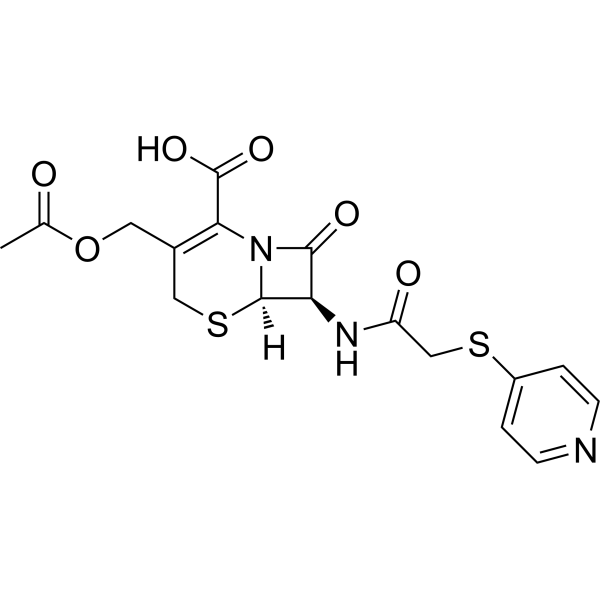
- Formel: C17H17N3O6S2
- Molecular Weight:423.46
-
Speicherung:
4°C, stored under nitrogen
* In solvent : -80°C, 6 months; -20°C, 1 month (stored under nitrogen)

To place orders, for customer services and technical support, please contact: MedChemExpress USA
Tel: 609-228-6898 E-mail: [email protected] [email protected]


-
 Biologische Aktivität
-
Chemical Information
- Protokoll
- Reinheit & Dokumentation
- Verweise
-
 Help & FAQs


Alle Antibiotic Isoform-spezifische Produkte anzeigen
More

Biologische Aktivität
Beschreibung
IC50 & Target
|
β-lactam |
In Vitro
Cephapirin (Cefapirin) inhibits Staphylococcus aureus by cephapirin concentrations of 0.09 to 12.5 mug/mL[2].
Cephapirin (Cefapirin) inhibits S. epidermidis, S. viridans, S. pyogenes, and Diplococcus pneumonia isolates by less than 1 mug/mL[2].
MedChemExpress (MCE) has not independently confirmed the accuracy of these methods. They are for reference only.
In Vivo
MedChemExpress (MCE) has not independently confirmed the accuracy of these methods. They are for reference only.


Chemical Information
-
CAS. Nr. 21593-23-7
-
Appearance Solid
-
Molecular Weight 423.46
-
Formel C17H17N3O6S2
-
Color White to off-white
-
SMILES
O=C(C(N12)=C(COC(C)=O)CS[C@]2([H])[C@H](NC(CSC3=CC=NC=C3)=O)C1=O)O
-
Synonyms
Cefapirin
-
Versand
Room temperature in continental US; may vary elsewhere.
-
Speicherung
4°C, stored under nitrogen
* In solvent : -80°C, 6 months; -20°C, 1 month (stored under nitrogen)


Reinheit & Dokumentation
-
Data Sheet (268 KB)
-
SDS (419 KB)
- English - EN (419 KB)
- Français - FR (419 KB)
- Deutsch - DE (419 KB)
- Norwegian - NO (419 KB)
- Español - ES (419 KB)
- Swedish - SV (419 KB)
- Italian - IT (419 KB)
- Korean - KR (419 KB)
- Portuguese - PT (419 KB)
-
Handling Instructions (2659 KB)
Verweise

Calculators
Konzentration (Stammlösung) × Volumen (Stammlösung) = Konzentration (Ziellösung) × Volumen (Ziellösung)


Cephapirin Related Classifications
HY-A0153 Related Classifications
 Powered by Bioz