



MS8709

Based on 1 Customer Validation
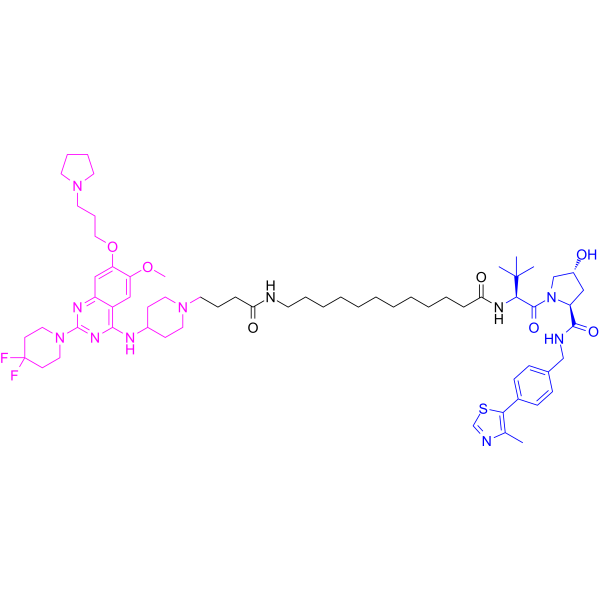
MS8709 is a PROTAC degrader that induces the degradation of G9a (EHMT2)/GLP (EHMT1) by recruiting VHL. MS8709 induces G9a/GLP protein degradation via a mechanism that simultaneously depends on G9a/GLP target protein binding, VHL recruitment, and the ubiquitin-proteasome system (UPS), while the mRNA levels of G9a and GLP do not show significant changes, indicating that the effect occurs primarily at the protein level rather than the transcriptional level. MS8709 retains the inhibitory effect on G9a/GLP methyltransferase activity and reduces H3K9me2 levels, thereby simultaneously affecting the catalytic and non-catalytic functions of G9a/GLP. MS8709 can be used for studies related to G9a/GLP biology, prostate cancer, lung cancer, and other relevant fields.
(Pink: G9a/GLP ligand (HY-187077); Blue: VHL ligand (HY-125845); Black: linker (HY-W105740)).
Nur für Forschungszwecke. Wir verkaufen nicht an Patienten.
- Reinheit : 99.87%
- CAS. Nr.: 3060730-06-2
- Formel: C64H95F2N11O7S
- Molecular Weight:1200.57
-
Speicherung:
4°C, protect from light
* In solvent : -80°C, 6 months; -20°C, 1 month (protect from light)

To place orders, for customer services and technical support, please contact: MedChemExpress USA
Tel: 609-228-6898 E-mail: [email protected] [email protected]


-
 Biologische Aktivität
-
Chemical Information
-
Lösungsmittel & Löslichkeit
- Protokoll
- Reinheit & Dokumentation
- Verweise
-
 Help & FAQs



Alle PROTACs Isoform-spezifische Produkte anzeigen
MoreAlle Histone Methyltransferase Isoform-spezifische Produkte anzeigen
More

Biologische Aktivität
Beschreibung
IC50 & Target
[1]|
GLP 260 nM (DC50) |
G9a 274 nM (DC50) |
Cellular Effect
|
Cell Line

|
Type | Value | Description | References |
|---|---|---|---|---|
| 22Rv1 | GI50 |
4.1 μM
|
Antiproliferative activity against 22Rv1 human prostate cancer cells assessed as reduction in cell viability incubated for 7 days by CCK-8 assay.
Antiproliferative activity against 22Rv1 human prostate cancer cells assessed as reduction in cell viability incubated for 7 days by CCK-8 assay.
|
38602846 |
| K562 | GI50 |
2 μM
|
Antiproliferative activity against K562 human leukemia cells assessed as reduction in cell viability incubated for 7 days by CCK-8 assay.
Antiproliferative activity against K562 human leukemia cells assessed as reduction in cell viability incubated for 7 days by CCK-8 assay.
|
38602846 |
| NCI-H1299 | GI50 |
5 μM
|
Antiproliferative activity against H1299 human non-small cell lung cancer cells assessed as reduction in cell viability incubated for 7 days by CCK-8 assay.
Antiproliferative activity against H1299 human non-small cell lung cancer cells assessed as reduction in cell viability incubated for 7 days by CCK-8 assay.
|
38602846 |
In Vitro
MS8709 (compound 10) (0.3 or 3 μM; 24 h) induces 73% and >99% degradation of G9a, as well as 49% and >99% degradation of GLP, respectively, in 22Rv1 cells[1].
MS8709 (3-3000 nM; 24 h) degrades G9a and GLP in a concentration-dependent manner in 22Rv1 cells, with DC50 values of 274 nM and 260 nM, respectively[1].
In 22Rv1 cells, MS8709 (3 μM; up to 48 h) induces a reduction in G9a and GLP as early as 4 h, achieves complete degradation at approximately 24 h, and maintains this effect up to 48 h[1].
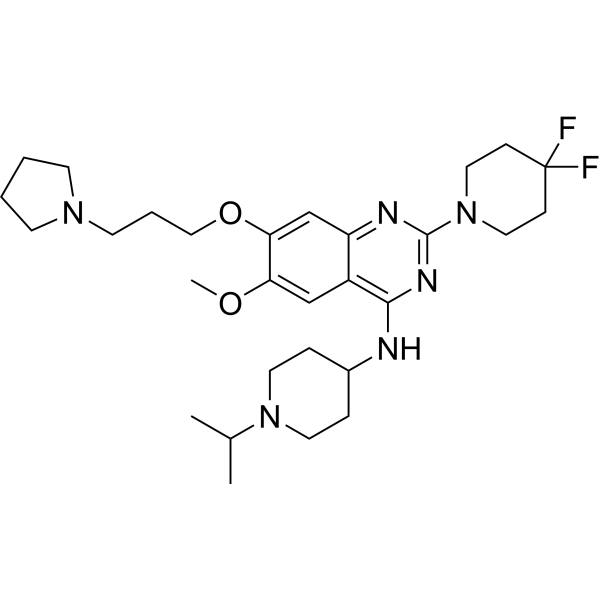
MS8709 inhibits the enzymatic activities of G9a and GLP in a concentration-dependent manner in a cell-free radioactive methyltransferase assay, and its activity profile is similar to that of UNC0642 and MS8709N, which retains the same G9a/GLP-binding moiety[1].
The G9a/GLP degradation in 22Rv1 cells induced by MS8709 (1 μM; 24 h) is rescued by 2 h pre-incubation with UNC0642 (10 μM), MG132 (HY-13259) (5 μM), MLN4942 (HY-70062) (1 μM), or VHL-1 (5 μM), supporting that its degradation is simultaneously dependent on G9a/GLP, VHL, and UPS engagement[1].
MS8709 (3 μM; 24 h) does not significantly alter G9a or GLP mRNA levels in H1299 cells[1].
MS8709 (10 μM) does not exert significant enzymatic activity inhibition of >50% in a panel composed of 21 other protein methyltransferases[1].
MS8709 (3 μM; 24 h) does not induce the degradation of EZH2, PRMT7, or SET7/9 proteins in 22Rv1 cells[1].
MS8709 (3 μM; 24 h) reduces G9a and GLP protein levels in K562 cells[1].
MS8709 (7 d) inhibits the growth of K562 cells with a GI50 of 2 μM, whereas UNC0642 does not exhibit a corresponding antiproliferative effect[1].
MS8709 (7 d) inhibits the growth of 22Rv1 cells with a GI50 of 4.1 μM, while the parental G9a/GLP inhibitor UNC0642 does not exhibit a corresponding growth inhibitory effect in this assay[1].
MS8709 (0.3-3 μM; 8 d) inhibits the clonogenic formation of 22Rv1 cells in a concentration-dependent manner, whereas UNC0642 (HY-13980) and MS8709N, which loses effective VHL recruitment capacity, do not exert the same effect[1].
MS8709 (3 μM; 24 h) reduces the protein levels of G9a and GLP in H1299 cells[1].
MS8709 (8 d) inhibits the growth of H1299 cells with a GI50 of 5 μM, whereas UNC0642 does not exhibit a corresponding growth inhibitory effect[1].
MS8709 (3 μM; 24 h) reduces the abundance of G9a and an additional 43 proteins in the whole proteome analysis of MCF-7 cells[2].
MS8709 (3 μM; 3 d) reduces the viability of MCF-7 cells[2].
MedChemExpress (MCE) has not independently confirmed the accuracy of these methods. They are for reference only.
-
Cell Line:22Rv1 human prostate cancer cells
-
Concentration:0.3, 3 µM
-
Incubation Time:24 h
-
Result:Induced 73% G9a degradation and 49% GLP degradation at 0.3 µM.
Induced >99% degradation for both G9a and GLP proteins at 3 µM.
-
Cell Line:22Rv1 human prostate cancer cells
-
Concentration:3, 10, 30, 100, 300, 1000, 3000 nM
-
Incubation Time:24 h
-
Result:Induced concentration-dependent degradation of G9a and GLP, with half-maximal degradation concentration (DC50) values of 274 nM for G9a and 260 nM for GLP.
-
Cell Line:22Rv1 human prostate cancer cells
-
Concentration:3 µM
-
Incubation Time:4-48 h
-
Result:Detected degradation of G9a and GLP first at 4 h, reached complete degradation by 24 h, and maintained full degradation effect up to 48 h.
-
Cell Line:22Rv1 human prostate cancer cells
-
Concentration:0.3, 1, 3 μM
-
Incubation Time:8 days
-
Result:Suppressed colony formation in a concentration-dependent manner.
Produced greater suppression than UNC0642 and MS8709N.
-
Cell Line:22Rv1 human prostate cancer cells
-
Concentration:MS8709: 1 μM; UNC0642: 10 μM; MG132: 5 μM; MLN4942: 1 μM; VHL-1: 5 μM
-
Incubation Time:24 h
-
Result:Rescued G9a degradation after UNC0642 pre-incubation.
Rescued GLP degradation after UNC0642 pre-incubation.
Rescued G9a/GLP degradation after MG132, MLN4942, or VHL-1 pre-incubation.
-
Cell Line:H1299
-
Concentration:3 μM
-
Incubation Time:24 h
-
Result:Did not appreciably alter G9a mRNA levels.
Did not appreciably alter GLP mRNA levels.
-
Cell Line:22Rv1
-
Concentration:3 μM
-
Incubation Time:24 h
-
Result:Did not induce degradation of EZH2.
Did not induce degradation of PRMT7.
Did not induce degradation of SET7/9.
-
Cell Line:K562
-
Concentration:3 μM
-
Incubation Time:24 h
-
Result:Decreased G9a protein levels.
Decreased GLP protein levels.
-
Cell Line:H1299
-
Concentration:3 μM
-
Incubation Time:24 h
-
Result:Decreased G9a protein levels.
Decreased GLP protein levels.
-
Cell Line:MCF-7
-
Concentration:3 μM
-
Incubation Time:3 days
-
Result:Reduced cell viability.
Parmacokinetics
| Species | Dose | Route | Cmax | Tmax |
|---|---|---|---|---|
| Mice[1] | 50 mg/kg | i.p. | 27 | 0.5 h |
In Vivo
MedChemExpress (MCE) has not independently confirmed the accuracy of these methods. They are for reference only.


Chemical Information
-
CAS. Nr. 3060730-06-2
-
Appearance Solid
-
Molecular Weight 1200.57
-
Formel C64H95F2N11O7S
-
Color White to off-white
-
SMILES
O=C([C@H]1N(C([C@@H](NC(CCCCCCCCCCCNC(CCCN2CCC(NC3=C4C=C(OC)C(OCCCN5CCCC5)=CC4=NC(N6CCC(F)(F)CC6)=N3)CC2)=O)=O)C(C)(C)C)=O)C[C@H](O)C1)NCC7=CC=C(C8=C(C)N=CS8)C=C7
-
Versand
Room temperature in continental US; may vary elsewhere.
-
Speicherung
4°C, protect from light
* In solvent : -80°C, 6 months; -20°C, 1 month (protect from light)


Lösungsmittel & Löslichkeit
In Vitro:
DMSO : 50 mg/mL (41.65 mM; ultrasonic and warming and heat to 60°C; Hygroscopic DMSO has a significant impact on the solubility of product, please use newly opened DMSO)
Please refer to the solubility information to select the appropriate solvent. Once prepared, please aliquot and store the solution to prevent product inactivation from repeated freeze-thaw cycles.
Storage method and period of stock solution: -80°C, 6 months; -20°C, 1 month (protect from light). When stored at -80°C, please use it within 6 months. When stored at -20°C, please use it within 1 month.
Please refer to the solubility information to select the appropriate solvent. Once prepared, please aliquot and store the solution to prevent product inactivation from repeated freeze-thaw cycles.
Storage method and period of stock solution: -80°C, 6 months; -20°C, 1 month (protect from light). When stored at -80°C, please use it within 6 months. When stored at -20°C, please use it within 1 month.
Konzentration (Stammlösung) × Volumen (Stammlösung) = Konzentration (Ziellösung) × Volumen (Ziellösung)
In Vivo:
Select the appropriate dissolution method based on your experimental animal and administration route.
- For the following dissolution methods, please ensure to first prepare a clear stock solution using an In Vitro approach and then sequentially add co-solvents:
- To ensure reliable experimental results, the clarified stock solution can be appropriately stored based on storage conditions. As for the working solution for In Vivo experiments, it is recommended to prepare freshly and use it on the same day.
- The percentages shown for the solvents indicate their volumetric ratio in the final prepared solution. If precipitation or phase separation occurs during preparation, heat and/or sonication can be used to aid dissolution.
Add each solvent one by one: 10% DMSO 40% PEG300 5% Tween-80 45% Saline
Solubility: ≥ 2.5 mg/mL (2.08 mM); Clear solution
This protocol yields a clear solution of ≥ 2.5 mg/mL (saturation unknown).
Taking 1 mL working solution as an example, add 100 μL DMSO stock solution (25.0 mg/mL) to 400 μL PEG300, and mix evenly; then add 50 μL Tween-80 and mix evenly; then add 450 μL Saline to adjust the volume to 1 mL.
Preparation of Saline: Dissolve 0.9 g sodium chloride in ddH₂O and dilute to 100 mL to obtain a clear Saline solution.
Add each solvent one by one: 10% DMSO 90% (20% SBE-β-CD in Saline)
Solubility: ≥ 2.5 mg/mL (2.08 mM); Clear solution
This protocol yields a clear solution of ≥ 2.5 mg/mL (saturation unknown).
Taking 1 mL working solution as an example, add 100 μL DMSO stock solution (25.0 mg/mL) to 900 μL 20% SBE-β-CD in Saline, and mix evenly.
Preparation of 20% SBE-β-CD in Saline (4°C, storage for one week): 2 g SBE-β-CD powder is dissolved in 10 mL Saline, completely dissolve until clear.
In Vivo Dissolution Calculator
Please enter the basic information of animal experiments:
-
-
-
-
Recommended: Prepare an additional quantity of animals to account for potential losses during experiments.
Please enter your animal formula composition:
-
%DMSO +
Recommended: Keep the proportion of DMSO in working solution below 2% if your animal is weak.
-
%+
-
+%Tween-80 + +
-
%Saline +
The co-solvents required include: DMSO, . All of co-solvents are available by MedChemExpress (MCE). , Tween 80. All of co-solvents are available by MedChemExpress (MCE).
Working solution concentration: 0.22 mg/mL
Method for preparing stock solution: mg drug dissolved in μL DMSO. Stock solution concentration: mg/mL. * In solvent : -80°C, 6 months; -20°C, 1 month (protect from light)
1. Take μL DMSO stock solution;
2. Add μL .
μL , mix evenly;
3. Then add μL Tween 80, mix evenly;
4. Then add μL
Please ensure that the stock solution in the first step is dissolved to a clear state, and add co-solvents in sequence. You can use ultrasonic heating (ultrasonic cleaner, recommended frequency 20-40 kHz), vortexing, etc. to assist dissolution.


Reinheit & Dokumentation
-
Data Sheet (289 KB)
-
SDS (252 KB)
- English - EN (252 KB)
- Français - FR (252 KB)
- Deutsch - DE (252 KB)
- Norwegian - NO (252 KB)
- Español - ES (252 KB)
- Swedish - SV (252 KB)
- Italian - IT (252 KB)
- Korean - KR (252 KB)
- Portuguese - PT (252 KB)
-
Handling Instructions (2659 KB)
Verweise
[1]. Velez J, et al. Discovery of the First-in-Class G9a/GLP PROTAC Degrader. Journal of medicinal chemistry. 2024 Apr 25;67(8):6397-6409. [Content Brief]
[2]. Mukherjee A, et al. A Novel PROTAC G9a/GLP Degrader that Inhibits, Similar to G9a siRNA, the Migration of MCF-7 Breast-Cancer Cells without Affecting Proliferation. Journal of medicinal chemistry. 2025 Sep 11;68(17):18258-18271. [Content Brief]


Complete Stock Solution Preparation Table
Please refer to the solubility information to select the appropriate solvent. Once prepared, please aliquot and store the solution to prevent product inactivation from repeated freeze-thaw cycles.
Storage method and period of stock solution: -80°C, 6 months; -20°C, 1 month (protect from light). When stored at -80°C, please use it within 6 months. When stored at -20°C, please use it within 1 month.
| Optional Solvent | Concentration Solvent Mass | 1 mg | 5 mg | 10 mg | 25 mg |
|---|---|---|---|---|---|
| DMSO | 1 mM | 0.8329 mL | 4.1647 mL | 8.3294 mL | 20.8234 mL |
| 5 mM | 0.1666 mL | 0.8329 mL | 1.6659 mL | 4.1647 mL | |
| 10 mM | 0.0833 mL | 0.4165 mL | 0.8329 mL | 2.0823 mL | |
| 15 mM | 0.0555 mL | 0.2776 mL | 0.5553 mL | 1.3882 mL | |
| 20 mM | 0.0416 mL | 0.2082 mL | 0.4165 mL | 1.0412 mL | |
| 25 mM | 0.0333 mL | 0.1666 mL | 0.3332 mL | 0.8329 mL | |
| 30 mM | 0.0278 mL | 0.1388 mL | 0.2776 mL | 0.6941 mL | |
| 40 mM | 0.0208 mL | 0.1041 mL | 0.2082 mL | 0.5206 mL |


MS8709 Related Classifications
HY-162362 Related Classifications
 Powered by Bioz