



Rapamycin (GMP Like)
Based on 1 Customer Validation
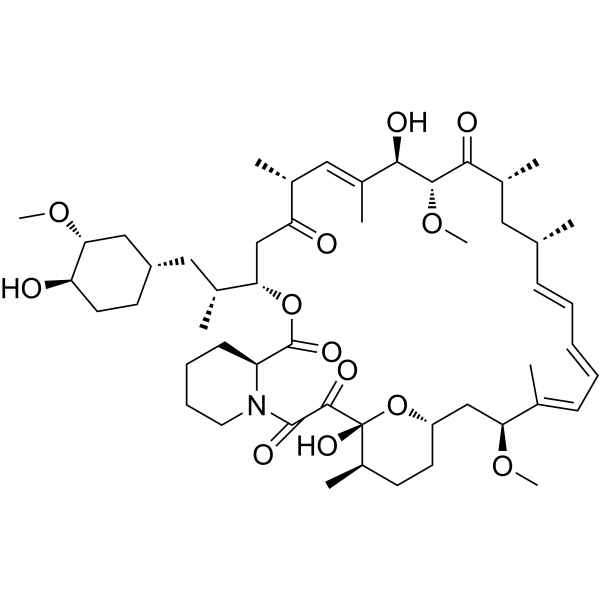
Rapamycin (Sirolimus) GMP Like is Rapamycin (HY-10219) produced by using GMP like guidelines. GMP Like small molecules works appropriately as an auxiliary reagent for cell therapy manufacture. Rapamycin (Sirolimus; AY 22989) is a potent and specific blood-brain barrier-transmissible mTOR inhibitor with an IC50 of 0.1 nM in HEK293 cells. Rapamycin is a molecular glue that binds FKBP12 and mTOR proteins together, thereby inhibiting mTOR kinase activity. Rapamycin binds to FKBP12 and specifically acts as an allosteric inhibitor of mTORC1. Rapamycin is an autophagy activator, an immunosuppressant.
Nur für Forschungszwecke. Wir verkaufen nicht an Patienten.
- Assay : 98.8%
- CAS. Nr.: 53123-88-9
- Formel: C51H79NO13
- Molecular Weight:914.17
-
Speicherung:
Please store the product under the recommended conditions in the Certificate of Analysis.

To place orders, for customer services and technical support, please contact: MedChemExpress USA
Tel: 609-228-6898 E-mail: [email protected] [email protected]


-
 Biologische Aktivität
-
Chemical Information
-
Lösungsmittel & Löslichkeit
- Protokoll
- Reinheit & Dokumentation
- Verweise
-
 Help & FAQs


-
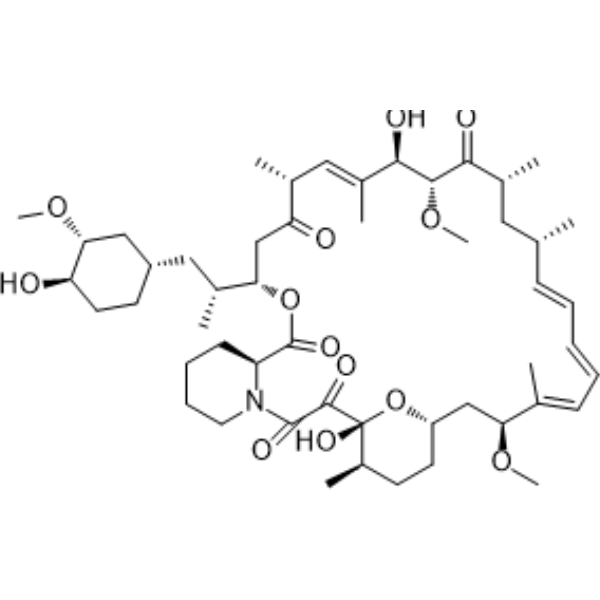
HY-10219
RapamycinmTOR Inhibitor -

HY-10219G
Rapamycin (GMP)mTOR Inhibitor -

HY-10219R
Rapamycin (Standard)Reference Standard -
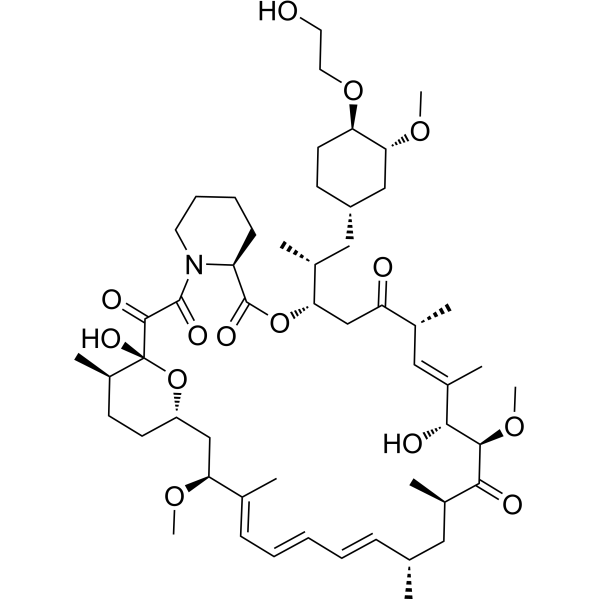
HY-10218
EverolimusmTORC Inhibitor -
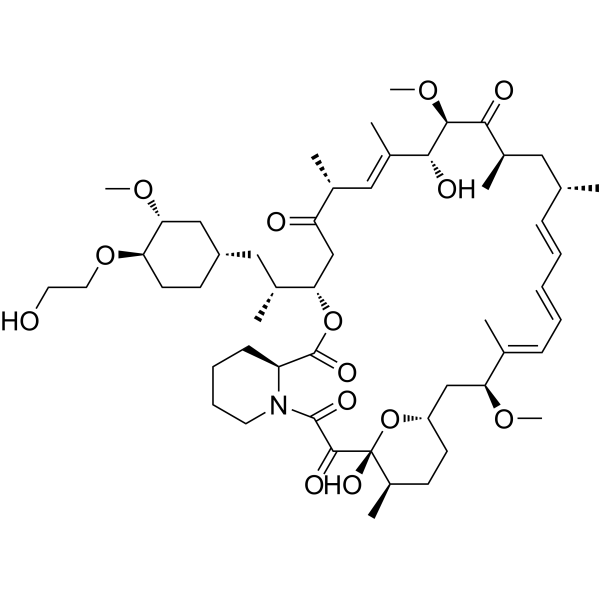
HY-10218R
Everolimus (Standard)mTORC Inhibitor -
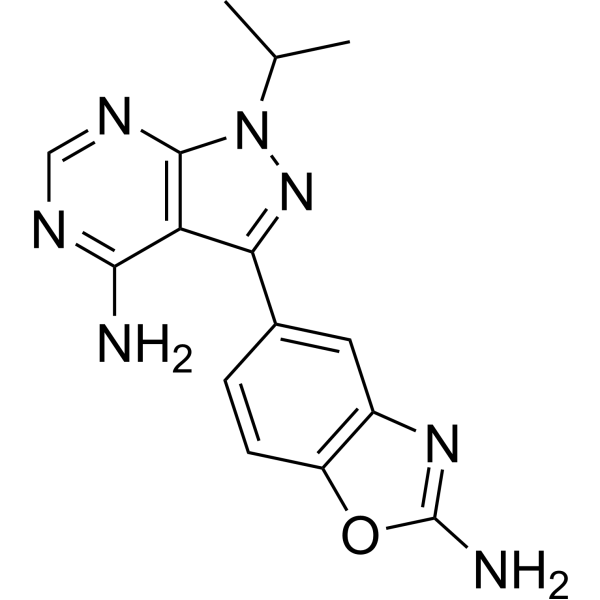
HY-13328
SapanisertibmTORC1/mTORC2 Inhibitor -
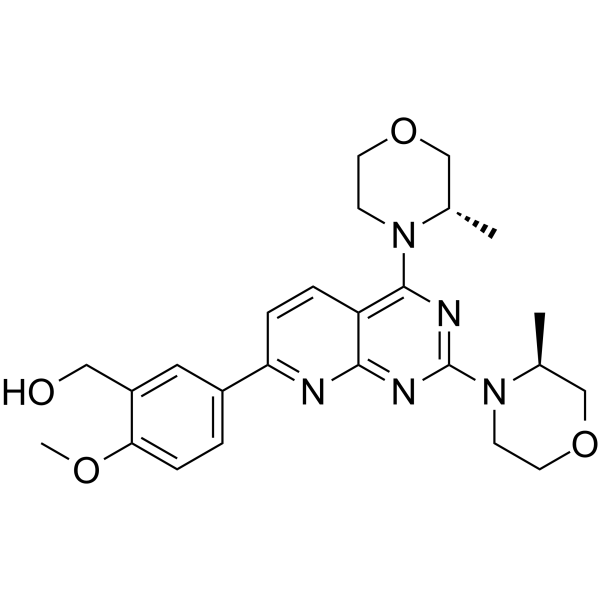
HY-10422
AZD-8055mTOR Inhibitor -
HY-15247
VistusertibmTORC Inhibitor -
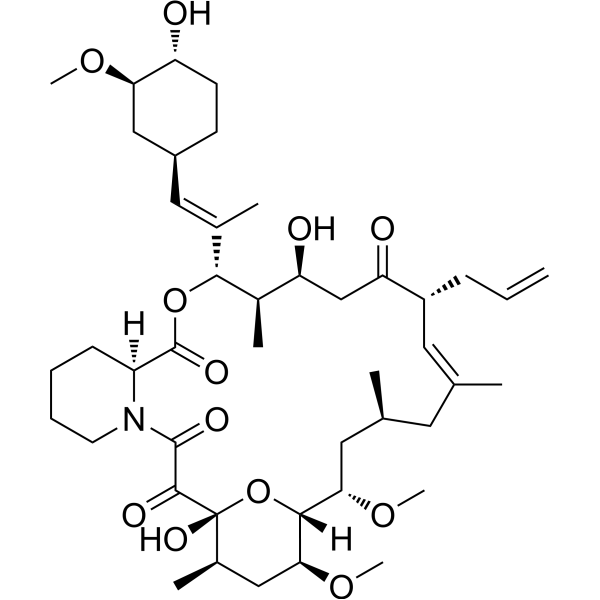
HY-13756
TacrolimusCalcineurin Inhibitor -
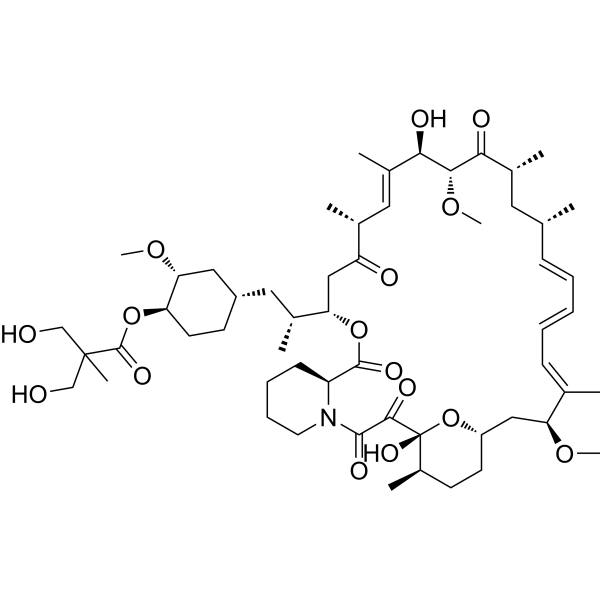
HY-50910
TemsirolimusmTOR Inhibitor -
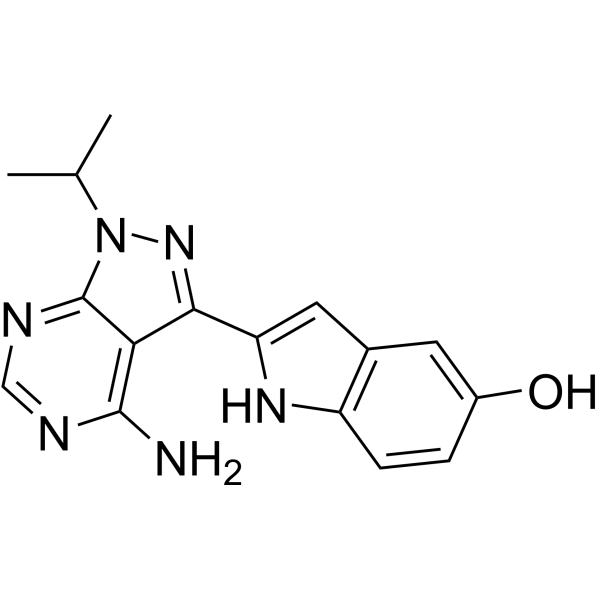
HY-10474
TorkinibmTOR Inhibitor -
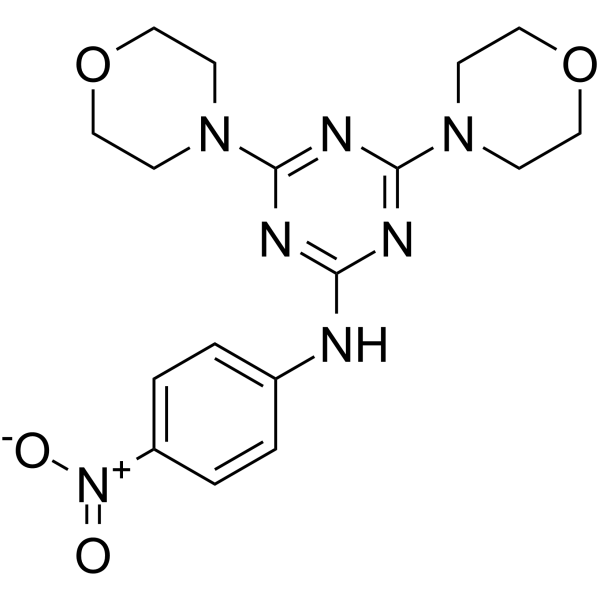
HY-B0795
MHY1485mTOR Activator
Alle Endogenous Metabolite Isoform-spezifische Produkte anzeigen
MoreAlle Antibiotic Isoform-spezifische Produkte anzeigen
More

Biologische Aktivität
Beschreibung
IC50 & Target
|
mTOR 0.1 nM (IC50, in HEK293 cells ) |
Microbial Metabolite |
FKBP12 |
Autophagy |
Cellular Effect
|
Cell Line

|
Type | Value | Description | References |
|---|---|---|---|---|
| A549 | IC50 |
18.74 μM
Compound: Rapamycin
|
Antiproliferative activity against human A549 cells by MTT assay
Antiproliferative activity against human A549 cells by MTT assay
|
[PMID: 31546197] |
| A549 | IC50 |
30.72 μM
Compound: Rapamycin
|
Antiproliferative activity against human A549 cells assessed as reduction in cell viability incubated for 24 hrs by MTT assay
Antiproliferative activity against human A549 cells assessed as reduction in cell viability incubated for 24 hrs by MTT assay
|
[PMID: 33862514] |
| A549 | IC50 |
49.35 μM
Compound: Rapamycin
|
Antitumor activity against human A549 cells assessed as cell growth inhibition incubated for 72 hrs by Cell Titer-Glo assay
Antitumor activity against human A549 cells assessed as cell growth inhibition incubated for 72 hrs by Cell Titer-Glo assay
|
[PMID: 35688004] |
| C-33-A | IC50 |
<50 nM
Compound: 25
|
Antiproliferative activity against human C-33-A cells assessed as inhibition of cell proliferation incubated for 5 to 7 days by MTS assay
Antiproliferative activity against human C-33-A cells assessed as inhibition of cell proliferation incubated for 5 to 7 days by MTS assay
|
[PMID: 36669398] |
| Caov-3 cell line | IC50 |
<50 nM
Compound: 25
|
Antiproliferative activity against human Caov-3 cell line assessed as inhibition of cell proliferation incubated for 5 to 7 days by MTS assay
Antiproliferative activity against human Caov-3 cell line assessed as inhibition of cell proliferation incubated for 5 to 7 days by MTS assay
|
[PMID: 36669398] |
| DU-145 | IC50 |
4 μM
Compound: Rapamycin
|
Antitumor activity against human DU-145 cells assessed as cell growth inhibition
Antitumor activity against human DU-145 cells assessed as cell growth inhibition
|
[PMID: 35688004] |
| HCT-8 | IC50 |
1.25 μM
Compound: Sirolimus
|
TP_TRANSPORTER: inhibition of Rhodamine 123 transport (basal to apical) (R123: 15 uM) in HCT-8 cells
TP_TRANSPORTER: inhibition of Rhodamine 123 transport (basal to apical) (R123: 15 uM) in HCT-8 cells
|
[PMID: 12235265] |
| HEK293 | IC50 |
1.1 μM
Compound: Rapamycin
|
TP_TRANSPORTER: inhibition of Phalloidin uptake (Phalloidin: 1 uM) in OATP-C-expressing HEK293 cells
TP_TRANSPORTER: inhibition of Phalloidin uptake (Phalloidin: 1 uM) in OATP-C-expressing HEK293 cells
|
[PMID: 14530907] |
| HEK293 | IC50 |
0.1 nM
Compound: rapamycin
|
Inhibition of mTOR kinase expressed in human HEK293 cells by Western blot analysis
Inhibition of mTOR kinase expressed in human HEK293 cells by Western blot analysis
|
[PMID: 17350953] |
| HEK293 | EC50 |
0.05 μM
Compound: Rapamycin
|
Inhibition of TPA-induced degradation of Pdcd4 (amino acid 39-91) expressed in human HEK293 cells assessed as minimum compound concentration required for 50% recovery of Pdcd4-luciferase signal incubated for 8 hrs by luciferase reporter gene assay
Inhibition of TPA-induced degradation of Pdcd4 (amino acid 39-91) expressed in human HEK293 cells assessed as minimum compound concentration required for 50% recovery of Pdcd4-luciferase signal incubated for 8 hrs by luciferase reporter gene assay
|
[PMID: 21539301] |
| HEK293 | IC50 |
0.1 nM
Compound: Rapamycin
|
Inhibition of mTOR in HEK293 cells
Inhibition of mTOR in HEK293 cells
|
[PMID: 32324396] |
| HEK-293T | EC50 |
0.1 nM
Compound: RAPA
|
Antiviral activity against HIV1 R5 assessed as inhibition of cell-cell fusion between R5-envelope expressing HEK293T cells and CD8 depleted human PBMCs pretreated for 6 days
Antiviral activity against HIV1 R5 assessed as inhibition of cell-cell fusion between R5-envelope expressing HEK293T cells and CD8 depleted human PBMCs pretreated for 6 days
|
[PMID: 17485501] |
| HEK-293T | EC50 |
1.3 nM
Compound: RAPA
|
Antiviral activity against HIV1 X4 assessed as inhibition of cell-cell fusion between X4-envelope expressing HEK293T cells and CD8 depleted human PBMCs pretreated for 6 days
Antiviral activity against HIV1 X4 assessed as inhibition of cell-cell fusion between X4-envelope expressing HEK293T cells and CD8 depleted human PBMCs pretreated for 6 days
|
[PMID: 17485501] |
| HeLa | IC50 |
>10000 nM
Compound: Rapamycin
|
Growth inhibition of human HeLa cells after 72 hrs by CCK8 assay
Growth inhibition of human HeLa cells after 72 hrs by CCK8 assay
|
[PMID: 29308895] |
| HeLa | IC50 |
0.77 μM
Compound: Rapamycin
|
Cytotoxicity against human HeLa cells
Cytotoxicity against human HeLa cells
|
[PMID: 30015070] |
| HepG2 | EC50 |
10 μM
Compound: Sirolimus
|
Activation of human PXR expressed in human HepG2 (DPX-2) cells assessed as induction of CYP3A4 after 24 hrs by luminescent analysis
Activation of human PXR expressed in human HepG2 (DPX-2) cells assessed as induction of CYP3A4 after 24 hrs by luminescent analysis
|
[PMID: 20966043] |
| HepG2 | CC50 |
67.2 μM
Compound: 78
|
Cytotoxicity against human HepG2 assessed as reduction in cell viability after 24 hrs by CellTiter-Glo luminescent assay
Cytotoxicity against human HepG2 assessed as reduction in cell viability after 24 hrs by CellTiter-Glo luminescent assay
|
[PMID: 28051303] |
| HT-3 | IC50 |
<50 nM
Compound: 25
|
Antiproliferative activity against human HT-3 cells assessed as inhibition of cell proliferation incubated for 5 to 7 days by MTS assay
Antiproliferative activity against human HT-3 cells assessed as inhibition of cell proliferation incubated for 5 to 7 days by MTS assay
|
[PMID: 36669398] |
| K562 | IC50 |
1 mM
Compound: rapamycin
|
Antiproliferative activity against human K562 cells
Antiproliferative activity against human K562 cells
|
[PMID: 18571290] |
| MCF7 | IC50 |
4980 nM
Compound: Rapamycin
|
Growth inhibition of human MCF7 cells after 72 hrs by CCK8 assay
Growth inhibition of human MCF7 cells after 72 hrs by CCK8 assay
|
[PMID: 29308895] |
| MCF7 | IC50 |
18.74 μM
Compound: Rapamycin
|
Antiproliferative activity against human MCF7 cells by MTT assay
Antiproliferative activity against human MCF7 cells by MTT assay
|
[PMID: 31546197] |
| MCF7 | EC50 |
<1 nM
Compound: Rapamycin
|
Cytotoxicity against human MCF7 cells after 5 days by Presto blue reagent-based fluorescence analysis
Cytotoxicity against human MCF7 cells after 5 days by Presto blue reagent-based fluorescence analysis
|
10.1039/C5MD00493D |
| MDA-MB-231 | IC50 |
>10000 nM
Compound: Rapamycin
|
Growth inhibition of human MDA-MB-231 cells after 72 hrs by CCK8 assay
Growth inhibition of human MDA-MB-231 cells after 72 hrs by CCK8 assay
|
[PMID: 29308895] |
| MDA-MB-231 | GI50 |
>100 nM
Compound: Rapamycin
|
Antiproliferative activity against human MDA-MB-231 cells incubated for 48 hrs by sulforhodamine B assay
Antiproliferative activity against human MDA-MB-231 cells incubated for 48 hrs by sulforhodamine B assay
|
[PMID: 32510949] |
| MDA-MB-231 | IC50 |
0.9 μM
Compound: Rapamycin
|
Antiproliferative activity against human MDA-MB-231 cells assessed as cell viability after 24 hrs
Antiproliferative activity against human MDA-MB-231 cells assessed as cell viability after 24 hrs
|
[PMID: 33139111] |
| MDA-MB-231 | IC50 |
35.79 μM
Compound: Rapamycin
|
Antiproliferative activity against human MDA-MB-231 cells assessed as reduction in cell viability incubated for 24 hrs by MTT assay
Antiproliferative activity against human MDA-MB-231 cells assessed as reduction in cell viability incubated for 24 hrs by MTT assay
|
[PMID: 33862514] |
| MDA-MB-453 | GI50 |
0.05 nM
Compound: Rapamycin
|
Antiproliferative activity against human MDA-MB-453 cells incubated for 48 hrs by sulforhodamine B assay
Antiproliferative activity against human MDA-MB-453 cells incubated for 48 hrs by sulforhodamine B assay
|
[PMID: 32510949] |
| MDA-MB-468 | IC50 |
37.2 μM
Compound: Rapamycin
|
Antiproliferative activity against human MDA-MB-468 cells assessed as reduction in cell viability incubated for 24 hrs by MTT assay
Antiproliferative activity against human MDA-MB-468 cells assessed as reduction in cell viability incubated for 24 hrs by MTT assay
|
[PMID: 33862514] |
| ME-180 | IC50 |
<50 nM
Compound: 25
|
Antiproliferative activity against human ME-180 cells assessed as inhibition of cell proliferation incubated for 5 to 7 days by MTS assay
Antiproliferative activity against human ME-180 cells assessed as inhibition of cell proliferation incubated for 5 to 7 days by MTS assay
|
[PMID: 36669398] |
| MEF | IC50 |
0.05 nM
Compound: Sirolimus
|
Inhibition of mTOR in mouse TSC1-/- MEF cells assessed as inhibition of S6 Ser240/244 phosphorylation incubated for 2 hrs by fluorescence based assay
Inhibition of mTOR in mouse TSC1-/- MEF cells assessed as inhibition of S6 Ser240/244 phosphorylation incubated for 2 hrs by fluorescence based assay
|
[PMID: 31223435] |
| MV4-11 | IC50 |
>500 nM
Compound: RAPA
|
Antiproliferative activity against human MV4-11 cells after 72 hrs by MTT assay
Antiproliferative activity against human MV4-11 cells after 72 hrs by MTT assay
|
[PMID: 30629434] |
| NCI-H460 | IC50 |
>10000 nM
Compound: Rapamycin
|
Growth inhibition of human H460 cells after 72 hrs by CCK8 assay
Growth inhibition of human H460 cells after 72 hrs by CCK8 assay
|
[PMID: 29308895] |
| OCI-AML2 | IC50 |
>500 nM
Compound: RAPA
|
Antiproliferative activity against human OCI-AML2 cells after 72 hrs by MTT assay
Antiproliferative activity against human OCI-AML2 cells after 72 hrs by MTT assay
|
[PMID: 30629434] |
| OCI-AML-3 | IC50 |
>500 nM
Compound: RAPA
|
Antiproliferative activity against human OCI-AML3 cells after 72 hrs by MTT assay
Antiproliferative activity against human OCI-AML3 cells after 72 hrs by MTT assay
|
[PMID: 30629434] |
| OVCAR-5 | IC50 |
>10000 nM
Compound: Rapamycin
|
Growth inhibition of human OVCAR5 cells after 72 hrs by CCK8 assay
Growth inhibition of human OVCAR5 cells after 72 hrs by CCK8 assay
|
[PMID: 29308895] |
| OVCAR-8 | IC50 |
<50 nM
Compound: 25
|
Antiproliferative activity against human OVCAR-8 cells assessed as inhibition of cell proliferation incubated for 5 to 7 days by MTS assay
Antiproliferative activity against human OVCAR-8 cells assessed as inhibition of cell proliferation incubated for 5 to 7 days by MTS assay
|
[PMID: 36669398] |
| PC-3 | IC50 |
<0.01 μM
Compound: Rapamycin
|
Antiproliferative activity against human PC3 cells
Antiproliferative activity against human PC3 cells
|
[PMID: 21978683] |
| PC-3 | IC50 |
<0.01 μM
Compound: Rapamycin
|
Inhibition of mTOR-mediated S6 phosphorylation in human PC3 cells
Inhibition of mTOR-mediated S6 phosphorylation in human PC3 cells
|
[PMID: 21978683] |
| PC-3 | IC50 |
>10 μM
Compound: Rapamycin
|
Inhibition of mTOR-mediated Akt phosphorylation in human PC3 cells
Inhibition of mTOR-mediated Akt phosphorylation in human PC3 cells
|
[PMID: 21978683] |
| PC-3 | EC50 |
43.1 μM
Compound: Rapamycin
|
Cytotoxicity against human PC3 cells by MTT assay
Cytotoxicity against human PC3 cells by MTT assay
|
[PMID: 28774426] |
| PC-3 | IC50 |
1.3 μM
Compound: Rapamycin
|
Antitumor activity against human PC-3 cells assessed as cell growth inhibition
Antitumor activity against human PC-3 cells assessed as cell growth inhibition
|
[PMID: 35688004] |
| SF-268 | IC50 |
2.7 μM
Compound: Rapamycin
|
Antitumor activity against human SF-268 cells assessed as cell growth inhibition
Antitumor activity against human SF-268 cells assessed as cell growth inhibition
|
[PMID: 35688004] |
| SiHa | IC50 |
1756 nM
Compound: Rapamycin
|
Growth inhibition of human SiHa cells after 72 hrs by CCK8 assay
Growth inhibition of human SiHa cells after 72 hrs by CCK8 assay
|
[PMID: 29308895] |
| SK-MEL-2 | IC50 |
1 μM
Compound: Rapamycin
|
Synergistic cytotoxicity against human SK-MEL-2 cells expressing NRAS mutant assessed as cell growth inhibition measured for 48 hrs in presence of LY3214996 by MTT assay
Synergistic cytotoxicity against human SK-MEL-2 cells expressing NRAS mutant assessed as cell growth inhibition measured for 48 hrs in presence of LY3214996 by MTT assay
|
[PMID: 36961300] |
| SK-MEL-2 | IC50 |
1 μM
Compound: Rapamycin
|
Synergistic cytotoxicity against human SK-MEL-2 cells expressing NRAS mutant assessed as cell growth inhibition measured for 48 hrs in presence of MEK-162 by MTT assay
Synergistic cytotoxicity against human SK-MEL-2 cells expressing NRAS mutant assessed as cell growth inhibition measured for 48 hrs in presence of MEK-162 by MTT assay
|
[PMID: 36961300] |
| SK-OV-3 | IC50 |
>10000 nM
Compound: Rapamycin
|
Growth inhibition of human SKOV3 cells after 72 hrs by CCK8 assay
Growth inhibition of human SKOV3 cells after 72 hrs by CCK8 assay
|
[PMID: 29308895] |
| SK-OV-3 | IC50 |
<50 nM
Compound: 25
|
Antiproliferative activity against human SK-OV-3 cells assessed as inhibition of cell proliferation incubated for 5 to 7 days by MTS assay
Antiproliferative activity against human SK-OV-3 cells assessed as inhibition of cell proliferation incubated for 5 to 7 days by MTS assay
|
[PMID: 36669398] |
| SUM185PE | GI50 |
0.04 nM
Compound: Rapamycin
|
Antiproliferative activity against human SUM185PE cells incubated for 48 hrs by sulforhodamine B assay
Antiproliferative activity against human SUM185PE cells incubated for 48 hrs by sulforhodamine B assay
|
[PMID: 32510949] |
| T47D | IC50 |
1576 nM
Compound: Rapamycin
|
Growth inhibition of human T47D cells after 72 hrs by CCK8 assay
Growth inhibition of human T47D cells after 72 hrs by CCK8 assay
|
[PMID: 29308895] |
| T-cell | IC50 |
1.6 nM
Compound: 1
|
T-cell antiproliferative activity in human mixed lymphocyte reaction
T-cell antiproliferative activity in human mixed lymphocyte reaction
|
[PMID: 16185865] |
| T-cell | IC50 |
2600 nM
Compound: 1
|
Antiproliferative activity in Lewis rat lymph node cells in rat mixed lymphocyte reaction
Antiproliferative activity in Lewis rat lymph node cells in rat mixed lymphocyte reaction
|
[PMID: 16185865] |
| T-cell | IC50 |
9.8 nM
Compound: 1
|
Tested for inhibition of T cell proliferation in the co-mitogen stimulated proliferation assay
Tested for inhibition of T cell proliferation in the co-mitogen stimulated proliferation assay
|
10.1016/0960-894X(95)00223-G |
| U-87MG ATCC | IC50 |
10 μM
Compound: Rapamycin
|
Antitumor activity against human U-87 MG cells assessed as cell growth inhibition
Antitumor activity against human U-87 MG cells assessed as cell growth inhibition
|
[PMID: 35688004] |
In Vitro
Rapamycin (12.5-100 nM; 24 hours) treatment exerts modest inhibitory effect on lung cancer cell proliferation in a dose-dependent manner in all cell lines (A549, SPC-A-1, 95D and NCI-H446 cells) tested, achieving about 30-40% reduction in cell proliferation at 100 nM vs. ~10% reduction at 12.5 nM[3].
Lung cancer cell line 95D cells are exposed to Rapamycin (10 nM, 20 nM) and RP-56976 (1 nM, 10 nM) alone or in combination (Rapamycin 20 nM+ RP-56976 10 nM). After 24 hours exposure to Rapamycin or RP-56976 alone does not significantly alter the level of expression or phosphorylation of ERK1/2, whereas cells treated with the combination of Rapamycin with RP-56976 exhibit a marked reduction in the phosphorylation levels of ERK1/2[3].
MedChemExpress (MCE) has not independently confirmed the accuracy of these methods. They are for reference only.
-
Cell Line:Lung cancer cell lines A549, SPC-A-1, 95D and NCI-H446
-
Concentration:12.5 nM, 25 nM, 50 nM, 100 nM
-
Incubation Time:24 hours
-
Result:Treatment exerted modest inhibitory effect on lung cancer cell proliferation in a dose-dependent manner in all cell lines.
-
Cell Line:95D cells
-
Concentration:10 nM and 20 nM
-
Incubation Time:24 hours
-
Result:Combination treatment with RP-56976 decreased phosphorylation of ERK.
In Vivo
MedChemExpress (MCE) has not independently confirmed the accuracy of these methods. They are for reference only.
-
Animal Model:24 male nu/nu mice aged 4-5 week old (15-20 g)[4]
-
Dosage:2.0 mg/kg
-
Administration:Intraperitoneal injection; every other day; 28 days
-
Result:Had a moderate inhibitory effect in monotherapy group. The combination with Metformin exerted a significantly increased inhibition of tumor growth.


Chemical Information
-
CAS. Nr. 53123-88-9
-
Appearance Solid
-
Molecular Weight 914.17
-
Formel C51H79NO13
-
Color White to off-white
-
SMILES
O=C([C@@]1(O)[C@@H](CC[C@@H](C[C@@H](/C(C)=C/C=C/C=C/[C@H](C[C@@H](C)C([C@@H]([C@@H](/C(C)=C/[C@H]2C)O)OC)=O)C)OC)O1)C)C(N3CCCC[C@H]3C(O[C@@H](CC2=O)[C@@H](C[C@H]4C[C@H]([C@H](O)CC4)OC)C)=O)=O
-
Synonyms
Sirolimus (GMP Like); AY-22989 (GMP Like); NSC 226080 (GMP Like)
-
Versand
Room temperature in continental US; may vary elsewhere.
-
Speicherung
Please store the product under the recommended conditions in the Certificate of Analysis.


Lösungsmittel & Löslichkeit
In Vitro:
Ethanol : 100 mg/mL (109.39 mM; Need ultrasonic)
Konzentration (Stammlösung) × Volumen (Stammlösung) = Konzentration (Ziellösung) × Volumen (Ziellösung)


Reinheit & Dokumentation
-
Data Sheet (284 KB)
-
SDS (252 KB)
- English - EN (252 KB)
- Français - FR (252 KB)
- Deutsch - DE (252 KB)
- Norwegian - NO (252 KB)
- Español - ES (252 KB)
- Swedish - SV (252 KB)
- Italian - IT (252 KB)
- Korean - KR (252 KB)
- Portuguese - PT (252 KB)
-
Handling Instructions (2659 KB)
Verweise
[1]. Edwards SR, et al. The rapamycin-binding domain of the protein kinase mammalian target of rapamycin is a destabilizing domain. J Biol Chem, 2007, 282(18), 13395-13401. [Content Brief]
[2]. Rangaraju S, et al. Rapamycin activates autophagy and improves myelination in explant cultures from neuropathicmice. J Neurosci. 2010 Aug 25;30(34):11388-97. [Content Brief]
[3]. Niu H, et al. Rapamycin potentiates cytotoxicity by RP-56976 possibly through downregulation of Survivin in lung cancer cells. J Exp Clin Cancer Res. 2011 Mar 10;30:28. [Content Brief]
[4]. Zhang JW, et al. Metformin synergizes with rapamycin to inhibit the growth of pancreatic cancer in vitro and in vivo. Oncol Lett. 2018 Feb;15(2):1811-1816. [Content Brief]
[5]. Svensson JE, et al. Evaluating the effect of rapamycin treatment in Alzheimer's disease and aging using in vivo imaging: the ERAP phase IIa clinical study protocol. BMC Neurol. 2024 Apr 4;24(1):111. [Content Brief]
[6]. Soini L, et al. Molecular glues to stabilise protein-protein interactions. Curr Opin Chem Biol. 2022 Aug;69:102169. [Content Brief]


Complete Stock Solution Preparation Table
| Optional Solvent | Concentration Solvent Mass | 1 mg | 5 mg | 10 mg | 25 mg |
|---|---|---|---|---|---|
| Ethanol | 1 mM | 1.0939 mL | 5.4694 mL | 10.9389 mL | 27.3472 mL |
| 5 mM | 0.2188 mL | 1.0939 mL | 2.1878 mL | 5.4694 mL | |
| 10 mM | 0.1094 mL | 0.5469 mL | 1.0939 mL | 2.7347 mL | |
| 15 mM | 0.0729 mL | 0.3646 mL | 0.7293 mL | 1.8231 mL | |
| 20 mM | 0.0547 mL | 0.2735 mL | 0.5469 mL | 1.3674 mL | |
| 25 mM | 0.0438 mL | 0.2188 mL | 0.4376 mL | 1.0939 mL | |
| 30 mM | 0.0365 mL | 0.1823 mL | 0.3646 mL | 0.9116 mL | |
| 40 mM | 0.0273 mL | 0.1367 mL | 0.2735 mL | 0.6837 mL | |
| 50 mM | 0.0219 mL | 0.1094 mL | 0.2188 mL | 0.5469 mL | |
| 60 mM | 0.0182 mL | 0.0912 mL | 0.1823 mL | 0.4558 mL | |
| 80 mM | 0.0137 mL | 0.0684 mL | 0.1367 mL | 0.3418 mL | |
| 100 mM | 0.0109 mL | 0.0547 mL | 0.1094 mL | 0.2735 mL |


Rapamycin (GMP Like) Related Classifications
HY-10219GL Related Classifications
 Powered by Bioz