



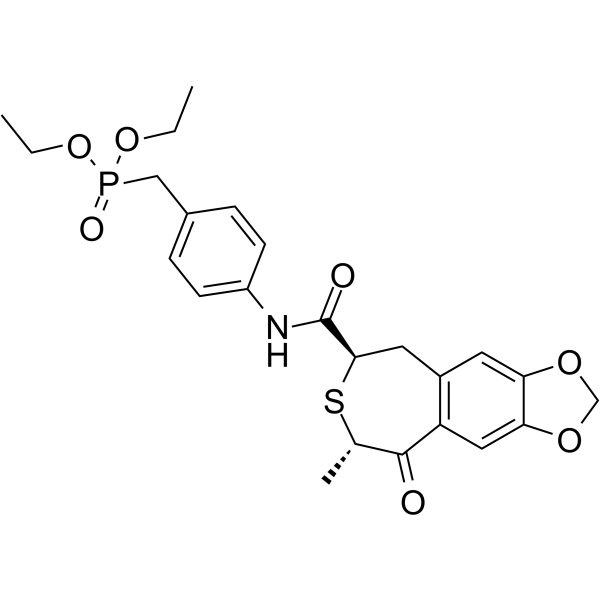
TAK-778
TAK-778 is a derivative of ipriflavone and has been shown to induce bone growth in in vitro and in vivo models.
For research use only. We do not sell to patients.
- CAS No.: 180185-61-9
- Formula: C24H28NO7PS
- Molecular Weight:505.52
-
Storage:
Please store the product under the recommended conditions in the Certificate of Analysis.

To place orders, for customer services and technical support, please contact: MedChemExpress USA
Tel: 609-228-6898 E-mail: [email protected] [email protected]


-
 Biological Activity
-
Chemical Information
- Purity & Documentation
- References
-
 Help & FAQs




Biological Activity
Description
In Vitro
TAK-778 is a derivative of ipriflavone and has been shown to induce bone growth in in vitro and in vivo models. Continuous treatment with TAK-778 (10 μM) for 1 to 21 days results in an increase in the area of mineralized nodules. TAK-778 at concentrations of 1 μM and higher significantly stimulates the activity of cellular Alkaline phosphatase (ALP). TAK-778 increases slightly but significantly the DNA content of the cells at the confluence stage. Treatment with TAK-778 also results in dose-dependent increases in the amount of soluble collagen and osteocalcin secreted into culture medium from days 5 to 7. TAK-778 enhances the secretion of both TGF-β and IGF-I at every time point during the 21 days of culture. Treatment of the cells with TAK-778 does not induce ALP activity, but does result in a dose-dependent increase in the saturated cell density. TAK-778 at a concentration of 10 μM significantly reduces the saturated cell density[2].
MedChemExpress (MCE) has not independently confirmed the accuracy of these methods. They are for reference only.
In Vivo
MedChemExpress (MCE) has not independently confirmed the accuracy of these methods. They are for reference only.


Chemical Information
-
CAS No. 180185-61-9
-
Molecular Weight 505.52
-
Formula C24H28NO7PS
-
SMILES
O=C(NC1=CC=C(CP(OCC)(OCC)=O)C=C1)[C@@H](C2)S[C@@H](C)C(C3=C2C=C4OCOC4=C3)=O
-
Shipping
Room temperature in continental US; may vary elsewhere.
-
Storage
Please store the product under the recommended conditions in the Certificate of Analysis.


Purity & Documentation
References
[1]. Rosa AL, et al. TAK-778 enhances osteoblast differentiation of human bone marrow cells via an estrogen-receptor-dependent pathway. J Cell Biochem. 2004 Mar 1;91(4):749-55. [Content Brief]
[2]. Notoya K, et al. Enhancement of osteogenesis in vitro and in vivo by a novel osteoblast differentiation promoting compound, TAK-778. J Pharmacol Exp Ther. 1999 Sep;290(3):1054-64. [Content Brief]
[3]. Cai M, et al. TAK-778 induces osteogenesis in ovariectomized rats via an estrogen receptor-dependent pathway. J Bone Miner Metab. 2011 Mar;29(2):168-73. [Content Brief]

Calculators
Concentration (start) × Volume (start) = Concentration (final) × Volume (final)


TAK-778 Related Classifications
HY-100167 Related Classifications
 Powered by Bioz