



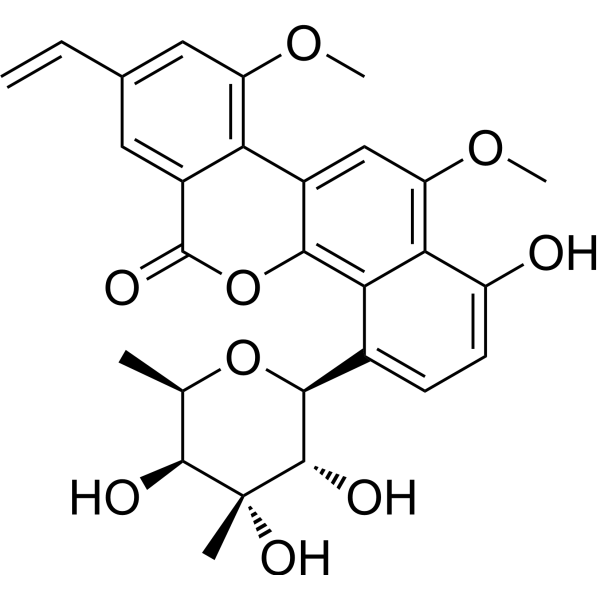
Chrysomycin A

Based on 1 Customer Validation
Chrysomycin A (Chr-A), an antibiotic, can be obtained from Streptomyces. Chrysomycin A exhibits antitumor and anti-tuberculous and MRSA activities. As for glioblastoma, Chrysomycin A inhibits the proliferation, migration, and invasion of cancer cells through the Akt/GSK-3β/β-catenin signaling pathway.
연구목적의 판매만을 진행합니다. 환자를 대상으로 한 판매는 하지 않습니다.
- Purity : 98.0%
- CAS No.: 82196-88-1
- 화학식: C28H28O9
- 분자량:508.52
-
보관:
-20°C, protect from light, stored under nitrogen
* In solvent : -80°C, 6 months; -20°C, 1 month (protect from light, stored under nitrogen)

To place orders, for customer services and technical support, please contact: MedChemExpress USA
Tel: 609-228-6898 E-mail: [email protected] [email protected]


-
 Biological Activity
-
Chemical Information
- Protocol
- 순도&문서
- References
-
 Help & FAQs


All Antibiotic Isoforms
More

Biological Activity
제품 설명
In Vitro
Chrysomycin A (0.2-1.8 μM; 48 h) has anti-glioblastoma efficacy, and inhibits cell viability in U251 and U87-MG human glioblastoma, as well as migration and invasion[1].
Chrysomycin A (0.2-1.8 μM; 48 h) inhibits Akt/GSK-3β/β-Catenin signaling pathway in U251 and U87-MG cells[1].
MedChemExpress (MCE) has not independently confirmed the accuracy of these methods. They are for reference only. Further protocols information, click here.
-
Cell Line:U251 and U87-MG human glioblastoma
-
Concentration:0.2, 0.4 and 0.8 μM for U251; 0.2, 0.6 and 1.8 μM for U87-MG
-
Incubation Time:48 hours
-
Result:Inhibited U251 and U87-MG with 0.475 μM and 1.77 μM, respectively.
-
Cell Line:U251 and U87-MG human glioblastoma
-
Concentration:0.2, 0.4 and 0.8 μM for U251; 0.2, 0.6 and 1.8 μM for U87-MG
-
Incubation Time:48 hours
-
Result:Significantly downregulated the expression of slug and MMP2.
Significantly decreased the protein expression of PI3K-p85, p-PI3K-p85, Akt and p-Akt, as well as c-Myc, cyclin D1.


Chemical Information
-
CAS No. 82196-88-1
-
Appearance Solid
-
분자량 508.52
-
화학식 C28H28O9
-
Color Light yellow to yellow
-
SMILES
O=C1C2=CC(C=C)=CC(OC)=C2C3=CC(OC)=C4C(O)=CC=C([C@H]5[C@@H]([C@]([C@H]([C@@H](C)O5)O)(C)O)O)C4=C3O1
-
Synonyms
Chr-A
-
Initial Source
marine-derived strain Streptomyces sp. 891
-
선적
Room temperature in continental US; may vary elsewhere.
-
보관
-20°C, protect from light, stored under nitrogen
* In solvent : -80°C, 6 months; -20°C, 1 month (protect from light, stored under nitrogen)

Protocol
-
Cell migration
Cell migration is a method that plays an important role in wound healing, cell differentiation, embryonic development, etc.
-
Cell invasion
Cell invasion is the ability of cells to migrate from one area to another via the extracellular matrix. Cell invasion is the response of normal and cancer cells to chemical and mechanical stimuli. Before migrating to a new region, the extracellular matrix is degraded by proteases within the cell. Cell invasion often occurs during wound repair, vascularization and inflammation, abnormal tissue invasion, and tumor cell metastasis.
-
Cell Viability Determination by MTT Colorimetric Assay
The following protocol uses the MTT colorimetric assay as a classic literature-established method for assessing cell viability/metabolic activity in cultured mammalian cells. MTT[3-(4,5-dimethylthiazol-2-yl)-2,5-diphenyltetrazolium bromide] is reduced by metabolically active cells to a colored formazan product; the amount of formazan is quantified spectrophotometrically and provides an indirect measure of metabolically active viable cells. Importantly, MTT reduction reflects cellular oxidoreductase/metabolic activity rather than an absolute direct count of living cells, so changes in cellular metabolism can alter the signal independently of cell number.


순도&문서
-
Data Sheet (280 KB)
-
SDS (252 KB)
- English - EN (252 KB)
- Français - FR (252 KB)
- Deutsch - DE (252 KB)
- Norwegian - NO (252 KB)
- Español - ES (252 KB)
- Swedish - SV (252 KB)
- Italian - IT (252 KB)
- Korean - KR (252 KB)
- Portuguese - PT (252 KB)
-
Handling Instructions (2659 KB)
References

Calculators
Concentration (start) × Volume (start) = Concentration (final) × Volume (final)


Chrysomycin A Related Classifications
HY-126771 Related Classifications
 Powered by Bioz