



Ulcerative Colitis
-
Ulcerative Colitis (71)


- 分子式: C12H8N2O4Zn
- 分子量: 309.58
Zinc picolinate is an orally effective zinc supplement. Zinc picolinate reduces the expression of Hsp70, inhibits oxidative DNA damage, increases serum ALP activity, decreases MDA concentration, elevates SOD levels, and raises zinc concentrations in serum, whole body and plasma. Zinc picolinate does not alter copper and manganese contents in rainbow trout. Zinc picolinate exerts a protective effect against Acetic acid (HY-Y0319)-induced experimental colitis in Sprague Dawley rats. Zinc picolinate reduces uterine fibroid volume, alleviates colonic oxidative damage, relieves colonic inflammation, and enhances intestinal barrier integrity. Zinc picolinate can be used in research related to uterine fibroids, ulcerative colitis and chronic obstructive pulmonary disease.

- 分子式: C13H21N5O2
- 分子量: 279.34
Etamiphyllin (Etamiphylline) is a respiratory and cardiac stimulant. Etamiphyllin camsylate relaxes bronchial and bronchiolar smooth muscle to open airways, and increases cardiac output without elevating heart rate. The level of Etamiphyllin camsylate decreases in mice with ulcerative colitis, and it is positively correlated with *Bifidobacterium* and *Faecalibacterium*. Etamiphyllin camsylate can be applied to research related to chronic obstructive pulmonary disease, respiratory failure and ulcerative colitis.
Vitamin K2 is an orally active proliferation inhibitor. Vitamin K2 induces Autophagy and Apoptosis. Vitamin K2 reduces the levels of proinflammatory cytokines (such as IL-1β, TNF-α, and IL-6). Vitamin K2 inhibits cell growth in leukemia cells. Vitamin K2 can be used for the research of involutional osteoporosis, non-alcoholic fatty liver disease, ulcerative colitis, acute myeloid leukemia, myelodysplastic syndromes, and hepatocellular carcinoma.
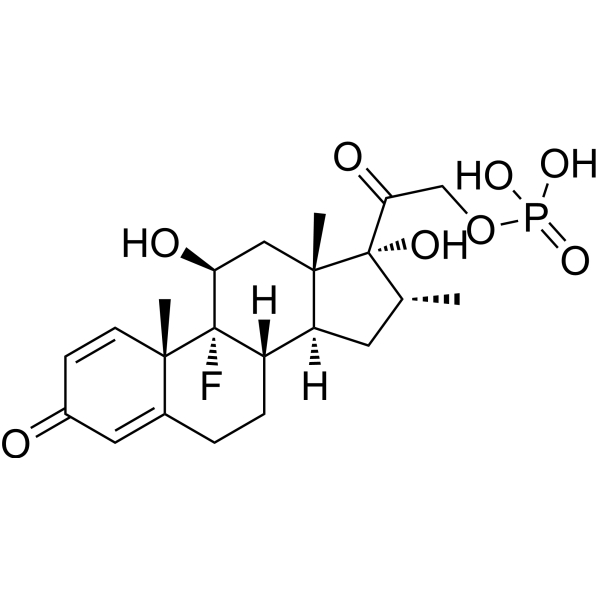
- 分子式: C22H30FO8P
- 分子量: 472.44
Dexamethasone phosphate (Dexamethasone 21-phosphate) is a prodrug form of the glucocorticoid Dexamethasone (HY-14648). Dexamethasone phosphate is prepared by introducing a phosphate ester group to the hydroxyl group at position 21 of the Dexamethasone molecule. Dexamethasone phosphate inhibits LPS (HY-D1056)-induced degradation of IRAK-1 and IRAK-4, and blocks LPS-induced activation of TRAF6, p-TAK1 and p-JNK. Dexamethasone phosphate inhibits the secretion of RANTES, TGF-β1 and NO, promotes the production of MIP-1α and IL-10, and blocks microglial migration. Dexamethasone phosphate is almost completely converted to Dexamethasone in rat blood, and supports transdermal delivery via iontophoresis. Dexamethasone phosphate can be used in research related to steroid-dependent ulcerative colitis, chemotherapy-induced vomiting, allergic asthma and acute colitis (inflammatory bowel disease).

- 分子式: C40H48N8O4
- 分子量: 704.86
DCM-KPV is a fluorescent probe targeting the human intestinal oligopeptide transporter PEPT1/SLC15A1 receptor (λex=480 nm, λem=620-670 nm). DCM-KPV specifically binds to PepT1 via its KPV domain and mediates receptor-targeted internalization, thus effectively accumulating in the cytoplasm and nucleus of cells overexpressing this receptor. DCM-KPV has the advantages of long emission wavelength, high emission efficiency, low photobleaching, and negligible cytotoxicity. DCM-KPV maintains stable fluorescence intensity under continuous illumination, exhibiting extremely high live cell compatibility. DCM-KPV can specifically accumulate at colonic inflammatory sites through the intestinal mucosa, enabling direct non-invasive visual differentiation between chronic and acute ulcerative colitis groups and the normal group.

- 分子式: C5H11N3O2
- 分子量: 145.16
4-Guanidinobutanoic acid (Standard) is the analytical standard of 4-Guanidinobutanoic acid (HY-113286). This product is intended for research and analytical applications. 4-Guanidinobutanoic acid is a metabolite of arginine and an orally active SLC36A1/Hedgehog signaling pathway activator. 4-Guanidinobutanoic acid drives epithelial reprogramming, enhances intestinal stem cell function and goblet cell differentiation. 4-Guanidinobutanoic acid promotes the enrichment of Akkermansia muciniphila via mucus-dependent niche expansion, regulates intestinal homeostasis, and establishes a microbiota-host feedback loop. 4-Guanidinobutanoic acid exhibits anti-aging and healthspan-regulating properties. 4-Guanidinobutanoic acid can be used in research related to ulcerative colitis, amyotrophic lateral sclerosis, and Duchenne muscular dystrophy.

- 分子式: C23H23D6ClFN3O4
- 分子量: 471.98
Cisapride-d6 (R51619-d6) is the deuterated-labeled Cisapride (HY-14149). Cisapride (R 51619) is an orally active, selective 5-HT4 receptor agonist with an EC50 of 140 nM. Cisapride also acts as an hERG potassium channel blocker with an IC50 of 9.4 nM. Cisapride exerts gastrointestinal prokinetic effects by activating 5-HT4 receptors, but it also blocks the hERG potassium channel responsible for the repolarization phase of cardiac action potentials, delaying repolarization and thus prolonging the action potential duration. Cisapride can be used in research related to gastrointestinal dysfunction, gastroesophageal reflux disease, functional dyspepsia, chronic gastritis, gastroparesis, ulcerative colitis and necrotizing enterocolitis.

- 分子式: C2213CH26D3ClFN3O4
- 分子量: 469.96
Cisapride-13C,d3 (R 51619-13C,d3) is the deuterated, 13C-labeled Cisapride (HY-14149). Cisapride (R 51619) is an orally active, selective 5-HT4 receptor agonist with an EC50 of 140 nM. Cisapride also acts as an hERG potassium channel blocker with an IC50 of 9.4 nM. Cisapride exerts gastrointestinal prokinetic effects by activating 5-HT4 receptors, but it also blocks the hERG potassium channel responsible for the repolarization phase of cardiac action potentials, delaying repolarization and thus prolonging the action potential duration. Cisapride can be used in research related to gastrointestinal dysfunction, gastroesophageal reflux disease, functional dyspepsia, chronic gastritis, gastroparesis, ulcerative colitis and necrotizing enterocolitis.

- 分子式: C35H43F4N3O4
- 分子量: 645.73
Zotemtegrast (LY-4268989; MORF-057) is an orally active integrin α4β7 antagonist. Zotemtegrast is applicable to research related to inflammatory bowel diseases such as ulcerative colitis and Crohn's disease.

- 分子式: C19H16O4
- 分子量: 308.33
Bisdemethoxycurcumin is an orally effective curcuminoid. Bisdemethoxycurcumin downregulates pro-inflammatory cytokines in macrophages by inhibiting the phosphorylation of PI3K/Akt and p38 MAPK. Bisdemethoxycurcumin relieves autophagy inhibition and promotes lipophagy to clear vascular smooth muscle foam cells by inhibiting the PDK1/Akt/mTOR pathway. Bisdemethoxycurcumin activates the cAMP/Epac/AMPKα axis and the NRF2/HO-1 antioxidant axis, thereby indirectly inhibiting the phosphorylation of NF-κB p65 and pro-inflammatory outputs such as IL-1β/IL-6/TNF-α, so as to alleviate pulmonary oxidative stress, inflammatory infiltration and pulmonary edema. Bisdemethoxycurcumin blocks NLRP3-mediated pyroptosis and protects cartilage extracellular matrix degradation by activating NRF2/HO-1. Bisdemethoxycurcumin also exerts a synergistic effect with potassium iodide against Candida.

- 分子式: C70H109N21O20S
- 分子量: 1596.81
PADI4_11 is an isoform-selective, allosteric PADI4 activator with a Kd of 457 nM. PADI4_11 enters cells via active transport, does not induce cytotoxicity or membrane damage, and serves as a tool for investigating the regulation, function and cellular reprogramming of PADI4. PADI4_11 can be used in studies related to rheumatoid arthritis and ulcerative colitis.

- 分子式: C30H41NO5
- 分子量: 495.65
STING-IN-19 is a STING inhibitor with a Kd value of 2.31 μM for human STING. STING-IN-19 inhibits the activation of TBK1 and IRF3 by binding to STING, thereby suppressing the activation of downstream signaling pathways. STING-IN-19 reduces the levels of key inflammatory cytokines IL-1β, IL-6 and TNF-α in colonic tissues and serum of mice with ulcerative colitis. STING-IN-19 can be used in studies related to ulcerative colitis.

- 分子式: C33H46N4O12
- 分子量: 690.74
β5i-IN-2 is a potent, selective, and orally active inhibitor of the immunoproteasome β5i subunit, with an IC50 of 0.08 μM against human β5i. β5i-IN-2 inhibits LPS (HY-D1056)- and IFN-γ-induced expression of IL-1β, IL-6, and TNF-α, and suppresses the JNK, ERK, and NF-κB signaling pathways. β5i-IN-2 can be used in research related to rheumatoid arthritis and ulcerative colitis.

- 分子式: C22H19N3O4S
- 分子量: 421.47
Urease-IN-25 (Compound 10a) is a urease inhibitor with an IC50 value of 0.50 μM against jack bean urease. Urease-IN-25 can be used in the research of Helicobacter pylori infection, chronic gastritis, peptic ulcer disease, gastric cancer, mucosa-associated lymphoid tissue lymphoma, and other conditions.


- 分子式: C30H25N5O4S
- 分子量: 551.62
Anti-inflammatory agent 117 is an orally active anti-inflammatory agent and c-Kit kinase inhibitor with an IC50 of 15.2 μM. Anti-inflammatory agent 117 blocks the NF-κB signaling pathway and inhibits the release of IL-6. Anti-inflammatory agent 117 exhibits anti-inflammatory effects in mouse models of acute lung injury, sepsis and ulcerative colitis. Anti-inflammatory agent 117 can be used in research related to acute lung injury, sepsis and ulcerative colitis.

- 分子式: C27H26FN5O3
- 分子量: 487.53
TYY-31 is an orally active, selective S1PR1 agonist with an EC50 of 1.13 pM. TYY-31 promotes the phosphorylation of ERK1/2. TYY-31 exerts anti-inflammatory and immunosuppressive effects, ameliorates DSS-induced colitis in mice, and reduces peripheral blood lymphocyte counts in mice in a dose-dependent manner. TYY-31 can be used for the research of ulcerative colitis.

- 分子式: C33H41BrN4O5S
- 分子量: 685.67
JAK2/STAT3-IN-2 is an orally active JAK2/STAT3 inhibitor. JAK2/STAT3-IN-2 inhibits the phosphorylation of tyrosine residues in JAK2 and STAT3, blocks downstream signal transduction, disrupts the dimerization and nuclear translocation of STAT3, and suppresses pro-inflammatory transcriptional activity. JAK2/STAT3-IN-2 inhibits the expression of IL-17A and IL-17F, reduces immune cell infiltration, and inhibits the production of NO simultaneously. JAK2/STAT3-IN-2 exerts a protective effect in a mouse model of ulcerative colitis induced by DSS (HY-116282C). JAK2/STAT3-IN-2 can be used for the research of ulcerative colitis.

- 分子式: C23H25Cl2FN2O5
- 分子量: 499.36
PI3K/AKT-IN-6 is an orally effective PI3K/AKT signaling pathway inhibitor and anti-inflammatory agent. PI3K/AKT-IN-6 inhibits the production of pro-inflammatory cytokines TNF-α and IL-6, and downregulates the expression of inflammatory mediators COX-2 and iNOS. PI3K/AKT-IN-6 improves related symptoms in colitis mice. PI3K/AKT-IN-6 can be used for the research of inflammatory diseases such as colitis.

- 分子式: C25H26O7
- 分子量: 438.47
MBL-1 is an orally active anti-inflammatory agent. MBL-1 can be isolated from the fermentation broth of Aspergillus sp. derived from gorgonians. MBL-1 inhibits the activity of the hCOX-2 protein with an IC50 of 5.77 μM. MBL-1 reduces the production of key pro-inflammatory mediators such as NO, ROS, IL-1β and IL-18 by inhibiting the MAPK/NF-κB and NLRP3 signaling pathways. MBL-1 exerts a protective effect against DSS-induced colitis. MBL-1 can be used for the research of ulcerative colitis.



