



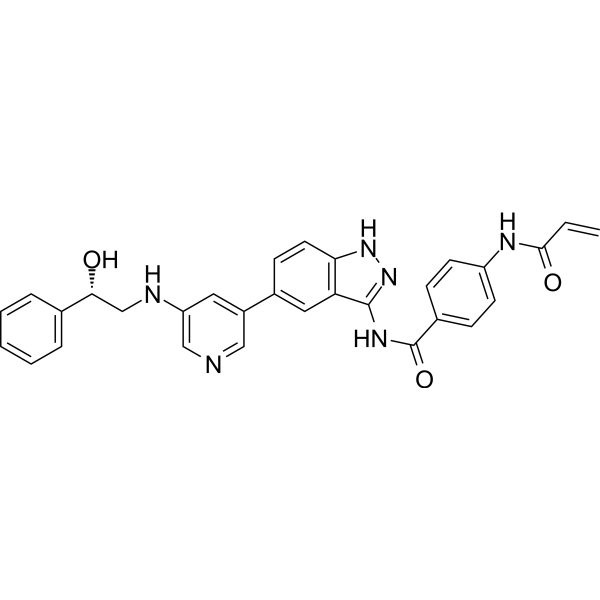
CDK7-IN-20
CDK7-IN-20 is a potent, selective and irreversible CDK7 (CDK) inhibitor with an IC50 value of 4 nM. CDK7-IN-20 displays >206-fold selectivity for CDK7 over CDK1, CDK2, CDK3, CDK5, CDK6, CDK9 and CDK12 . CDK7-IN-20 has the potential for autosomal dominant polycystic kidney disease (ADPKD) research.
For research use only. We do not sell to patients.
- CAS No.: 3034210-97-1
- Formula: C30H26N6O3
- Molecular Weight:518.57
-
Storage:
Please store the product under the recommended conditions in the Certificate of Analysis.

To place orders, for customer services and technical support, please contact: MedChemExpress USA
Tel: 609-228-6898 E-mail: [email protected] [email protected]


-
 Biological Activity
-
Chemical Information
- Purity & Documentation
- References
-
 Help & FAQs




Biological Activity
Description
IC50 & Target
[1]|
CDK7 4 nM (IC50) |
CDK1 3375 nM (IC50) |
CDK2 823 nM (IC50) |
CDK3 1837 nM (IC50) |
CDK5 >10,000 nM (IC50) |
CDK6 950 nM (IC50) |
CDK9 526 nM (IC50) |
CDK12 >10,000 nM (IC50) |
GSK3β 148 nM (IC50) |
Cellular Effect
|
Cell Line

|
Type | Value | Description | References |
|---|---|---|---|---|
| THP-1 | IC50 |
13 μM
Compound: B2
|
Cytotoxicity against human THP-1 cells assessed as cell viability measured after 24 hrs by CCK-8 assay
Cytotoxicity against human THP-1 cells assessed as cell viability measured after 24 hrs by CCK-8 assay
|
[PMID: 36384292] |
In Vitro
In Madin-Darby canine kidney (MDCK) cells, CDK7-IN-20 (Compound B2; 1-3 μM; from day 4 to day 12) shows high potency to inhibit cyst growth and exhibited lower cytotoxicity than THZ1[1].
MedChemExpress (MCE) has not independently confirmed the accuracy of these methods. They are for reference only.
In Vivo
ADME Profiles of CDK7-IN-20 (Compound B2)a[1].
| CDK7-IN-20 (Compound B2) | ||
| parameters | i.v. 5 mg/kg | s.c. 5 mg/kg |
| AUClast (h·ng/mL) | 26,937 | 17,280 |
| AUCIFN_obs (h·ng/mL) | 31,698 | 17,411 |
| t1/2 (h) | 17.8 | 3.4 |
| Tmax (h) | 0.5 | |
| Cmax (h) | 3806 | |
| Cl_obs (mL/min/kg) | 2.80 | |
| Vss_obs (mL/kg) | 1275 | |
| MRTIFN_obs (h) | 10.2 | 4.8 |
| F (%) | 64.2 | |
| plasma protein binding (bound%)b | >99 | |
| permeability of Caco-2 A to B Papp (10–6 cm/s)/B to A Papp (10–6 cm/s)/efflux ratioc | <0.133/6.370/>48.0 |
bPlasma from mouse. PPB was tested at 1 and 10 μM substrate concentrations.
bCaco-2 membrane permeability at 10 μM substrate concentrations. The value of 0.133 was determined by quantitative limit (1.0 nM)[1].
MedChemExpress (MCE) has not independently confirmed the accuracy of these methods. They are for reference only.
-
Animal Model:Neonatal Pkd1flox/flox:Ksp-Cre mice[1]
-
Dosage:5 mg/kg
-
Administration:Subcutaneous administration; once daily; for 6 days
-
Result:Significantly reduced the kidney size and cyst formation of the ADPKD mice.


Chemical Information
-
CAS No. 3034210-97-1
-
Molecular Weight 518.57
-
Formula C30H26N6O3
-
SMILES
C=CC(NC1=CC=C(C=C1)C(NC2=NNC3=C2C=C(C=C3)C4=CC(NC[C@H](C5=CC=CC=C5)O)=CN=C4)=O)=O
-
Shipping
Room temperature in continental US; may vary elsewhere.
-
Storage
Please store the product under the recommended conditions in the Certificate of Analysis.


Purity & Documentation
References

Calculators
Concentration (start) × Volume (start) = Concentration (final) × Volume (final)


CDK7-IN-20 Related Classifications
HY-151878 Related Classifications
 Powered by Bioz