



GXF-111
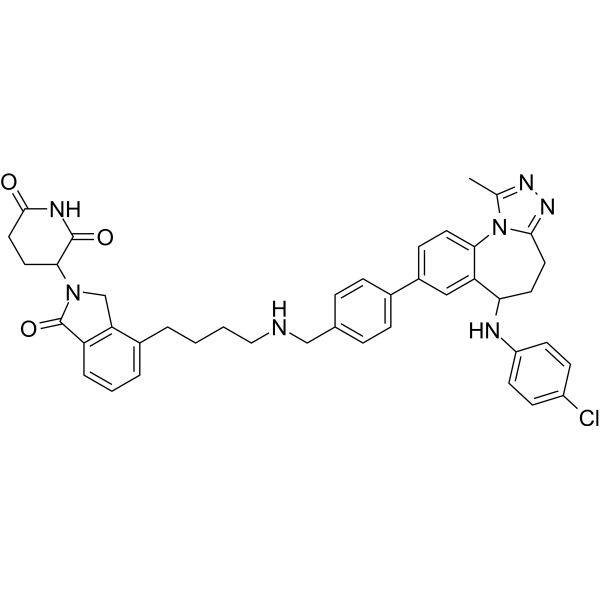
GXF-111 is a BRD3 and BRD4-L PROTAC degrader. Its BD1 and BD2 Ki values against human BRD3 are 11.97 nM and 2.45 nM, respectively. The degradation activity of GXF-111 depends on its binding to BET proteins and Cereblon, as well as the involvement of a functional proteasome. The degradation selectivity of GXF-111 is mainly determined by differences in degradation kinetics and cell types. GXF-111 induces G1 phase cell cycle arrest, downregulates c-Myc expression, upregulates p21 expression, and exhibits antiproliferative activity against a variety of cancer cell lines. GXF-111 can serve as a research tool for cancer-related studies.
(Pink: BRD3 and BRD4-L Target protein ligand; Blue: Cereblon ligand (HY-138793); Black: linker).
For research use only. We do not sell to patients.
- Formula: C42H42ClN7O3
- Molecular Weight:728.28
-
Storage:
Please store the product under the recommended conditions in the Certificate of Analysis.

To place orders, for customer services and technical support, please contact: MedChemExpress USA
Tel: 609-228-6898 E-mail: [email protected] [email protected]


-
 Biological Activity
-
Chemical Information
- Protocols
- Purity & Documentation
- References
-
 Help & FAQs


All PROTACs Isoforms
More

Biological Activity
Description
IC50 & Target
|
BRD3 BD2 2.45 nM (Ki) |
BRD3 BD1 11.97 nM (Ki) |
BRD4-L |
Cellular Effect
|
Cell Line

|
Type | Value | Description | References |
|---|---|---|---|---|
| A549 | IC50 |
14.26 μM
Compound: 24; GXF111
|
Antiproliferative activity against human A549 cells assessed as cell growth inhibition measured after 4 days by CCK-8 assay
Antiproliferative activity against human A549 cells assessed as cell growth inhibition measured after 4 days by CCK-8 assay
|
[PMID: 37084596] |
| HeLa | IC50 |
6.96 μM
Compound: 24; GXF111
|
Antiproliferative activity against human HeLa cells assessed as cell growth inhibition measured after 4 days by CCK-8 assay
Antiproliferative activity against human HeLa cells assessed as cell growth inhibition measured after 4 days by CCK-8 assay
|
[PMID: 37084596] |
| HepG2 | IC50 |
17.25 μM
Compound: 24; GXF111
|
Antiproliferative activity against human HepG2 cells assessed as cell growth inhibition measured after 4 days by CCK-8 assay
Antiproliferative activity against human HepG2 cells assessed as cell growth inhibition measured after 4 days by CCK-8 assay
|
[PMID: 37084596] |
| HGC-27 | IC50 |
2.35 μM
Compound: 24; GXF111
|
Antiproliferative activity against human HGC-27 cells assessed as cell growth inhibition measured after 4 days by CCK-8 assay
Antiproliferative activity against human HGC-27 cells assessed as cell growth inhibition measured after 4 days by CCK-8 assay
|
[PMID: 37084596] |
| MCF7 | IC50 |
0.23 μM
Compound: 24; GXF111
|
Antiproliferative activity against human MCF7 cells assessed as cell growth inhibition measured after 4 days by CCK-8 assay
Antiproliferative activity against human MCF7 cells assessed as cell growth inhibition measured after 4 days by CCK-8 assay
|
[PMID: 37084596] |
| MM1.S | IC50 |
95.2 nM
Compound: 24; GXF111
|
Antiproliferative activity against human MM1.S cells assessed as cell growth inhibition measured after 4 days by CellTitre-Glo assay
Antiproliferative activity against human MM1.S cells assessed as cell growth inhibition measured after 4 days by CellTitre-Glo assay
|
[PMID: 37084596] |
| MV4-11 | IC50 |
6.31 nM
Compound: 24; GXF111
|
Antiproliferative activity against human MV4-11 cells assessed as cell growth inhibition measured after 3 days by CellTitre-Glo assay
Antiproliferative activity against human MV4-11 cells assessed as cell growth inhibition measured after 3 days by CellTitre-Glo assay
|
[PMID: 37084596] |
In Vitro
GXF-111 (compound 24) binds to BRD3 BD2 with high affinity (Ki = 2.45 nM) and shows lower affinity for BRD3 BD1 (Ki = 11.97 nM), exhibiting approximately 5-fold selectivity for the BD2 domain of BRD3[1].
GXF-111 (3-4) potently inhibits the growth of MV4-11 and MM.1S cells, with IC50 values of 6.31 nM and 95.2 nM after 3-day and 4-day treatment, respectively[1].
GXF-111 (for 4 days) inhibits the growth of MCF-7 (IC50 = 0.23 μM), HGC-27 (IC50 = 2.35 μM), A549 (IC50 = 14.26 μM), HeLa (IC50 = 6.96 μM) and HepG2 (IC50 = 17.25 μM) cells[1].
GXF-111 (0.1-30 nM; 24 h) selectively degrades BRD3 (1-3 nM) and BRD4-L in MM.1S cells without affecting BRD4-S, and only exerts a partial effect on BRD2 at higher doses; meanwhile, this compound regulates the expression of c-Myc and p21 without inducing significant apoptosis[1].
GXF-111 (30 nM; 1-24 h) induces time-dependent selective degradation of BRD3 and BRD4-L in MM.1S, HGC-27 and MCF-7 cells. Compared with BRD2, the degradation of BRD3/BRD4-L initiates earlier, and GXF-111 exerts minimal effects on BRD4-S within 24 hours[1].
GXF-111 (0.1-1000 nM; 24 h) selectively degrades BRD3 and BRD4-L (but not BRD2 or BRD4-S) in HGC-27, MCF-7, A549, HeLa and HepG2 cells, while it selectively degrades BRD4-L and BRD4-S in MV4-11 cells; its degradation efficacy varies among different cell lines[1].
The degradation of BRD3 and BRD4-L in MM.1S cells induced by GXF-111 (30 nM; 4 h) depends on its binding to BET proteins, binding to Cereblon, and functional proteasome activity[1].
GXF-111 (1-300 nM; 24 h) induces G1-phase cell cycle arrest in MM.1S cells in a dose-dependent manner[1].
MedChemExpress (MCE) has not independently confirmed the accuracy of these methods. They are for reference only.
-
Cell Line:MM.1S
-
Concentration:0.1, 0.3, 1, 3, 10 and 30 nM
-
Incubation Time:24 h
-
Result:Dose-dependently depleted BRD3 and BRD4-L; BRD3 was depleted at 1-3 nM, while BRD2 was only partially depleted at 10 nM, and BRD4-S remained intact.
Decreased c-Myc expression and increased p21 expression, with minimal PARP cleavage detected.
-
Cell Line:MM.1S, HGC-27, MCF-7
-
Concentration:30 nM
-
Incubation Time:1, 3, 6, 8 and 24 h
-
Result:In MM.1S and MCF-7 cells, BRD3 and BRD4-L degradation began as early as 3-6 h, while BRD2 degradation onset was delayed until ~24 h.
In HGC-27 cells, BRD3 and BRD4-L degradation onset occurred after 8 h.
BRD4-S remained minimally degraded across all time points in all three cell lines.
-
Cell Line:HGC-27, MCF-7, A549, HeLa, HepG2, MV4-11
-
Concentration:0.1, 0.3, 1, 3, 10 and 30 nM (HGC-27, MV4-11); 1, 3, 10, 30, 100 and 300 nM (MCF-7); 3, 10, 30, 100, 300 and 1000 nM (A549); 1, 3, 10, 30, 100 and 300 (HeLa); 10, 30, 100, 300, 1000 and 3000 (HepG2)
-
Incubation Time:24 h
-
Result:In HGC-27, MCF-7, A549, HeLa, and HepG2 cells, BRD3 and BRD4-L were depleted dose-dependently, while BRD2 and BRD4-S remained intact.
In MV4-11 cells, BRD4-L and BRD4-S were selectively degraded over BRD2 and BRD3.
Degradation potency varied by cell line: 3-10 nM was sufficient for BRD3 degradation in HGC-27 and MCF-7, while 30-100 nM was required in A549, HeLa, and HepG2.
-
Cell Line:MM.1S
-
Concentration:30 nM
-
Incubation Time:4 h
-
Result:Degradation of BRD3 and BRD4-L by this compound was rescued by co-treatment with BY27 (HY-126325) (a BET binder) or Lenalidomide (HY-A0003) (a Cereblon binder).
The proteasome inhibitor MG132 (HY-13259) dose-dependently abolished this compound-induced degradation of BRD3 and BRD4-L.
-
Cell Line:MM.1S
-
Concentration:1-300 nM
-
Incubation Time:24 h
-
Result:Dose-dependently induced cell cycle arrest at the G1 phase of the cell cycle.


Chemical Information
-
Molecular Weight 728.28
-
Formula C42H42ClN7O3
-
SMILES
O=C1N(C2C(NC(CC2)=O)=O)CC3=C1C=CC=C3CCCCNCC4=CC=C(C5=CC=C6C(C(NC7=CC=C(Cl)C=C7)CCC8=NN=C(C)N86)=C5)C=C4
-
Shipping
Room temperature in continental US; may vary elsewhere.
-
Storage
Please store the product under the recommended conditions in the Certificate of Analysis.


Purity & Documentation
References

Calculators
Concentration (start) × Volume (start) = Concentration (final) × Volume (final)


GXF-111 Related Classifications
HY-153414 Related Classifications
 Powered by Bioz